

Dynamics 365 Field Service vs. Acumatica Service Management: Which one suits your service business?

Table of Contents
Introduction
Choosing a field service management platform has long-term operational consequences. The system you adopt affects how efficiently work orders are scheduled, how technicians operate in the field, how service revenue is tracked, and how well your organization can scale as demand grows. A mismatch between platform capability and business complexity often leads to process workarounds, rising costs, and eventual reimplementation.
This comparison of Dynamics 365 Field Service vs. Acumatica Service Management is intended to help service organizations understand which platform aligns better with their operational model, growth plans, and technology ecosystem. While both solutions support core field service needs, they are designed with different assumptions around scale, automation, integration, and licensing.
By examining scheduling and dispatching, mobile experience, financial integration, customization flexibility, and cost structure, this article provides a practical framework to evaluate which solution is the right fit for your service business, both today and as it evolves.
Scheduling & Dispatching
Scheduling and dispatching are central to effective field service operations. Both Dynamics 365 Field Service and Acumatica Service Management address these needs, but they differ in the level of complexity and automation they are designed to handle.
Dynamics 365 Field Service:
For scheduling, Dynamics 365 Field Service is a true powerhouse. Its scheduling engine includes resource optimization, skill-based assignment, territory management, and AI-assisted scheduling. This level of sophistication is especially valuable for organizations managing high volumes of work orders or complex service requirements.
Acumatica Service Management:
Acumatica Service Management solution also offers strong scheduling and dispatching capabilities, including appointment calendars, drag-and-drop scheduling, and technician availability tracking. While its automation and AI capabilities are not as advanced as Dynamics 365, they are often sufficient for many service organizations and easier to work with on a daily basis.
The bottom line is that Dynamics is more powerful for handling complicated processes, while Acumatica is simpler and more intuitive.
Mobility & Technician Experience
Since field technicians rely heavily on mobile devices throughout the day, interface design, usability, and offline access are critical to productivity.
Dynamics 365 Field Service:
The Dynamics 365 Field Service offers a robust mobile app experience that lets technicians view work orders, capture signatures, update job status, and work offline when connectivity is limited. The app integrates well with Microsoft tools like Teams and Outlook, enabling communication and scheduling directly from the field.
You may also like: Leveraging Mobile Capabilities in Dynamics 365 Field Service
Acumatica Service Management:
Acumatica also provides mobile access for technicians, enabling them to view assignments, update work progress, and clock time from anywhere. While the interface is not as polished as Microsoft’s mobile apps, it is functional and often appreciated for its efficiency and straightforward design.
The bottom line is that Dynamics delivers a more refined mobile experience; Acumatica prioritizes practicality over visual polish.
Financial Integration
Financial integration is critical for linking field service activity with billing, inventory, and revenue tracking. Both platforms support this well, but through different approaches.
Dynamics 365 Field Service:
Dynamics 365 Field Service integrates closely with Dynamics 365 Finance, Dynamics 365 Supply Chain Management, and Dynamics 365 Business Central. Inventory usage, procurement, billing, and revenue recognition flow seamlessly across the platform. Organizations already using the Dynamics ERP and CRM ecosystem benefit from reduced data silos and consistent financial visibility.
According to Gartner, by 2027, 75 % of organizations will use real-time field service applications integrated with back-office processes to improve operational performance and customer satisfaction.
Integrate Dynamics 365 Field Service With Your Existing Systems
Connect Field Service with finance, inventory, CRM, and third-party tools to remove data gaps and manual work. Our team handles integrations across the Microsoft ecosystem and beyond.
Request a DemoAcumatica Service Management:
Acumatica Service Management is built directly into the Acumatica ERP, allowing service operations, inventory, and financials to be connected from the start. This setup appeals to organizations that want to track costs, billing, and service profitability within a single system, without switching between applications.
The bottom line is that both platforms handle financial integration effectively. Dynamics stands out within broader business ecosystems, while Acumatica offers a more unified, all-in-one experience.
Customization & Flexibility
Each service-based business has different operational needs, and both platforms approach customization in distinct ways.
Dynamics 365 Field Service:
Dynamics 365 Field Service is highly configurable, especially when combined with Power Platform tools such as Power Apps and Power Automate. These tools allow teams to adjust workflows, automate processes, and tailor the system to specific service models. However, this level of flexibility often requires technical expertise or third-party support, which can increase implementation time and cost.
Acumatica Service Management:
Acumatica is also known for its flexibility, supported by an open architecture and modular design. Its structure makes customizations more accessible, and many organizations find they can modify the system with less technical complexity compared to Dynamics.
If deep customization is a priority and the organization is prepared for a steeper learning curve, Dynamics may be the better fit. If flexibility with simpler customization is preferred, Acumatica is often easier to adapt.
Cost and Licensing
Cost often plays a deciding role when organizations compare field service platforms, especially for teams that expect to scale.
Dynamics 365 Field Service:
Dynamics 365 Field Service follows a per-user subscription model. As service teams grow, additional users and modules typically require more licenses. For expanding organizations, this can increase overall costs over time, particularly when multiple roles need access to the system.
Acumatica:
Acumatica uses a consumption-based licensing model that is tied to system usage rather than the number of users. This approach can be better suited for organizations with large technician teams or seasonal workforce changes, since adding users does not directly increase licensing fees.
For service teams planning rapid growth or managing fluctuating staffing levels, Acumatica is often the more economical option from a licensing standpoint.
Which is Right For You?
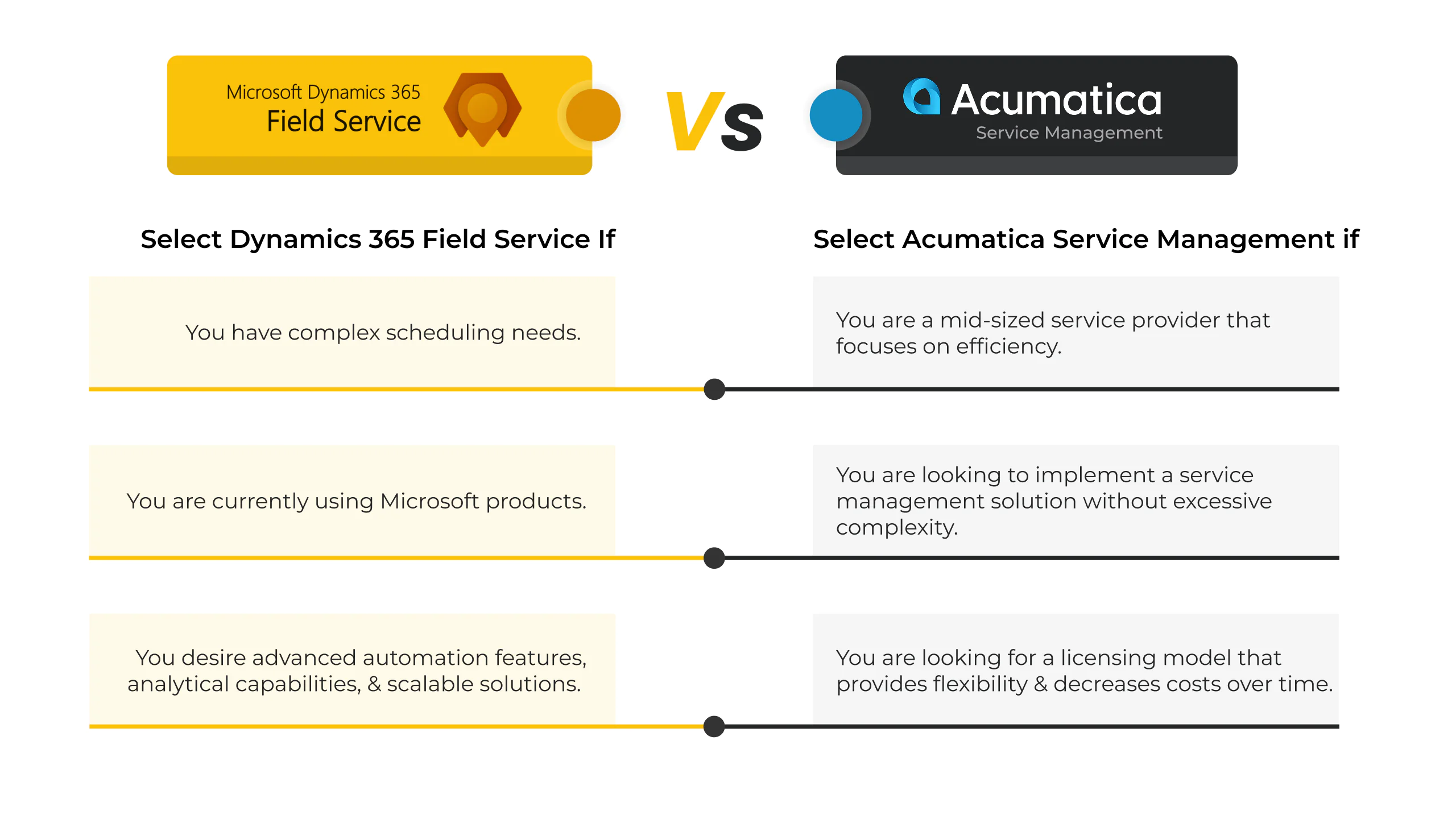
There is no overall winner, but there is a right fit for your business.
You may also like: Benefits of Adopting Dynamics 365 Field Service for Your Business
Keep Your Field Service Environment Stable, Secure, And Up To Date
Get Ongoing Dynamics 365 Field Service Support. We provide functional and technical support, issue resolution, and continuous improvements as your needs change.
Request a DemoConclusion
Both Dynamics 365 Field Service and Acumatica Service Management are high-quality software platforms with unique characteristics. Dynamics 365 Field Service will appeal to larger businesses( enterprise level of sophistication and integration), while Acumatica will appeal to smaller ( mid-size) growing companies seeking agility, simplicity, and value.
When in doubt, start with your internal business processes and your growth expectations when choosing a software platform.
FAQs
Dynamics 365 Field Service is designed for complex, high-volume service operations within the Microsoft ecosystem, while Acumatica Service Management focuses on simpler, ERP-centered service workflows.
Dynamics 365 Field Service handles advanced scheduling scenarios such as skill-based assignments, territory rules, and large work order volumes more effectively.
Dynamics 365 offers a more polished mobile app with deeper Microsoft tool integration, whereas Acumatica provides a functional mobile experience focused on core technician tasks.
Yes. Dynamics 365 integrates tightly with Microsoft ERP products, while Acumatica connects service, inventory, and financials directly within its ERP platform.
Acumatica is generally easier to modify with less technical effort, while Dynamics 365 supports deeper configuration but often requires specialized skills.
Dynamics 365 uses per-user licensing, which can scale costs as teams grow, while Acumatica’s usage-based model is often better for larger or seasonal technician teams.