Microsoft 365 Copilot vs. ChatGPT: Which Tool Fits Your Workflow?

Table of Contents
Introduction
The conversation around Copilot vs. ChatGPT has become one of the most consequential technology decisions organizations face in 2026. Both platforms have evolved far beyond simple AI assistants, now representing two distinct approaches to enterprise AI, each powered by next-generation models and designed for very different usage contexts.
ChatGPT, now powered by GPT-5.2 with Instant, Thinking, and Pro tiers, is a versatile conversational AI built for creative writing, coding assistance, research, and complex problem-solving across domains. ChatGPT is approaching 1 billion weekly active users, handles 2.5 billion prompts per day, and ranks #10 globally on Cloudflare Radar, the only AI platform in the top 20. OpenAI’s annualized revenue exceeded $25 billion by February 2026.
Microsoft Copilot reached 15 million paid seats as of Q2 FY2026—but this represents just 3.3% of Microsoft’s 450 million commercial M365 subscribers. The gap between licensed seats and active users tells a more nuanced adoption story explored below.
Powered by GPT-5 and GPT-5.2 through Azure OpenAI and enhanced by the Work IQ intelligence layer, Copilot functions like a contextual coworker, understanding organizational data, documents, and workflows to automate tasks and support day-to-day business operations.
How Does ChatGPT vs. Copilot Compare in Core Capabilities?
ChatGPT vs. Copilot is less about which tool is better and more about where each delivers value. The right choice depends on whether you need flexibility across use cases or structured support within Microsoft 365 and business applications.
ChatGPT:
ChatGPT is a conversational AI designed for versatility and creativity. It excels at generating text, answering questions, writing code, and brainstorming ideas, platform-agnostic, ideal for individuals and businesses seeking flexibility.
- GPT-5.2 models with improved reasoning, coding, and multimodal capabilities
- ChatGPT Agent for autonomous task completion across websites and connected services
- Deep Research for comprehensive, agentic web research
- Company Knowledge connectors (Slack, Google Drive, GitHub)
- Apps SDK and MCP protocol for enterprise workflow automation
- Data residency programs now available in Europe, Asia, and the Americas
Microsoft Copilot:
Copilot is embedded directly into Word, Excel, Outlook, Teams, and Dynamics 365. It acts like a smart colleague who understands your documents, emails, and workflows.
- GPT-5 and GPT-5.2 as default models with real-time router for optimal performance per prompt
- Work IQ memory layer for personalized, context-aware responses grounded in org data
- Agent Builder with document generation capabilities (Word, Excel, PowerPoint)
- Agent 365 unified control plane for enterprise governance
- Security Copilot with 12 Microsoft-built agents included for M365 E5 customers
- Microsoft Entra Agent ID for IT oversight of AI agents
Further Reading: The Right AI for Dynamics 365: Copilot vs. ChatGPT
Not Sure Which AI Fits Your Organization?
Copilot and ChatGPT solve very different problems. We help organizations map AI tools to real workflows, security requirements, and user roles so adoption drives measurable value, not confusion.
Request a ConsultationHow Do ChatGPT and Copilot Differ in Their Intelligence Models?
ChatGPT focuses on general-purpose reasoning, creativity, and multimodal problem-solving. Copilot is optimized for context-aware productivity within Microsoft 365, combining LLM reasoning with enterprise data and compliance constraints.
ChatGPT Architecture:
ChatGPT runs on GPT-5.2 with multimodal reasoning, live voice, projects, and agent-style tooling in tiered plans.
Recent Model Updates:
- GPT-5.2 models introduce stronger reasoning, coding accuracy, and improved reliability for complex tasks
- OpenAI has focused recent model updates on reducing hallucinations and improving long-form reasoning quality
- Knowledge coverage reflects recent model updates, with expanded access to late-2025 information depending on plan and feature availability
- Enterprise users report saving 40 to 60 minutes per day; heavy users save 10+ hours weekly
Microsoft Copilot Architecture:
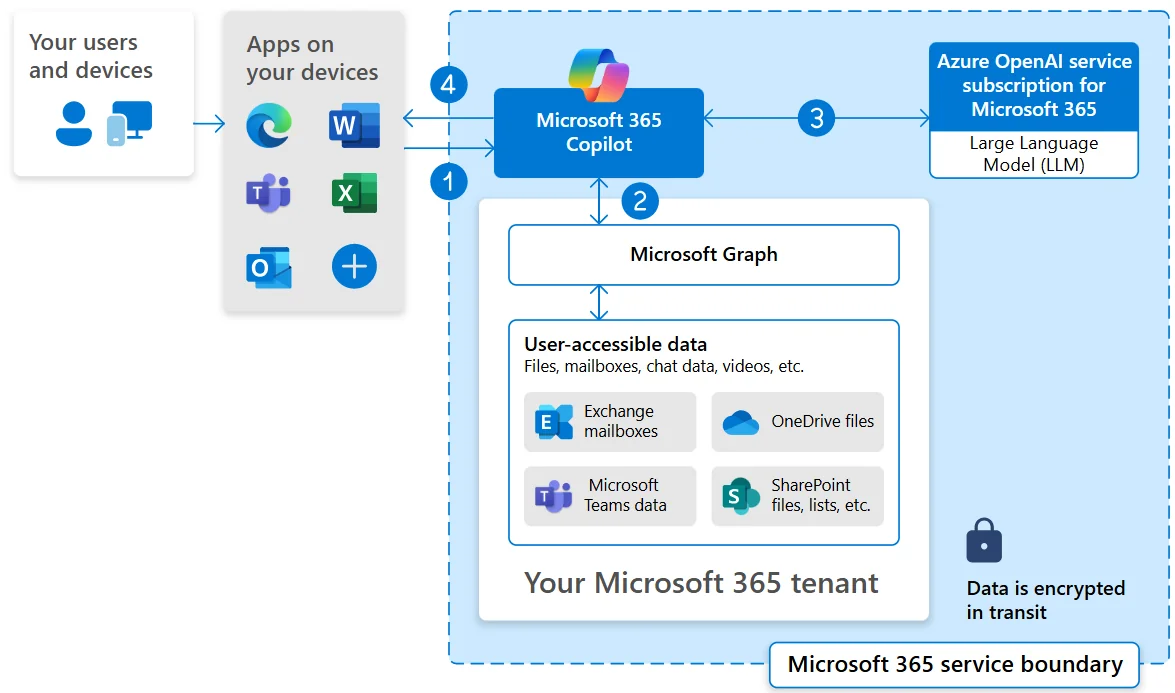
Combines Azure OpenAI models with an orchestration layer, grounding via Microsoft Graph (emails, chats, files), and M365 apps. Operates inside Microsoft’s service boundary, inheriting your existing compliance posture.
Recent Architecture Enhancements:
- GPT-5 default model with real-time router selecting optimal model per prompt
- Work IQ intelligence layer an intelligence layer understanding your work data, patterns, and company context to turn intent into results
- MCP servers for scheduling, document generation, email, and CRM integration
- Copilot Studio agents can now generate Word, Excel, and PowerPoint content
How Does ChatGPT vs. Copilot Compare in Enterprise Integration?
Enterprise integration determines how well an AI platform fits within an organization’s existing IT environment. Strong integration reduces friction, improves adoption, and ensures AI-driven insights operate seamlessly across teams and tools.
ChatGPT:
Critical security distinction verified by Microsoft (2026): Copilot provides Enterprise Data Protection across all business data within the Microsoft 365 service boundary. ChatGPT uses ingestion/sync connectors that pull Microsoft 365 data OUTSIDE Microsoft’s trust boundary, a critical compliance consideration for regulated industries.
A February 2026 Forrester survey found 34% of enterprise AI assistant deployments now include licenses for more than one AI platform most using Copilot for M365 tasks and ChatGPT for cross-platform work.
Recent Updates:
- Expanded connectors for enterprise data sources and knowledge bases
- Enhanced API capabilities for automation and workflow integration
- Improved support for hybrid environments and cross-platform collaboration
Microsoft Copilot:
Copilot is embedded directly into Microsoft 365 apps, including Word, Excel, Outlook, Teams, and Dynamics 365. Its strength lies in native integration with Microsoft Graph, enabling context-aware actions across documents, emails, and chats.
In hybrid or third-party environments, Copilot Studio enables the creation of custom agents and multi-agent workflows to interact securely with external tools, though setup may require IT oversight.
Recent Updates:
- Copilot Studio enables custom workflows and third-party API integrations
- Enhanced orchestration for hybrid environments and multi-agent tasks
- Expanded support for enterprise applications beyond core Microsoft 365 apps
How Do ChatGPT and Copilot Differ in Enterprise Security Features
Enterprise security is a critical factor for organizations evaluating AI platforms. It encompasses data protection, compliance with industry standards, access controls, and auditability.
Strong security ensures sensitive information remains safe while enabling AI tools to operate effectively across workflows, giving businesses confidence in both day-to-day operations and regulatory reporting.
ChatGPT:
ChatGPT Enterprise provides SOC 2 Type II and ISO 27001 certified security, with data encrypted in transit and at rest. Admin controls, role-based access, and audit logs give organizations visibility into usage and data handling.
Connections to company knowledge sources are secured, ensuring sensitive data remains protected while AI-powered workflows operate.
Recent Updates:
- Enterprise Compliance API with time-stamped conversation logs
- Granular workspace GPT controls for domain and API access management
- Data residency programs now available in Europe and Asia
- 24/7 support with SLAs and dedicated AI advisors for organization-wide rollouts
- SOC 2 Type II and ISO 27001 certified; no business data used for training by default
Microsoft Copilot:
Copilot inherits Microsoft 365’s enterprise-grade security and compliance standards. It operates within tenant policies, ensuring real-time protection, identity management, and regulatory compliance across SOC, ISO, and FedRAMP frameworks. Security Copilot further provides threat detection and monitoring across enterprise workloads, while all agent actions are logged for auditability.
Recent Updates:
- Security Copilot with 12 Microsoft-built agents across Defender, Entra, Intune, and Purview (included for M365 E5 customers)
- Microsoft Entra Agent ID for AI agent identity controls
- Baseline security mode and richer audit logs in M365 admin center
- Real-time protection powered by Microsoft Defender
- Important: Echoleak vulnerability (Jan 2025) demonstrated email data exfiltration risk via Copilot patched, but highlights governance importance
Adoption Reality: What the Data Actually Says in 2026
Workplace Conversion Rates:
The 35.8% Copilot conversion rate means nearly 2 in 3 employees with a Copilot license are not actively using it. The primary cause is a training and change management gap not a technology problem. Organizations with structured rollout programs achieve 65–78% daily active user rates at 90 days; big-bang deployments average just 12–22%.
When users choose between Copilot, ChatGPT, and Gemini simultaneously (Q1 2026 enterprise survey): ChatGPT: 76% primary tool preference · Copilot: 18% · Gemini: 6%.
Paid Market Share Among AI Subscribers (Recon Analytics, Jan 2026)
| Platform | Jan 2026 Share | Trend |
|---|---|---|
|
ChatGPT |
55.2% ▲ Growing |
↑ from ~40% in Jul 2025 |
|
Google Gemini |
15.7% ▲ Growing |
↑ from ~12% in Jul 2025 |
|
Microsoft Copilot |
11.5% ▼ Declining |
↓ from 18.8% in Jul 2025 (−39%) |
Despite Copilot’s declining paid market share, 70% of Fortune 500 companies have adopted M365 Copilot in some form, but Lighthouse Global analysis confirms this reflects pilot deployments, not enterprise-wide rollouts. Most enterprises are 12–18 months from scaled deployment.
Key 2026 Updates: What Organizations Need to Know
Both ChatGPT and Microsoft Copilot continue evolving rapidly. Enterprises should understand current pricing, features, integrations, and security to make informed AI strategy decisions.
Microsoft 365 Pricing and Packaging in 2026:
Microsoft 365 now includes several updated plans and capabilities in 2026:
- Microsoft Defender for Office 365 Plan 1 added to E3 plans
- Intune Remote Help, Advanced Analytics, and Intune Plan 2 added to E3 and E5
- Security Copilot available to all M365 E5 customers
- URL safety and threat checks active on Business Basic, Standard, and E1 plans
- E3 base pricing increases from $36 to $39/user/month
- Existing customers remain on current pricing until renewal
- Organizations negotiating EAs in May–June 2026 report Copilot add-on discounts of 15–25% below list when bundled with core M365 or Azure commitments
ChatGPT Enterprise in 2026:
ChatGPT Enterprise has expanded its capabilities for business use this year:
- GPT-5.2 models deliver stronger reasoning, coding accuracy, and multimodal performance
- Enterprise minimum: 150 seats with annual contract; benchmark pricing $45–$75/user/month (not publicly listed)
- Agentic workflows allow autonomous execution across internal systems and SaaS tools
- Data residency programs now available in Europe, Asia, and the Americas
- Governance and workspace controls enhanced for regulated industries
- Enterprise Compliance API with time-stamped conversation logs
Where Do ChatGPT and Microsoft Copilot Deliver the Most Value?
The real difference between ChatGPT and Microsoft Copilot lies in the workflow context. It’s not about which tool is smarter, but where each delivers the most value.
ChatGPT:
Microsoft Copilot:
How Do ChatGPT and Microsoft Copilot Compare in Enterprise Security & Compliance?
Security and compliance often determine whether an AI platform can be adopted at scale. Enterprises must assess how each solution handles data boundaries, identity controls, regulatory requirements, auditability, and governance before deployment.
Both platforms provide enterprise safeguards, but they operate within different security architectures.
Microsoft Copilot :
Microsoft Copilot ensures prompts, responses, and Graph-accessed data remain within the Microsoft 365 service boundary. It respects existing permissions, Conditional Access, MFA, sensitivity labels, DLP, retention, and auditing. Importantly, your data is not used to train foundation models.
Recent Security Enhancements:
- Security Copilot with 12 Microsoft-built agents across Defender, Entra, Intune, and Purview
- Real-time protection powered by Microsoft Defender
- Microsoft Entra Agent ID for IT oversight of AI agents
- Baseline security mode and richer audit logs in the M365 admin center
ChatGPT:
ChatGPT Enterprise/Business workspaces also provide strong safeguards: no training on your business data by default, encryption in transit and at rest, SAML SSO/SCIM, role-based access controls, admin analytics, and data retention controls. SOC 2 and ISO attestations back to these commitments, though organizations may still evaluate data residency and connector scopes per policy.
Recent Enterprise Features:
- Enterprise Compliance API with time-stamped conversation logs
- Granular workspace GPT controls for domain and API access management
- Data residency programs are now available in Europe and Asia
- 24/7 support with SLAs and dedicated AI advisors for organization-wide rollouts
Pricing Comparison: 2025 to 2026
| Tier | ChatGPT | Microsoft Copilot |
|---|---|---|
|
Free |
Free (GPT-4o-mini + limited GPT-4o) |
Copilot Chat (with M365) |
|
Individual/Plus |
$8/month (GPT-5.2 Instant, 10x messages) |
Included in M365 Personal/Family |
|
Pro/Premium |
$20/month (Plus) · $200/month (Pro) |
Copilot Pro: $20/user/month |
|
Business |
$20/user/month (annual) · $25/month |
$21/user/month (≤300 users) + M365 plan* |
|
Enterprise |
~$45–$75/user/month negotiated (150-seat min) |
$30/user/month + M365 base plan* |
TCO Reality: For 100 seats, M365 Copilot all-in (including E3 base) costs approximately $86,000–$90,000/year. ChatGPT Enterprise at negotiated rates for 100 seats (~$55/user/month) costs ~$66,000/year with no base plan prerequisites. Enterprises negotiating EAs before July 2026 can lock in current M365 base pricing.
Plan AI Adoption Without Creating Governance Risk
Choosing between Copilot and ChatGPT is as much an architecture decision as a productivity one. Get guidance on permissions, data boundaries, compliance, and rollout strategy before you scale.
Request a ConsultationConclusion
The choice between ChatGPT and Microsoft Copilot isn’t about which AI is better overall; it’s about alignment with your goals.
- ChatGPT shines as a flexible, creative assistant for content generation, coding help, and open-ended problem solving.
- Microsoft Copilot is built for productivity and enterprise workflows, offering deep integration with Word, Excel, Outlook, Teams, and Dynamics 365.
The strategic question is not which tool is smarter, but which tool earns its cost in your specific workflow. Start with a 30-day pilot on the platform most aligned to your primary use cases, measure actual usage and time savings, and scale from there. Enterprises on Microsoft 365 already paying for E3/E5 will find Copilot’s incremental value high; organizations outside the Microsoft ecosystem will find ChatGPT’s superior conversion rate and lower all-in cost more defensible.
FAQs: Copilot vs ChatGPT
Yes. Many enterprises use Copilot for Microsoft 365 productivity and ChatGPT for strategy, ideation, development support, and cross-platform research.
Copilot operates entirely within the Microsoft 365 tenant boundary and follows existing security controls. ChatGPT Business and Enterprise provide encryption, SSO, role-based access, and default protection of customer data. The difference is architectural, not intent.
ChatGPT requires minimal setup for team adoption, whereas Copilot needs structured planning around data governance, permissions, and content organization before scaling.