Standard AI Tools or Custom-Built Intelligence: What’s the Better Fit for Your Company?

Table of Contents
Introduction
Here’s a common pattern.
A startup spends months and a large budget building a custom AI system, then realizes a standard API would have handled the use case. At the same time, growing companies continue relying on off-the-shelf tools long after their requirements have evolved.
The issue is not the approach. It is the timing.
The right choice depends on your stage, your data maturity, and how central AI is to your business outcomes.
Let’s break down when standard AI tools make sense and when custom development becomes necessary. You will also see how to evaluate cost, data, and business impact before making the decision.
Where AI Implementations Go Wrong
Most AI initiatives do not fail because of the technology. They fail because of how they are implemented.
- Investing in custom AI before validating real use cases
- Relying on standard tools long after requirements become complex
- Scaling usage without understanding cost implications
- Building models without structured, reliable data
These mistakes do not show up immediately. They appear as rising costs, inconsistent performance, and limited business impact.
Why Standard AI Tools Work Well Early?
Most companies start with existing AI tools for good reason.
They let you move fast. You can launch a working feature such as a chatbot, AI copilot, or workflow automation assistant without hiring an ML team or setting up infrastructure. Model training, scaling, and optimization are already handled.
Cost is also predictable in the early stage.
- Pay only for usage
- Validate ideas without heavy upfront investment
- Build and test features quickly
Many teams validate entire use cases with minimal spend. Early-stage AI features such as chatbots, document summarization, AI copilots, and task-level AI agents are often deployed using standard APIs at a fraction of the cost of custom development.
This aligns with broader industry trends. Nearly 88% of organizations are already using AI in at least one business function, but most remain in pilot or experimentation stages rather than full-scale deployment. This is why many organizations start with standard tools to test AI use cases before scaling them into revenue, service, or operational workflows.
In enterprise environments, this often takes the form of pre-built AI capabilities within platforms like Microsoft 365 Copilot, Power Platform, or other cloud-based AI services, which allow teams to experiment without committing to full-scale custom development.
The limitation appears when usage grows or requirements become specific.
- High API volume increases the cost significantly
- Generic models struggle with domain-specific language
- Limited control over outputs and performance
These are not failures. They indicate your requirements have changed.
When Custom AI Becomes a Strategic Advantage?
Custom AI starts to make sense when it directly affects how you compete and differentiate.
If small improvements in accuracy or relevance impact revenue, retention, or customer experience, control over the model becomes important.
Examples:
- In healthcare, systems trained on internal clinical data perform more accurately than general models
- In finance, models trained on your transaction patterns reduce false positives in fraud detection
The key factor is data.
If you have access to unique, high-quality data, custom models can produce results that generic systems cannot match. In enterprise environments, this often involves building on platforms like Azure AI and Microsoft Fabric, where custom models are supported by structured data pipelines and scalable infrastructure.
You may also like: AI in Financial Planning: Key to More Strategic Decisions in 2026
What Custom AI Development Actually Involves?
Custom AI is not just model building. It requires a full system.
You need:
- ML engineers with domain understanding
- Reliable data pipelines
- High-quality training data
- Experimentation and evaluation frameworks
- Deployment systems for production use
- Ongoing monitoring and updates
Data readiness is often the biggest constraint.
Many teams start building models before their data is structured or sufficient. Once data pipelines are cleaned and consistent, performance improves significantly.
Cost is also a factor.
- Skilled ML talent is expensive
- Infrastructure and tooling add to the investment
- First-year costs can be substantial for focused initiatives
This is why timing matters. Without the right foundation, custom AI can be costly and fail to deliver results.
What Is a Practical Approach to Deciding Between Standard AI Tools and Custom AI?
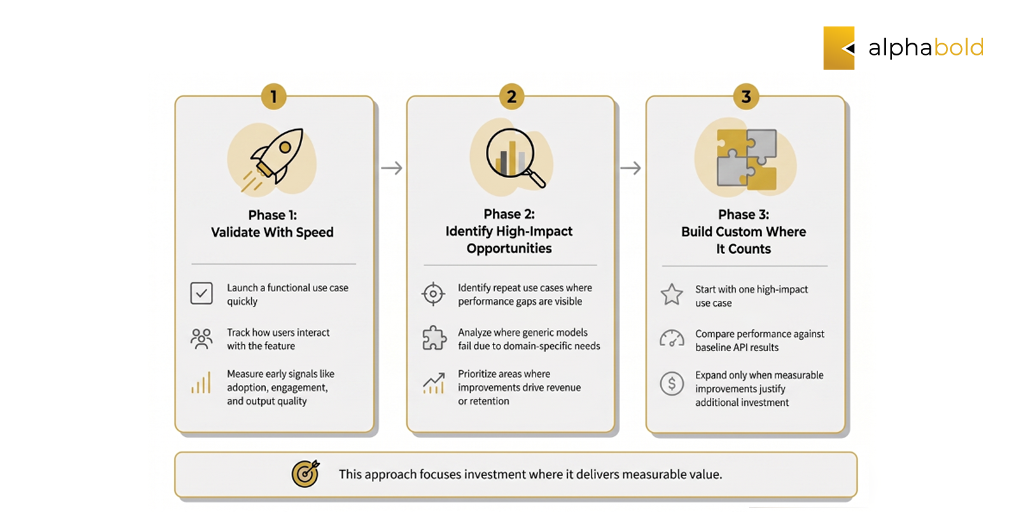
The most successful AI implementations we’ve seen follow a deliberate evolution rather than an all-or-nothing approach:
Phase 1: Validate With Speed
Start with APIs and pre-built tools to ship quickly and learn. Your goal is understanding what users need, where the value lies, and which use cases matter most. This exploration phase typically costs a few thousand dollars, not hundreds of thousands.
- Launch a functional use case quickly instead of aiming for perfection
- Track how users interact with the feature, not just if it works
- Measure early signals like adoption, engagement, and output quality
Phase 2: Identify High-Impact Opportunities
After gathering real usage data, patterns emerge. Maybe 80% of your chatbot traffic focuses on three specific workflows. Or your recommendation system performs well for returning users but struggles with new customers. These insights show you where custom development could deliver the most value.
- Identify repeat use cases where performance gaps are visible
- Analyze where generic models fail due to domain-specific needs
- Prioritize areas where improvements directly affect revenue or retention
Phase 3: Build Custom Where It Counts
Develop or fine-tune models for those high-leverage areas while keeping standard tools for everything else. You’re not rebuilding your entire stack; you’re strategically upgrading the components that justify the investment and deliver competitive advantage.
- Start with one high-impact use case instead of multiple parallel builds
- Compare performance against baseline API results before scaling
- Expand only when measurable improvements justify additional investment
This approach focuses investment where it delivers measurable value.
You may also like: Most AI Agents Aren’t Worth What You’re Paying For Them
Build the Right AI Strategy for Your Growth Stage
Whether you're validating ideas or scaling AI across your business, get a roadmap that aligns with your data, budget, and goals.
Get a Custom AI RoadmapWhat Questions Should You Ask to Decide Between Standard AI Tools and Custom AI?
When evaluating whether custom AI makes sense for your business, these questions help clarify the path forward:
How Central is AI to Your Product?
If it supports operations, standard tools are often enough. If it drives differentiation, custom becomes more relevant.
Do You Have Unique Data?
Standard models train on publicly available data. If you have proprietary datasets, unique customer behavior, specialized domain knowledge, or process data your competitors lack, custom models can turn that data into a competitive moat.
What Happens To Cost at Scale?
Low usage favors APIs. High and growing usage may justify custom infrastructure.
Do You Have The Capacity?
Custom AI requires ongoing effort. Assess internal capability or need for external partners.
How Should You Choose Between Standard AI Tools and Custom AI Based on Your Stage?
The right AI strategy depends on your stage and priorities.
For many companies, standard tools remain the best option early on. They allow you to deliver value quickly while focusing on your core business.
Custom AI becomes relevant when:
- Product-market fit is established
- Clear limitations appear in existing tools
- Data can support better performance
- AI outcomes directly affect business results
At that point, the decision becomes strategic rather than experimental.
Not Sure Whether Standard AI or Custom AI Is Right for You?
Get a clear evaluation of your current AI approach, cost structure, and where custom development can actually improve outcomes.
Book Your AI Strategy SessionConclusion
The practical approach treats AI as an evolving capability. Start with proven tools to ship quickly and learn from real usage. Track usage, cost, and where users get value.
As you scale, look for clear signals for custom development: rising API costs, performance gaps that affect outcomes, or proprietary data that could improve results.
When these signals appear, move step by step. Start with one high-impact use case, measure results against clear metrics, and expand only when value is proven.
The decision is not standard vs custom. It is about using the right approach at the right stage. Match your AI approach to your current needs and where your business is heading.
FAQs
You are ready when you already use AI in production, understand its limits, and can point to specific areas where performance or cost is holding you back.
No. Custom AI only makes sense when you have clear business value tied to performance, unique data, or scale. Otherwise, standard tools are usually more practical.
They invest in custom AI too early, before validating use cases and data readiness. This often leads to high cost without measurable business impact.
It is critical. Without structured, reliable data, custom AI will not perform well or justify the investment.
Cost becomes important at scale. Standard tools are cost-efficient early on, but high usage volumes can shift the economics in favor of custom solutions.
Explore Recent Blog Posts

Related Posts