AI-Enhanced Dynamics 365 Sales: What Executives Need to Know

Table of Contents
Introduction
Every sales leader is dealing with some version of the same pressure: more pipeline to manage, leaner teams, and expectations that haven’t come down. The difference in 2026 is that the technology has finally caught up with the ambition. AI inside Dynamics 365 Sales is no longer a feature roadmap item — it is operational, and organizations that have deployed it are seeing measurable changes in how their teams work.
This blog explores how AI-enhanced Dynamics 365 Sales addresses the challenges executives actually face. We cover the core Copilot capabilities that are already in production, the 2026 Wave 1 updates rolling out between April and September, and the agentic AI shift that is redefining what a CRM can do. We also include updated statistics, three new technical sections covering the most significant advances, and a FAQ section at the end.
The Value of AI in Dynamics 365 Sales
The value of AI-enhanced Dynamics 365 Sales lies in its ability to move sales teams beyond simple CRM tracking. It automates admin work, delivers predictive insights, and ensures every customer interaction is timely, contextual, and personalized. When we meet sales leaders, the same concerns come up:
- “My team spends hours updating CRM.” “Our forecasts are never accurate.”
- “Reps aren’t sure where to focus.”
AI-enhanced Dynamics 365 Sales addresses these issues directly. Microsoft’s 2025 updates make the platform even more impactful. In fact, Gartner finds that sellers who gather buyer intelligence grow their accounts by 5 percent.
Key AI Capabilities Inside Dynamics 365 Sales:
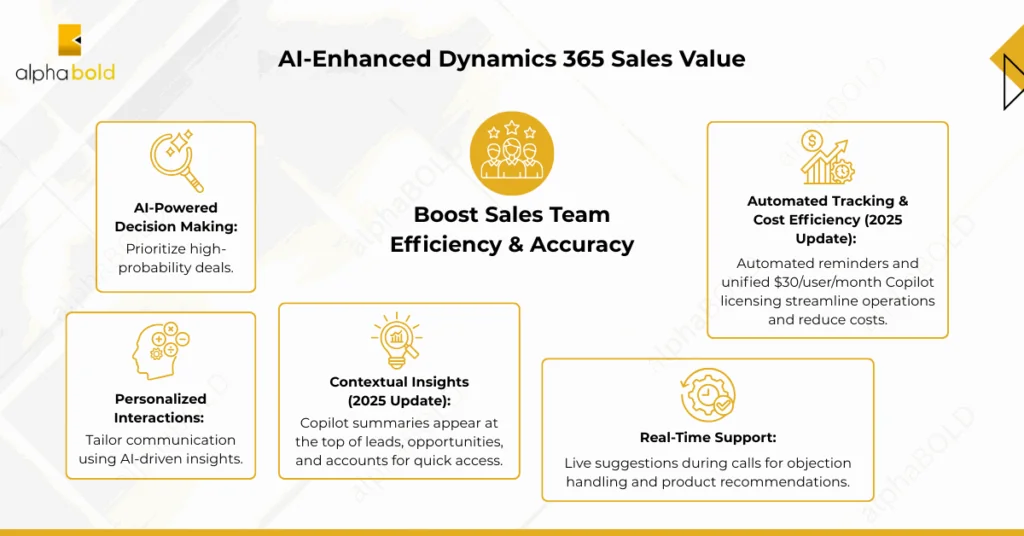
- AI-powered decision making: Identify the next best actions and prioritize deals with higher win probability.
- Personalized customer interactions: AI-driven prompts help reps tailor communication to each buyer’s profile.
- Contextual insights (Updated 2025): With Release Wave 2, Copilot-generated summaries now appear directly at the top of leads, opportunities, and accounts. This eliminates side-panel navigation and gives reps instant visibility into the most important details.
- Real-time conversation support: Equip reps with live suggestions during calls to handle objections and recommend products.
- Automated opportunity tracking and cost efficiency (Updated 2025): Automated reminders keep the pipeline moving. Microsoft’s new unified Copilot licensing at $30 per user per month reduces complexity and makes enterprise-wide adoption more cost-effective.
Copilot Agents
What is a D365 Sales Copilot Agent?
Copilot Agents in Dynamics 365 Sales act as AI assistants that scale across teams. They connect organizational data, automate repetitive processes, and provide contextual guidance so leaders can ensure consistency, compliance, and smarter engagement across every sales cycle stage.
Most executives tell us the same story: their reps spend more time managing systems than engaging customers. Copilot Agents shift that balance by automating workflows across Outlook, Teams, and CRM, freeing staff to focus on revenue-driving activities instead of administration.
Strategic Benefits Include:
- Enterprise-wide consistency: Standardize how sales data is updated and tracked across the organization.
- Secure orchestration: Integrate multiple Microsoft applications without creating silos or compliance risks.
- Smarter prioritization: Surface the highest-value opportunities to keep sales teams focused on what matters.
- Governance-ready design (2025 update): With the new Agent 365 platform, IT leaders can centrally manage both human users and AI agents from one admin center, ensuring deployments are secure, compliant, and aligned with enterprise standards.
See AI in Action with Dynamics 365 Sales
Explore how Copilot Agents, predictive insights, and real-time automation can reduce admin work and help your teams focus on closing deals.
Request a DemoA More Customer-Centric Sales Process
Dynamics 365 Sales creates a unified, customer-centric experience by connecting Teams, LinkedIn, and Outlook data. This integration gives sales professionals a complete view of each customer, enabling stronger relationships and smoother workflows without relying on third-party add-ons.
When we meet with clients, one of the biggest frustrations we hear is that sales data lives in silos. Marketing, service, and sales all use different systems, and no one has the full customer picture. Dynamics 365 Sales closes that gap by consolidating insights and embedding collaboration tools directly into the platforms teams already use.
Core Advantages Include:
- 360-degree customer view: Access history, preferences, and past interactions in one place.
- Cross-team collaboration: Connect sales, marketing, and service teams through Microsoft Teams integration.
- Embedded LinkedIn insights: Enrich profiles with professional data to support targeted, relevant outreach.
- Streamlined workflows: Eliminate the friction of switching between apps while keeping processes compliant and consistent.
With the latest updates, Copilot insights appear inline at the top of customer records. This means sales reps no longer waste time toggling between tabs. They get immediate visibility into opportunities, risks, and action items, reinforcing the customer-first approach.
What Is New in 2026 Wave 1: The Agentic AI Shift in Dynamics 365 Sales
April 2026 to September 2026:
Microsoft’s 2026 Release Wave 1 marks a decisive shift in how Dynamics 365 Sales operates. The central theme, in Microsoft’s own words, is that AI is no longer assistive — it is operational. The platform is moving from a system of record to a system of action, where CRM data, Microsoft 365 signals, and autonomous agents work together to drive selling activity without waiting for a human to initiate each step.
Unified CRM and Microsoft 365 Data Signals:
Copilot in Dynamics 365 Sales can now draw on data spanning CRM and Microsoft 365 simultaneously — including email threads, meeting recaps, Teams conversations, and calendar activity. This means a rep reviewing an account gets a summary that reflects not just what is in the CRM record but what has happened across every digital touchpoint in their Microsoft environment.
The practical effect is that sellers spend less time hunting for context and more time acting on it. Pipeline risks surface based on signals like email non-response or missed follow-ups, not just CRM field values.
Sales Qualification Agent:
The Sales Qualification Agent, introduced in preview and expanding in Wave 1, automates the research, enrichment, and scoring of inbound leads without human intervention. It ingests new leads, pulls firmographic and behavioral data, scores them against your defined criteria, and routes them to the right rep with context attached.
For organizations receiving high volumes of inbound leads from webinars, content downloads, or paid campaigns, this collapses what was previously a multi-step manual process into a single automated workflow.
Configurable Record Summaries and Sales Home:
New cross-app capabilities in Wave 1 include improvements to Model Context Protocol servers, which allow AI agents to query and act on data outside Dynamics 365 without manual integration work. For organizations with data in legacy systems or third-party platforms, MCP connectors enable Copilot to reason across a broader data surface than was previously possible.
Immersive Home — reaching general availability in Wave 1 — provides an adaptive landing page designed for agent management and workflow monitoring, giving administrators and power users a single place to oversee AI activity across the organization.
Immersive Home and Model Context Protocol (MCP) Servers:
Wave 1 introduces configurable record summaries, allowing organizations to define exactly what Copilot surfaces at the top of each record type based on their sales process. A SaaS company might prioritize product usage signals; a professional services firm might surface relationship history and project status. The summary is tailored, not generic.
The updated Sales Home experience also gives sellers a unified, AI-driven workspace that shows their most critical tasks, at-risk deals, and recommended next actions in a single prioritized view — replacing the fragmented dashboard experience that many teams work around today.
Autonomous Sales Agents: Beyond Copilot Assistance
The distinction between Copilot and autonomous agents is significant and worth understanding clearly. Copilot responds to prompts — a seller asks a question or requests a draft and Copilot generates a response. An autonomous agent operates independently: it receives a trigger, executes a multi-step workflow, and reports the outcome, with humans reviewing exceptions rather than every individual action.
In Dynamics 365 Sales, autonomous agents introduced in Wave 2 2025 and expanded in 2026 are already handling workflows that previously required dedicated human effort:
Lead Qualification Agent:
Ingests inbound leads, scores them, enriches contact and account data from external sources, routes to the right sales rep, and schedules an initial follow-up task — all without a human touching the record first. For high-volume pipelines, this alone can reclaim significant time that was previously spent on triage.
Customer Churn Prevention Agent:
Monitors engagement patterns across CRM and Microsoft 365 data, identifies accounts showing reduced activity, and drafts personalized retention outreach for the account owner to review. Rather than discovering churn risk in a quarterly review, the agent surfaces it in real time when intervention is still possible.
Pipeline Health Agent:
Continuously evaluates opportunity health scores, risk indicators such as lack of engagement or overdue tasks, and win/loss prediction signals. When a deal’s health score drops below a defined threshold, the agent flags it, analyzes the specific reason, and suggests a targeted revival action — whether that is scheduling a technical demo, sending a case study, or escalating to a senior relationship owner.
Governance and the Agent 365 Platform:
Autonomous capability requires governance proportional to its autonomy. The Agent 365 platform gives IT administrators a centralized admin center for managing both human users and AI agents, with full audit trails for every autonomous decision, role-based access controls, and human-in-the-loop checkpoints for high-stakes actions.
Every autonomous action is logged and explainable, which matters for regulated industries and for organizations that need to demonstrate how sales decisions were made.
Conversation Intelligence: Turning Every Sales Call Into a Coaching Asset
One of the most underutilized capabilities in Dynamics 365 Sales is Conversation Intelligence — the AI layer that analyzes recorded customer calls and extracts structured insight from them. In 2026, with expanded Microsoft Teams integration and improved signal extraction, this has become a serious sales management tool rather than a compliance checkbox.
What Conversation Intelligence Captures:
- Sentiment shifts during the call, including moments where the conversation lost momentum
- Competitor mentions and how the rep responded to them
- Buying signals — questions about pricing, timelines, implementation, and decision-making process
- Talk-to-listen ratio for individual reps, tracked over time
- Action items extracted automatically and logged to the CRM record
How Sales Leaders Use It:
The data from Conversation Intelligence feeds directly into coaching workflows. Managers can filter calls by outcome — won, lost, stalled — and identify patterns. A rep with a high talk-to-listen ratio who is losing late-stage deals gets targeted coaching on discovery, not generic training.
At the team level, conversation data reveals which objections come up most often, which competitor names surface most frequently, and which deal stages have the highest drop-off. This turns anecdote into analysis.
Integration With Opportunity Records:
Every call summary, extracted action item, and sentiment score is linked to the relevant opportunity in Dynamics 365. When a rep opens a record before a follow-up call, they see not just the standard CRM fields but a chronological view of every conversation, with Copilot surfacing the most relevant context from the full history.
For sales organizations that run multiple stakeholder calls over a complex deal cycle, this continuity is what prevents the “let me check my notes” problem that slows deal velocity and damages customer confidence.
What This Means for Executives
The question is no longer whether AI belongs in your sales stack. In 2026, organizations that have not deployed these capabilities are running a slower, less informed sales motion than their competitors who have.
The practical decisions executives face now are about configuration, governance, and adoption — not whether to move. Which agents to deploy first. How to define the scoring models. What data to include in the unified signal layer. How to build the governance structure that lets IT trust what the agents are doing.
AlphaBOLD has been implementing Dynamics 365 Sales environments with Copilot and agentic AI configurations since these capabilities entered general availability. We configure the system to your sales process, not the other way around — including custom record summaries, tuned lead scoring models, governed agent workflows, and adoption programs that get your team using the tools from day one.
FAQS
Copilot is prompt-driven — a seller asks a question or requests an action and Copilot generates a response that the seller acts on. An autonomous agent is trigger-driven — it executes a defined multi-step workflow independently when a condition is met, such as a new lead arriving or an opportunity health score dropping below a threshold. Humans review exceptions and outcomes rather than approving each individual step. Both are available inside Dynamics 365, and most organizations deploy them in combination.
Wave 1, rolling out between April and September 2026, includes unified CRM and Microsoft 365 data signals for Copilot, the Sales Qualification Agent reaching broader availability, configurable record summaries, the updated Sales Home experience, improvements to Model Context Protocol servers for cross-system data access, and the general availability of Immersive Home for agent management. The central theme is moving Dynamics 365 Sales from a system of record to a system of action.
Lead scoring in Dynamics 365 Sales uses AI trained on your own historical data — which leads converted, which did not, and what those leads had in common. Scores are recalculated in real time based on over 100 behavioral and demographic signals. Sales managers can adjust model weightings through a visual dashboard without developer involvement, allowing the scoring to reflect your specific business context rather than a generic template.
Conversation Intelligence is a native capability within Dynamics 365 Sales, but it requires configuration to be useful. You need to connect it to your Teams or phone system recordings, define which call types to analyze, set up the coaching workflow, and align the action item extraction with your CRM fields. AlphaBOLD handles this configuration as part of our Sales implementations, ensuring the data captured maps cleanly to your opportunity records and coaching processes.
We start with the use cases that save sellers the most time with the least change in behavior — Copilot summaries, automated follow-ups, and meeting recaps inside Teams. These deliver immediate value and build trust in the system before we expand into more advanced capabilities like autonomous agents and conversation intelligence. We also run role-specific training for reps, managers, and administrators, because each group gets different value from the platform and needs to understand what the AI is doing and why.
Autonomous agents in Dynamics 365 operate within the Agent 365 platform, which gives IT administrators centralized control over both human users and AI agents. Every autonomous decision is logged with a full audit trail, and organizations can define which actions require human approval before execution. For regulated industries, this audit capability is essential. AlphaBOLD implements governance frameworks as part of every agentic AI deployment, defining agent scope, access boundaries, and escalation rules before any agent goes live.
Microsoft unified its Copilot licensing in 2025, replacing the previous fragmented structure with a single add-on at $30 per user per month on top of the base Dynamics 365 Sales license. This license covers the full suite of Copilot capabilities — summaries, email drafting, conversation intelligence, predictive scoring, and the agent framework. For organizations that were previously evaluating Copilot features individually, this simplification makes enterprise-wide deployment significantly more straightforward to budget and approve.
By default, Copilot accesses data within Dynamics 365 and connected Microsoft 365 services. To extend it to legacy systems, third-party platforms, or external data sources, organizations use Model Context Protocol connectors — custom adapters that allow agents to query and act on data outside the Microsoft ecosystem. Wave 1 includes improvements to MCP server infrastructure that make these connections more accessible. AlphaBOLD builds and governs MCP connectors as part of complex integration engagements.
Explore Recent Blog Posts