AI for Banking: Benefits, Risks, & Use Cases in 2026

Table of Contents
Introduction
Eight months into 2026, AI in banking is past the opening wave of experimentation. Financial institutions must now prove which deployments improve operations, reduce risk, and justify investment. The 2026 Global AI in Financial Services Report found that 81% of surveyed firms had adopted AI at some level and 40% reported advanced adoption. Yet only 14% considered it transformational.
That gap defines AI for banking. Adoption is widespread, but transformation remains limited. Banks now need reliable data, connected systems, risk-based governance, and measurable outcomes to scale responsibly.
This blog explores how banks are using AI to enhance productivity, reduce risk, and create measurable business outcomes, and what the next phase of AI innovation means for the financial industry in 2026.
What Is AI in Banking?
AI in banking refers to the use of machine learning, natural language processing, predictive models, generative AI, and intelligent automation to analyze financial data, support decisions, and improve banking workflows.
Predictive models can support credit and fraud risk analysis. Generative AI can summarize documents, retrieve approved information, and prepare communications. Generative AI use cases for financial services should support governed workflows rather than replace systems of record or deterministic calculations.
Agentic systems can coordinate multiple steps and initiate approved actions. Banks considering that level of automation can explore how AI agents for banking support transaction monitoring and customer service.
What Are the Benefits of AI in Banking?
The main benefits of AI in banking include operational efficiency, faster risk detection, improved customer support, and stronger decision support. They depend on the data, workflows, controls, and human review surrounding the technology.
- Greater operational efficiency: AI can support document extraction, reconciliation, case preparation, reporting, and knowledge retrieval. The 2026 global report found positive productivity effects across technology and data functions, back-office operations, and front-office roles.
- Stronger fraud detection: AI can analyze transaction, identity, device, behavioral, and relationship data to identify suspicious activity that static thresholds may miss. Specialized AI agents for fraud detection can also help prioritize alerts and prepare evidence for investigators.
- Faster customer service: Banking assistants can answer routine questions, summarize interactions, provide proactive notifications, and transfer relevant context to employees.
- Improved risk and credit analysis: Predictive models can organize more information and identify patterns faster, while governed human decision-makers retain responsibility for consequential outcomes.
- More efficient compliance operations: AI can assist with KYC and AML screening, alert prioritization, investigation summaries, policy retrieval, and regulatory reporting.
- Better employee support: Teams can retrieve approved information and prepare work without searching across disconnected systems.
How Is AI Being Used in Banking as of August 2026?
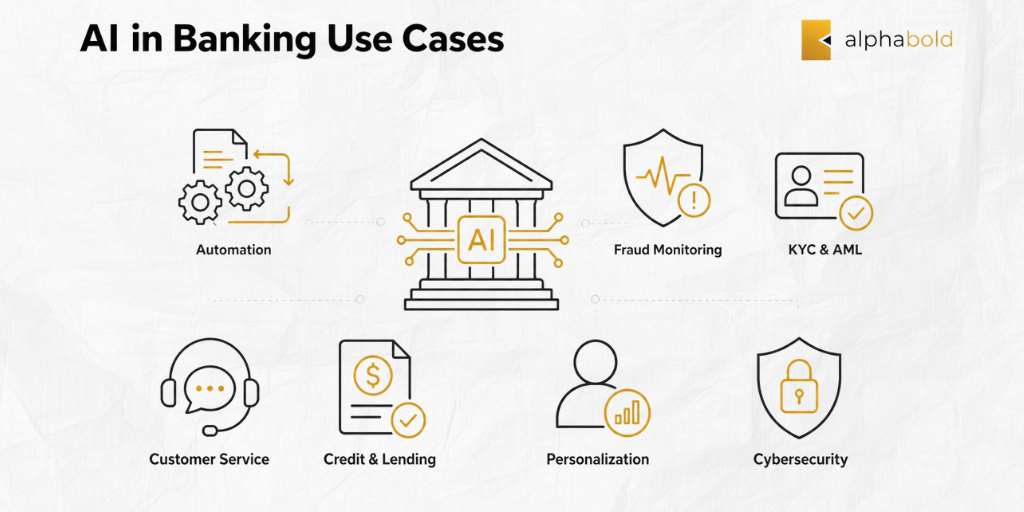
By August 2026, leading banking AI use cases are improving execution more often than reinventing business models. Adoption is concentrated in practical workflows that help employees process information, identify risk, and serve customers. Common applications at the pilot stage or beyond include:
- Process automation: AI can extract data, prepare documents, route work, and reconcile records. Banks still need quality review and defined exception handling.
- Fraud monitoring: AI can identify anomalies and connect transaction, identity, device, and behavioral signals. Account restrictions and payment holds require risk-based human oversight.
- KYC and AML: AI can prioritize alerts, gather evidence, and draft case summaries. Decisions must remain explainable, documented, and defensible.
- Customer service: AI can answer routine questions, summarize cases, and recommend routing. Customers need a clear path to a qualified employee when automation cannot resolve an issue.
- Credit and lending: AI can support data analysis, underwriting preparation, and risk modelling. Fair-lending testing, explainability, and human accountability remain essential.
- Personalization: AI can produce relevant insights, proactive notifications, and next-best actions. Banks must maintain appropriate consent, privacy, and suitability controls.
- Cybersecurity: AI can help detect threats and prioritize incidents, but security teams must validate findings and govern the response.
Further reading: Top Generative AI Trends Shaping 2026
Identify the Right AI Use Cases for Your Bank
Not every banking workflow requires the same model, platform, or level of automation. AlphaBOLD helps financial institutions evaluate use cases, data requirements, integration needs, expected value, and human oversight before implementation.
Get Expert ConsultationWhat Does AI in Banking Look Like in Practice?
Results from the first eight months of 2026 show mature AI programs expanding into employee workflows. Bank of America reported in March that 20.6 million users interacted with Erica nearly 700 million times during 2025, taking total interactions beyond 3.2 billion. In July, more than 18,000 employees used EricaAssist, which delivered guidance in under three seconds and reduced average call time by nearly one minute.
AI works best when embedded in a defined process. AlphaBOLD’s work modernizing CalPrivate Bank’s loan process demonstrates how connected systems, structured workflows, and document management can establish a foundation for continued automation.
What Are the Risks of AI in Banking?
The leading risks of AI in banking include exposure of sensitive data, unreliable output, biased decisions, limited explainability, false positives, cyberattacks, and excessive dependence on external providers.
- Data privacy and security: Customer information can be exposed through prompts, logs, training pipelines, integrations, or poorly governed external tools.
- Hallucinations and unreliable output: Generated answers may sound credible while being incomplete or incorrect. Banks must distinguish and test for AI hallucinations and fabricated outputs.
- Bias and unfair outcomes: Historical data can reproduce discriminatory patterns or introduce proxy variables into credit, fraud, or customer-treatment decisions.
- Limited explainability: Banks need to understand and document why a consequential recommendation or decision occurred.
- False positives and customer harm: AI may incorrectly flag legitimate activity, delay access to funds, or create unnecessary investigations. Customers need understandable explanations and timely remediation.
- Loss of human oversight: Complex disputes, financial hardship, low-confidence results, and decisions affecting credit or access to funds should be escalated to qualified employees.
- Third-party risk: Dependence on model and cloud providers can introduce outages, changing costs, limited transparency, and concentration risk.
The 2026 global report identifies privacy and unreliable output as the two leading concerns. By August, these are production issues, not hypothetical barriers. A structured AI risk management framework helps banks organize ownership, testing, monitoring, escalation, and incident response.
What Are the Advantages and Disadvantages of AI in Banking?
The advantages and disadvantages of AI in banking often appear within the same workflow:
- Faster processing and knowledge retrieval can improve productivity, but inaccurate or unsupported output can create rework.
- Better fraud and risk analysis can identify suspicious patterns, but false positives may disrupt legitimate customers.
- Scalable customer support can shorten response times, but poor escalation can leave customers trapped in automated channels.
- More consistent workflow support can improve execution, but biased data and limited explainability can produce unfair outcomes.
- Greater personalization can make services more relevant, but it also creates privacy, consent, and suitability concerns.
The balance depends less on the model alone and more on how the bank governs data, decisions, integrations, and human accountability.
Why Do Banking AI Projects Struggle to Scale?
Banking AI projects often stall because production introduces fragmented data, legacy systems, access controls, workflow exceptions, and regulatory responsibilities absent from the pilot.
This challenge is not limited to banking. Gartner’s April 2026 research found that organizations reporting successful AI initiatives invested up to four times more in data quality, governance, AI-ready employees, and change management than organizations experiencing poor outcomes. Only 39% of surveyed technology leaders were confident that their AI investments would improve financial performance.
Effective production AI integration must address permissions, APIs, systems of record, monitoring, cost, and exception paths. Banks should assess common AI implementation challenges before selecting a platform.
How Should Banks Govern AI as of August 2026?
Responsible AI in banking requires controls proportionate to the use case and its potential impact. Banks should:
- Inventory AI applications, owners, data sources, and actions.
- Classify use cases by materiality, customer impact, and regulatory exposure.
- Establish approved data, permissions, retention, and lineage controls.
- Define when human review, approval, or customer escalation is mandatory.
- Test accuracy, bias, explainability, security, and operational resilience.
- Monitor performance, drift, complaints, overrides, rework, and incidents.
- Assess third-party models and cloud dependencies continuously.
The regulatory position has also become clearer. The Federal Reserve’s July remarks emphasized use-case materiality, proportionality, and existing risk-management frameworks adapted to AI risks. The EU AI Act became broadly applicable on August 2, 2026. Its transparency requirements are in effect, while requirements for sensitive high-risk uses, including certain credit-scoring systems, are scheduled for December 2, 2027.
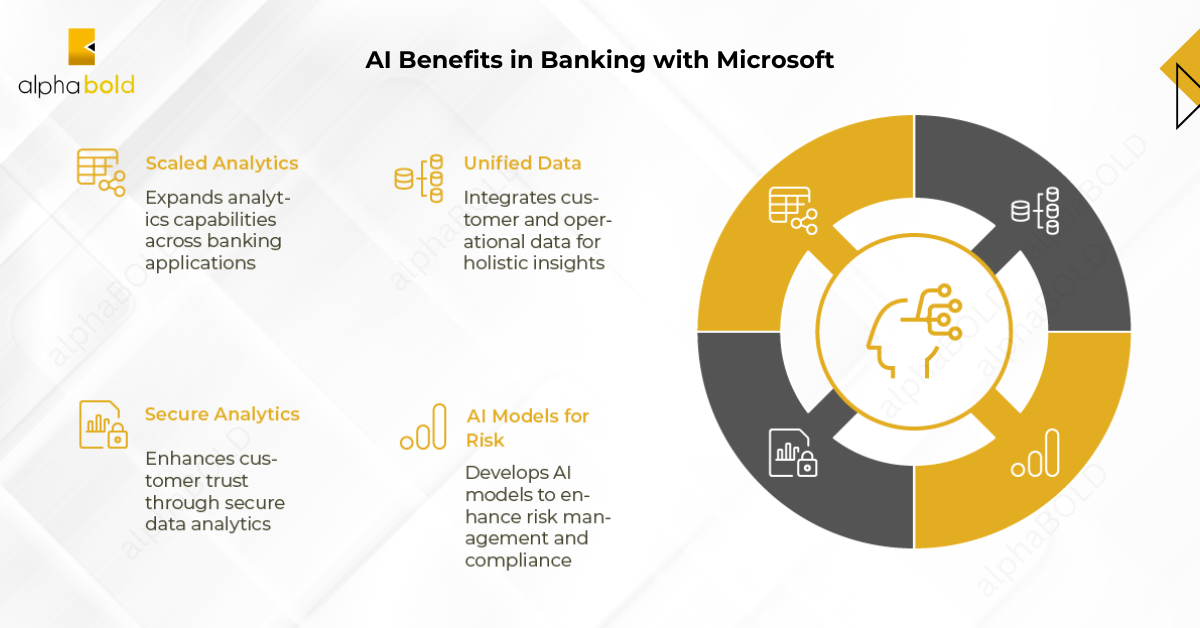
Banks can use Microsoft Fabric consulting services to consolidate governed data for analytics and approved AI workflows. The platform does not remove the need for validation, security, or human accountability.
Read more: AI in Finance – Fantasy or Reality?
Build a Governed AI Roadmap for Banking
Move from disconnected pilots to secure, measurable AI adoption. AlphaBOLD can help your bank prepare its data, connect critical systems, establish governance controls, and scale AI workflows aligned with operational and customer priorities.
Get Expert Consultation
Conclusion
By August 2026, the question is whether deployed AI can deliver measurable value without weakening customer protection, compliance, or operational resilience. AI is improving execution, fraud analysis, customer support, and employee productivity, but adoption alone is not an advantage. Banks now need to scale the right use cases with reliable data, defined workflows, measurable outcomes, and accountable human decisions.
Take the Next Step with AI
With AlphaBOLD, banks can confidently adopt AI, ensuring security, compliance, and operational efficiency. Let’s discuss how we can support your AI initiatives.
Request a ConsultationFAQs
Through August 2026, the clearest value has appeared in process automation, knowledge retrieval, customer support, fraud analysis, compliance preparation, and employee assistance. Enterprise profitability and revenue gains remain harder to measure.
Yes. Incomplete data, changing customer behavior, overly sensitive thresholds, or model limitations can produce false positives. Consequential cases should include human review, an understandable explanation, and a timely remediation process.
Escalation is appropriate when confidence is low, the customer disputes information, access to money or credit may be affected, legal rights are involved, hardship is identified, or the customer requests human assistance.
Banks need approved data sources, role-based access, encryption, retention limits, data-loss prevention, vendor assessment, monitoring, and clear restrictions on how sensitive information enters external AI models.
Explore Recent Blog Posts