
Digital Transformation in the Food and Beverage Industry with Dynamics 365

Table of Contents
Introduction
Digital transformation in the food and beverage industry is no longer about adopting new systems or improving reporting. It is about enabling fast, accurate decision-making across supply chains shaped by perishability, demand volatility, cost pressure, and regulatory requirements.
Food and beverage operations already generate large volumes of data across inventory, production, procurement, logistics, and finance. The challenge is not visibility. It is converting live operational signals into coordinated actions before waste, service failures, or margin erosion occur.
ERP-led operating models address this gap by connecting planning and execution in real time. Dynamics 365 provides a unified foundation for managing inventory, demand, costs, compliance, and customer operations as a single, decision-driven system.
This article examines how digital transformation in the food and beverage industry is evolving and how Dynamics 365 supports operational control, resilience, and margin protection across the value chain.
Why Digital Transformation in the Food and Beverage Industry Has Changed
Digital transformation in the food and beverage industry has evolved as supply chains have become more volatile and less forgiving. Perishable inventory, demand swings, cost pressure, and regulatory requirements leave little room for delayed or disconnected decisions.
Digital initiatives have improved transparency. 58% of food companies report that digital transformation has improved supply chain visibility. Visibility, however, does not prevent loss on its own.
Common breakdowns still occur when:
- Planning and execution operate on different timelines
- Local decisions are made without downstream cost or compliance context
- Manual overrides introduce inconsistency and risk
- Responses to disruption are slow or uncoordinated
What differentiates performance is not access to data, but the ability to turn live operational signals into aligned decisions across the supply chain.
ERP as a Decision Engine, Not a Record-Keeping System
Traditional ERP systems were designed to capture transactions and produce reports after activities were completed. In complex food and beverage operations, that approach is no longer sufficient. By the time issues appear in reports, inventory may already be wasted, costs absorbed, or service commitments missed.
Modern ERP-led operating models treat ERP as a decision engine rather than a system of record. Planning, execution, and cost impact are connected continuously, allowing teams to evaluate trade-offs and act while outcomes can still be influenced.
Instead of operating in functional silos, ERP supports:
- Decisions that reflect inventory constraints, production capacity, and supplier reliability
- Alignment between demand signals and operational execution
- Cost awareness embedded into daily operational choices
- Consistent responses to disruptions without manual rework
When ERP governs how decisions are made across inventory, procurement, production, logistics, and finance, organizations move from reactive correction to controlled execution across the supply chain.
Inventory and Demand Planning in a Volatile Food Supply Chain
Inventory and demand planning in the food and beverage industry operate under constant uncertainty. Short shelf life, promotions, seasonal demand, and shifting customer preferences make static forecasts unreliable and slow to adjust.
When planning cycles lag behind real demand, organizations face two outcomes: excess stock that expires or shortages that disrupt service. These issues are rarely caused by a lack of data. They stem from planning models that cannot respond quickly enough to changing conditions.
Modern ERP-led planning connects demand signals directly to inventory, production capacity, and procurement constraints. Instead of relying on periodic forecasts, organizations continuously rebalance stock levels and production plans as conditions change.
Effective inventory and demand planning enables:
- Reduced spoilage through accurate, real-time stock alignment
- Fewer stockouts by responding quickly to demand shifts
- Better coordination between sales forecasts and production schedules
- Faster planning adjustments without manual intervention
In volatile supply chains, planning effectiveness is defined by responsiveness, not forecast accuracy alone.
You may also like: Maximizing Supply Chain Efficiency with BC Inventory Management
Customize Warehouse and Landed Cost Tracking
Configure Dynamics 365 to reflect your warehouse layouts, routing rules, carrier agreements, and landed cost structures for accurate margin tracking.
Request a ConsultationProduction, Quality, and Change Management Without Disruption
Production and quality operations in the food and beverage industry operate under constant change. Recipe updates, packaging modifications, supplier substitutions, and regulatory requirements must be implemented quickly without disrupting output or compromising compliance.
When these changes are managed through disconnected tools or manual approvals, organizations introduce risk. Production schedules drift, quality controls weaken, and teams rely on informal workarounds that are difficult to audit or scale.
Dynamics 365 supports controlled production and change management by connecting demand plans, production execution, quality processes, and compliance rules within a single operational system. Changes to formulations, packaging, or processes are governed through structured workflows that maintain traceability while allowing operations to continue.
With Dynamics 365, organizations can:
- Align production schedules with updated demand and material availability
- Apply controlled engineering and recipe changes without halting operations
- Enforce quality and compliance requirements consistently across sites
- Reduce risk from untracked manual changes and overrides
By embedding governance directly into production workflows, Dynamics 365 helps food and beverage organizations adapt to change without sacrificing control or operational continuity.
Warehouse, Logistics, and Landed Cost as Margin Intelligence:
In the context of digital transformation in the food and beverage industry, warehouse and logistics operations play a direct role in margin protection. Inefficient picking, limited inventory accuracy, and unplanned transportation costs quietly erode profitability long before issues appear in financial reports.
When warehousing and transportation operate without a unified view, organizations struggle to understand the true cost of moving products from production to customers. Manual adjustments, delayed cost allocation, and disconnected logistics data make it difficult to evaluate trade-offs between service levels and margin impact.
Dynamics 365 provides integrated warehouse and transportation management that connects inventory movement, shipment execution, and landed cost tracking in real time. This allows organizations to see the full cost-to-serve across distribution channels and make informed logistics decisions as conditions change.
With Dynamics 365 food and beverage organizations gain:
- Accurate warehouse execution through controlled picking, packing, and inventory movements
- Real-time visibility into transportation planning and shipment status
- Landed cost tracking that captures freight, duties, and handling expenses
- Clear insight into how logistics decisions affect margins and pricing
By treating warehouse and logistics data as margin intelligence, organizations can balance service expectations with profitability across the supply chain.
Integrate Dynamics 365 with Order and Service Systems
Connect Dynamics 365 with ERP, order management, and service platforms to ensure customer interactions reflect live inventory and cost data.
Request a ConsultationAsset Intelligence and Operational Resilience
Within digital transformation in the food and beverage industry, asset reliability directly affects production continuity, product quality, and waste reduction. Equipment failures, temperature deviations, or unplanned downtime can disrupt tightly sequenced operations and create immediate financial and compliance risk.
When asset management is reactive, issues are addressed only after production is impacted. Maintenance teams rely on schedules or manual checks, while early warning signs are often missed or acted on too late.
Dynamics 365 enables asset intelligence by connecting equipment data, maintenance activities, and operational context within a single ERP environment. Asset usage, condition signals, and performance trends are monitored continuously, allowing teams to intervene before failures disrupt production or compromise quality.
With Dynamics 365, organizations can:
- Reduce unplanned downtime through condition-based and predictive maintenance
- Monitor critical production and storage environments in real time
- Trigger alerts and corrective actions when performance thresholds are exceeded
- Extend asset life while maintaining consistent production quality
By embedding asset intelligence into daily operations, food and beverage organizations strengthen operational resilience and reduce the downstream impact of equipment-related disruptions.
Cost, Pricing, and Margin Protection in Real Time
In digital transformation in the food and beverage industry, cost control is no longer a back-office function. Volatile input prices, fluctuating logistics costs, and frequent production adjustments mean margins can erode quickly if cost visibility lags behind operations.
Traditional cost accounting often surfaces issues after profitability has already been impacted. When material usage, labor, and freight costs are reviewed retrospectively, pricing decisions are made on outdated assumptions and corrective actions come too late.
Dynamics 365 embeds cost management directly into operational workflows, linking production activity, inventory movement, procurement, and logistics costs in real time. This allows organizations to understand margin impact as decisions are made, not after the fact.
With Dynamics 365, food and beverage organizations can:
- Track material, labor, and logistics costs as they occur
- Align pricing decisions with real-time cost data
- Maintain consistency across pricing, rebates, and discounts
- Identify margin pressure early and take corrective action
By connecting cost, pricing, and execution within a single system, organizations protect margins while operating in environments where cost structures change continuously.
You may also like: Dynamics 365 Implementation Cost
Customer Experience Built on Operational Truth
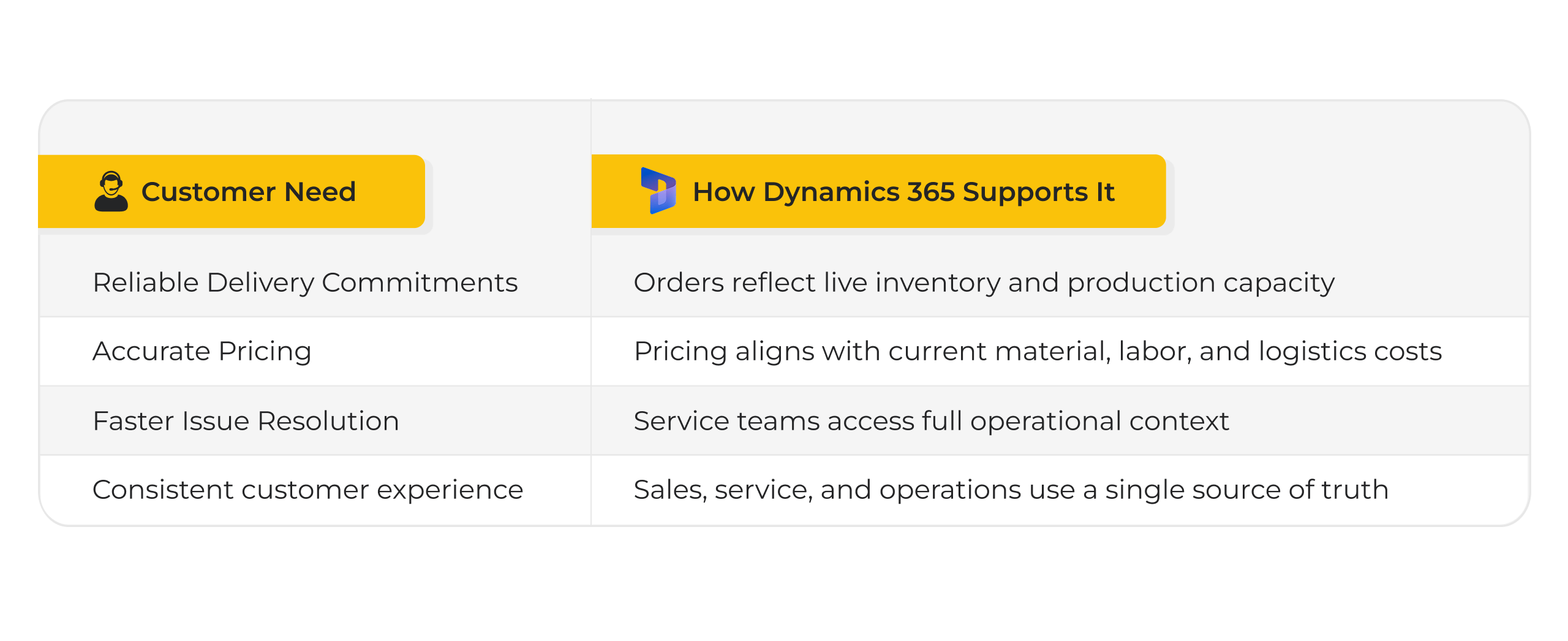
In digital transformation in the food and beverage industry, customer experience depends on accurate, real-time operational data.
Integrate Dynamics 365 Across Supply Chain and Customer Operations
Connect Dynamics 365 with inventory, production, logistics, cost management, and customer-facing systems to ensure decisions are based on live operational data across the value chain.
Request a ConsultationConclusion
Digital transformation in the food and beverage industry is no longer defined by system adoption or improved visibility. It is defined by how effectively organizations make and execute decisions across inventory, sourcing, production, logistics, cost management, and customer operations.
As supply chains become more volatile and margins more sensitive, disconnected planning and delayed responses increase risk. ERP-led operating models address this by unifying data, processes, and governance into a single execution framework.
Dynamics 365 supports this shift by enabling real-time alignment between planning and execution, embedding cost and compliance awareness into daily operations, and reducing reliance on manual intervention. For food and beverage organizations, this approach delivers greater operational control, resilience, and margin protection across the value chain.