LLM as a Service (LLMaaS): Benefits, Use Cases & Challenges in 2026

Table of Contents
Introduction
Three years ago, deploying a large language model in production meant assembling a specialized ML infrastructure team, provisioning GPU clusters, negotiating cloud contracts for hundreds of thousands of dollars in compute, and accepting a six-to-twelve-month runway before a single user could interact with your system. Today, the same capability is a single API call away. That shift is not incremental. It is a structural change in how software is built.
LLM as a Service (LLMaaS) is the delivery model behind this transformation. By exposing pre-trained frontier models through cloud APIs on a consumption basis, LLMaaS has collapsed the barrier between an organization having an AI idea and shipping it. The economics have inverted: what once required a Series B budget to prototype now fits comfortably inside a sprint. What once demanded months of infrastructure work now takes an afternoon of integration.
The scale of adoption reflects this. Enterprise AI integration is no longer a strategic moonshot reserved for tech giants. It is table stakes across financial services, healthcare, legal, manufacturing, and virtually every other sector. In 2026, organizations that have not yet deployed at least one production AI-powered workflow are the exception, not the rule — and LLMaaS is the infrastructure layer making that possible.
But accessibility does not mean simplicity. The same forces that make LLMaaS easy to start make it deceptively hard to do well. Data governance, latency architecture, hallucination risk, vendor dependency, and cost at scale are all real problems that surface the moment you move from proof-of-concept to production. Organizations that treat LLMaaS as a plug-and-play feature rather than a foundational capability are learning this the hard way.
This article covers what LLMaaS actually is under the hood, what is new in 2026 that every technical team should know, the real benefits and the real risks, the use cases generating the strongest ROI, and what responsible, durable adoption looks like in practice.
What Is LLM as a Service?
LLM as a Service is a cloud-native delivery model in which pre-trained large language models are exposed via REST APIs, enabling developers to integrate natural language understanding, generation, reasoning, and multimodal capabilities into applications without managing model weights, training infrastructure, or serving hardware.
At the infrastructure level, when your application makes an LLMaaS API call, your request is routed to a provider-managed serving cluster typically a fleet of high-memory GPU nodes running quantized model weights behind a load balancer. The provider handles tokenization, batching, KV-cache management, and output detokenization. Your application receives a structured response, usually JSON, containing the generated text and metadata like token usage and finish reason. From your codebase’s perspective, calling a frontier LLM is no more complex than calling a data engineering API or a payment processor.
The analogy to SaaS is useful but imprecise. Unlike traditional SaaS which serves fixed functionality, LLMaaS exposes a general-purpose reasoning engine. What your application can do with it is largely a function of how well you craft the prompts, context, and orchestration logic around the API calls which is why prompt engineering, RAG architecture, and agent design have become first-class engineering disciplines.
Exploring AI Integration for Your Business?
AlphaBOLD helps organizations design and implement LLMaaS architectures that are secure, scalable, and built for production from day one.
Request a ConsultationWhat's New in LLMaaS in 2026
The LLMaaS landscape in 2026 looks materially different from even eighteen months ago. Several technical developments have changed what is possible, what is practical, and what teams need to design for. If your mental model of LLMaaS is still anchored to the 2023-era pattern of short context, single-modal text completion, you are working with an outdated map.
Extended Context Windows: 1M+ Tokens
Context windows have expanded dramatically. Leading providers now support context lengths exceeding 1 million tokens — enough to feed an entire codebase, a year of CRM notes, or hundreds of pages of regulatory documents into a single prompt. This fundamentally changes the data engineering pattern for many use cases: workloads that previously required complex chunking, vector databases, and retrieval pipelines can now be handled with direct context injection, dramatically simplifying architecture. However, long-context calls are significantly more expensive per request, and latency scales non-linearly with context length, so this is a design trade-off, not a free upgrade.
Technical note: Long-context vs. RAG trade-offs
For documents under ~200K tokens with well-structured content, direct context injection now often outperforms RAG pipelines on accuracy and consistency. For dynamic, frequently updated corpora or datasets exceeding context limits, RAG remains the right architecture. Many production systems in 2026 use a hybrid approach: RAG to retrieve top-N relevant chunks, then context injection for those chunks plus surrounding structure.
Reasoning Models and Extended Thinking:
A new class of model has emerged that explicitly separates a multi-step internal reasoning phase from the final response generation. These reasoning models — sometimes called extended thinking or chain-of-thought inference models — are designed for tasks that benefit from deliberation: complex mathematical problems, multi-constraint planning, legal analysis, and code generation involving non-trivial logic.
The practical implication is that not all LLMaaS calls should use the same model. For simple classification, summarization, or extraction tasks, a fast, cheap standard model is appropriate. For tasks requiring deep reasoning, routing to a reasoning-capable model at the cost of higher latency and token spend produces substantially better results. Intelligent model routing is now a core component of well-designed agentic AI architectures.
Native Multimodal APIs:
Text-only LLMaaS is no longer the standard. Leading provider APIs now natively accept images, audio, video frames, and structured documents as input alongside text. This has opened up a generation of use cases that previously required separate computer vision or speech-to-text pipelines: automated invoice processing from PDFs, quality inspection from production-line images, clinical note generation from audio recordings, and contract review from scanned documents.
For engineering teams, this means the integration surface has expanded. A single API can now replace what was previously a multi-model pipeline with separate preprocessing, OCR, and language understanding stages, reducing both integration complexity and points of failure.
Structured Outputs and JSON Mode:
One of the most practically significant improvements of the past year is the broad availability of guaranteed structured outputs. Providers now offer a constrained generation mode variously called JSON mode, structured output mode, or response format enforcement in which the model is constrained to produce output that strictly conforms to a developer-specified JSON schema. This eliminates the brittle parse-and-validate pattern that caused production incidents in early LLM integrations. For custom software development teams integrating LLMaaS into typed application backends, structured outputs have become a prerequisite for reliable production use.
Technical note: How structured output enforcement works: Most providers implement structured output enforcement through constrained decoding specifically by applying a grammar or JSON schema as a logit mask at each generation step, forcing the model to only produce tokens that keep the output valid against the schema. This is more reliable than post-hoc validation because the model literally cannot generate invalid JSON. The trade-off is a small increase in generation latency (~5-15%) and the need to define schemas upfront.
Function Calling and Tool Use at Scale:
Function calling the ability for a model to emit a structured invocation request for an external tool, pause generation, receive the tool result, and continue reasoning with that result incorporated has matured significantly. In 2026, parallel function calling (multiple simultaneous tool invocations), multi-turn tool use, and strongly-typed function signatures are standard across major providers.
This is the technical foundation underpinning the rise of agentic AI workflows. An agent that can search a knowledge base, query a CRM, write a database record, send a notification, and reflect on the combined results in a single reasoning loop without human intervention between steps is built on robust function calling infrastructure. The architectural challenge has shifted from ‘can the model call tools’ to ‘how do you govern which tools it can call, in what sequence, with what authorization controls.’
Batch Processing APIs and Asynchronous Inference:
Real-time inference is appropriate for interactive applications, but a significant share of enterprise LLM workloads are non-interactive: nightly document processing, bulk classification, large-scale data enrichment, periodic report generation. In 2026, all major providers offer dedicated batch inference endpoints that process large volumes of requests asynchronously at meaningfully lower cost typically 40-60% below synchronous API pricing with throughput measured in millions of tokens per hour rather than tokens per second.
For organizations running high-volume document processing or analytics pipelines, batch APIs are not optional. Routing appropriate workloads to batch endpoints is one of the highest-leverage cost optimization moves available.
Fine-Tuning and Continued Pre-Training APIs:
Provider-managed fine-tuning APIs which allow organizations to adapt a base model on their own labelled data without managing training infrastructure have become considerably more capable and cost-effective. In 2026, fine-tuned models can be deployed as named model variants accessible through the same API endpoints as base models, with no additional serving overhead. For organizations with domain-specific data assets structured clinical records, legal corpora, proprietary product catalogs fine-tuning can produce models that outperform much larger base models on in-domain tasks at a fraction of the inference cost.
You may also like: How AlphaBOLD Approaches Generative AI Implementation
Key Benefits of LLMaaS
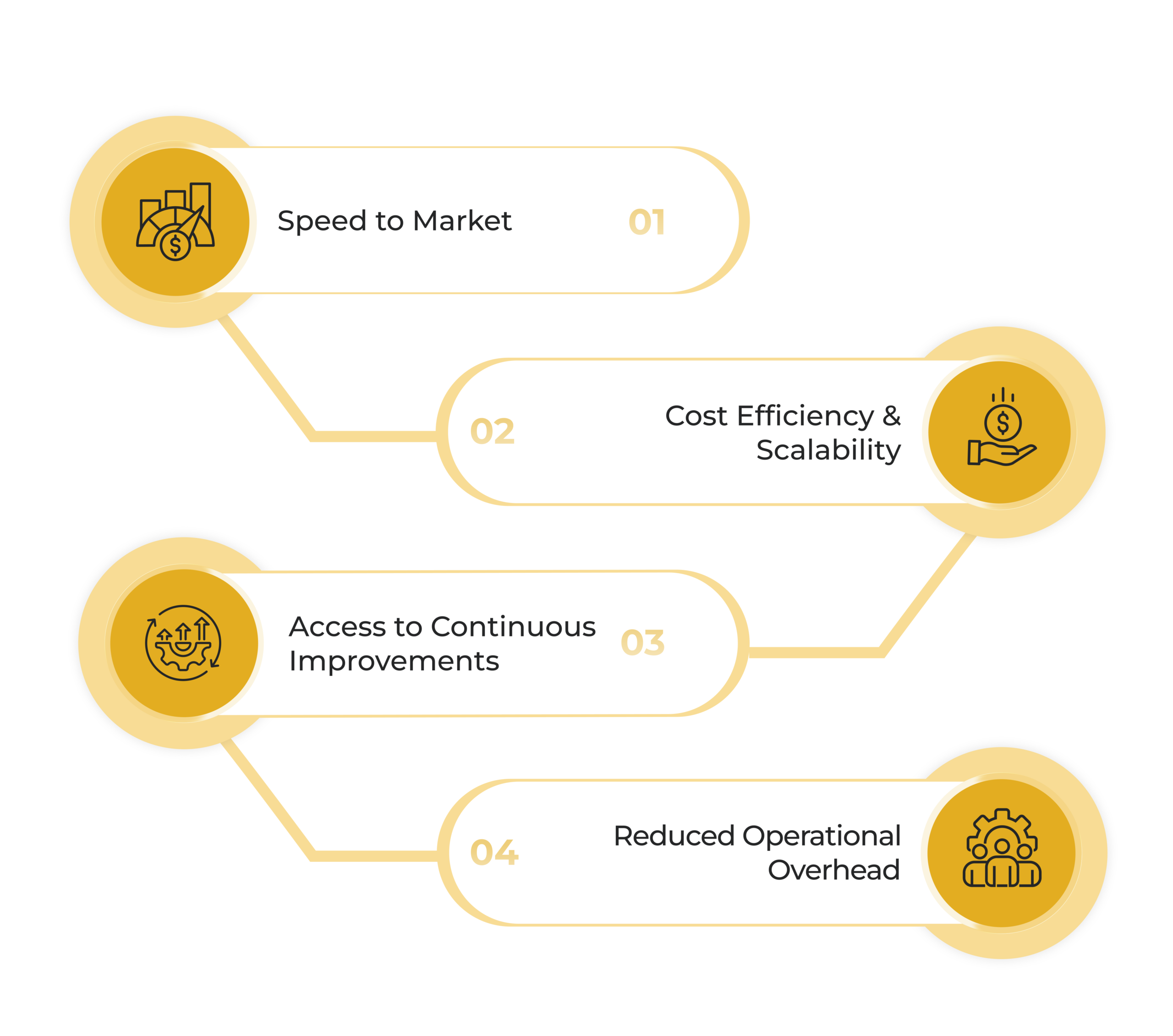
- Speed to Market: One of the most transformative advantages of LLMaaS is how dramatically it shortens development timelines. In 2026, a product team can integrate a sophisticated AI assistant, document summarizer, or code generation tool in days rather than years. API-first design means developers can prototype, test, and ship AI-powered features without waiting on model training pipelines or hardware procurement cycles.
- Cost Efficiency and Scalability: Training a frontier language model can cost tens of millions of dollars in compute alone, to say nothing of the research talent required. LLMaaS converts this massive capital expenditure into a predictable operational cost. Organizations pay per token or per API call, scaling seamlessly from a handful of test queries to millions of production requests. This model is especially valuable for smaller organizations that would otherwise be priced out of frontier AI entirely.
- Access to Continuous Improvements: When you self-host a model, its capabilities are frozen at the point of deployment. LLMaaS flips this equation. Providers continuously release improved model versions, safety updates, and new capabilities. Customers benefit automatically from these enhancements, often without changing a single line of integration code. In a field evolving as rapidly as AI, this is an enormous advantage.
- Reduced Operational Overhead: Running large models in production is notoriously complex. It demands deep expertise in distributed systems, GPU optimization, load balancing, and model quantization. LLMaaS offloads all of this to the provider. Engineering teams can focus on building product value rather than maintaining AI infrastructure, a significant advantage in competitive talent markets where ML infrastructure specialists are scarce and expensive.
Ready to Put LLMaaS to Work in Your Organization?
Our AI specialists help you identify the right use cases, design secure integrations, and build for scale from day one.
Request a ConsultationTop LLMaaS Use Cases Driving Adoption in 2026
LLMaaS has moved well beyond chatbots. Here are the use cases defining enterprise AI deployments this year:
- Intelligent Document Processing: Law firms, insurers, and financial institutions are using LLMaaS to extract, summarize, and cross-reference information across thousands of documents in minutes, work that once took teams of analysts days to complete.
- Agentic Workflows: In 2026, LLMs are not just answering questions; they are orchestrating multi-step tasks autonomously. From automatically triaging customer support tickets to managing procurement workflows, LLMaaS powers agents that reason, plan, and execute across enterprise systems.
- Code Generation and Developer Tools: Coding assistants embedded in IDEs, CI/CD pipelines, and code review platforms represent one of the highest-ROI applications. Teams report measurable gains in developer throughput, with LLMaaS-powered tools handling boilerplate, documentation, test generation, and debugging suggestions.
- Healthcare and Clinical Decision Support: Healthcare providers are deploying LLMaaS for clinical documentation, patient communication, and surfacing relevant research at the point of care. Specialist models, fine-tuned on medical corpora, are reducing administrative burden and improving information access for clinicians.
- Multilingual Customer Experience: Global enterprises are leveraging LLMaaS to deliver high-quality, real-time support across dozens of languages, collapsing the cost and complexity of managing separate localization workflows for each market.
Challenges and Considerations
Data Privacy and Security: Despite its advantages, LLMaaS is not without friction. Organizations adopting this model must navigate a set of significant challenges.
Every token sent to a third-party LLMaaS endpoint leaves your perimeter. For organizations handling PII, PHI, financial data, or trade secrets, this is not a theoretical concern. Key controls in 2026 include: enterprise-tier API agreements with zero-data-retention commitments, private deployment options (dedicated cloud instances or on-premises model serving), prompt-level PII scrubbing before API calls, and output scanning for inadvertent data leakage. Organizations with existing managed IT and security frameworks are significantly better positioned to implement these controls systematically rather than project by project.
Technical note: Zero data retention (ZDR) agreements
Enterprise ZDR agreements with major providers typically guarantee that prompt and completion data is not logged, stored, or used for model training. These agreements are available on enterprise plans and are a prerequisite for HIPAA-aligned and many GDPR-aligned deployments. Always verify what ‘no training on your data’ means contractually provider policies vary significantly in what they retain for abuse monitoring vs. model training.
Vendor Lock-In: Dependency on a single LLM provider creates exposure to pricing changes, deprecations, and capability shifts outside your control. Forward-thinking engineering teams are designing abstraction layers that allow model swapping without significant re-engineering, treating the underlying model as a replaceable component rather than a fixed dependency.
Reliability and Latency: Real-time applications are particularly sensitive to the variable latency inherent in shared cloud APIs. While providers have invested heavily in throughput and availability, organizations building customer-facing products must architect for graceful degradation, caching strategies, and appropriate fallback behaviors. Service outages, however rare, will occur, and production systems must be resilient to them.
Hallucinations and Output Quality: LLMs can generate confident-sounding but factually incorrect responses. For high-stakes applications in legal, medical, or financial contexts, output quality assurance is not optional. Best practices in 2026 include retrieval-augmented generation (RAG) architectures, human-in-the-loop validation for critical decisions, and robust evaluation pipelines that continuously measure model output quality against ground truth.
Token Cost Management at Production Scale:
The Road Ahead
The LLMaaS market in the second half of 2026 and into 2027 is converging on several developments that will further change what is architecturally possible and economically practical.
Edge inference running quantized model variants on-device or at network edge nodes is closing the latency and data sovereignty gap for real-time and privacy-sensitive applications. Specialized vertical models fine-tuned on domain corpora (medical, legal, financial, industrial) and available through standard API endpoints are beginning to outperform general-purpose frontier models on in-domain tasks at significantly lower cost. Regulatory compliance tooling automated GDPR/HIPAA audit logs, data lineage tracking for LLM outputs, explainability annotations is moving from enterprise custom builds to standard provider features.
The organizations that will extract disproportionate value from LLMaaS over the next two to three years are those investing now in the evaluation infrastructure, governance frameworks, and prompt engineering disciplines that turn raw API access into reliable, production-grade capability. AlphaBOLD’s AI and custom software teams help organizations build exactly that foundation not just the integration, but the architecture and governance that makes it durable.
Conclusion
LLM as a Service has structurally changed the economics and accessibility of AI adoption. The combination of dramatically lower token costs, extended context windows, multimodal inputs, structured output enforcement, and mature tooling for function calling and batch processing means that in 2026, the capability ceiling for what you can build on LLMaaS has risen substantially while the cost floor has dropped.
But the challenges have not disappeared they have shifted. The hard problems are no longer infrastructure provisioning or model training. They are data governance, output reliability at scale, cost management, and building the evaluation and governance disciplines that distinguish trustworthy AI products from impressive demos. Organizations that treat these as first-class engineering concerns from the start will build the AI capabilities that last.
Looking to Integrate LLMaaS Into Your Tech Stack?
AlphaBOLD helps businesses design, implement, and govern LLMaaS solutions that are secure, scalable, and production-ready.
Request a ConsultationFAQs
Data custody (who holds your prompts and completions), retention policies (how long provider logs persist), and compliance certifications (HIPAA BAA, SOC 2, ISO 27001) are the primary concerns. Enterprise-tier agreements with zero data retention commitments address most of these. Pairing LLMaaS with a managed IT and compliance framework that enforces consistent controls across all AI integrations significantly reduces risk surface.
LLMaaS is the delivery infrastructure API access to a language model. Agentic AI is an architectural pattern in which the LLM is given tools, a goal, and the ability to iteratively plan and execute multi-step actions without human intervention at each step. Agentic systems are built on LLMaaS APIs, specifically using function calling and tool use capabilities to enable the model to interact with external systems.
Design a model abstraction layer in your application architecture that decouples business logic from provider-specific APIs. Define internal interfaces for: sending a prompt and receiving a completion, streaming tokens, calling tools, and handling errors. Provider-specific implementation details live behind that interface. This allows model swapping — for cost, performance, or compliance reasons — without touching application code. Evaluate provider-agnostic frameworks like LangChain or LlamaIndex, but account for their own dependency management overhead.
Responsible production adoption includes: RAG or context grounding to reduce hallucination risk, structured output enforcement for typed application integrations, automated evaluation pipelines sampling production outputs against ground truth, per-request audit logging for compliance, prompt-level PII scrubbing before API calls, token spend attribution per feature, and semantic caching to reduce both cost and latency. AlphaBOLD’s generative AI practice embeds these controls into every engagement architecture.
A working prototype using an existing provider SDK can be built in a day. A production-hardened integration with proper error handling, retry logic, streaming, and structured outputs typically takes one to two sprints. A full production deployment with evaluation pipelines, cost governance, compliance controls, and monitoring takes four to eight weeks depending on complexity. AlphaBOLD’s custom software development teams accelerate this timeline by starting from proven integration patterns rather than building from scratch.
Explore Recent Blog Posts

Related Posts