
Multimodal AI Testing for Dynamics 365 Contact Center: Voice, Text, and Video Validation

Table of Contents
Introduction
Customer experience leaders are under pressure to deliver seamless service across every channel. In modern environments like Dynamics 365 Contact Center, a single customer journey can begin in chat, escalate to voice, and continue over email or video, all within the same case lifecycle. What appears unified to the customer is powered by multiple AI models working simultaneously behind the scenes.
As organizations embed AI into routing, sentiment detection, agent assistance, and case prioritization, the operational stakes increase. AI decisions now influence escalation paths, customer retention, compliance exposure, and agent productivity. Multimodal AI testing for Dynamics 365 Contact Center is therefore not simply a technical validation exercise. It is a governance and risk management requirement.
Without structured validation across voice, text, and video interactions, enterprises risk inconsistent intent detection, unstable sentiment scoring, and inaccurate agent recommendations. For CIOs and VP CX leaders investing in AI-powered contact centers, multimodal AI testing for Dynamics 365 provides the control framework needed to ensure reliability, accountability, and consistent customer experience across channels.
What is Multimodal AI in Dynamics 365 Contact Center?
Multimodal AI refers to AI systems that process and correlate multiple types of input at the same time. In Dynamics 365 Contact Center, this means analyzing spoken conversations, written communication, and, where applicable, video interactions within a single customer journey. Rather than treating each channel independently, the system continuously updates its understanding of customer intent and sentiment as interactions move across touchpoints.
In practice, multimodal AI within Dynamics 365 Contact Center typically includes:
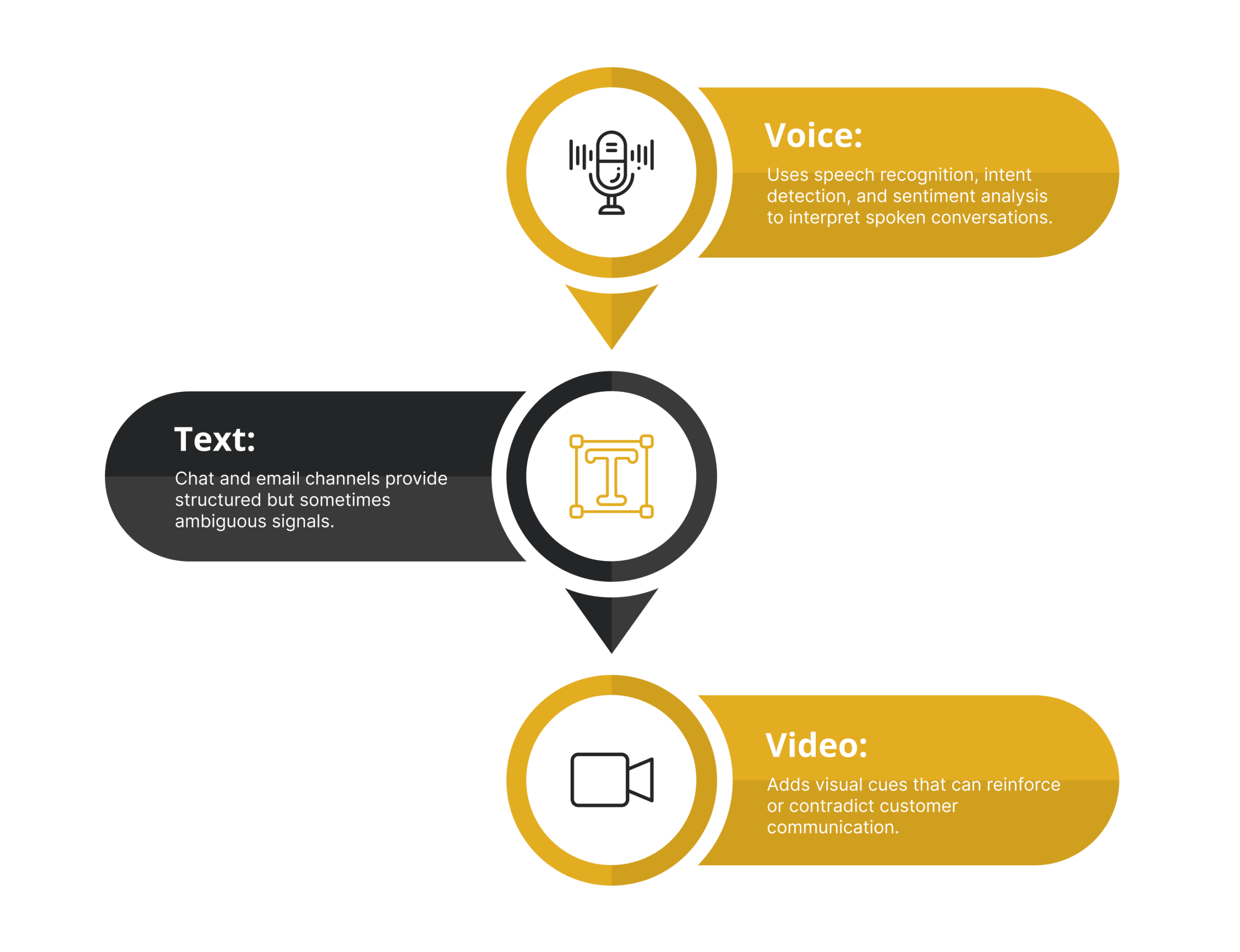
- Voice intelligence: Speech recognition, intent detection, and sentiment analysis that interpret tone, urgency, and context in real time.
- Text analysis: Chat and email processing that evaluates intent, topic shifts, and emotional signals within structured and unstructured messages.
- Video signal interpretation: Visual cues that may reinforce or contradict spoken language, adding another layer of contextual awareness where video engagement is enabled.
For enterprise leaders, the significance of multimodal AI is not technical complexity. It is decision impact. When AI correlates voice, text, and video signals together, it directly influences routing logic, escalation paths, agent recommendations, compliance tracking, and customer retention outcomes.
Industry research estimates the global multimodal AI market at approximately USD 3.85 billion in 2026, reflecting increasing enterprise investment in systems capable of integrating speech, text, and visual inputs within operational workflows. Multimodal capability is rapidly moving from isolated experimentation to production deployment across customer-facing platforms.
For organizations operating AI-powered contact centers, the priority is how to govern, validate, and monitor these systems to ensure consistent interpretation, reliable automation, and stable customer experience across channels.
Why AI-Driven Contact Centers Demand Cross-Channel Validation
Traditional QA models were designed for siloed systems. Chatbots were tested independently. Voice flows followed predefined IVR paths. Video interactions, when used, were reviewed separately.
AI-powered contact centers do not operate in silos.
In Dynamics 365 Contact Center, AI continuously interprets intent and sentiment across chat, voice, email, and video. These interpretations influence routing, escalation logic, and agent recommendations. When AI drives operational decisions, validation must reflect how signals interact across channels.
Without cross-channel validation, enterprises face three clear risks:
- Inconsistent interpretation: If sentiment and intent are evaluated differently across touchpoints, prioritization and routing decisions can become unstable.
- Escalation and compliance exposure: Misclassification of urgency or intent can delay escalations and weaken audit defensibility in regulated environments.
- Agent guidance errors at scale: AI recommendations depend on accurate context. Incomplete cross-channel correlation can produce conflicting or outdated guidance.
As automation expands, validating channels independently is no longer sufficient. Multimodal AI testing for Dynamics 365 ensures voice, text, and video inputs are assessed together, aligning AI behavior with real customer journeys. For enterprise leaders, this is not a testing enhancement. It is a control mechanism for protecting customer experience, operational consistency, and brand trust in AI-driven service environments.
What Are the Key Focus Areas for Multimodal AI Testing?
Multimodal AI testing evaluates how AI systems interpret and correlate voice, text, and video inputs within a single customer journey. The objective is not to validate each channel independently, but to confirm that signals are processed together in a way that supports accurate routing, escalation, and agent guidance.
Key focus areas include:
- Voice Intelligence Validation: Voice remains one of the most variable channels. Accents, speech speed, emotional shifts, and background noise can materially affect intent detection and sentiment scoring. Effective validation must include real-world conditions such as interrupted speech, hesitation, rising frustration, and incomplete statements. AI systems must demonstrate consistent interpretation under imperfect audio conditions.
- Text and Chat Interpretation: Text interactions introduce ambiguity. Short responses, sarcasm, mixed tone, and topic shifts can alter intent classification. Validation must ensure the AI maintains contextual continuity across extended conversations and transitions cleanly from automated bots to human agents without losing sentiment or intent history.
- Video Interaction Signals: Where video is enabled, visual cues add another interpretive layer. Facial expressions, body language, and environmental factors may reinforce or contradict spoken words. Testing must account for degraded video quality, missing visual data, and conflicting signals to ensure AI workflows remain stable and predictable.
Robust multimodal AI testing for Dynamics 365 ensures that combined inputs are interpreted coherently, reducing misclassification, minimizing escalation errors, and maintaining consistent decision logic across channels.
Strengthen AI Reliability Across Channels
Validate that AI in Dynamics 365 Contact Center consistently understands and reacts correctly across all communication channels.
Request a ConsultationWhere Does Multimodal Testing Matter Most in Cross-Channel Scenarios?
Multimodal testing becomes essential when customer interactions shift between channels and AI decisions must remain consistent. Real-world behavior rarely follows scripted paths. Conversations evolve, tone changes, and context builds over time.
The highest-risk scenarios include:
- Tone shifts across channels: A polite chat interaction may escalate into a frustrated voice call. AI must detect continuity in intent and urgency rather than resetting interpretation at each touchpoint.
- Conflicting contextual signals: Visual cues during video engagement may contradict spoken language. Without correlation, intent classification and sentiment scoring can become unstable.
- Decision continuity: Intent history, sentiment trends, and case context must persist across interactions to support accurate prioritization and routing.
- Agent guidance integrity: Recommendations must reflect the full cross-channel context, not a partial view of the most recent interaction.
These are the scenarios where single-channel validation fails and cross-channel governance becomes necessary.
How Can Multimodal Testing Be Scaled with Automation and AI?
The complexity of multimodal systems makes purely manual validation insufficient. Scaling validation requires a combination of structured testing frameworks and AI-assisted simulation.
Effective approaches include:
- Voice simulation models: Testing speech recognition under varied accents, pacing, emotional shifts, and background interference.
- Dynamic text generation: Simulating unpredictable chat behavior, sarcasm, topic changes, and incomplete inputs.
- Synthetic visual inputs: Introducing controlled video variations to test interpretation under degraded or conflicting visual conditions.
- Adaptive validation agents: Automated test agents that monitor AI outputs, detect anomalies, and adjust validation paths to improve coverage in evolving Dynamics 365 deployments.
For enterprise environments, automation is not about speed alone. It is about maintaining control as AI models scale and update.
How Do You Measure Quality Beyond Pass and Fail?
In AI-driven contact centers, quality cannot be reduced to binary outcomes. Validation must measure decision stability and contextual accuracy across channels.
Key performance indicators include:
- Intent continuity across interactions: Whether customer goals are accurately tracked as conversations move between chat, voice, and video.
- Sentiment consistency: Whether emotional interpretation remains stable as context evolves.
- Recommendation precision: Whether AI-generated guidance reflects the full customer journey.
- Escalation accuracy: Whether urgent cases are elevated appropriately without unnecessary handoffs.
The objective is not simply functional accuracy. It is operational consistency. AI should deliver the same level of understanding regardless of channel, ensuring predictable outcomes for customers and agents alike.
Deliver Consistent Cross-Channel AI Performance
Ensure Dynamics 365 Contact Center AI operates with reliable intent detection, stable sentiment scoring, and governed decision logic across voice, chat, and video.
Request a ConsultationConclusion
Multimodal AI is redefining how customer interactions are interpreted and acted upon in Dynamics 365 Contact Center. As AI evaluates voice, text, and video inputs simultaneously, it becomes embedded in routing decisions, escalation logic, and agent guidance workflows. These are not isolated technical functions. They directly influence customer retention, compliance posture, and operational performance.
As enterprises scale automation, the risk surface expands. Inconsistent sentiment scoring, fragmented intent tracking, or unstable cross-channel interpretation can introduce decision volatility at scale. Multimodal AI testing for Dynamics 365 provides a structured validation framework that ensures AI behavior remains consistent, explainable, and aligned with real customer journeys.
For CIOs and customer experience leaders, the priority is not simply deploying AI capabilities. It is governing how those capabilities perform across channels and over time. Organizations that invest in cross-channel validation strengthen decision integrity, reduce operational risk, and build confidence in AI-driven service environments.
AI-powered contact centers are evolving rapidly. Ensuring reliability across modalities is no longer optional. It is foundational to deliver predictable, accountable, and resilient customer experience.
FAQs
Multimodal AI testing helps ensure that routing decisions, sentiment scoring, and escalation logic remain consistent across voice, chat, and video interactions. By validating how AI correlates signals across channels, organizations reduce the risk of misclassification, delayed escalations, biased interpretations, and incorrect agent guidance. This strengthens operational stability, improves audit defensibility, and protects customer experience on a scale.
Enterprise-grade AI environments require structured validation, ongoing monitoring, and clear audit trails. Governance should include cross-channel intent tracking, sentiment stability checks, model performance monitoring, and documented escalation logic. Multimodal validation ensures that AI decisions remain explainable and consistent as models are updated or expanded across new communication channels.
Explore Recent Blog Posts