
Generative AI with Model Context Protocol (MCP) for ERP and CRM: What Enterprise Leaders Need to Know

Table of Contents
The Integration Problem That's Been Holding Enterprise AI Back
Here’s an uncomfortable truth about enterprise AI adoption: the models themselves were never the bottleneck. Since GPT-4 arrived in March 2023, organizations have had access to remarkably capable AI. Yet most enterprise deployments remain stuck in pilot mode. Impressive demos that never quite make it to production. The real culprit? Data isolation.
Generative AI with Model Context Protocol (MCP) highlights this gap clearly. Your AI assistant can write eloquent emails and summarize documents with ease. But ask it to check a customer’s order status in SAP, cross-reference their support history in Dynamics 365, and recommend a retention strategy based on account health? Suddenly you’re back to copying and pasting between screens like it’s 2005.
The reason is simple: every new data source has traditionally required its own custom integration work. Consider what this looks like in practice:
- Connecting five AI tools to ten enterprise systems means
50 bespoke integrations to build and maintain. - Each connection requires mapping, authentication, error handling, and ongoing updates.
- Even small changes in underlying systems often break multiple integrations.
AI remains stuck reasoning from partial, stale, or disconnected data.
Engineers call this the N×M problem, and it has quietly strangled enterprise AI ambitions for years.

What MCP Is and Why the Industry Is Aligning Behind It
In November 2024, Anthropic open-sourced the Model Context Protocol, or MCP for short. It is an architectural standard for connecting AI systems to external data sources and tools. The analogy that has stuck in the industry is “USB-C for AI”: a universal connector that lets any AI model plug into any data source through a consistent interface.
The architecture has three components:
- Hosts: the AI applications themselves
- Clients: embedded connectors that speak the MCP language
- Servers: lightweight programs that expose specific data sources or capabilities
When a user asks a question, the AI can:
- discover available tools at runtime
- request the data it needs
- take action through standardized protocols rather than custom code
All without the brittle, one-off integrations that dominated enterprise AI before MCP.

What makes this significant is not the technical design alone. It is how fast the industry has moved.
Within months of Anthropic’s announcement:
- OpenAI integrated MCP across ChatGPT and its Agents SDK
- Google DeepMind confirmed support for upcoming Gemini models in April 2025
- Microsoft built MCP servers into Dynamics 365 Sales, Customer Service, and Business Central
- SAP, Oracle, and Salesforce released their own implementations
- Community directories were tracking more than 16,000 MCP servers by mid-2025
This kind of cross-vendor alignment rarely happens this quickly in enterprise software. When competitors like Microsoft, Google, and OpenAI converge on a single standard within months, that signals something worth paying attention to.
See How MCP Transforms ERP and CRM Workflows
AI becomes valuable only when it can work with real operational data. Our team can walk you through practical MCP-enabled scenarios across sales, service, and finance, and help you understand what early adoption would look like inside your organization.
Request a DemoMCP in the ERP and CRM Landscape
Enterprise resource planning and customer relationship management systems sit at the heart of most organizations. They contain the transactional truth: who bought what, when, for how much, with what margin, and through which channel. They also represent decades of accumulated business logic, customization, and organizational knowledge embedded in workflows.
Historically, making AI genuinely useful against this data meant choosing between two imperfect approaches:
- Extract data into a warehouse and let AI query static snapshots, which sacrifices real-time accuracy and creates synchronization issues.
- Build custom integrations for each AI tool, each data source, and each use case, which burns engineering time and creates maintenance burdens that grow over time.
MCP offers a third path. Generative AI with Model Context Protocol (MCP) enables AI systems to work directly with ERP and CRM data through a consistent and standardized interface, without the brittle custom connections that slowed enterprise adoption.
A properly implemented MCP server exposes ERP or CRM data in a way that any MCP-compatible AI can consume. The AI discovers available capabilities at runtime, requests what it needs, and acts on the response. No bespoke glue code required.
Consider a practical scenario. A sales manager asks their AI assistant:
“Which of my open opportunities have had no customer contact in the past two weeks, and what is the latest support ticket status for each account?”
Without MCP, answering this requires:
- pre-built integrations between the AI, CRM, and support systems
- or manual lookups across multiple screens
With MCP servers connected to Dynamics 365 Sales and Customer Service, the AI can query both systems in real time, correlate the data, and surface actionable insights in a single response.
Microsoft’s implementation illustrates this pattern clearly. The Dynamics 365 Sales MCP server exposes tools for listing leads, qualifying leads, generating lead summaries, and managing email outreach. The Customer Service MCP server provides case retrieval, status updates, case notes, and email drafting. When combined with Business Central’s MCP capabilities for order and quote generation, the result is AI that can reason across sales, service, and finance without custom integration work.
SAP has taken a similar approach through SAP BTP, where organizations can deploy MCP servers aligned with SAP Level 2 and Level 3 business processes. Oracle has released MCP servers for database interactions, allowing AI to query enterprise data stores through natural language. One particularly clever community implementation, an OData to MCP bridge, automatically translates existing OData metadata into MCP tool definitions, making thousands of enterprise services AI-accessible with minimal additional development.
The pattern is clear. The major ERP and CRM vendors are treating MCP as core infrastructure, not an experimental add-on.
The Realistic Case for Adoption
Where are we in the adoption curve? The data paints a clear picture. McKinsey’s 2025 State of AI survey shows that 88 percent of organizations now use AI in at least one business function. Yet, most remain in pilot mode, and only a third have scaled AI across their entire enterprise. Deloitte expects 25 percent of companies using generative AI to launch agentic AI pilots in 2025, rising to 50 percent by 2027. Three quarters of organizations are still at the starting line.
This is the point where Generative AI with Model Context Protocol (MCP) becomes strategic rather than speculative. Organizations experimenting with agentic AI face a practical choice:
- build custom integrations that will need replacement as standards mature
- or adopt MCP early and grow with the ecosystem
The advantage shows up quickly:
- Cross-functional workflows become possible without large integration projects
- Context-aware assistance improves because AI accesses live data instead of stale snapshots
- Integration maintenance drops as MCP replaces N x M custom connections with standardized servers
Evaluate Your Readiness for MCP and Agentic AI
Most organizations are still in the piloting stage. A guided assessment can help you identify the use cases, governance structures, and integration points that deliver measurable value with MCP.
Request a DemoAn Evolving Standard: What Practitioners Are Learning
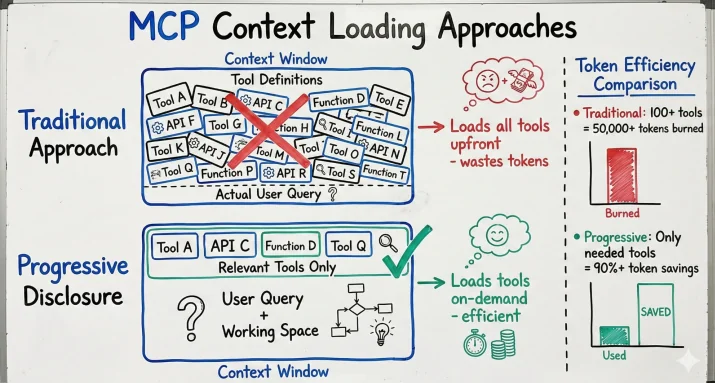
MCP is still young, and real-world use is revealing where patterns need to mature. The biggest focus right now is context efficiency. Many current implementations load all tool definitions upfront, which becomes costly when dozens of MCP servers are involved.
Anthropic’s work on code execution introduces “progressive disclosure,” a pattern where the AI loads only the necessary tools for the current task. It is similar to retrieval-augmented generation for tool discovery and significantly reduces token usage. Anthropic reports reductions of more than 90 percent in tool-heavy environments, along with improved accuracy due to lower cognitive load.
Similar patterns are emerging across the ecosystem. Cloudflare has published work on what it calls “Code Mode” for MCP interactions, and the community is refining best practices for tool organization, description clarity, and staged loading. As these approaches stabilize, Microsoft, SAP, and other enterprise vendors will likely fold them into their own implementations.
Security is another area of active development. The flexibility that makes Generative AI with Model Context Protocol (MCP) so powerful also requires careful governance when connecting AI to production systems. The MCP specification already recommends human-in-the-loop approval for sensitive operations, and enterprise teams are expanding this with audit logging, access controls, and approval workflows for regulated environments.
None of these points to problems with MCP’s architecture. It reflects the normal evolution of a new standard as adoption increases. REST APIs, OAuth, and GraphQL went through the same process. The rough edges only appear in production. The community then develops the patterns to smooth them out.
Organizations engaging with MCP now are not just early adopters. They are helping shape how the standard evolves and building institutional knowledge that will compound as usage patterns mature.
A Framework for Evaluation
Organizations considering MCP for ERP and CRM integration should approach it with clear eyes and practical expectations.
Start with use cases, not technology.
Identify workflows where AI access to multiple systems creates measurable value. Examples include:
- customer service scenarios that require CRM and order history correlation
- sales processes that depend on inventory, pricing, and opportunity data
- financial operations that benefit from connecting procurement, receiving, and accounts payable
Assess your vendor ecosystem.
Your path depends heavily on the platforms you run:
- Microsoft Dynamics 365 already ships with MCP support
- SAP and Oracle customers now have expanding options
- Salesforce is integrating MCP through Agentforce
Generative AI with Model Context Protocol (MCP) will surface different opportunities depending on how these systems are used across your organization.
Plan for governance from day one.
MCP increases what AI can do, which increases the need for proper controls. Define:
- which systems AI can access
- which actions require human approval
- how you will audit tool invocations
- who is responsible for reviewing new MCP servers
Organizations that treat MCP as a purely technical choice often end up retrofitting governance later.
Consider build versus consume.
For custom internal data sources, you will build MCP servers. SDKs exist for Python, TypeScript, Java, and C Sharp. For common enterprise platforms, prefer vendor-provided or community vetted servers so you benefit from shared standards rather than recreating custom integration at a new layer.
Expect the standard to evolve.
MCP is maturing quickly. Anthropic’s November 2025 update introduced task-based workflows for long-running operations, improved authentication, and better support for server-sent events. Organizations adopting now should architect with flexibility in mind.
Build a Realistic Roadmap for MCP Adoption
MCP is evolving quickly, and every vendor ecosystem is moving at a different pace. We can help you map out where MCP fits into your current ERP and CRM landscape and how to adopt it without disrupting existing systems.
Request a DemoWhat Comes Next
We’re at the beginning of agentic AI adoption in the enterprise. Not the middle. Not the end.
The strategic question isn’t whether AI will integrate deeply with ERP and CRM systems. That outcome is clear. The question is whether your organization will be ready with the infrastructure, governance, and institutional knowledge to benefit when that integration becomes routine. Or whether you’ll be building those foundations under competitive pressure while others are already extracting value.
MCP represents a promising path toward breaking down the data isolation that has constrained enterprise AI. It’s not a finished product. It’s an evolving standard that will strengthen through adoption and community contribution.
The major vendors have aligned behind it. The implementation patterns are maturing as production deployments surface what works and what needs refinement. The ecosystem continues to grow.
Organizations that engage thoughtfully now, understanding both the opportunity and the current state of the standard, will be best positioned for what comes next.
Explore Recent Blog Posts