
AI-Powered Predictive Maintenance in Manufacturing

Table of Contents
Introduction
This blog highlights the benefits of AI-driven predictive maintenance in manufacturing, including reduced downtime, improved equipment reliability, better maintenance planning, and more efficient use of resources.
Unexpected equipment failures can stop production, increase repair costs, and affect customer commitments. In today’s connected manufacturing environment, the impact can extend beyond a single facility, delaying orders, disrupting supplier timelines, and creating pressure across global supply chains. Traditional reactive and preventive maintenance methods often fall short because they either address issues after failures occur or follow fixed schedules that may not reflect actual equipment conditions.
AI-powered predictive maintenance uses sensor data, maintenance logs, and operational records to detect early warning signs before failures happen. This allows manufacturers to plan maintenance more effectively, improve asset performance, and build a more proactive maintenance strategy.
What is AI-driven Predictive Maintenance?
AI-driven predictive maintenance is a data-based approach that helps manufacturers identify equipment issues before they turn into failures. It uses real-time and historical data to understand how equipment is performing and when maintenance may be needed.
This usually includes:
- Sensor data from equipment, such as vibration, temperature, pressure, and energy use
- Machine logs that show operating patterns, errors, and performance changes
- Maintenance history, including past repairs, inspections, and part replacements
- Asset condition records that help teams understand current equipment health
- AI and machine learning models that detect anomalies and predict possible failures
- Time-series analysis that tracks equipment behavior over time
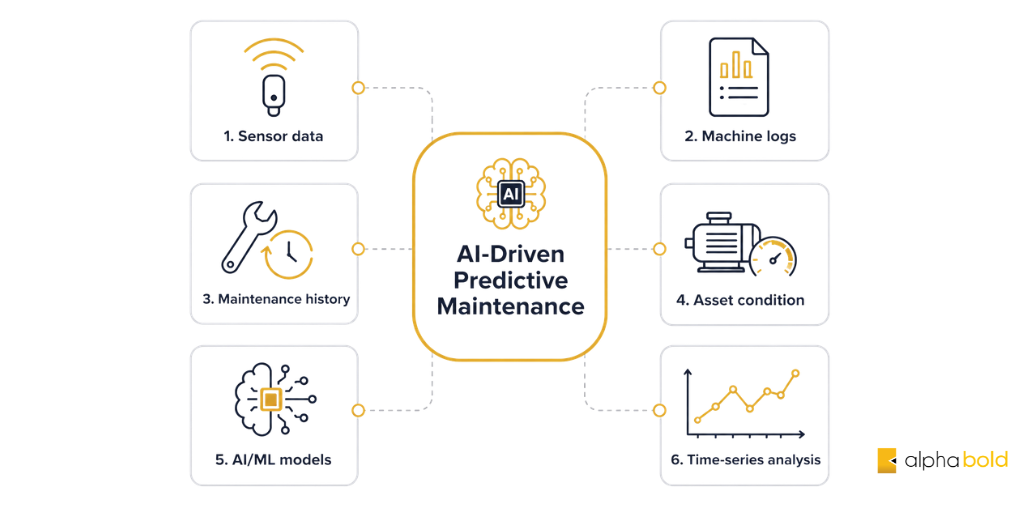
Instead of waiting for equipment to break down or following fixed maintenance schedules, AI-driven predictive maintenance helps teams service assets based on their actual condition. This makes maintenance planning more accurate, reduces unnecessary servicing, and helps manufacturers keep production running with fewer interruptions.
How is Generative AI Transforming Predictive Maintenance?
Previously, AI-driven predictive maintenance was limited to detecting equipment issues before they happened. Now, it is increasingly connected to the way maintenance teams work, plan, and make decisions.
With generative AI and large language models, manufacturers can make predictive maintenance systems easier to use. Instead of only showing alerts or dashboards, these tools can help teams understand what the data means and what action to take next.
For example, AI can help maintenance teams:
- Summarize machine logs, work orders, and past repair history
- Identify possible causes behind recurring equipment issues
- Turn technician notes into structured maintenance records
- Search manuals, asset records, and troubleshooting guides using natural language
- Recommend next steps based on asset condition and maintenance history
- Connect equipment alerts with work orders, parts availability, and production schedules
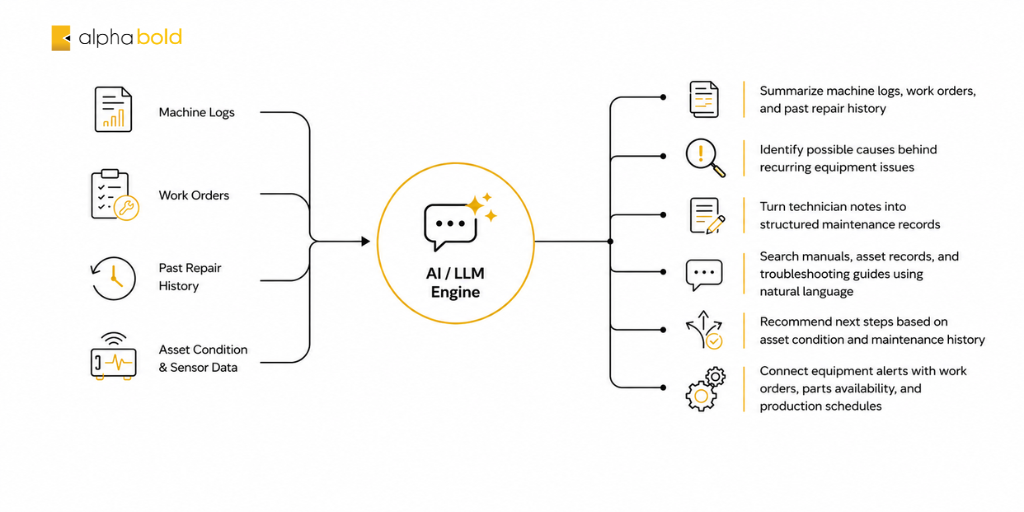
Industrial AI platforms are also supporting this shift. Tools like Palantir AIP, Microsoft Fabric, Siemens Senseye, and connected field service systems are helping manufacturers bring asset data, maintenance workflows, inventory, and operational planning into one connected view.
This matters because prediction alone is not enough. Manufacturers need systems that can explain the issue, support faster decisions, and help teams act before equipment problems affect production.
How Is Generative AI Improving Maintenance Workflows?
Generative AI is helping make AI-driven predictive maintenance more useful for technicians, planners, and operations teams. Instead of only showing alerts, it can summarize information, explain possible issues, and recommend the next step based on available equipment and maintenance data.
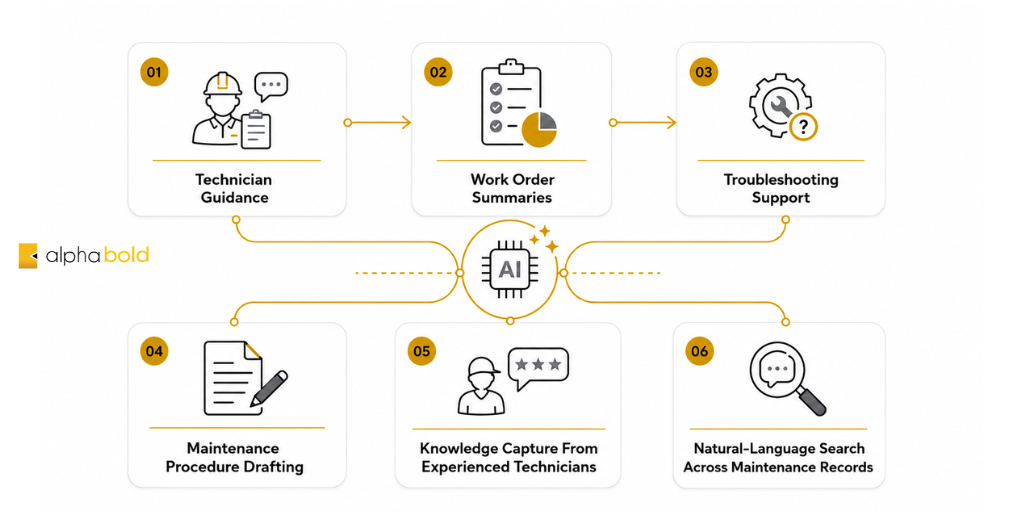
Technician Guidance
According to IBM, generative AI helps asset management teams with day-to-day maintenance workflows by creating content such as work orders and maintenance reports. For technicians, this means AI can support the work happening on the floor by organizing asset information, service history, and maintenance context into clearer guidance.
Work Order Summaries
Generative AI can summarize work orders, related activities, service history, priority, and recommended next steps. This helps maintenance teams review issues faster without searching through multiple records before they understand what has happened and what needs attention.
Troubleshooting Support
AI can also help technicians identify possible causes behind recurring equipment issues. IBM notes that natural language processing can read unstructured data, including maintenance logs, technician notes, work orders, and failure records, to surface patterns that may otherwise remain hidden.
Maintenance Procedure Drafting
Generative AI can help draft inspection steps, safety notes, repair instructions, and maintenance procedures. This is useful when manufacturers want to standardize maintenance work across assets, facilities, or shifts without relying only on informal knowledge.
Knowledge Capture From Experienced Technicians
Many manufacturers depend on experienced technicians who understand equipment behavior through years of hands-on work. McKinsey’s 2026 operations guidance notes that generative AI should be applied where it solves a business challenge, not treated as a technology upgrade alone. In maintenance, one of those challenges is capturing knowledge before it is lost and making it easier for teams to reuse.
Natural-Language Search Across Maintenance Records
Generative AI also makes it easier to search maintenance information using natural language. Instead of manually going through manuals, asset records, logs, and troubleshooting guides, technicians can ask questions such as what caused a similar issue before, which part was replaced last time, or what steps should be followed next.
Generative AI helps make predictive maintenance more practical because it turns data into guidance. For manufacturers, the goal is not just to know that a failure may happen. The goal is to understand the issue, plan the right response, and act before production is affected.
How Do IoT, Edge AI, And Real-Time Analytics Support Predictive Maintenance?
AI-driven predictive maintenance depends on how quickly and reliably manufacturers can collect, process, and use equipment data. This is where IoT sensors, edge AI, and real-time analytics become important.
IoT Sensors Collect Asset Data
IoT sensors collect asset data such as vibration, temperature, pressure, speed, energy use, and runtime. This data gives maintenance teams a continuous view of equipment condition instead of relying only on manual inspections or past service records.
Edge AI Processes Data Closer To The Machine
Edge AI helps process some of this data closer to the machine or production line. This is useful when teams need faster detection, local response, or continued visibility even when cloud connectivity is limited.
Real-Time Analytics Add Operational Context
Real-time analytics then helps teams identify issues faster and connect them with the right operational context. Platforms such as Microsoft Fabric can bring factory-floor data together with asset history, shift data, production schedules, and cost information. This gives teams a more complete view of what is happening and how maintenance decisions may affect operations.
AlphaBOLD’s work with a wearable alcohol-monitoring technology manufacturer shows how real-time monitoring solutions must be designed around practical constraints. In this case, the challenge was to support continuous monitoring without affecting battery life, user experience, or regulatory requirements. The same principle applies to predictive maintenance in manufacturing, where IoT and analytics systems must be reliable, scalable, and aligned with how operations actually work.
AlphaBOLD’s work with a wearable alcohol-monitoring technology manufacturer shows how real-time monitoring solutions must be designed around practical constraints. The solution needed to support continuous monitoring without affecting battery life, user experience, or regulatory requirements. The same principle applies to predictive maintenance in manufacturing, where IoT and analytics systems must be reliable, scalable, and aligned with operational realities.
Read full success story here.
Advanced Architecture Should Match Business Needs
However, not every manufacturer needs advanced 5G or edge architecture immediately. The right setup depends on:
- Asset criticality
- Latency requirements
- Plant layout and connectivity
- Data maturity
- Existing systems and integrations
- Scale of production operations
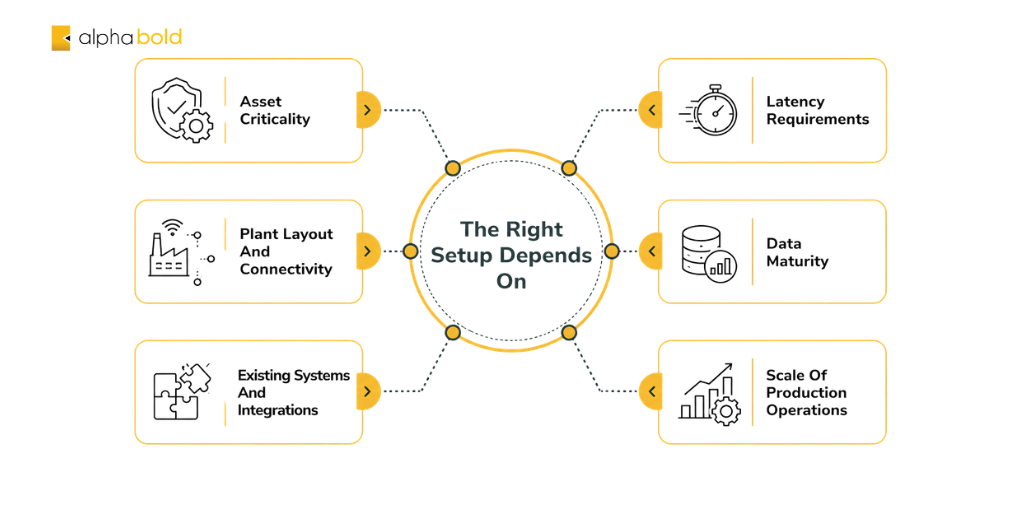
The goal is not to adopt every advanced technology at once. The goal is to build an architecture that matches the manufacturer’s maintenance needs, production risks, and ability to act on the insights generated.
How Does Predictive Maintenance Improve Spare Parts And Inventory Planning?
Predictive maintenance becomes more valuable when it is connected to supply chain and inventory workflows. Once teams know which assets are showing signs of wear or failure, they can plan not only the maintenance activity but also the parts, tools, and resources needed to complete the work.
Maintenance predictions can help manufacturers forecast parts demand more accurately. For example, if asset health data shows that a component is likely to need replacement soon, the maintenance team can check inventory, review lead times, and coordinate with procurement before the issue becomes urgent.
This is especially important when spare parts have long lead times, limited supplier availability, or high replacement costs. By connecting asset condition with inventory and procurement data, manufacturers can reduce emergency purchases, avoid last-minute delays, and improve maintenance readiness.
The goal is to make parts planning more proactive. Instead of waiting for a failure and then searching for the right component, teams can align maintenance schedules, parts availability, and production needs in advance.
Reduce Maintenance Costs And Prevent Unexpected Breakdowns
Let our AI experts help you with predictive maintenance solutions that deliver measurable results.
Request a ConsultationWhat Benefits Can Manufacturers Expect From AI-Driven Predictive Maintenance?
AI-driven predictive maintenance can help manufacturers improve reliability, planning, and operational control. However, the results depend on the quality of data, the assets selected, the systems connected, and how well teams use the insights in daily workflows.
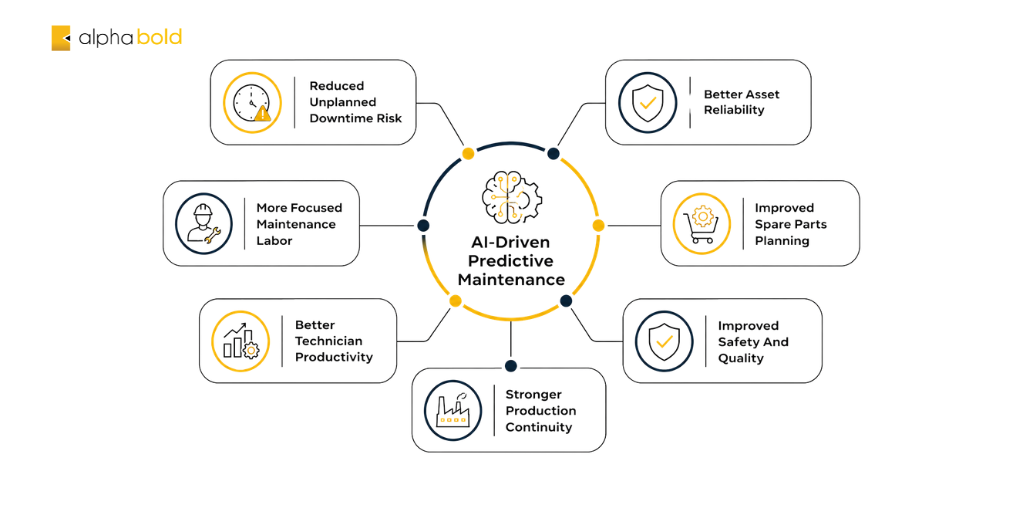
Reduced Unplanned Downtime Risk
By identifying early warning signs, predictive maintenance helps teams address equipment issues before they turn into major disruptions. This reduces the risk of unexpected failures affecting production schedules.
Better Asset Reliability
Predictive maintenance gives teams a clearer view of asset condition and performance trends. This helps manufacturers maintain critical equipment more effectively and improve long-term reliability.
More Focused Maintenance Labor
Instead of spending time on unnecessary checks or reacting to emergencies, maintenance teams can focus on assets that actually need attention. This improves the use of technician time and supports better planning.
Improved Spare Parts Planning
When maintenance predictions are connected to inventory and procurement data, teams can plan spare parts more effectively. This helps reduce emergency purchases and improves readiness for upcoming maintenance work.
Better Technician Productivity
Technicians can work faster when they have access to asset history, machine data, recommended actions, and relevant maintenance records. This reduces time spent searching for information and supports more consistent execution.
Improved Safety And Quality
Equipment issues can affect worker safety, product quality, and process consistency. Predictive maintenance helps teams detect risks earlier and address them before they create larger operational problems.
Stronger Production Continuity
When maintenance is planned around asset condition and production needs, manufacturers can reduce interruptions and keep operations moving more consistently. This supports better delivery performance and stronger customer commitments.
You may also like: 4 Key Steps for Business Leaders to Implement AI
What Challenges Should Manufacturers Plan For?
AI-driven predictive maintenance can create strong operational value, but implementation is not always simple. Manufacturers need the right data, connected systems, and internal readiness before predictive insights can turn into better maintenance decisions.
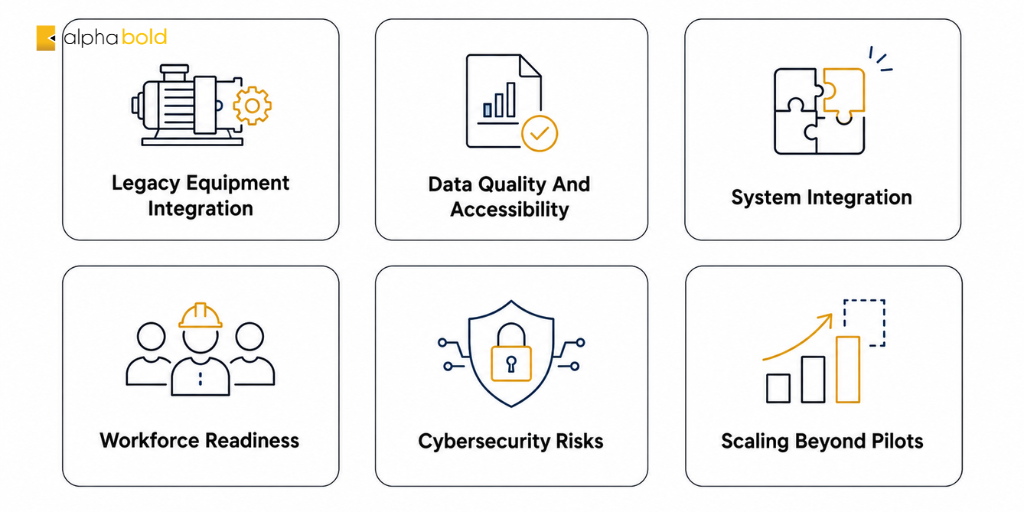
Legacy Equipment Integration
Many manufacturing facilities still rely on older machines that were not built to share real-time performance data. These assets may need sensors, connectivity, or custom integrations before they can support predictive maintenance. Instead of modernizing everything at once, manufacturers can start with critical equipment first and scale gradually.
Data Quality And Accessibility
Predictive maintenance depends on reliable data. If machine logs are incomplete, sensor data is inconsistent, or maintenance records are scattered across systems, AI models may produce weak or inaccurate insights. Manufacturers need clean asset data, consistent records, and connected systems to make predictions useful.
System Integration
Predictive maintenance works best when equipment data is connected to maintenance, inventory, ERP, analytics, and reporting systems. Without integration, teams may see the alert but still struggle to turn it into action. The goal is to connect insights with the workflows teams already use.
Workforce Readiness
Maintenance teams need to trust and understand the recommendations generated by AI. Technicians, planners, and supervisors should know what an alert means, how urgent it is, and what action should follow. Training and change management are important for adoption.
Cybersecurity Risks
As more machines, sensors, and systems become connected, manufacturers also increase their cybersecurity exposure. Predictive maintenance programs should include secure data flows, access controls, monitoring, and protection for operational technology environments.
Scaling Beyond Pilots
Many manufacturers can test predictive maintenance on one asset or production line, but scaling it across facilities is harder. To move beyond pilots, they need repeatable data models, clear ownership, governance, and measurable business outcomes.
Optimize Your Maintenance Strategy Today
Discover how advanced maintenance solutions can save costs, minimize downtime, and enhance equipment reliability. Let our experts guide you through implementing tailored solutions to meet your unique needs.
Request a ConsultationWhat Are Real-World Applications Of AI-Powered Predictive Maintenance?
AI-powered predictive maintenance is being applied across industries where equipment reliability affects production, safety, quality, and delivery timelines. According to IBM, organizations are using AI-driven predictive maintenance to monitor asset health, detect early warning signs, and move beyond traditional maintenance strategies.
Automotive Manufacturing
Automotive manufacturers rely on robotic arms, conveyors, presses, welding systems, and automated assembly lines, where even a short equipment issue can affect production flow.
Magna is one example of how AI is being applied in this environment. In 2026, Magna shared that it uses AI across several manufacturing areas, including vision inspection, predictive maintenance through condition-based monitoring, autonomous mobile robots, energy optimization, and factory orchestration. This shows how predictive maintenance is becoming part of a broader connected factory strategy, not a standalone tool.
Medical Device And High-Volume Manufacturing
Predictive maintenance is also useful in high-volume manufacturing environments where equipment reliability directly affects capacity, quality, and delivery.
Business Insider reported that Bausch + Lomb adopted AI software to help manufacturing workers monitor, test, and fix mechanical issues as the company expanded contact lens production. The system is designed to predict machinery issues before they arise and alert maintenance workers so they can diagnose and fix problems earlier.
Consumer Manufacturing
In consumer manufacturing, predictive maintenance can support production efficiency by reducing equipment-related interruptions and helping teams schedule work more effectively.
Prose, a custom shampoo and moisturizer company, uses AI algorithms for demand planning, product formulation, predictive maintenance for machines, and more efficient production scheduling. Business Insider reported that AI and automation now influence most of Prose’s production, showing how predictive maintenance can work alongside broader manufacturing automation.
Aerospace
In aerospace, predictive maintenance is especially important because equipment reliability, safety, and validation are closely connected.
A 2026 Business Insider article on NASA and aerospace digital twins notes that predictive maintenance is one of the common uses of AI and digital twin technology in the aerospace industry. Sensors can stream real-time data from aircraft or engines into a digital twin, allowing AI to update the model, generate predictions, and support human evaluation. The article also points to Airbus and Boeing as companies using AI and digital twin technology for predictive maintenance, product development, and simulation.
Energy And Heavy Industry
Energy and heavy industrial environments depend on equipment such as pipes, tanks, vessels, power assets, and production infrastructure. Failures in these environments can affect safety, uptime, and service reliability.
Business Insider reported that Gecko Robotics uses robots, sensors, and AI to inspect critical infrastructure such as dams, power plants, oil and gas facilities, pipes, tanks, and vessels. Its AI platform analyzes inspection data to detect corrosion, erosion, and cracking before failures occur, helping teams plan maintenance before problems escalate.
These examples show that predictive maintenance is not limited to one type of manufacturer. It is being used wherever asset reliability affects output, safety, quality, and continuity. However, the value depends on more than the AI model itself. Manufacturers need reliable data, connected systems, clear workflows, and teams that can act on the insights generated.
How Can AlphaBOLD Help Manufacturers Make Predictive Maintenance Operational?
Predictive maintenance creates value when it moves beyond dashboards and becomes part of day-to-day maintenance, production, and planning workflows. AlphaBOLD helps manufacturers turn predictive maintenance ideas into connected, production-ready workflows by:
- Assessing asset and data readiness to identify where predictive maintenance can create the most value
- Connecting IoT sensor data, machine logs, maintenance records, and operational data
- Building reliable data pipelines that support analytics, reporting, and AI-driven insights
- Using Microsoft Fabric, Azure, Power BI, Dynamics 365, and Copilot where they fit the business and technical requirements
- Integrating predictive insights with work orders, inventory, ERP, and reporting systems
- Supporting governance, adoption, security, and scale so predictive maintenance can move beyond pilot projects
With the right strategy and implementation approach, AlphaBOLD helps manufacturers turn equipment data into actionable maintenance workflows that improve reliability, planning, and operational control.
Ready to minimize downtime and maximize efficiency?
Let’s discuss how AI-powered predictive maintenance can transform your manufacturing operations. Request a consultation with our experts at AlphaBOLD and discover a solution customized to your needs.
Request a ConsultationConclusion
AI-driven predictive maintenance is no longer only about predicting equipment failure. It is becoming a connected maintenance approach that brings together asset data, machine logs, generative AI, IoT, real-time analytics, inventory planning, and enterprise workflows.
For manufacturers, the goal is not just to detect issues earlier. The goal is to turn equipment data into timely action, better planning, and more reliable production. This requires clean data, connected systems, user adoption, and an implementation strategy that fits the manufacturer’s assets, operations, and business priorities.
With the right approach, AI-driven predictive maintenance can help manufacturers reduce disruption, improve asset reliability, and make maintenance more proactive across the organization.
FAQs
The first step is to assess asset and data readiness. Manufacturers need to identify which equipment is most critical, what data is already available, where system gaps exist, and whether maintenance records are reliable enough to support predictive insights. This helps teams start with the right assets instead of trying to apply AI across every machine at once.
In most cases, yes, but the level of investment depends on the asset, plant environment, and business need. Some manufacturers may start with existing machine logs and maintenance history, while others may need IoT sensors, edge processing, or real-time analytics to monitor critical equipment more effectively. The right setup should match asset criticality, latency needs, data maturity, and operational goals.
AlphaBOLD helps manufacturers move from predictive maintenance planning to implementation by connecting asset data, IoT signals, analytics, and enterprise workflows. This can include building data pipelines, integrating predictive insights with ERP, inventory, work orders, and reporting systems, and using Microsoft technologies such as Fabric, Azure, Power BI, Dynamics 365, and Copilot where they fit the business and technical requirements.
Explore Recent Blog Posts