How to Integrate Generative AI into Your Existing Business Model Without Disrupting Operations

Table of Contents
Introduction
Generative AI is rapidly changing how organizations automate work, analyze data, and generate insights. For many business leaders, however, the challenge is not whether to adopt the technology but how to integrate generative AI into an existing business model without disrupting operations. Established processes, legacy systems, and organizational change risks often make AI adoption feel more complicated than the technology itself.
In practice, most initiatives that attempt to integrate generative AI fail for operational reasons rather than technical ones. Organizations deploy powerful tools but lack the supporting architecture around them. Success metrics remain undefined, governance frameworks are absent, employees receive generic training instead of role-specific guidance, and AI tools are added to technology stacks without deep integration into existing workflows.
Organizations that succeed treat AI adoption as an operational design challenge, not just a technology project. Integrating generative AI requires disciplined planning across processes, systems, governance, and workforce readiness.
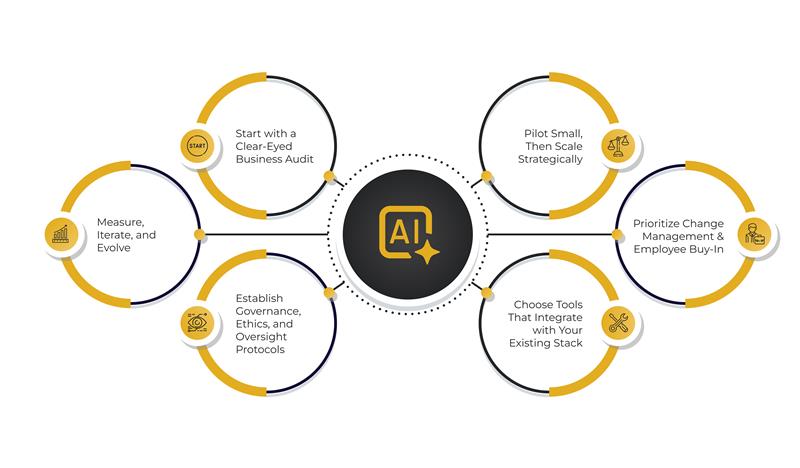
This guide outlines a practical six-step framework that helps organizations integrate generative AI into their business model while maintaining operational stability and measurable business outcomes.
Start with a Clear-Eyed Business Audit
Before organizations attempt to integrate generative AI into their operations, they need a clear understanding of how work currently flows through the business. AI adoption should begin with a focused audit that identifies where automation, faster analysis, or AI-assisted content generation could deliver measurable value.
Most early opportunities appear in workflows that are repetitive, time-consuming, or dependent on large volumes of information. These often include document processing, internal reporting, customer communications, and data analysis tasks that currently require significant manual effort.
A structured audit helps organizations move from general interest in AI to clearly defined use cases.
Key questions include:
- Which repetitive tasks consume the most employee hours?
- Where do emails, reports, or proposals create operational bottlenecks?
- Which processes rely on manual review of documents or support tickets?
- Where does slow data analysis delay decision-making?
The result becomes the organization’s initial roadmap for how to integrate generative AI into existing workflows while maintaining operational stability.
You may also like: The Complete Guide to Preparing Your Data for AI Success
Planning a Generative AI Initiative?
AlphaBOLD helps organizations move from AI strategy to production-grade implementation without disrupting existing operations.
Request a ConsultationPilot Small, Then Scale Strategically
Many organizations attempt to integrate generative AI through large, organization-wide deployments. This approach often creates confusion, resistance, and unclear results. A more effective strategy is to start with a controlled pilot.
Select one workflow or department where generative AI can address a clearly defined problem. Early pilots often focus on tasks such as drafting internal communications, summarizing documents, generating reports, or assisting with customer support responses. The goal of the pilot is not perfection but evidence.
Define success before launching the pilot. Establish a:
- specific problem statement,
- measurable outcome
- clear evaluation window.
For example, a marketing team might test whether generative AI can reduce the time required to produce campaign drafts, while a finance team might evaluate whether AI-assisted document summarization improves reporting speed.
Once results are measured and validated, organizations can expand the use case gradually across teams and workflows, reducing risk while building internal confidence in the technology.
Prioritize Change Management and Employee Buy-In
Technology rarely fails because of the technology itself. Most organizations struggle to integrate generative AI because employees are unclear about how the technology fits into their roles or workflows. Without clear communication and training, even well-designed AI initiatives can stall.
Leaders should frame generative AI as an operational assistant that reduces repetitive work and supports higher-value tasks. When employees understand how AI improves their day-to-day responsibilities, adoption becomes significantly easier.
Organizations integrating generative AI should focus on a few practical change management priorities:
- Communicate the purpose of AI adoption clearly. Explain which workflows will change and why the change is necessary.
- Provide role-specific training. Teams should learn how AI applies directly to their responsibilities.
- Establish internal AI champions. Early adopters can demonstrate effective use cases and support colleagues.
- Set expectations for human review. Employees should understand when AI outputs require validation.
Organizations that successfully integrate generative AI treat workforce readiness as part of the implementation strategy, not an afterthought.
The way AI adoption is communicated internally also matters. Messaging that frames AI as handling repetitive work so employees can focus on higher-value tasks is far more effective than language that suggests AI is replacing roles. Clear communication should explain which workflows will change, how responsibilities will evolve, and what support employees will receive during the transition.
Training should also be role-specific. Content teams need to understand how to review AI-generated drafts for brand voice and accuracy, finance teams must know when AI-generated analysis requires verification, and sales teams using CRM platforms such as Dynamics 365 should understand when AI-generated insights require human validation.
Choose Tools That Integrate with Your Existing Stack
Not all generative AI tools integrate smoothly with enterprise systems. When organizations integrate generative AI, the goal is to enhance existing workflows rather than introduce isolated tools that operate outside the business architecture.
Before selecting a platform, evaluate how well it connects with your existing systems, including CRM platforms, collaboration tools, data infrastructure, and operational applications.
Focus on a few critical integration factors:
- Integration depth: Confirm whether integrations support real-time data exchange or simple file exports.
- Data flows: Map what data enters the AI system, what outputs it produces, and how frequently those interactions occur.
- API and connector support: Prioritize tools with strong APIs or native connectors to existing platforms.
- Scalability: Ensure the platform can support higher usage volumes and additional AI workflows over time.
Organizations operating within the Microsoft ecosystem often benefit from native integration across Dynamics 365 and the Power Platform, which can reduce the need for custom engineering compared to standalone tools.
A well-designed integration architecture also allows organizations to update underlying AI models later without rebuilding core business workflows.
You may also like: The Complete Guide to Preparing Your Data for AI Success
Need Help Evaluating AI Tools for Your Stack?
AlphaBOLD helps organizations assess, architect, and implement AI solutions that fit their existing technology ecosystem.
Request a ConsultationEstablish Governance, Ethics, and Oversight Protocols
Organizations that integrate generative AI without governance expose themselves to operational, legal, and reputational risks. AI adoption should be supported by clear policies that define how systems are used, monitored, and reviewed.
Governance is not just a compliance exercise. It determines what data AI systems can access, who is accountable for outputs, and how issues are detected and corrected when failures occur.
A strong governance framework typically addresses several core areas:
- Data privacy: Define what information can and cannot be used in AI workflows.
- Output validation: Establish responsibility for reviewing AI-generated content before it reaches customers or decision-makers.
- Accuracy and brand standards: Ensure outputs align with organizational policies and messaging.
- Bias monitoring: Track and mitigate unintended bias in AI-assisted decisions.
- Usage and cost controls: Monitor token consumption and set usage thresholds.
- Model management: Define how model updates are evaluated before deployment.
- Incident response: Document procedures for handling inaccurate, harmful, or non-compliant outputs.
Most organizations begin with a human-in-the-loop (HITL) approach where AI assists but humans review outputs before they reach production systems.
Technical Note: Human-in-the-loop architecture
In HITL workflows, AI-generated outputs pass through a human review step before reaching end users or system records. For high-risk workflows such as customer communications, financial reporting, or compliance documentation, HITL should be mandatory until performance reliability is proven.
Measure, Iterate, and Evolve
Organizations that successfully integrate generative AI treat it as an evolving capability rather than a one-time deployment. Continuous measurement and refinement are essential to ensure AI systems deliver sustained operational value.
From the start, organizations should track both performance signals and business outcomes.
Key metrics often include:
- Leading indicators: response latency, output acceptance rates, and prompt revision frequency.
- Operational efficiency: time saved per task or workflow.
- Quality metrics: error rates or correction frequency.
- Business impact: customer satisfaction scores or improved decision speed.
Regular review cycles allow teams to evaluate what is working, where results are falling short, and which new capabilities should be incorporated as AI technology evolves.
Because AI models, APIs, and pricing structures change frequently, organizations should periodically reassess their AI architecture and vendor dependencies.
Usage analytics also provide valuable insights into how employees interact with AI tools. These signals often reveal opportunities to improve workflows and integrate generative AI more effectively across the organization.
Final Thoughts: Disruption Is Optional
Adopting generative AI does not require organizations to dismantle existing operations. In most cases, successful adoption comes from disciplined execution rather than rapid experimentation.
Organizations that succeed follow a consistent pattern. They audit workflows, run controlled pilots, prepare their workforce, select tools that align with their existing architecture, establish governance early, and continuously measure results.
This approach turns AI from a collection of isolated experiments into a structured operational capability that improves efficiency, decision-making, and organizational resilience.
As the technology evolves, the organizations that benefit most will be those that treat AI adoption as an ongoing capability rather than a one-time deployment.
If your organization is exploring how to integrate generative AI into its business model, AlphaBOLD helps leaders move from strategy to production-ready implementation.
You may also like: Choosing the Right Generative AI Solution for Your Business Needs
Ready to Build Your Generative AI Strategy?
AlphaBOLD partners with business and technology leaders to design AI adoption frameworks that deliver measurable results without operational disruption.
Request a ConsultationFrequently Asked Questions (FAQs)
The most consistent failure pattern is deploying AI into undefined workflows without clear success metrics, governance policies, or change management. The technology performs adequately; the adoption infrastructure around it does not. Organizations that establish measurable pilot criteria, role-specific training, and governance frameworks before deploying have substantially higher success rates.
Prioritize workflows that are high-volume, repetitive, clearly scoped, and low-risk if the output requires human correction. Document processing, internal content drafting, structured data extraction, and report generation consistently produce strong early results. Avoid piloting AI in workflows where errors have immediate compliance, legal, or customer-facing consequences before your governance and review processes are mature. Engaging an AI implementation partner to facilitate your process selection and pilot design significantly reduces the risk of choosing a use case that looks promising but has hidden complexity.
At minimum, you need: API access to your target LLM provider, a structured approach to managing prompt templates and versioning, a logging and monitoring layer that records inputs, outputs, latency, and token costs per request, and a data governance policy that specifies what can and cannot be sent to a third-party API. For more advanced deployments involving retrieval-augmented generation or fine-tuning, you additionally need a well-structured data engineering pipeline that can supply clean, current, correctly formatted data to the AI system on demand. The quality of your data infrastructure is frequently the binding constraint on AI output quality.
Start by classifying what data categories your AI workflows will process and mapping that against your regulatory obligations (GDPR, HIPAA, SOC 2, etc.). For most enterprise deployments, the right controls include enterprise-tier API agreements with zero-data-retention commitments, prompt-level PII scrubbing before API calls for workflows involving personal data, output scanning for unintended data leakage, and a managed IT framework that enforces these controls consistently across all AI integrations rather than relying on individual team compliance.
Well-scoped pilots with clear baseline metrics typically show measurable time and cost savings within four to eight weeks of deployment. Scaled production deployments across multiple workflows typically reach demonstrable ROI within three to six months. The primary factors that compress or extend this timeline are the quality of your pre-integration audit, the discipline of your pilot design, and the maturity of your underlying data infrastructure.
Generative AI refers to the base capability: models that generate text, images, code, or other content in response to inputs. Agentic AI refers to systems where the AI autonomously plans and executes multi-step workflows, calling tools and making decisions without human intervention at each step. For most organizations in early AI adoption, generative AI applications (drafting, summarization, classification, extraction) are the right starting point. Agentic systems add significant architectural complexity and governance requirements and are most appropriate for mature AI programs with established evaluation infrastructure already in place.
Explore Recent Blog Posts

Related Posts