MCP Servers for Enterprise AI: What to Consider Before Connecting Business Systems

Table of Contents
MCP servers give AI agents a standardized way to access business applications, data, and tools. For enterprise leaders, however, the protocol is only part of the decision. The real question is whether the connection has been designed with the right identity controls, permissions, approval rules, monitoring, and integration architecture.
Model Context Protocol, or MCP, can reduce the need to create a separate connection between every AI application and every business system. That makes it attractive to organizations that want AI agents to work with ERP, CRM, project management, document, support, and development platforms.
A successful enterprise implementation still requires more than installing a public server or exposing an API. Organizations must decide what the agent can access, which actions it can perform, how those actions will be approved, and how the complete workflow will be tested and monitored.
Why Are Enterprises Considering MCP Servers?
MCP servers help AI applications retrieve information and invoke approved tools through a consistent interface. Instead of asking employees to copy data from several applications into an AI assistant, an agent can request current information from connected systems and use it within the task.
For example, an agent could:
- Review open opportunities in CRM and related support cases
- Retrieve pending approvals from ERP
- Summarize delayed project tasks and supporting documents
- Search internal policies before answering an employee question
- Create a service ticket after collecting the required information
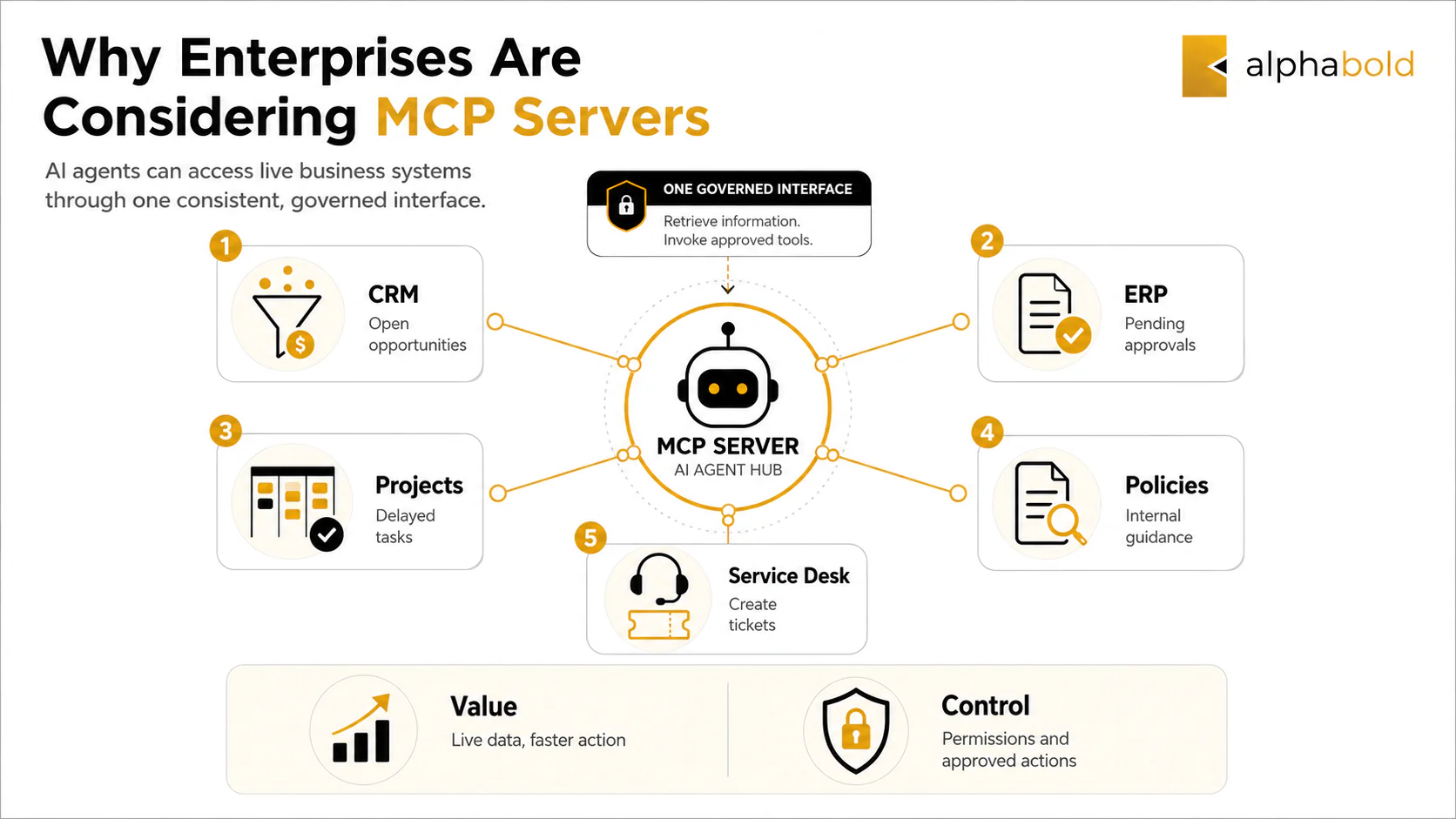
The value comes from connecting AI to the systems where work already happens. The risk comes from giving an AI application access to business data and actions without sufficient controls.
The official 2026 MCP roadmap identifies governance maturation and enterprise readiness as current priorities. This is an important signal for buyers: MCP is developing quickly, but production use still depends on deliberate architecture and governance decisions.
Where Does MCP Fit in an Enterprise AI Architecture?
An MCP server sits between an AI application and a connected system. It exposes defined resources, prompts, or tools that an MCP-compatible client can discover and call.
In an enterprise environment, that technical connection must operate within a wider architecture that includes:
- User and workload identity
- Role-based permissions
- APIs and integration services
- Data classification and privacy controls
- Approval workflows
- Logging and observability
- Error handling and recovery
- Security testing and lifecycle management
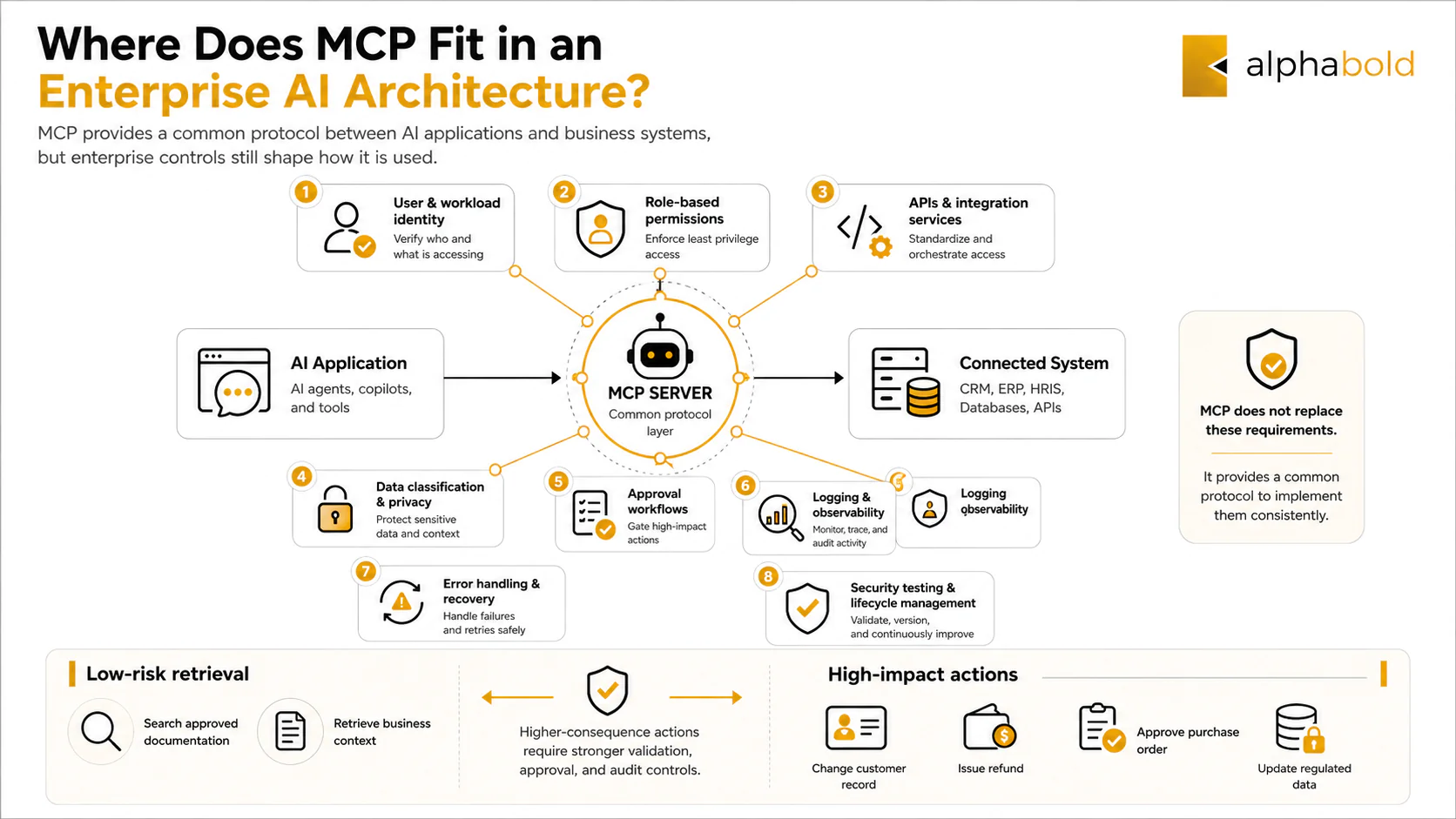
MCP does not remove these requirements. It gives teams a common protocol through which they can implement them.
A useful architecture also separates low-risk retrieval from high-impact actions. Searching approved documentation is different from changing a customer record, issuing a refund, approving a purchase order, or updating regulated data. The higher the consequence, the stronger the validation, approval, and audit requirements should be.
What Must Be Controlled Before AI Can Act Through MCP?
- Identity and Permission Boundaries: The agent should operate within defined user or service permissions. If an employee cannot view payroll records or approve a transaction directly, the MCP-enabled agent should not gain that authority on the employee’s behalf.
Teams must determine whose identity is passed to the connected system, whether access is evaluated for every request, and how credentials, tokens, and secrets are protected. - Tool Scope and Action Approval: Each MCP tool should have a clear purpose, accepted inputs, and restricted output. Broad tools that can query or modify large parts of a system create more risk than narrowly defined tools designed around a specific workflow.
Sensitive or irreversible actions may require user confirmation or human approval. Organizations should also define transaction limits, required fields, and conditions under which the agent must stop and escalate. - Data Exposure and Untrusted Content: An MCP server can return documents, records, messages, or content created outside the organization. That content may include incorrect information or instructions intended to manipulate an AI agent.
Implementations therefore need controls around which sources can be used, how retrieved content is treated, and what information can be returned to the user. Sensitive fields should be filtered before they enter the model context where appropriate. - Monitoring and Auditability: Organizations should be able to trace which agent called which tool, who initiated the request, what action was attempted, what system responded, and whether the operation succeeded.
This information supports troubleshooting, security review, compliance, and business accountability. It also helps teams identify repeated failures, slow dependencies, unexpected tool selection, and workflows that require stronger controls.
Unify your Data Landscape, Gain Actionable Insights, and Optimize your Marketing Strategy!
Identify which applications, data sources, workflows, and actions are suitable for MCP-enabled AI, and define the controls required before implementation begins.
Request a ConsultationShould You Use a Public or Custom MCP Server?
A public or vendor-supported MCP server may be appropriate when it covers the required platform, supports the necessary authentication model, and exposes tools that align with the intended workflow.
Before adopting one, teams should evaluate:
- Who developed and maintains the server
- Which data and actions it can access
- How authentication and authorization work
- Whether tool definitions are appropriately limited
- How updates and vulnerabilities are handled
- What logging and deployment options are available
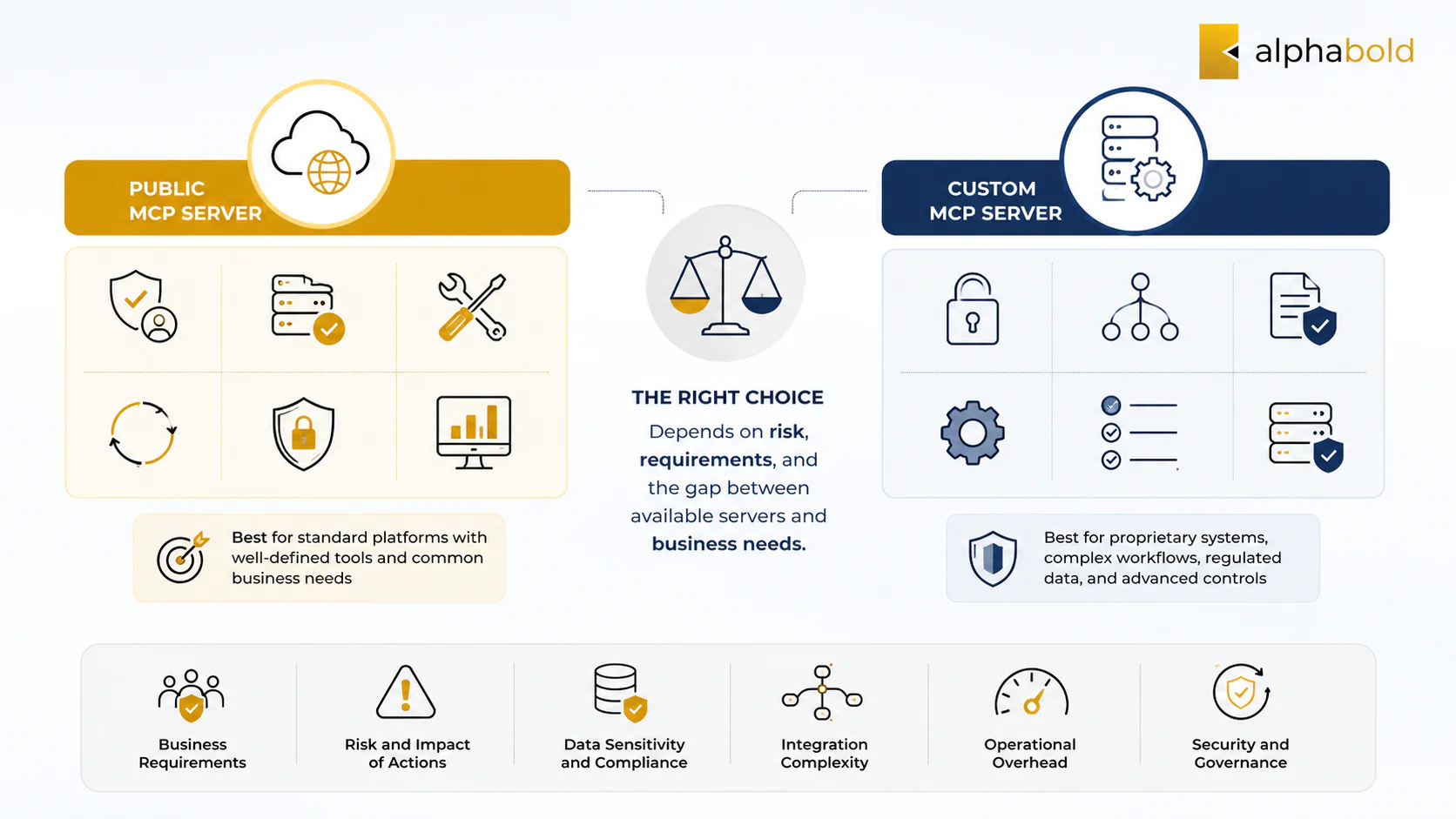
A custom MCP server is often more suitable when the organization uses proprietary applications, complex business rules, regulated data, or workflows spanning several systems. It also gives the company more control over permissions, validations, tool design, logging, and approval steps.
Custom does not automatically mean better. It introduces development, testing, hosting, maintenance, and security responsibilities. The right choice depends on the risk of the workflow and the gap between available servers and business requirements.
Does MCP Replace APIs, Middleware, or iPaaS?
MCP does not automatically replace the existing integration layer. APIs, middleware, event systems, and iPaaS platforms continue to move and synchronize data between applications through predictable business processes.
MCP serves a different purpose. It standardizes how an AI application discovers and uses approved tools and context. In many implementations, the MCP server calls an existing API or integration service rather than connecting directly to the underlying database.
This distinction affects architecture decisions:
- Use APIs or middleware for deterministic, high-volume system-to-system processes
- Use MCP when an AI agent must select tools or retrieve context dynamically
- Combine them when the MCP server should invoke an established, governed business service
- Avoid duplicating integration logic inside several MCP servers
An experienced implementation partner should assess the current architecture before recommending MCP. Adding another connection layer without understanding existing APIs, identity services, and data flows can create more complexity rather than less.
You may also like: AI Agents for ERP: Turn Enterprise Data Into Insights
What Should You Ask an MCP Implementation Partner?
A qualified partner should be able to explain how MCP will fit into your current environment, not only how to build a server.
Ask:
- Which use cases are appropriate for MCP, and which should remain conventional integrations?
- How will the agent inherit or enforce existing user permissions?
- Which actions will require confirmation or human approval?
- How will sensitive information be filtered or restricted?
- How will tool calls, failures, and business actions be logged?
- How will the solution handle unavailable services, timeouts, and invalid responses?
- How will public and custom servers be reviewed, tested, and updated?
- How will changes to models, prompts, systems, or MCP specifications affect the implementation?
Strong answers should connect the protocol to architecture, security, business rules, testing, and operations. A generic demonstration that retrieves data from one application is not sufficient evidence that the provider can support a production workflow.
How Can AlphaBOLD Support Enterprise MCP Implementation?
AlphaBOLD helps organizations determine where MCP fits within a broader AI and integration strategy. The work begins with the business process, systems, data, permissions, and risks involved, rather than with the protocol alone.
Depending on the requirement, AlphaBOLD can support:
- MCP use-case and architecture assessment
- Public server evaluation
- Custom MCP server development
- ERP, CRM, database, and API integration
- Identity and permission design
- Human approval and exception workflows
- AI agent and Microsoft Copilot implementation
- Functional, security, integration, and failure-path testing
- Monitoring, deployment, and ongoing optimization
AlphaBOLD’s current AI services focus on integrating AI into business-critical platforms, workflows, and data environments, while its Microsoft Copilot services cover agent development, enterprise data connections, governance, and security controls.
Explore AlphaBOLD’s Artificial Intelligence Consulting Services and Microsoft Copilot Consulting and AI Agent Deployment capabilities.
Connect AI to Business Systems with the Right Controls
Design MCP-enabled AI around your existing applications, identities, business rules, and governance requirements.
Talk to Our ExpertsConclusion
MCP servers can make enterprise AI integrations more consistent and reusable, but the protocol does not make an implementation secure or production-ready by itself.
Value depends on choosing the right use cases, enforcing permissions, limiting tools, protecting data, using existing integration services appropriately, and monitoring every important action. It also depends on deciding when a public server is sufficient and when the business needs a custom implementation.
Organizations evaluating MCP should look beyond connector availability. The stronger question is whether the architecture gives AI useful access without weakening the controls already protecting business systems.
FAQs
MCP supports structured connections, but security depends on the implementation. Organizations still need identity controls, restricted permissions, narrowly defined tools, approval workflows, logging, testing, and secure credential management.
No. MCP often works with existing APIs. It standardizes how AI applications discover and call tools, while APIs continue to provide the underlying system access and business logic.
A custom server may be appropriate when public options do not support the required application, authentication model, business rules, security controls, regulated data, or cross-system workflow.
Explore Recent Blog Posts