

Table of Contents
Introduction: Why Microsoft Fabric's ROI Matters
Microsoft Fabric’s ROI has emerged as a critical consideration for organizations evaluating their data analytics investments. In today’s data-driven business landscape, executives are constantly seeking solutions that not only streamline operations but also deliver substantial financial returns.
These challenges can amount to poor decision-making, cost inefficiencies, lack of innovation, and loss of competitive edge. Given the cut-throat competition in the current global market, data analysis has become essential to staying ahead of the trends and increasing a company’s profitability.
As you step into a future built on AI, IoT, and other technologies, you must create a business environment to support AI innovation, tech solutions, and an ROI of Microsoft Fabric that expands your profitability goals. If your data environment has organically grown over the years, and you are facing challenges with siloed and fragmented solutions like Power BI, Azure Data Factory, and other tools, Microsoft Fabric solutions can be a true-life saver with its long-term cost-saving benefits.
2025 Update: Microsoft Fabric Delivers 379% ROI
The 2024 Forrester Consulting Total Economic Impact™ (TEI) study confirms that Microsoft Fabric’s ROI reaches 379% over three years—making it one of the highest-returning data analytics investments available. This updated study, published in June 2024, provides enterprises with validated, quantifiable data on the financial impact of deploying Microsoft Fabric.
Key ROI Statistics from Forrester TEI Study:
| Metric | Value |
|---|---|
|
3-Year ROI |
379% |
|
Data Engineer Productivity Increase |
50% |
|
Business Analyst Productivity Increase |
40% |
|
Legacy System Consolidation Savings |
$779,000 (3 years) |
|
Reduction in Employee Attrition |
8% |
|
Eliminated Spend on Previous Solutions |
$1.1 million |
|
Customer Count (as of 2025) |
19,000+ organizations |
Microsoft Fabric is now Microsoft’s fastest-growing analytics platform in the company’s history, with over 19,000 customers adopting the unified data platform.
Drive Efficiency with Microsoft Fabric
Ready to revolutionize your data analytics approach with Microsoft Fabric consultants? Schedule a demo with our team and discover how Microsoft Fabric can streamline your processes and drive efficiency.
Request a DemoThe Forrester Total Economic Impact™ Study
Microsoft and Forrester Consulting collaborated to carry out a Total Economic Impact (TEI) analysis, which examined the possible return on investment (ROI) of Microsoft Fabric that businesses can achieve by implementing the platform. The study provides executives with insightful guidelines that make it possible to thoroughly assess the potential financial impact of Microsoft Fabric’s ROI on your company.
For organizations considering data engineering and advanced analytics, understanding the ROI of Microsoft Fabric is essential for making informed investment decisions.
Quantified Benefits of Microsoft Fabric:
- 50% Increase in Data Engineering Productivity: Data engineers and scientists experienced a 50% productivity increase after implementing Microsoft Fabric. The unified platform eliminates the need to switch between multiple tools, reducing context-switching overhead and enabling faster data pipeline development.
- 40% Increase in Business Analyst Productivity: Business analysts saw a 40% productivity boost due to streamlined access to data and self-service analytics capabilities. With Power BI integrated directly into Fabric, analysts can create reports and dashboards without waiting for IT support.
- $779,000 in Legacy System Savings: By eliminating outdated infrastructure and consolidating technologies, organizations saved up to $779,000 over three years. This directly contributes to Microsoft Fabric’s ROI by reducing the need for multiple servers, virtual machines, and analysis services.
- $1.1 Million in Eliminated Solution Costs: Organizations saved almost $1.1 million by reducing expenditures on existing analytics solutions. Once they implemented Fabric, most or all of the fees and administrative expenditures connected with previous analytics systems were eliminated.
2025 Feature Updates That Enhance Microsoft Fabric's ROI
Copilot and AI Capabilities Now Available for All Paid SKUs:
As of April 30, 2025, Microsoft removed the F64 SKU requirement for Copilot and AI capabilities. Customers using paid SKUs F2 and above now have access to:
- Copilot across all Fabric workloads (Data Factory, Data Engineering, Power BI)
- Fabric Data Agents for natural language data queries
- AI Functions for LLM-powered data transformations
- Integration with Microsoft Copilot
Fabric Data Agents: Agentic AI for Enterprise Data
Fabric data agents (formerly AI Skills) allow users to ask questions in natural language and get real-time answers from their enterprise data. These agents:
- Reason over and understand data in OneLake
- Respect row-level and table-level security rules
- Integrate with Azure AI Foundry and Microsoft 365 Copilot
- Support enterprise governance through Agentic AI solutions
OneLake Security: Centralized Data Access Control
Expanded Database Mirroring Support:
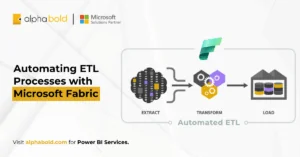
Microsoft is expanding mirroring support to include SQL Server, SQL Server 2025, Oracle, Dataverse, Cosmos DB, Azure PostgreSQL, and Snowflake enabling real-time replication and analytics across hybrid data estates. This enhances the ROI of Microsoft Fabric by eliminating complex ETL processes.
Common Data Challenges Microsoft Fabric Solves
To make data accessible and collaborate through the processing phase, developing teams frequently use complex procedures and interfaces that take hundreds of hours to develop and maintain. Here are some of the most common challenges that contribute to Microsoft Fabric’s ROI by providing solutions:
- Difficulty in Project and Task Collaboration: Individual team members sometimes utilize different tools that need unique login credentials with specialist programming or query language. This can often result in project delays, misunderstandings, and finger-pointing. Microsoft Fabric’s unified workspace eliminates these silos with Power Platform integration for seamless collaboration.
- Suboptimal Use of Employees’ Skills: Data professionals often spend more time on data manipulation than on generating insights. The TEI study found that Microsoft Fabric’s ROI includes giving staff more time to concentrate on insights rather than data manipulation, allowing them to use their abilities and grow.
- Delays in Access to Insights: Some interviewees said the scale of their organization’s data sets made it difficult to work in real time due to processing limitations. Microsoft Fabric’s OneLake architecture provides a single source of truth, dramatically reducing time-to-insight. Organizations leveraging Business Intelligence services see immediate improvements in data accessibility.
Accelerate your Business with Microsoft Fabric
Curious about the benefits of Microsoft Fabric for your organization? Schedule a demo today and let us demonstrate how Fabric can accelerate your journey to success.
Request a DemoUnquantified Benefits That Enhance ROI
Among the valuable benefits that have not been fully quantified for this research on Microsoft Fabric’s ROI are:
- Improved work satisfaction: Microsoft Fabric helped improve work satisfaction for all data professionals
- Increased team capacity and innovation: The SaaS-based UI encourages data workers of all skill levels to experiment and grow
- Enhanced alignment: Employees experienced improvements in the connection between data analytics’ commercial and technological aspects
- 8% reduction in employee attrition: Fabric contributes to employee satisfaction and retention
You may also like: Microsoft Fabric for Data Analytics
Industry ROI Comparison: Microsoft Fabric vs. Competitors
Recent studies show how Microsoft Fabric’s ROI compares to other major data platforms:
| Platform | 3-Year ROI | Payback Period | Source |
|---|---|---|---|
|
Microsoft Fabric |
379% |
<6 months |
Forrester 2024 |
|
Databricks Lakehouse |
482% |
4.1 months |
Nucleus Research |
|
Snowflake AI Data Cloud |
354% |
<6 months |
Forrester 2024 |
|
Informatica |
328% |
4.2 months |
Nucleus Research |
For organizations already invested in the Microsoft ecosystem, Microsoft Fabric’s ROI is particularly compelling due to seamless integration with existing tools and licensing structures. Learn more in our Microsoft Fabric vs. Databricks comparison
Frequently Asked Questions About Microsoft Fabric's ROI
According to the 2024 Forrester Total Economic Impact™ study, Microsoft Fabric delivers a 379% ROI over three years. This includes a 50% increase in data engineering productivity, 40% improvement in business analyst efficiency, $779,000 in legacy system savings, and $1.1 million in eliminated solution costs.
Most organizations achieve a positive ROI within 3-6 months of implementing Microsoft Fabric. The Forrester study indicates that all major analytics platforms, including Fabric, show triple-digit returns with sub-6-month payback periods.
The main cost savings include elimination of multiple tool licenses (Power BI, Azure Data Factory, Synapse all consolidated), reduced infrastructure costs through OneLake’s unified storage, decreased labor costs through productivity gains, and lower data integration expenses through built-in connectors and mirroring capabilities.
Microsoft Fabric uses capacity-based pricing, not per-user licensing. You purchase a capacity (starting from F2) that includes all services at no extra charge. Options include a free trial, Fabric Capacity Reservation (annual purchase for savings), and Pay-As-You-Go. Storage is billed separately on a per-gigabyte-per-month basis. Learn more at Power BI Pricing Guide.
As of April 30, 2025, Copilot and AI capabilities are available to ALL paid Fabric SKUs (F2 and above). Previously, these features required F64 or higher. This includes Copilot in notebooks, Power BI, Data Factory, and access to Fabric Data Agents.
Databricks Lakehouse shows a higher 3-year ROI (482%) according to Nucleus Research. However, Microsoft Fabric offers distinct advantages for organizations already using the Microsoft ecosystem, including seamless integration with Power BI, Microsoft 365, Dynamics 365, and Azure. The best choice depends on your existing infrastructure and specific use cases. See our detailed comparison at Microsoft Fabric vs. Databricks.
OneLake is Microsoft Fabric’s unified, multi-cloud data lake that stores all organizational data in a single location. It contributes to ROI by: eliminating data duplication costs, reducing data movement expenses, enabling real-time analytics without ETL overhead, and supporting cross-platform data access through shortcuts to AWS S3, Google Cloud Storage, and other sources.
Yes, the Forrester TEI study found an 8% reduction in employee attrition among organizations using Microsoft Fabric. The platform improves work satisfaction by allowing data professionals to focus on insights rather than data manipulation, and its intuitive SaaS-based interface encourages skill development and innovation.
Fabric Data Agents (formerly AI Skills) allow users to query enterprise data using natural language. They reason over OneLake data, respect security rules, and integrate with Microsoft 365 Copilot and Azure AI Foundry. This enables non-technical users to get insights independently, reducing dependency on data teams and accelerating decision-making.
AlphaBOLD’s Microsoft Fabric consulting services help organizations: assess current data architecture, plan capacity and licensing strategies, implement best practices for OneLake governance, automate ETL processes, and train teams on Copilot and AI features. We ensure you realize the full 379% ROI potential. Request a Fabric consultation
Has Microsoft Fabric Interested You? Talk to our Microsoft Fabric Consultants
Curious about what Microsoft Fabric's ROI can do for your business? Request your demo with AlphaBOLD today!
Request a DemoConclusion: Realizing Microsoft Fabric's ROI
Having explored Microsoft Fabric’s ROI throughout this blog, you’ve seen its significant, disruptive potential. This is not just theoretical; it’s a proven impact validated by Microsoft and Forrester Consulting’s Total Economic Impact study. The ROI of Microsoft Fabric extends beyond mere numbers, creating favorable conditions for increased productivity and profitability by addressing critical challenges such as cooperation barriers and data accessibility.
With the 2025 enhancements including Copilot for all SKUs, Fabric Data Agents, OneLake security, and expanded mirroring capabilities, Microsoft Fabric’s ROI continues to grow. The platform is now Microsoft’s fastest-growing analytics solution with over 19,000 customers.
Don’t miss the opportunity to join the ranks of businesses worldwide that have already realized the tremendous benefits of Microsoft Fabric’s ROI. It’s time to explore how Microsoft Fabric can transform your business operations. Request a demo today to discover the difference it can make for your enterprise.
Explore Recent Blog Posts