
Warehouse vs. Lakehouse: Choosing the Right Microsoft Fabric Solution

Table of Contents
Introduction
As data becomes increasingly central to business operations, organizations face a critical decision: choosing the right architecture for storing, managing, and analyzing vast amounts of data. Within Microsoft Fabric, two primary architectural paradigms stand out: Warehouses and Lakehouses. Each offers unique advantages tailored to specific use cases, but determining the best fit depends on your organization’s data needs, workloads, and overall business goals.
In this blog, we delve into the Microsoft Fabric Warehouse vs. Lakehouse comparison, exploring their key differences, ideal applications, and the robust support Microsoft Fabric provides for both options. We’ve also updated this guide for 2026 to reflect the latest platform changes, including Fabric IQ, AI agent capabilities, and expanded mirroring support that have meaningfully shifted how organizations approach this decision.
What is a Data Warehouse?
A Data Warehouse is a centralized, purpose-built repository specifically designed for storing and managing large volumes of structured data. Unlike general data storage solutions, a data warehouse is tailored for analytical processing, making it a cornerstone of business intelligence (BI) systems. It operates on the principle of storing clean, transformed, and pre-processed data; ensuring the information is well-organized and ready for querying and analysis. Data in a warehouse is typically collected from multiple sources, integrated into a unified format, and then structured according to a predefined schema. This enables users to run complex queries, generate detailed reports, and derive valuable insights efficiently.
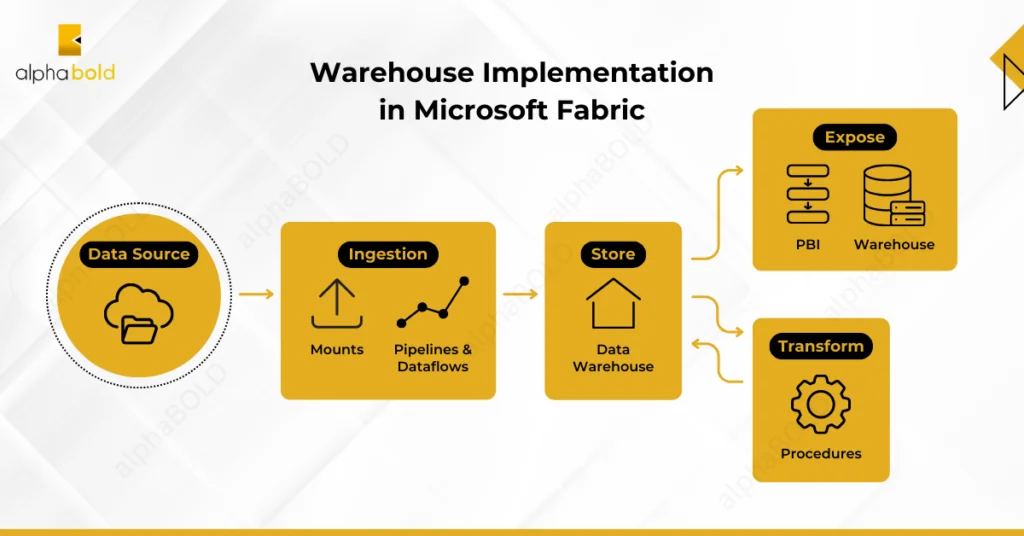
Data warehouses are engineered to handle read-intensive operations, which are optimized to perform rapid querying and data retrieval on vast datasets. As a result, they offer high-performance capabilities for large-scale analytics, providing businesses with the speed and scalability needed to make data-driven decisions.
Key Characteristics of a Data Warehouse:
- Schema-on-write: Data must be structured and cleaned before loading.
- Optimized for analytics: Query performance and speed are prioritized.
- ETL process: Involves Extract, Transform, Load (ETL), where data is pre-processed before being stored.
- High data quality: Data is often aggregated from multiple sources and stored in a consistent, structured format.
- MPP architecture: Microsoft Fabric Warehouse uses massively parallel processing (MPP) to automatically distribute queries across compute nodes, removing the need for manual capacity planning.
- 28,000+ organizations: As of early 2026, Fabric Warehouse has been adopted by over 28,000 organizations worldwide, reflecting its maturity as Microsoft’s primary enterprise analytics store.
Transform your data infrastructure with AlphaBOLD and Microsoft Fabric
From real-time analytics to machine learning, our tailored solutions empower your business to stay ahead. Request a personalized demo today and take the first step toward smarter, data-driven decisions.
Request a DemoWhat is a Lakehouse?
A Lakehouse is a modern data architecture that integrates the key benefits of both data lakes and data warehouses, offering a unified platform for managing various data types. It combines the flexibility and scalability of a data lake, designed to store vast amounts of raw, unstructured, and semi-structured data, with the robust analytics capabilities traditionally associated with a data warehouse. This allows organizations to work with everything from structured data like relational tables to unstructured formats such as images, videos, and log files — all within a single system.
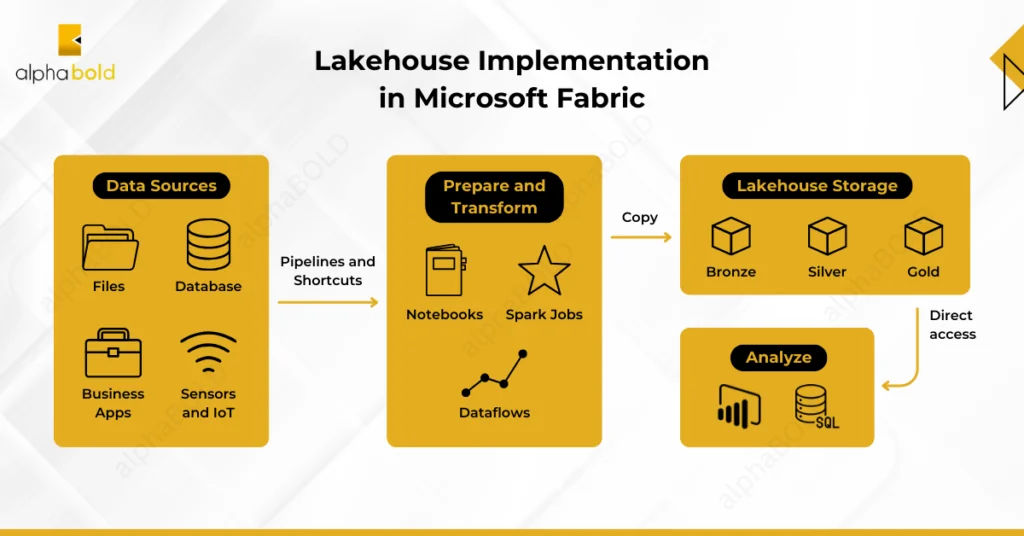
“Lakehouse” describes an architecture where data lake’s raw storage capabilities are combined with a data warehouse’s analytical and querying power. This architecture allows businesses to store data in its native format without rigid pre-processing, enabling efficient, high-performance analytics. The Lakehouse is cost-effective, offering scalable and low-cost storage, and it supports a variety of workloads, from real-time analytics and machine learning to traditional business intelligence. By merging the strengths of both systems, a Lakehouse provides an adaptable solution for handling modern data challenges while delivering the performance needed for data-driven decision-making. In 2025 and 2026, the amount of data stored in Microsoft Fabric’s OneLake has increased by more than six times year-over-year, reflecting rapid enterprise adoption and confirming the Lakehouse as the default starting point for most new Fabric deployments.
Suppose you lead an organization that relies heavily on data analysis or you are interested in learning about Microsoft Fabric’s ROI. In that case, this blog is for you: Microsoft Fabric’s ROI: Cost-Saving Features and Benefits.
Key Characteristics of a Lakehouse:
- Schema-on-read: Data can be loaded in raw format and structured later, allowing for greater flexibility.
- Supports multiple data types: Structured (tables) and unstructured (images, videos, logs) data can be stored and analyzed.
- Unified architecture: Combines storage and processing in a single platform.
- Flexible analytics: Allows real-time data processing, machine learning, and advanced analytics.
- Delta Parquet foundation: All Lakehouse data is stored in Delta Parquet format, enabling high-performance analytics across Spark, T-SQL, and Direct Lake Power BI — without duplication.
- Copilot-ready by default: As of April 2025, Copilot and AI capabilities are available to all paid Fabric SKUs (F2 and above), making Lakehouse data immediately accessible to AI-driven workflows.
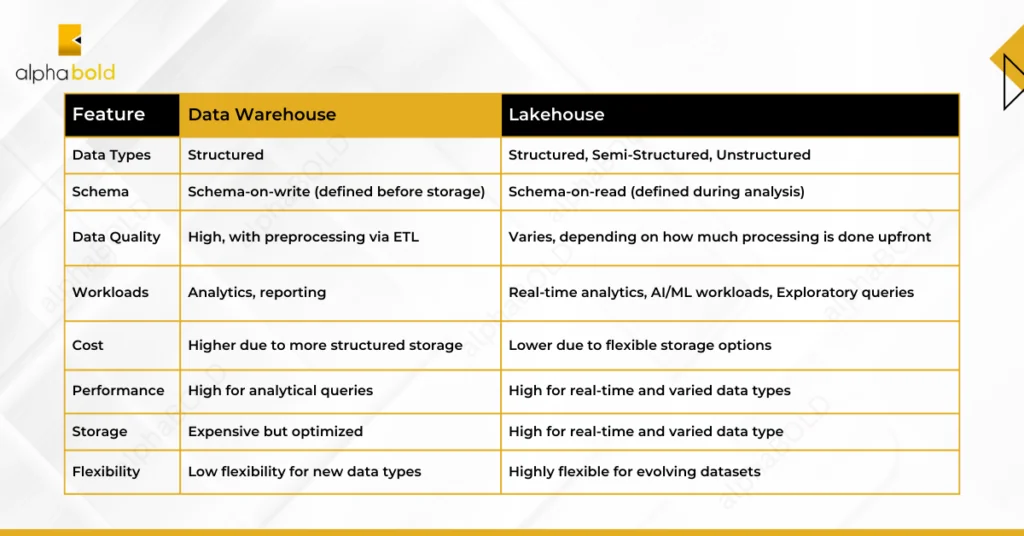
Microsoft Fabric Warehouse vs. Lakehouse: A Feature Comparison
Still Confused Between Microsoft Fabric Warehouse Vs. Lakehouse?
AlphaBOLD's Microsoft Fabric solutions ensure you don’t have to compromise. Request a demo today to discover how we can align your data architecture with your unique business objectives.
Request a DemoMicrosoft Fabric Warehouse vs. Lakehouse: Use Cases
1- When to Choose a Data Warehouse:
- Your organization focuses primarily on business intelligence and reporting.
- Data is highly structured, and query performance is critical.
- You require data quality control and consistent formats.
- You need unified role-based access control that enforces permissions consistently across all compute engines.
Example: A retail business analyzing historical sales trends and generating detailed BI reports.
2- When to Choose a Lakehouse:
- You must work with structured and unstructured data, such as logs, images, or IoT data.
- Your workloads include machine learning, real-time analytics, or streaming data.
- Flexibility is important; you do not want to pre-process all data before analysis.
- You want to deploy Fabric Data Agents that allow business users to query data in plain English without writing SQL or DAX.
- Your organization operates a multi-cloud estate and needs shortcuts to Amazon S3 or Google Cloud Storage without data migration.
Example: A media company analyzing user behavior patterns using structured data (clickstream) and unstructured data (video logs).
What’s New in 2026: Microsoft Fabric Warehouse and Lakehouse Updates
This section is new for 2026. It covers the most impactful platform changes that affect how you should evaluate and deploy Fabric Warehouse and Lakehouse architectures today.
Fabric Warehouse: Key 2026 Updates
Microsoft has continued to invest heavily in the Fabric Warehouse experience. Organizations evaluating the warehouse path should be aware of the following developments:
Direct Lakehouse File Querying:
Fabric Warehouse now supports direct ingestion and querying of files stored in OneLake Lakehouse folders using familiar T-SQL syntax. You can load CSV and Parquet files directly into Warehouse tables, or run ad-hoc queries against Lakehouse files using OPENROWSET(BULK) — without configuring Spark, staging storage, or complex IAM. This significantly reduces the operational gap between the two architectures.
Expanded Mirroring Support:
Microsoft has expanded database mirroring to include SQL Server 2025, Oracle, Dataverse, Azure PostgreSQL, Snowflake, and Cosmos DB. For organizations with heterogeneous data estates, this means Fabric Warehouse can now serve as a near-real-time analytics layer over existing transactional systems without complex ETL pipelines.
Unified Security Model:
OneLake Security (currently in preview, expected GA in 2026) introduces a centralized role-based access model where permissions are set once and automatically enforced across Spark notebooks, SQL endpoints, Excel Online, and Direct Lake Power BI semantic models. This eliminates the security inconsistency that previously made governed warehouse deployments more complex to manage.
Fabric Lakehouse: Key 2026 Updates
Fabric IQ: Semantic Layer for the Enterprise
One of the most significant 2026 additions to the Fabric platform is IQ (currently in preview), a new workload for unifying business semantics across data, models, and systems. IQ includes ontologies, plans, Fabric Graph, and data agents, enabling consistent metrics, reusable definitions, and context-aware automation across the entire Fabric platform. For Lakehouse deployments, IQ ensures that the same metric definitions used in Power BI reports are enforced when data agents query the Lakehouse directly.
Fabric Data Agents on OneLake
Fabric Data Agents allow users to interact with OneLake data in plain English. Instead of writing SQL or DAX, analysts can ask questions and receive validated, governed answers drawn from Lakehouse tables. These agents integrate with Copilot Studio, Microsoft Teams, and Azure AI Foundry, enabling a self-service analytics experience without compromising data governance.
Ready to Modernize Your Data Architecture for 2026?
AlphaBOLD’s certified Microsoft Fabric consultants can assess your current environment and design a Warehouse or Lakehouse implementation that meets your AI, governance, and analytics goals. Get started with a scoping call today.
Request a DemoAI-Readiness: How Copilot and Fabric IQ Change the Equation
This section is new for 2026. AI readiness has become a primary evaluation criterion when choosing between Fabric Warehouse and Lakehouse, and the two architectures now offer meaningfully different AI integration paths.
Prior to 2025, Copilot and AI features in Microsoft Fabric were restricted to F64 SKUs and above, limiting access to large enterprises. Since April 2025, Copilot capabilities are available to all paid Fabric SKUs starting at F2. This makes AI-readiness a relevant consideration at virtually every organizational scale.
Warehouse + AI: Governed Analytics for Structured Data
In a Fabric Warehouse deployment, AI integration primarily operates through the semantic layer. Power BI Copilot can generate DAX queries from natural language prompts, allowing business users to explore structured data without SQL expertise. Copilot is also embedded in the SQL editor, assisting data engineers with query generation, optimization suggestions, and inline code documentation.
For organizations that require explainable, auditable AI outputs — such as those in finance, healthcare, or regulated industries — the Warehouse’s structured schema and unified governance model makes it easier to trace how a metric or insight was derived.
Lakehouse + AI: Flexible Foundation for Machine Learning
The Lakehouse architecture is better suited to organizations building or operationalizing machine learning models. Because raw and semi-structured data can be stored and accessed directly, data scientists can work with the full data estate without waiting for transformation pipelines to deliver clean warehouse copies.
Fabric Data Agents, built on top of OneLake, allow non-technical users to query Lakehouse data in conversational language. These agents connect to Copilot Studio and Microsoft Teams, meaning insights from the Lakehouse can be surfaced directly in business workflows without requiring any SQL or BI expertise from the end user.
Which Architecture Is More AI-Ready?
Neither architecture is inherently more AI-ready; the decision depends on AI use case type. The table below summarizes the distinction:
| AI Use Case | Best Architecture | Why |
|---|---|---|
|
Copilot for BI reports |
Warehouse |
Structured schema enables reliable DAX/SQL generation |
|
ML model training |
Lakehouse |
Raw data access without ETL dependencies |
|
NL data querying (agents) |
Lakehouse |
Fabric Data Agents operate natively on OneLake |
|
Governed metric definitions |
Warehouse + IQ |
Fabric IQ enforces semantic consistency across engines |
|
Real-time AI scoring |
Lakehouse |
Spark integration with ML frameworks and streaming data |
Let AlphaBOLD Help You Build an AI-Ready Data Architecture
Whether you’re building a governed Warehouse for Copilot-powered BI or a flexible Lakehouse for machine learning and data agents, AlphaBOLD’s Microsoft Fabric experts can design and implement the right solution for your organization.
Talk to a Microsoft Fabric ExpertMicrosoft Fabric Support for Both Architectures
Microsoft Fabric is a unified analytics platform designed to manage both warehouse and Lakehouse architectures. It supports:
- Synapse Data Warehouse: For users who need a high-performance data warehouse for structured, transactional data.
- Lakehouse architecture: Via OneLake and Delta Lake, offering scalable, flexible data storage for structured and unstructured data.
- Fabric IQ: A new workload that unifies business semantics across both architectures, enabling consistent metrics and context-aware automation.
- Real-Time Intelligence: Supports streaming data ingestion from IoT devices, event hubs, and APIs — writing directly to OneLake for immediate Lakehouse availability.
Conclusion: Microsoft Fabric Warehouse vs. Lakehouse
Choosing between Microsoft Fabric Warehouse vs. Lakehouse depends mainly on the type of data you work with and the nature of your workload. If you need to handle large volumes of structured data and prioritize performance for analytics, a Data Warehouse might be your best bet. However, a Lakehouse provides the flexibility and scalability you need if your data is varied and your use cases extend beyond traditional BI.
In 2026, both architectures are more capable and AI-integrated than ever before. New features like direct Lakehouse file querying from the Warehouse, expanded mirroring, Fabric IQ, and Copilot availability at all paid SKUs have blurred some of the traditional boundaries between the two. For many organizations, the right answer will involve deploying both — a structured Warehouse for governed BI reporting and a Lakehouse for exploratory analytics, data science, and agent-based workflows.
With Microsoft Fabric, you can implement both architectures and switch between them as your data needs evolve, ensuring your data infrastructure can support your business goals today and in the future. As a certified Microsoft Solutions Provider, AlphaBOLD can help you assess your data architecture needs and guide you in selecting and implementing the right Microsoft Fabric solution to support your long-term data strategy.
Explore Recent Blog Posts