I did not expect to be thinking about ontologies again.
Back in 2009, my final year project was built around them. Ontologies are the formal way of defining concepts, relationships, and meaning so that systems/machines can reason about the world consistently. It felt like an academic idea at the time. Interesting, but niche. Something that lived in research papers and university labs.
Sixteen years later, it turns out the business world has been quietly suffering from the exact problem ontologies were designed to solve.
For years, companies had one big data problem: data was everywhere.
Some lived in ERP systems. Some in CRM. Some were in Excel files that only one person fully understood. Some in Power BI models are built by different teams at different times. Everyone wanted a single place for data, and platforms like Microsoft Fabric are helping make that possible.
But bringing all the data into Fabric surfaces a harder problem.
Now the data is in one place in Fabric, but what does it actually mean?
Simply centralizing data does not create clarity. It can expose more confusion.
The CFO says revenue is down. Sales says it is growing. Operations says orders are delayed. Customer service says the numbers do not match any of the reports.
Nobody is lying. Nobody entered bad data. The problem is that nobody agreed on what the words mean.
What is an active customer? What is a completed order? What counts as delayed? These definitions live in people’s heads, buried in report logic, or scattered across instruction sets.
Leadership stops trusting the reports. That is the real cost of missing meaning.
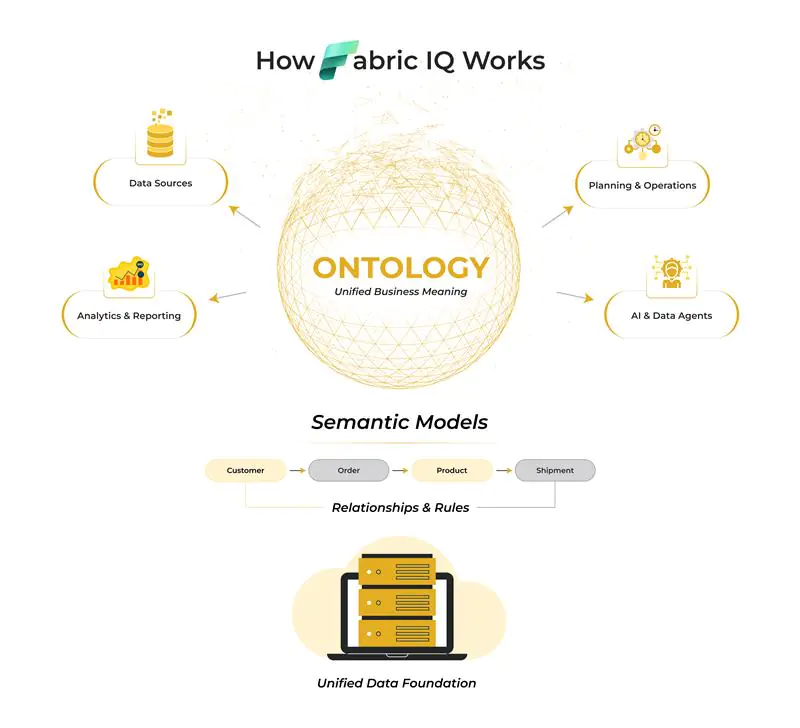
Microsoft Fabric IQ is about Meaning, Not Movement
Not just storing or moving data, but helping organizations understand Fabric IQ and define business concepts in a shared way so data can be understood with context. Instead of just raw tables and fields, you build a layer of meaning around entities like customer, order, shipment, product, and asset, along with their relationships.
When I first encountered this idea in 2009, the challenge was always implementation. How do you make something this abstract actually useful in practice? Microsoft Fabric IQ is part of the answer to that question, and it took the industry about 16 years to realize why it matters.
Make Your Data Work for Both People and AI
Most setups serve either reporting or AI, rarely both well. Let me help you structure your Fabric environment so that Fabric IQ analytics and agents use the same definitions.
This is also where Microsoft Fabric data agents enter the picture, and where the distinction matters most.
Many organizations today give business context to AI agents through instruction sets. Tell the agent which tables to use, how to define revenue, and which records to exclude. That helps. But it still depends on written guidance. If those instructions are incomplete, outdated, or inconsistent across agents, the confusion follows them in.
And this is where the stakes get very high.
A data agent with instructions is like giving a smart new hire a cheat sheet. Microsoft Fabric IQ is like giving the whole company a shared business language.
That does not replace agents. It makes them substantially more reliable because they are no longer working from prompts written in isolation. They are working from a business foundation where meaning is consistent across reports, analytics, and every AI experience built on top of the data.
The difference between those two worlds is not incremental. It is the difference between AI that occasionally gets things right and AI that can actually be trusted.
Companies spent years trying to get their data in one place. Fabric is helping solve that. But centralization was never the finish line; it was the precondition. The harder work is making that data mean the same thing to everyone who touches it.
That is the problem Microsoft Fabric IQ is designed to solve. And if you have spent any time in analytics, you already know how long this problem has been waiting for a real answer.
The organizations that get this right will not just have all their data in one place. They will have a business that understands its own data, trusts it, and can act on it, with both humans and AI working from the same foundation of meaning.
Stop Reconciling Reports. Start Trusting Them
If your teams spend more time validating numbers than acting on them, it’s time to fix the root cause. We help you standardize definitions across Fabric so insights are consistent everywhere.
This shift is less about adding another layer of technology and more about removing ambiguity from how the business operates. When definitions are shared and consistent through Microsoft Fabric data modeling, decisions stop getting debated at the metric level and start focusing on what actually needs to be done next. That is where data finally becomes useful, not just available.
And that is where things start to compound. Reports line up, teams stop second-guessing numbers, and AI systems stop producing conflicting outputs. Instead of fixing interpretations, organizations can focus on outcomes.
In my next post, I will go deeper into how ontologies actually work, why they matter, and how they can be used within the Microsoft Fabric ecosystem to give data practical business meaning. This is where things get really interesting because the conversation moves from theory to implementation. Stay tuned.
FAQs
What is Fabric IQ, and how is it different from traditional data modeling?
It defines shared business meaning, not just data structure, so metrics stay consistent across reports and systems.
Why do reports still conflict after centralizing data in Microsoft Fabric?
Because teams use different definitions for the same metrics, even when the data source is the same.
How does Fabric IQ improve analytics accuracy?
It standardizes definitions, so all reports and dashboards follow the same logic and support Microsoft Fabric analytics.
What role does Fabric IQ play in AI and data agents?
It gives agents a consistent business context, reducing reliance on scattered instructions.
Can Fabric IQ replace data governance?
No, it complements governance by focusing on definitions, while governance handles control and quality.
How do you get started with Fabric IQ?
Start by defining key business terms and aligning teams, then implement those definitions in Fabric.
What problems does Microsoft Fabric IQ solve for reporting teams?
It removes conflicting metrics and reduces time spent validating numbers.
How does Fabric IQ impact Power BI reports?
It ensures consistent definitions, so dashboards align across teams.
To provide the best experiences, we use technologies like cookies to store and/or access device information. Consenting to these technologies will allow us to process data such as browsing behavior or unique IDs on this site. Not consenting or withdrawing consent, may adversely affect certain features and functions.
Functional
Always active
The technical storage or access is strictly necessary for the legitimate purpose of enabling the use of a specific service explicitly requested by the subscriber or user, or for the sole purpose of carrying out the transmission of a communication over an electronic communications network.
Preferences
The technical storage or access is necessary for the legitimate purpose of storing preferences that are not requested by the subscriber or user.
Statistics
The technical storage or access that is used exclusively for statistical purposes.The technical storage or access that is used exclusively for anonymous statistical purposes. Without a subpoena, voluntary compliance on the part of your Internet Service Provider, or additional records from a third party, information stored or retrieved for this purpose alone cannot usually be used to identify you.
Marketing
The technical storage or access is required to create user profiles to send advertising, or to track the user on a website or across several websites for similar marketing purposes.
To provide the best experiences, we use technologies like cookies to store and/or access device information. Consenting to these technologies will allow us to process data such as browsing behavior or unique IDs on this site. Not consenting or withdrawing consent, may adversely affect certain features and functions.
Functional
Always active
The technical storage or access is strictly necessary for the legitimate purpose of enabling the use of a specific service explicitly requested by the subscriber or user, or for the sole purpose of carrying out the transmission of a communication over an electronic communications network.
Preferences
The technical storage or access is necessary for the legitimate purpose of storing preferences that are not requested by the subscriber or user.
Statistics
The technical storage or access that is used exclusively for statistical purposes.The technical storage or access that is used exclusively for anonymous statistical purposes. Without a subpoena, voluntary compliance on the part of your Internet Service Provider, or additional records from a third party, information stored or retrieved for this purpose alone cannot usually be used to identify you.
Marketing
The technical storage or access is required to create user profiles to send advertising, or to track the user on a website or across several websites for similar marketing purposes.