Is Your Microsoft 365 Data Protected from AI Exposure?

Table of Contents
Introduction
Microsoft Purview Information Protection is no longer a compliance checkbox. In 2026, with generative AI embedded in everyday M365 workflows, it is becoming a critical defense between sensitive business data and unmanaged AI exposure. This blog explains how sensitive data can move into AI tools, where traditional controls fall short, and how Microsoft Purview helps organizations strengthen protection through sensitivity labels, DLP, DSPM for AI, Insider Risk Management, retention policies, and AI Data Security Investigations.
Why AI Changes the Data Protection Conversation
As organizations bring AI deeper into Microsoft 365, the risk no longer lies solely in where files are stored. Sensitive information can now surface through prompts, summaries, shared documents, meeting notes, and connected workflows. A contract in SharePoint, an HR file in OneDrive, or a financial report in Teams can quickly become part of an AI interaction if classification and access controls are not properly configured.
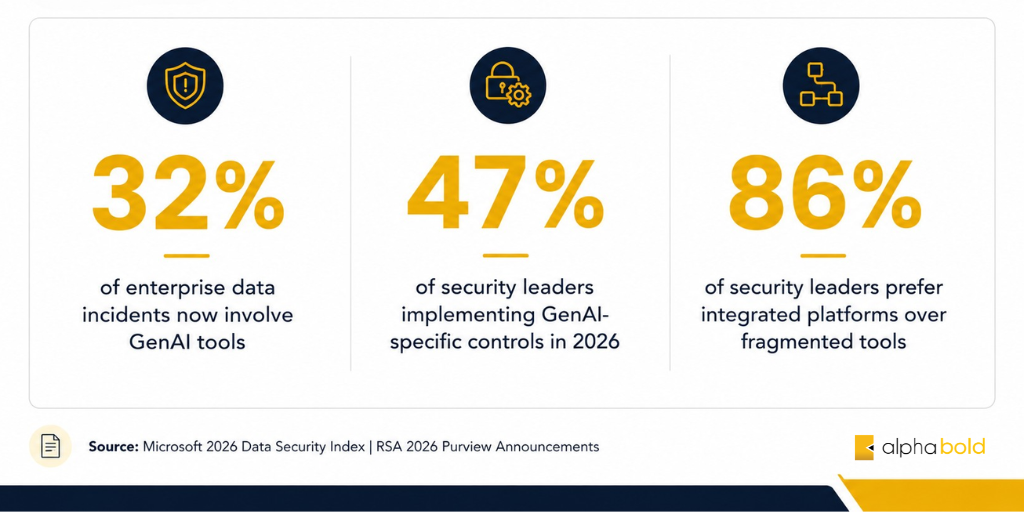
The 2026 Microsoft Data Security Index, based on surveys of over 1,700 security professionals across 10 markets, found that 32% of enterprise data incidents now involve generative AI tools. Employees access AI using personal credentials and personal devices, bypassing corporate controls. The exposure is not malicious; it is routine, which makes it harder to stop with awareness alone. The six pillars of Microsoft Purview exist to close that technical gap, not a cultural one.
Key Takeaways
- 32% of enterprise data incidents now involve generative AI tools (Microsoft 2026 Data Security Index).
- Employees paste sensitive M365 data into ChatGPT, Gemini, and Copilot daily, often without realizing the compliance risk.
- Microsoft Purview’s six pillars, Sensitivity Labels, DLP, DSPM for AI, Insider Risk Management, Retention, and AI Data Security Investigations, travel with your data into AI interactions.
- The EU AI Act’s high-risk provisions take full effect August 2026, and new Purview AI Data Security Investigations support the required transparency and oversight obligations.
- Implementing Purview-based controls is a prerequisite for responsible Copilot deployment, not an optional add-on.
The Invisible Risk in Your AI Workflows
Picture a routine Tuesday morning. A sales manager copies a client contract with Microsoft 365 Copilot to generate a proposal summary. An HR director uploads an employee performance spreadsheet into an AI writing tool to draft year-end reviews. A developer pastes code containing database credentials into ChatGPT to debug a function. None of these people are acting recklessly, and yet in each case, sensitive data has just left your controlled environment.
This is the defining data security challenge of 2026: the risk is not malicious, it is mundane. It lives in productivity habits, not in the actions of bad actors. Because it is routine, it is almost impossible to stop with culture alone. You need controls that are invisible to the well-intentioned user and impenetrable to the careless one.
Compliance Reality Check: Under GDPR Article 28, sharing customer personal data with any third-party processor, including AI services, without a valid Data Processing Agreement is a reportable violation. Fines reach €20 million or 4% of global annual turnover. Intent is not a defense.
“The question is no longer whether your employees are using AI. They are. The question is whether your data protection controls travel with the data when they do.”
You may also like: Microsoft Agent 365: Capabilities, Benefits, and Competitive Analysis
How Sensitive Data Leaks into AI, Step by Step
Understanding the exposure pathway is the first step to closing it. Here is how a typical data leak into an AI tool unfolds inside a standard M365 environment:
- Creation Without Classification, Sensitive documents, contracts, HR records, and financial data are created and stored in SharePoint, Teams, or Exchange, but without sensitivity labels, there is no machine-readable indicator of how the data should be handled.
- Copilot or External AI Interaction, A user interacts with Microsoft 365 Copilot, which can access their entire permissioned data estate, or paste content into an external AI tool via browser. Without label-aware controls, Copilot may surface confidential content the user was not meant to see, or the user unknowingly exports it.
- Data Ingested Without Controls, The external AI service processes the data. Without DLP endpoint policies or browser-level interception, there is no warning, no block, no audit trail. The AI vendor’s retention and usage policies now apply, which may include storing or training on your data.
- Breach, Audit, or Regulatory Action, A vendor breach, a regulatory audit, or a whistleblower surfaces the incident. Without policy enforcement logs or audit evidence, your organization cannot demonstrate due diligence, and the regulator has no reason to be lenient.
Breaking: Ai Prompts Now Visible to Compliance Teams
As of May–June 2026, Microsoft Purview Insider Risk Management is rolling out the ability for authorized enterprise security teams to review risky AI prompts and responses in plaintext. Your AI interactions, including those in Copilot, are now part of the same compliance machinery that governs your email and documents.
Microsoft Purview: Six Pillars of Protection
Microsoft Purview is not a bolt-on security product. It is the integrated data security and compliance fabric built natively into Microsoft 365. I Protection is data-centric and it follows your content wherever it goes, including AI tools, external sharing, and endpoint devices. The platform rests on six interconnected pillars:
- Sensitivity Labels & Information Protection: Classify and encrypt data automatically or manually across Exchange, SharePoint, Teams, and OneDrive. Labels apply encryption and access controls that persist even when a file is downloaded or shared externally, including when opened inside an AI tool.
- DSPM for AI: Data Security Posture Management purpose-built for AI. Discover which AI apps access your M365 tenant, assess oversharing risks, and apply one-click remediation policies to Copilot and third-party generative AI interactions.
- Retention & Records Management: Ensures data is retained exactly as long as regulations require and deleted on schedule. Stale, unclassified data in SharePoint is a prime AI oversharing liability. Lifecycle management eliminates exposure before it occurs.
- Data Loss Prevention (DLP): Policy-driven controls that detect sensitive data, credit card numbers, national IDs, health records, source code, and block or warn when it is pasted into browser-based AI tools, uploaded externally, or sent via unapproved channels.
- ️ Insider Risk Management: Machine-learning models detecting anomalous behavior, departing employees downloading unusual file volumes, or users prompting Copilot with confidential financial terms. Now includes plaintext review of risky AI prompts (May 2026 rollout).
- AI Data Security Investigations: Generally available since January 2026 (preview prior to that), with new capabilities announced April 30, 2026 including OCR for image content and custom examination types: correlates logs across M365, Azure, and third-party AI services to reconstruct the full data lifecycle of any AI interaction, tracing what was accessed, by whom, and where it went. As of May 2026, it also integrates proactive AI insights directly into DSPM workflows.
How Ai-Aware DLP Works in Practice: When a user on a managed Windows endpoint attempts to paste content classified as Confidential into ChatGPT or another browser-based AI tool, Purview DLP intercepts the action at the browser layer, displaying a policy tip warning or blocking the paste entirely. This works across Edge, Chrome, and Firefox on enrolled devices. No additional agent software is required.
Not Sure If Your Purview Controls Are Ready for Copilot?
AlphaBOLD's Microsoft 365 governance practice helps organizations configure sensitivity labels, DLP policies, DSPM for AI, and Insider Risk Management before Copilot deployment, not after an incident.
Request a ConsultationThe 2026 Regulatory & Threat Landscape
- Eu Ai Act, August 2026 Enforcement Deadline: The EU AI Act’s requirements for high-risk AI systems, including transparency, human oversight, and data governance, take full effect in August 2026. Organizations deploying or using AI systems that process personal data must demonstrate compliance. Microsoft Purview’s Compliance Manager now includes EU AI Act assessment templates, giving organizations audit-ready evidence trails before regulators come calling.
- Copilot Oversharing, The Silent Risk Inside Your Tenant: Microsoft 365 Copilot is not a standalone AI, it is a reasoning engine over your entire permissioned M365 estate. If a user has access (even vestigial access from an old role) to a sensitive SharePoint site, Copilot can and will surface that content in a generated response. Without sensitivity labels correctly applied and permissions hygiene enforced, Copilot becomes an accelerant for internal data exposure, not just a productivity tool. DSPM for AI exists precisely to identify and remediate these oversharing pathways.
- Agentic Ai, The Frontier Risk: AI agents, autonomous systems that act on behalf of users across multiple services, are entering enterprise M365 environments in 2026. Unlike a chatbot, agents can access data, trigger workflows, and interact with external systems continuously, without direct human interaction. Agent 365 Runtime Protection (public preview, April 2026) adds a runtime enforcement layer that monitors agent behavior in real time, flags suspicious operations such as unauthorized data access or unexpected API calls and can automatically revoke agent permissions. Microsoft plans general availability in Q3 2026.
- Insider Risk, Still the Most Overlooked Vector: External breaches dominate headlines, but a significant proportion of data loss originates internally, through negligence, disgruntlement, or a departing employee taking what they know. Purview Insider Risk Management now integrates with Microsoft Fabric Lakehouse indicators, meaning data exfiltration risk can be detected across analytics workloads as well as traditional M365 surfaces.
Your Information Protection Readiness Checklist
Use the checklist below to assess Purview deployment maturity. If more than three items are missing, your AI adoption is running ahead of your governance. That gap is your near-term compliance risk.
- A sensitivity label taxonomy is defined, published, and applied consistently across Exchange, SharePoint, Teams, and OneDrive, not just manually, but via auto-labeling policies.
- Auto-labeling policies are configured to classify documents containing financial data, HR records, or customer PII automatically, reducing reliance on user action.
- DLP policies are active across endpoints and browsers, blocking or warning on sensitive content pasted into generative AI sites.
- DSPM for AI is enabled; AI tool usage across the tenant is inventoried, assessed, and reviewed at least monthly.
- Insider Risk Management is configured with at least a departing-employee policy and a risky AI usage policy template.
- Retention and deletion policies are active across all M365 workloads, stale, unclassified data does not accumulate in SharePoint or Teams channels.
- A Compliance Manager assessment against at least one applicable framework (GDPR, ISO 27001, EU AI Act) has been completed in the last 12 months.
- Security awareness training includes explicit guidance on the risks of sharing organizational data with external and consumer-grade AI tools
Ready to Build an Audit-Ready Purview Environment?
AlphaBOLD configures end-to-end Microsoft Purview deployments, sensitivity labels, DLP, DSPM for AI, Insider Risk, and Compliance Manager assessments, aligned to GDPR, ISO 27001, and the EU AI Act. We work with M365 E3 and E5 organizations across financial services, healthcare, and enterprise operations.
Schedule a Purview Readiness AssessmentConclusion
Sensitive data does not wait for your security controls to catch up. It moves with your employees to Copilot prompts, browser-based AI tools, and external services, with or without your governance in place.
Microsoft Purview closes that gap technically. Sensitivity labels, DLP, DSPM for AI, and Insider Risk Management work together to ensure your data protection travels with your content, not behind it.
With EU AI Act enforcement landing in August 2026, the window to get this right is narrowing. The organizations that will handle regulatory scrutiny are the ones that configured Purview before an incident forced the conversation.
Frequently Asked Questions
Microsoft Purview Information Protection is the data classification and protection layer within the broader Microsoft Purview compliance platform. Standard M365 security (Defender, Entra Conditional Access, Intune) secures access to systems and devices. Purview secures the data itself, applying sensitivity labels, encryption, and DLP policies that travel with the content wherever it goes, including into AI tools, email attachments, and externally shared files. The distinction matters because a user can be properly authenticated and still inadvertently expose sensitive data by pasting it into an unauthorized AI service. Purview addresses that gap.
Yes, when properly configured. Purview DLP endpoint policies intercept content at the browser layer on managed Windows devices enrolled in Intune. When a user attempts to paste content classified as Confidential into a browser-based AI tool, the DLP policy displays a warning or blocks the action entirely. This protection works across Microsoft Edge, Chrome, and Firefox on enrolled devices. It does not cover unmanaged personal devices, which is why device enrollment policy and conditional access controls are prerequisites for comprehensive AI data protection.
Data Security Posture Management (DSPM) for AI provides tenant-wide visibility into which AI applications are accessing your M365 data, which users are interacting with which AI tools, and where oversharing risks exist in your Copilot configuration. Standard DLP is policy enforcement, it blocks or warns on specific actions in real time. DSPM for AI is posture assessment, it gives you a continuous inventory and risk score of your AI data exposure so you can identify and remediate risks proactively before an incident triggers a DLP rule.
The EU AI Act’s high-risk AI system requirements take full effect in August 2026. If your organization is based in or processes data about individuals in the EU, and you use AI systems that fall into high-risk categories (which includes several enterprise HR, credit scoring, and critical infrastructure use cases), you are in scope. Microsoft 365 Copilot itself is not classified as high-risk under the Act, but the AI systems you build or deploy using Copilot Studio or third-party integrations may be. Microsoft Purview Compliance Manager includes an EU AI Act assessment template that generates an evidence trail for regulatory review.
AlphaBOLD’s Purview engagements follow a three-phase approach: governance design (defining your sensitivity label taxonomy, DLP scope, and retention policies), technical deployment (auto-labeling configuration, DLP endpoint policies, DSPM for AI setup, and Insider Risk policy templates), and validation (Compliance Manager assessment against your applicable framework, GDPR, ISO 27001, or EU AI Act). A standard engagement covering core Purview deployment for an M365 E3 or E5 tenant typically runs 6 to 10 weeks depending on data volume, regulatory requirements, and the number of custom label policies required.