

Table of Contents
Introduction
AI agents are rapidly becoming a core part of how organizations operate. Recent industry research indicates that more than 85% of enterprises and 78% of small and mid-sized businesses are already using AI agents within their business processes (McKinsey), reflecting how quickly agent-based automation is moving beyond experimentation. Beyond simple assistants, enterprises are now deploying autonomous agents that can qualify leads, monitor systems, execute workflows, and act on business data with limited human involvement.
As this adoption accelerates, a new enterprise challenge has emerged: how to manage, secure, and govern AI agents at scale. Unlike traditional applications, AI agents can operate autonomously, interact with sensitive data, and trigger business actions across systems, making visibility and control critical.
Microsoft Agent 365 is Microsoft’s response to this challenge. Rather than introducing another standalone agent, Microsoft has focused on building a control plane designed to help organizations deploy and govern AI agents using existing enterprise infrastructure. This approach extends familiar identity, security, and compliance capabilities from users and applications to AI agents, treating them as first-class participants in the enterprise environment.
As a relatively new capability introduced through Microsoft’s early access programs, Agent 365 represents an important step in how organizations approach AI agent governance. For enterprises seeking to scale agent-based workflows responsibly, understanding Agent 365’s capabilities, benefits, and how it compares to alternative platforms is becoming increasingly relevant.
This blog examines Microsoft Agent 365’s core capabilities, the business and IT benefits it enables, and how it compares to other approaches shaping the emerging AI agent landscape.
What Are the Core Capabilities of Microsoft Agent 365?
What Is the Agent Registry in Microsoft Agent 365?
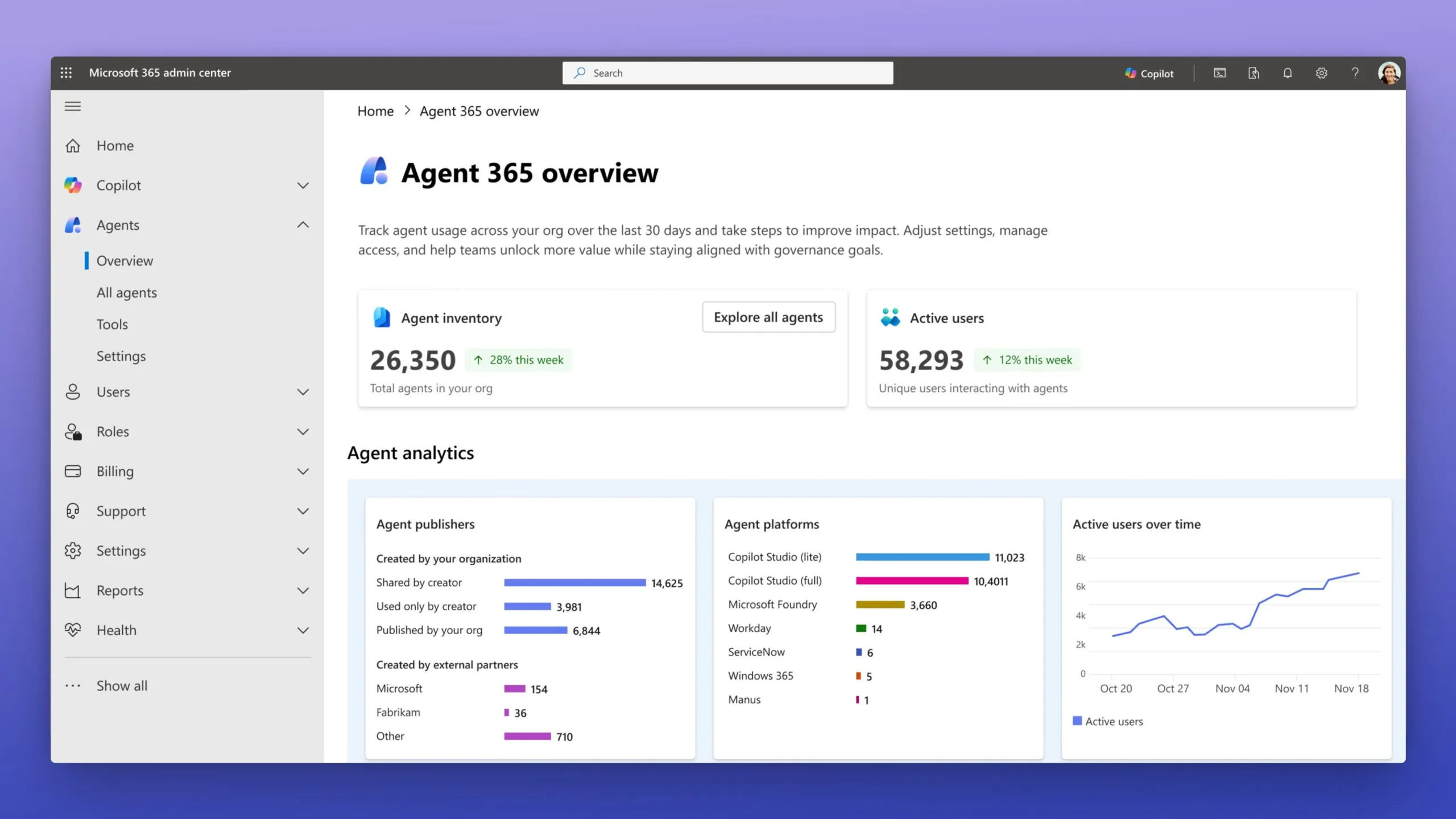
The Agent Registry provides a centralized inventory of AI agents across the organization, including Microsoft-built, custom, and previously unmanaged agents.
It is designed to give IT teams visibility into what agents exist, who owns them, and how they are being used.
Key capabilities include:
- Centralized listing of registered and discovered agents
- Association of agents with Microsoft Entra Agent IDs
- Improved accountability and lifecycle visibility
How Does Microsoft Agent 365 Control Agent Access?
Microsoft Agent 365 uses Microsoft Entra to apply identity-based access controls to AI agents.
This allows organizations to enforce least-privilege access, ensuring agents only interact with the systems and data required for their defined role.
Access control supports:
- Identity-based permissions for agents
- Alignment with existing Conditional Access policies
- Reduced risk from over-permissioned agents
How Does Microsoft Agent 365 Provide Visibility Into Agent Activity?
Microsoft Agent 365 is designed to provide visibility into agent usage through telemetry, dashboards, and alerts.
This observability helps IT and security teams understand how agents operate across departments and identify potential risks early.
Visibility features focus on:
- Agent usage and activity trends
- Operational monitoring at scale
- Early detection of abnormal or unexpected behavior
How Does Microsoft Agent 365 Support Interoperability Across Agents?
Microsoft Agent 365 is positioned to govern agents built using Microsoft tools as well as agents created through open frameworks or third-party platforms.
This interoperability is critical for enterprises operating in hybrid, multi-vendor environments where agent development is not centralized.
Interoperability benefits include:
- Reduced vendor lock-in
- Centralized governance across diverse agent ecosystems
- Consistent management standards across platforms
How Does Microsoft Agent 365 Address Security and Compliance?
Microsoft Agent 365 extends existing Microsoft security and compliance tooling to AI agents.
By integrating with Microsoft Defender and Purview, organizations can apply data protection, threat detection, and policy enforcement to agent activity.
Security and compliance capabilities include:
- Data governance and monitoring for agent interactions
- Threat detection and investigation tied to agent identities
- Alignment with existing enterprise compliance policies
Further Reading: Leveraging AI & Copilot in Power Platform: Automate & Build
Establish the Right Governance Foundation for AI Agents
As AI agents move into core business workflows, governance, security, and visibility become critical. Defining the right control model early helps organizations scale agent adoption responsibly while avoiding operational, security, and compliance risks.
Request a ConsultationWhat Are the Key Benefits of Microsoft Agent 365 for Enterprises?
Microsoft Agent 365 is designed to help organizations scale AI agent adoption with governance, security, and operational visibility built in. The benefits focus less on automation speed and more on enabling responsible, enterprise-grade deployment of AI agents.
How Does Microsoft Agent 365 Reduce the Risk of Shadow AI?
Microsoft Agent 365 helps organizations surface and govern AI agents that may otherwise operate outside IT visibility.
By providing centralized registration and oversight, it reduces the likelihood of unmanaged agents accessing sensitive systems or data.
Risk reduction benefits include:
- Improved visibility into agent usage across teams
- Reduced exposure from unapproved or unknown agents
- Clear ownership and accountability for agent activity
How Does Microsoft Agent 365 Improve Security and Compliance?
Microsoft Agent 365 extends existing identity, security, and compliance controls to AI agents.
This allows organizations to apply consistent policies without introducing new security frameworks or parallel governance models.
Security and compliance benefits include:
- Alignment with existing Entra, Defender, and Purview policies
- More consistent data protection for agent interactions
- Improved auditability for regulated environments
How Does Microsoft Agent 365 Support Scalable AI Adoption?
Microsoft Agent 365 is designed to help organizations move from isolated AI experiments to broader, enterprise-wide agent deployments.
Clear governance and visibility lower the friction for IT approval and operational scale.
Scalability benefits include:
- Faster approval of new agent use cases
- Reduced rework caused by governance gaps
- Greater confidence in expanding agent-based workflows
How Does Microsoft Agent 365 Improve Operational Visibility?
Microsoft Agent 365 provides centralized insight into how agents are used across departments and business functions.
This visibility supports better decision-making as agent usage increases and workflows become more interconnected.
Operational visibility benefits include:
- Clear understanding of where agents are deployed
- Insight into agent activity patterns and usage trends
- Earlier identification of performance or risk issues
How Does Microsoft Agent 365 Align with Existing Microsoft Investments?
Microsoft Agent 365 is built to extend tools many enterprises already use rather than replace them.
This reduces change management effort and helps organizations leverage existing Microsoft investments more effectively.
Alignment benefits include:
- Familiar admin and security workflows for IT teams
- Lower learning curve for governance and oversight
- Better integration with Microsoft 365, Entra, and security tooling
Key Benefits of Microsoft Agent 365
| Benefit Area | What It Delivers | Why It Matters to Enterprises |
|---|---|---|
|
Centralized AI Agent Governance |
A single control plane to register, manage, and oversee AI agents across the organization |
Reduces fragmentation and prevents unmanaged agent deployments as adoption scales |
|
Reduced Shadow AI Risk |
Improved visibility into approved and previously unmanaged agents |
Helps mitigate security, compliance, and operational risks from untracked AI usage |
|
Stronger Security Posture |
Extends identity, access control, and threat protection to AI agents |
Ensures agents operate under the same security standards as users and applications |
|
Compliance and Audit Readiness |
Centralized oversight of agent activity and data access |
Supports regulatory requirements and internal audit processes |
|
Scalable AI Adoption |
Clear governance and guardrails for deploying new agents |
Enables organizations to move from pilots to enterprise-wide use with confidence |
|
Improved Operational Visibility |
Insight into where agents are deployed and how they are used |
Helps IT and business leaders make informed decisions as agent usage grows |
|
Alignment with Existing Microsoft Tools |
Built on Microsoft 365, Entra, Defender, and Purview |
Reduces learning curve and leverages existing platform investments |
|
Lower Governance Overhead |
Uses familiar admin and security workflows |
Avoids introducing parallel tools or processes for AI oversight |
You may also be interested to read more about AI-Powered Proactive Engagement in Microsoft Dynamics 365 (Public Preview)
Prepare Your Organization for Scalable AI Agent Adoption
As AI agents become embedded across business functions, having the right governance, security, and operating model in place is essential. Evaluating platforms like Microsoft Agent 365 within the context of your existing architecture helps ensure agent adoption delivers value without introducing unnecessary risk.
Request a ConsultationHow Does Microsoft Agent 365 Compare to Other AI Agent Platforms?
How Does Microsoft Agent 365 Compare to Salesforce Agentforce and Einstein?
Salesforce Agentforce and Einstein are designed to automate sales, service, and marketing workflows within the Salesforce ecosystem.
They excel at CRM-native use cases but are primarily governed within Salesforce’s platform boundaries.
Key differences include:
- Salesforce focuses on customer-facing and revenue workflows
- Governance is strongest inside Salesforce data and processes
- Less emphasis on cross-productivity or identity-level control
Microsoft Agent 365 differentiation:
Agent 365 is positioned as a horizontal control plane that spans identity, productivity, security, and business applications, making it better suited for enterprises managing agents across multiple systems beyond CRM.
How Does Microsoft Agent 365 Compare to ServiceNow AI Agents?
ServiceNow’s AI agents are tightly integrated into IT service management and operational workflows.
They are well-suited for automating incident response, service delivery, and internal processes within the ServiceNow platform.
Key differences include:
- Strong depth in IT operations and service workflows
- Governance optimized for operational use cases
- More limited reach across productivity and analytics tools
Microsoft Agent 365 differentiation:
Agent 365 is designed to govern agents operating across business functions, productivity tools, and analytics environments, not just IT operations.
How Does Microsoft Agent 365 Compare to Open-Source Agent Frameworks?
Open-source agent frameworks offer flexibility and rapid experimentation, often favored by engineering teams.
However, governance, identity, and security controls typically require custom implementation.
Key differences include:
- High customization and development freedom
- Limited built-in governance and compliance
- Security and audit controls must be manually designed
Microsoft Agent 365 differentiation:
Agent 365 prioritizes enterprise governance by design, offering standardized identity, security, and compliance integration without requiring custom frameworks.
How Does Microsoft Agent 365 Compare to Standalone AI Agent Platforms?
Standalone AI agent platforms often focus on execution speed, orchestration, or task automation.
While effective for specific use cases, they may lack deep integration with enterprise identity and security systems.
Key differences include:
- Strong task-level automation capabilities
- Limited native identity and policy enforcement
- Additional governance layers often required
Microsoft Agent 365 differentiation:
Agent 365 integrates directly with Microsoft Entra, Defender, and Purview, allowing organizations to manage agents using the same controls already applied to users and applications.
When Is Microsoft Agent 365 the Right Fit?
Microsoft Agent 365 is best suited for organizations that prioritize governance, security, and scalability over rapid, unmanaged experimentation.
It is particularly relevant for enterprises already standardized on Microsoft identity, security, and productivity platforms.
Agent 365 is a strong fit when:
- AI agents operate across multiple business functions
- Security and compliance requirements are high
- Centralized visibility and control are non-negotiable
- Microsoft 365 and Entra are already core platforms
Competitive Comparison: Microsoft Agent 365 vs. Other AI Agent Platforms
| Evaluation Area | Microsoft Agent 365 | Salesforce Agentforce / Einstein | ServiceNow AI Agents | Open-Source Agent Frameworks |
|---|---|---|---|---|
|
Primary Focus |
Enterprise governance and control plane for AI agents |
CRM-centric automation and customer workflows |
IT operations and service management automation |
Custom agent development and experimentation |
|
Core Strength |
Identity-, security-, and compliance-first agent management |
Deep CRM workflow integration |
Strong ITSM and operational process automation |
Flexibility and extensibility |
|
Governance Model |
Centralized governance using Microsoft identity and security infrastructure |
Governance largely within Salesforce platform |
Governance focused on ServiceNow workflows |
Custom-built governance required |
|
Identity & Access Control |
Integrated with Microsoft Entra |
Managed within Salesforce user and role model |
Tied to ServiceNow user and role framework |
Must be implemented manually |
|
Security & Compliance |
Integrated with Defender and Purview |
Platform-specific security controls |
Strong operational security controls |
Varies by implementation |
|
Cross-Platform Agent Management |
Designed to manage Microsoft and non-Microsoft agents |
Primarily Salesforce ecosystem |
Primarily ServiceNow ecosystem |
Depends on custom integration |
|
Productivity Tool Integration |
Native alignment with Microsoft 365 and Power Platform |
Limited beyond Salesforce tools |
Limited beyond ServiceNow workflows |
Not native |
|
Best Fit For |
Enterprises prioritizing governance, visibility, and scale |
Sales- and marketing-driven organizations |
IT- and operations-centric teams |
Engineering-led teams and experimentation |
|
Scalability Approach |
Control-first, enterprise-ready adoption |
Workflow expansion within CRM |
Operational automation at scale |
Developer-driven scaling |
Evaluate the Right Control Model for AI Agents
As AI agents expand across business functions, selecting the right governance and control approach becomes a strategic decision. Assessing how platforms like Microsoft Agent 365 align with your existing architecture, security requirements, and operating model helps ensure AI adoption scales without unnecessary risk.
Request a ConsultationWhat Is the Future Outlook for Microsoft Agent 365?
Microsoft Agent 365 reflects a broader shift in how enterprises are approaching AI adoption, moving from isolated automation toward governed, agent-driven operations. As AI agents become more autonomous and embedded across business workflows, centralized governance, visibility, and security will become essential rather than optional.
In the near term, organizations can expect greater emphasis on standardizing how agents are identified, monitored, and controlled, particularly in environments where multiple teams and tools are involved. Platforms like Microsoft Agent 365 indicate that enterprise AI strategy is increasingly focused on infrastructure and operating models, not just individual use cases.
Over time, the success of AI agents in enterprise environments will depend less on how quickly agents can be deployed and more on how well they are governed. For organizations already invested in Microsoft’s identity, security, and productivity ecosystem, Microsoft Agent 365 represents a practical foundation for managing this next phase of AI adoption responsibly.
As AI agents continue to reshape how work is performed, enterprises that establish governance frameworks early will be better positioned to scale innovation while maintaining control, compliance, and trust.
Frequently Asked Questions
AlphaBOLD uses Microsoft Agent 365 as a governance and control layer when designing and deploying AI agents. This ensures agents are introduced with clear identity, access controls, security policies, and operational visibility from day one.
No. AlphaBOLD builds AI agents using platforms such as Microsoft Copilot Studio, Power Platform, and Azure services, while Microsoft Agent 365 is used to manage, secure, and govern those agents at scale across the organization.
AlphaBOLD helps organizations assess AI readiness, identity architecture, security posture, and data governance to ensure Microsoft Agent 365 can be adopted effectively without introducing compliance or operational gaps.
AlphaBOLD designs agent governance models that leverage Microsoft Entra for identity, Purview for data governance, and Defender for security monitoring, with Agent 365 serving as the centralized control plane for enforcement and oversight.
Organizations should involve AlphaBOLD before scaling AI agents beyond pilot use cases. Early engagement helps define governance, security, and operating models upfront, reducing risk and rework as agent adoption expands.
Explore Recent Blog Posts