Microsoft Sentinel vs Security Copilot: Use Cases and Security Automation Strategies for Microsoft 365

Table of Contents
Introduction
Microsoft Sentinel vs Security Copilot is often framed as a choice between two competing products. It isn’t. Sentinel collects and analyzes your security data; Security Copilot helps your team act on that data faster, using natural language instead of manual queries and scripts.
Understanding how the two work together, and what each one actually costs, is the first step toward a Microsoft 365 security strategy that scales with today’s threat volume.
In this blog, we’ll compare Microsoft Sentinel and Security Copilot across their core capabilities, use cases, licensing, and automation features. We’ll also explain how they complement each other and when organizations should use one, the other, or both as part of a Microsoft 365 security strategy.
What Is the Difference Between Microsoft Sentinel and Security Copilot?
Microsoft Sentinel vs Security Copilot is a common comparison for organizations evaluating Microsoft’s security ecosystem.
Microsoft Sentinel vs Security Copilot is a common comparison for organizations evaluating Microsoft’s security ecosystem, but the two tools serve different purposes.
Microsoft Sentinel is a cloud-native SIEM and SOAR platform that collects, correlates, and analyzes security data across Microsoft 365, Azure, endpoints, identities, and supported third-party tools. Microsoft Security Copilot is a generative AI assistant for security and IT operations that helps analysts interpret security data, summarize incidents, investigate threats, and take action using natural-language prompts.
| Microsoft Sentinel | Microsoft Security Copilot | |
|---|---|---|
|
What it is |
Cloud-native SIEM and SOAR platform |
Generative AI assistant for security and IT operations |
|
Core job |
Ingests, correlates, and analyzes security data at scale |
Interprets security data and produces summaries, investigation guidance, risk context, and remediation recommendations |
|
Where it runs |
Microsoft Defender portal, with Azure portal support continuing during Microsoft’s transition period |
Standalone Security Copilot portal, plus embedded experiences across Microsoft security products |
|
How it is billed |
Consumption-based, with costs tied to data ingestion, retention, and related Azure services |
Consumption-based through Security Compute Units; eligible Microsoft 365 E5 and E7 customers receive included monthly SCU allocation |
|
Can you use one without the other? |
Yes, Sentinel works independently of Security Copilot |
Yes, but without Sentinel you lose SIEM-level correlation across broader custom, third-party, hybrid, and multi-cloud log sources |
What Security Challenges Are Pushing Microsoft 365 Customers Toward These Tools?
Security teams are adopting AI-assisted tools because alert volume has outgrown what manual review can handle. The most common pressures include:
- Alert fatigue from daily volumes of log entries and notifications across users, devices, and apps
- Understaffed security teams that cannot scale headcount as fast as alert volume grows
- Slow detection and response, which extends the window attackers have to move laterally
- Hybrid and multi-cloud complexity, which makes it harder to correlate signals across environments
- Fragmented visibility, where related incidents in different tools never get connected
These gaps leave organizations exposed to ransomware, phishing, credential theft, and insider risk, not because the threats are new, but because detection and response have not kept pace with alert volume.

Build a Stronger Microsoft 365 Security Foundation
Before investing in new security tools, make sure your monitoring, detection, and response processes are ready. Our team can help you create a practical roadmap.
Request a ConsultationHow Does Microsoft Sentinel Secure a Microsoft 365 Environment?
Microsoft Sentinel secures a Microsoft 365 environment by collecting security signals from Microsoft 365 services, Azure resources, endpoints, identities, and supported third-party platforms into a single security operations platform. It analyzes this data to detect suspicious activity, prioritize threats, and help security teams investigate incidents faster.
Sentinel combines built-in analytics, threat intelligence, and automation to help organizations detect and respond to threats across their environment. Its key capabilities include:
- Centralized visibility: Collects logs and security events from Microsoft 365, Azure, Microsoft Defender, Microsoft Entra ID, and supported third-party security tools.
- Threat detection: Uses analytics rules and machine learning to identify suspicious behavior and generate higher-confidence alerts.
- Threat intelligence: Correlates internal events with known indicators of compromise to improve detection accuracy.
- Incident investigation: Links related alerts into a single incident, giving analysts the context needed to investigate faster.
- Security automation: Uses playbooks built on Azure Logic Apps to automate repetitive response actions, such as notifying teams, enriching incidents, opening tickets, or triggering containment workflows.

How Does Security Copilot Work with Sentinel and Other Microsoft Security Tools?
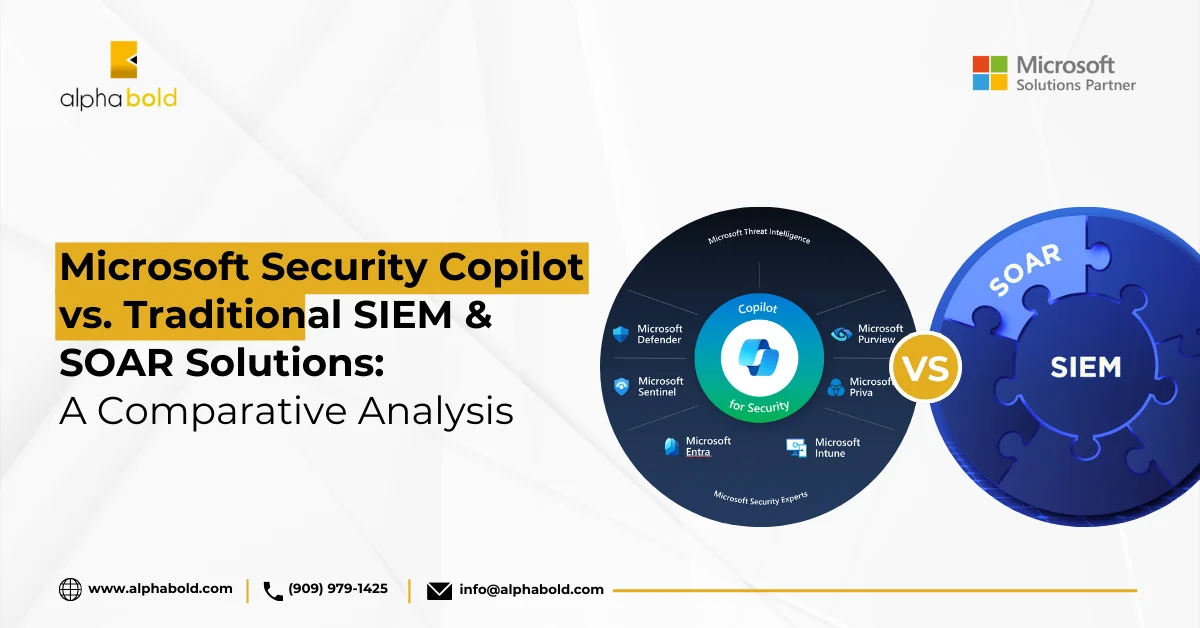
Security Copilot works by taking a natural-language prompt, grounding it in your organization’s actual security data, and returning an incident summary, investigation guidance, risk context, or remediation recommendation in seconds. It draws on Microsoft Sentinel, Microsoft Defender XDR, Microsoft Entra, Microsoft Intune, Microsoft Purview, and supported third-party tools through connected plugins.
Two things matter for how this plays out day to day:
- It runs in two modes. The embedded experience puts Copilot directly inside Microsoft security products, including Defender XDR, Entra, Intune, Purview, and Sentinel-supported workflows, so analysts do not have to switch tools for routine tasks. The standalone portal supports deeper, multi-step investigations and reusable promptbooks.
- It inherits the analyst’s permissions. Copilot uses on-behalf-of authentication, so it only reaches data that the signed-in user is already authorized to see. This is especially relevant for regulated industries evaluating data access, compliance, and governance controls.
Microsoft’s 2025 live operations research found that Security Copilot adoption was associated with measurable productivity improvements across security operations, data loss prevention, and endpoint management. The study reported a 22.88% decrease in alerts per incident, a 68.44% decrease in the probability of incident reopening, an 18.38% reduction in time to classify a DLP alert, and a 54.34% reduction in time to resolve a device policy conflict. Because the findings are based on observational data from live operations rather than a randomized controlled trial, organizations should treat them as strong productivity indicators rather than guaranteed outcomes.
What Does Security Copilot Cost?
Security Copilot is billed through Security Compute Units, or SCUs. SCUs measure the compute capacity used to run Security Copilot workloads across standalone and embedded Microsoft security experiences.
For organizations that do not qualify for Microsoft 365 E5 or E7 inclusion, Security Copilot uses a provisioned and overage capacity model. Microsoft lists provisioned SCUs at $4 per SCU per hour and overage SCUs at $6 per SCU per hour.
Eligible Microsoft 365 E5 and E7 customers receive included Security Copilot capacity. Microsoft provides 400 SCUs per month for every 1,000 paid user licenses, capped at 10,000 SCUs per month. This included capacity also scales for customers with fewer than 1,000 paid user licenses.
A few details are important for planning:
- Included SCUs do not roll over. Microsoft states that SCU allocations reset monthly and unused capacity cannot be carried forward.
- Included E5 and E7 capacity is tenant-wide. It is shared across users and Security Copilot experiences in the tenant.
- Usage beyond included SCUs should be planned carefully. Microsoft states that usage beyond the allocated SCUs will be throttled at a future date, with an option to scale beyond the allocation at $6 per SCU when available.
- Standalone provisioned SCUs are billed by the hour. If provisioned capacity is left running continuously, the estimated monthly cost assumes that capacity remains active 24 hours a day.
- Microsoft Sentinel is priced separately through Azure. Sentinel costs depend on factors such as data ingestion, analytics, retention, pricing tier, Log Analytics usage, and related Azure services.
Because every prompt, workflow, promptbook, and agent can consume SCUs differently, sizing Security Copilot requires planning. Teams should start with expected use cases, monitor actual consumption, and adjust capacity based on real SOC usage patterns instead of guessing.
Bonus Reading: Guide to Microsoft Copilot Pricing & Licensing
What Happens Without a Clear Strategy?
Without correctly configured data connectors, detection rules, and response workflows, Sentinel can create the same alert fatigue it is meant to solve, only with more data sources feeding it. Security Copilot can summarize a high volume of low-quality alerts just as easily as meaningful ones. The AI layer does not fix a noisy detection layer beneath it.
A common pattern is that a team turns on multiple data connectors at default settings, increases ingestion volume, and analytics rules tuned for a different environment produce a flood of low-priority incidents. Copilot then spends capacity summarizing noise instead of accelerating real investigations.
The fix is not to add more AI immediately. The fix is to decide which signals matter, which incidents should be prioritized, which responses can be automated safely, and where human review is still required.
AlphaBOLD helps organizations approach this as a security operations design challenge, not just a licensing decision. Our team reviews the existing Microsoft 365, Azure, Sentinel, Defender, Entra, Intune, and Purview environment, then builds a practical roadmap for data ingestion, detection tuning, automation, governance, and Security Copilot capacity planning. This helps make sure AI-assisted security workflows work on relevant signals instead of consuming budget on avoidable noise.
How Does AlphaBOLD Help Organizations Implement Sentinel and Security Copilot?

That work typically includes:
- Data connector and ingestion review: Onboarding the right sources at the right volume so Sentinel costs track risk reduction rather than unnecessary log volume.
- Detection rule tuning: Building analytics rules around the organization’s actual environment instead of relying only on default templates.
- Automated response playbooks: Building SOAR workflows so common incident types can be triaged, enriched, assigned, or contained faster.
- SCU capacity planning: Sizing Security Copilot usage around actual SOC workflows, expected prompt volume, agent usage, and the tradeoff between included E5/E7 capacity and standalone SCU provisioning.
- Governance and access review: Aligning Copilot’s data access with existing permissions, security roles, compliance requirements, and internal approval processes.
- Cost and usage monitoring: Helping teams track Sentinel ingestion, retention, and Security Copilot SCU usage so spend remains tied to operational value.
The goal is straightforward: make sure the budget allocated to these tools translates into faster detection and response, not just higher security tooling costs.
What Should You Evaluate Before Adopting Sentinel and Security Copilot?
When evaluating Microsoft Sentinel vs Security Copilot, start by reviewing your current security monitoring maturity, existing Microsoft licensing, and incident response workflows.
Specifically, assess:
- Current alert volume and how it is triaged today
- Existing Microsoft 365 license tier, including E3, E5, or E7, and what is already included
- Current Sentinel readiness, including connectors, analytics rules, workbooks, retention, and automation
- Compliance requirements that affect data access, storage, retention, and reporting
- How much of incident response is already automated versus manual
- Which Copilot use cases are most valuable, such as phishing triage, incident summarization, DLP alert classification, endpoint policy support, or investigation guidance
- Scale and efficiency targets for the next 12 to 24 months
This baseline determines whether you are ready to use Security Copilot now, whether included E5 or E7 capacity covers your expected usage, and where Sentinel configuration needs work before AI assistance adds value.
Ready to Plan Your Microsoft Security Deployment?
Whether you're evaluating Microsoft Sentinel, Security Copilot, or both, AlphaBOLD can assess your environment, recommend the right architecture, and build a deployment plan aligned with your security and compliance requirements.
Request a ConsultationConclusion
If you are comparing Microsoft Sentinel vs Security Copilot, it is important to understand that the two solutions are designed to work together rather than replace one another. Microsoft Sentinel provides centralized detection, investigation, and response capabilities across security data sources, while Security Copilot helps analysts interpret information, summarize incidents, and respond faster with AI assistance.
Together, they can reduce manual effort and improve SOC efficiency, but only when they are configured and managed correctly. Poor data ingestion strategy, noisy detections, weak automation rules, and unclear SCU planning can limit the value of both tools.
AlphaBOLD helps organizations plan, implement, and optimize Microsoft security solutions based on their existing environment, compliance requirements, and operational goals. Whether you are deploying Microsoft Sentinel, enabling Security Copilot, or integrating both, our team can help you build a security strategy that supports long-term growth and evolving threats.
FAQs
AlphaBOLD reviews the existing security posture, configures data connectors and detection rules, builds automated response playbooks, reviews governance and access controls, and helps right-size Security Copilot capacity so spend aligns with actual SOC usage.