


Table of Contents
Introduction
Modern manufacturing is complex. Skilled teams spend hours manually copying data, tracking orders, and managing compliance. While AI grabs headlines, Robotic Process Automation (RPA) quietly transforms back offices and factory floors, delivering measurable ROI in weeks, not years.
RPA in manufacturing doesn’t mean assembly-line robots. It refers to software bots that handle rule-based, repetitive digital tasks, reclaiming time, reducing errors by up to 80%, and streamlining workflows across procurement, quality control, and supply chain operations.
This guide explains the challenges, proven benefits, and real-world use cases of RPA in manufacturing. Whether you’re evaluating automation for the first time or scaling existing programs, you’ll discover actionable strategies that leading manufacturers use to gain competitive advantage.
The Current State of RPA Adoption in Manufacturing
According to a research, manufacturing leads all sectors in RPA adoption, with over 35% of enterprises already operationalizing automation programs. This isn’t just about cost-cutting. Forward-thinking manufacturers leverage RPA to accelerate time-to-market, boost accuracy in financial reporting, and free up employees for high-value work.
Automation has enabled companies like Schneider Electric to reduce personal protective equipment (PPE) order processing from four hours to just two minutes and helped Constellation Automotive reclaim 126,000 hours by automating 30 operational processes.
These success stories reflect a broader shift: manufacturers now view RPA as a strategic layer in digital transformation, bridging data silos, scaling processes, and enabling business agility in real time.
7 High-Impact RPA Use Cases Transforming Manufacturing Operations
1. Finance & Procurement Automation:
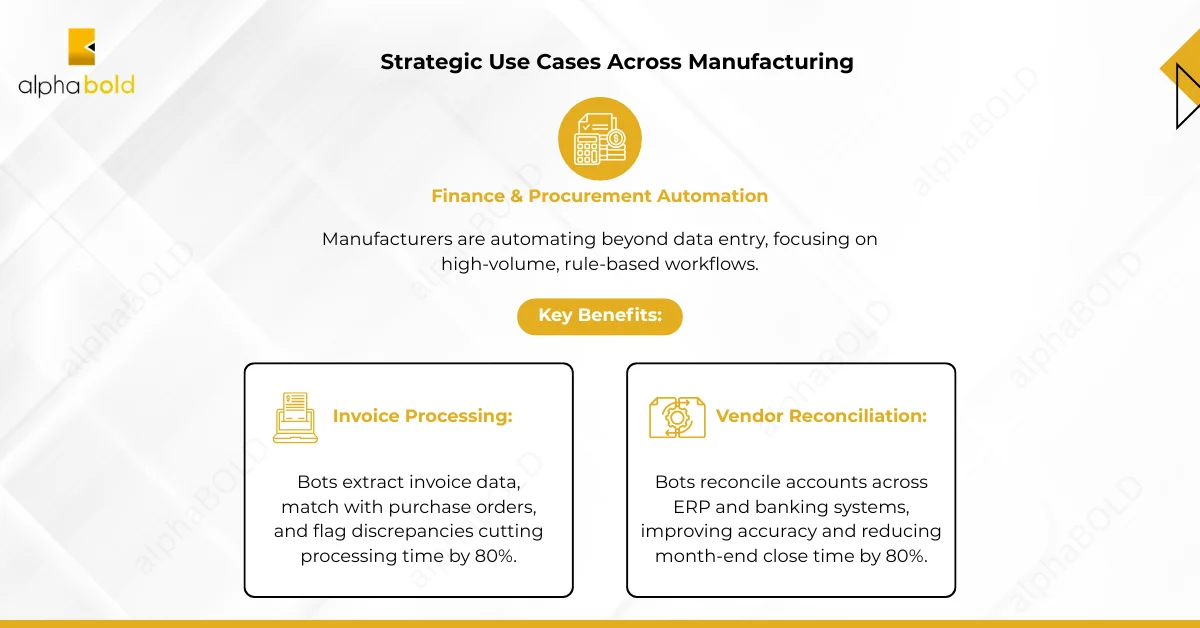
Finance and procurement often serve as entry points due to the sheer volume of invoices, purchase orders, and reconciliations. For instance, manufacturers relying on Excel-based invoice workflows are using bots to auto-match POs, validate line items, and process payments within seconds—cutting processing times by over 80% and reducing human error.
RPA bots streamline high-volume, rule-based financial workflows such as:
- Invoice Processing: Bots automatically extract invoice data, match it with purchase orders, and flag discrepancies, reducing processing time by 80% and lowering human error.
- Vendor Reconciliation: Bots reconcile vendor accounts across ERP and banking systems, eliminating manual checks and improving month-end close accuracy.
Real Results: One electronics manufacturer went from 180 minutes per invoice to 36 minutes, generating $180,000 in annual savings from one process alone.
2. Supply Chain Visibility & Alerts:
In the supply chain, RPA improves responsiveness by continuously monitoring vendor portals, updating ERP records, and triggering alerts for shipment delays or inventory shortfalls. Leading wineries and CPG companies, including E. & J. Gallo, have used RPA to accelerate new product launches without hiring additional staff, demonstrating how automation supports speed without compromising control.
RPA improves supply chain agility by:
- Monitoring supplier portals for shipment updates or delays.
- Updating ERP and MRP systems in real-time.
- Sending automated alerts for inventory shortages or exceptions.
3. Quality Assurance & Regulatory Compliance:
Quality assurance and compliance have also benefited significantly. When paired with AI and vision-based technologies, RPA enables automatic defect logging, batch trend analysis, and end-to-end regulatory reporting.
RPA reduces the manual burden in QA and compliance by:
- Logging inspection results automatically into compliance databases.
- Generating real-time audit reports and regulatory documents.
- Standardizing defect categorization and trend analysis.
Example: In pharmaceutical manufacturing, where regulatory compliance can make or break a company, RPA has become essential. Companies report a 45% reduction in case processing time while maintaining perfect audit trails. That’s millions in savings and avoided regulatory penalties.
4. Production Scheduling & Maintenance Coordination:
On the production side, RPA enhances scheduling by factoring in machine availability, order demand, and labor capacity.
Automation enhances production by:
- Scheduling maintenance tasks based on machine data or IoT-triggered alerts.
- Allocating resources dynamically based on order volumes and equipment availability.
Example: A Japanese automaker achieved 78% effort reduction in network maintenance by letting RPA handle routine scheduling and resource allocation. The human planners? They focus on strategic decisions and exception handling.
RPA Implementation Challenges in Manufacturing and How to Solve Them
Despite its benefits, RPA in Manufacturing is not without implementation friction especially in environments with legacy systems and fragmented IT infrastructure. Many organizations struggle to connect older ERP platforms, on-premise MES systems, and custom-built databases.
To overcome this, leading firms invest in middleware platforms such as Azure Integration Services or deploy RPA tools with robust API and UI compatibility.
Challenge #1: Legacy System Integration
Manufacturing IT systems are often a mix of outdated ERP platforms, new IoT sensors, poorly understood legacy MES platforms, and proprietary PLM data formats. Integrating RPA into this complex environment demands deep technical expertise.
Solution: Effective implementations typically rely on middleware and API-first strategies. However, unforeseen issues often arise. For example, an automotive supplier discovered that their legacy system only updated overnight, rendering real-time automation impractical without extensive adjustments.
Challenge #2: Workforce Resistance and Change Management
The biggest hurdle of implementing RPA in manufacturing industry isn’t technical—it’s cultural. Despite evidence showing that RPA generates more jobs than it replaces, skepticism among workers persists, often for valid reasons.
The solution lies in transparency and engagement. Demonstrate how RPA reduces repetitive tasks rather than replacing jobs. Involve employees in identifying automation opportunities and outline career growth in bot management and process optimization roles.
Companies that prioritize these strategies see adoption rates as high as 85%. Conversely, neglecting cultural integration and change management has caused 44% of automation initiatives to fail.
Challenge #3: Critical Skills Gap in RPA Implementation
RPA implementation demands expertise that many manufacturers lack. Success hinges on finding professionals proficient in manufacturing processes and automation technologies—a challenge, as 71% of manufacturers struggle to attract qualified talent.
Solution: Addressing this gap involves strategic capability building. Initiatives like citizen developer programs empower business users to create basic automations. Partnering with vendors for early-stage implementations ensures progress while your team gains hands-on experience. To secure specialized talent, competitive compensation is often a necessary investment.
You may also like: Robotic Process Automation (RPA) in Microsoft Power Platform
Ready to Overcome Implementation Challenges?
AlphaBOLD's AI and RPA in Manufacturing solutions simplify integration, optimize workflows, and drive efficiency.
Request a ConsultationHow to Implement RPA Successfully: A Step-by-Step Framework?
Step 1: Start with a Pilot Program
Step 2: Choose the Right RPA Platform
Step 3: Establish Governance and Scale Strategically
Emerging Tech Combinations: What’s Next in RPA Future?
AI-Powered Intelligent Automation:
With machine learning and natural language processing capabilities, bots are evolving from rule-followers to intelligent agents capable of interpreting invoices, analyzing maintenance logs, or making predictions based on sensor data:
- Predictive maintenance forecasts failures weeks in advance.
- Quality control systems learn from defects to prevent future issues.
- Production planning optimizes multiple variables simultaneously.
Example: electronics manufacturer are deploying AI-enabled bots to extract data from engineering drawings, validate compliance documents, and automate change requests reducing manual effort by up to 95%.
IoT Integration for Smart Manufacturing:
IoT devices on the production line generate real-time data that RPA bots can consume. This creates new automation loops, such as triggering work orders when a sensor detects a temperature anomaly or restocking raw materials when inventory hits a minimum threshold. These integrations are powering predictive maintenance and smart factory initiatives worldwide.
Cloud and Edge Computing Architecture:
Enhance RPA's Effectiveness for Your Organization.
If your team is considering implementing RPA, AlphaBOLD can assist. From assessing opportunities to implementation and training, our RPA consultants deliver measurable outcomes tailored to your goals.
Request a ConsultationConclusion
RPA in manufacturing is essential for competing globally; it is not just a trend or a replacement for workers. Leading companies use RPA to reconsider operations entirely.
The challenge isn’t whether to adopt RPA in the manufacturing industry but to start now and scale effectively. Benefits include increased efficiency, reduced costs, better quality, and employees engaged in meaningful work. While you consider your options, competitors are already implementing solutions. The future of manufacturing belongs to those who take decisive action today.
FAQs
Simple pilot automations can be deployed in 4-8 weeks, while enterprise-wide implementations typically take 3-6 months. The key is to start small with high-impact processes, then scale based on measurable results.
ROI gaps typically occur when use cases are not aligned with strategic goals. A structured framework that includes readiness evaluation, pilot validation, enterprise scaling, and continuous improvement ensures consistent business impact.
Explore Recent Blog Posts