
Security Testing for Healthcare: Protecting Patient Trust Across Portals, APIs, and EHR Systems

Table of Contents
Introduction
This blog explores why security testing matters for healthcare organizations and how it helps protect patient portals, healthcare APIs, EHR-connected systems, and other digital tools that support care delivery.
As healthcare organizations expand digital access through online scheduling, patient communication, lab results, billing, telehealth, and connected records, security becomes part of the patient experience. A weak access control setting, an exposed API, or an insecure portal can affect more than just data protection. It can disrupt care, damage patient trust, create compliance issues, and slow revenue-related workflows.
Security testing helps healthcare leaders assess whether their digital systems are secure, reliable, and ready to support patients, providers, payers, and partners. It identifies weaknesses before they become business risks, giving organizations a stronger foundation for safe digital care.
Why Security Testing Matters to Healthcare Organizations?
Healthcare executives may not initially view security testing as a priority. They are usually focused on patient experience, care quality, operational efficiency, compliance, and revenue protection. However, security testing directly supports all these areas because most healthcare services now depend on connected digital systems.
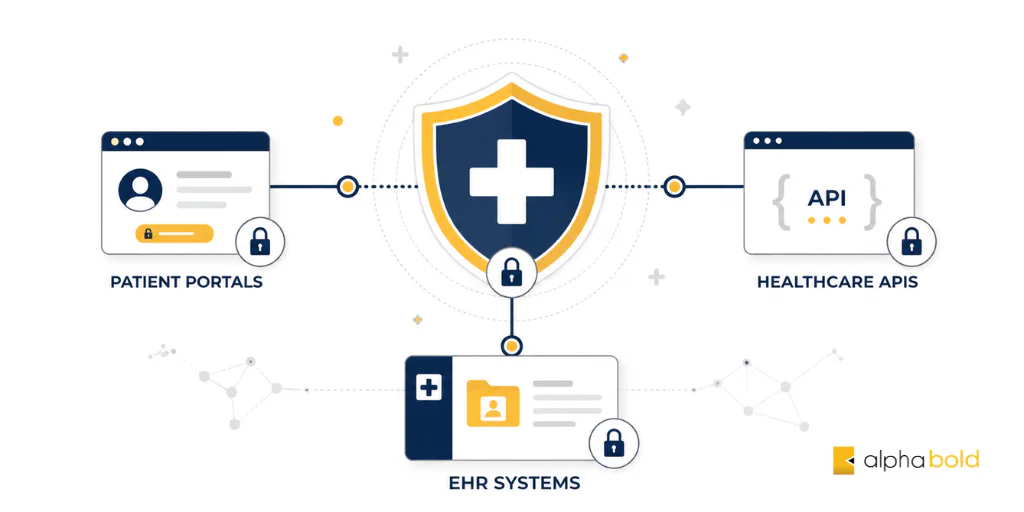
Patient portals, healthcare APIs, and EHR-connected platforms handle sensitive information every day. Patients use them to book appointments, view test results, pay bills, request prescription refills, and communicate with providers. Internal teams rely on them to access records, coordinate care, process claims, and share information across departments.
This growing reliance on digital healthcare systems has created a larger attack surface. A recent study by the National Library of Medicine on healthcare system vulnerabilities found that health IT has improved access, coordination, and data sharing, but has also introduced new risks to protected health information. The study reported that cyber-related PHI breaches increased from 15.3% in 2013 to 79.2% in 2023, showing how healthcare risk has shifted toward digital systems, external threats, and connected infrastructure.
If these systems are not tested properly, small weaknesses can become serious business risks. A broken permission setting can expose patient records. An insecure API can allow unauthorized access to data. A weak login process can put patient accounts at risk. A system disruption can delay care delivery, billing, and communication.
Security testing helps healthcare organizations identify these risks before they affect patients or operations. It gives leaders clearer visibility into where their systems are exposed and what needs to be fixed to protect trust, maintain compliance, and support secure digital growth.
What Is Security Testing in Healthcare?
Security testing is the process of evaluating digital systems to find weaknesses that could expose data, disrupt operations, or allow unauthorized access. In healthcare, this means testing the systems that store, process, or exchange protected health information.
This includes:
- Patient portals
- Healthcare APIs
- EHR-connected systems
- Telehealth platforms
- Billing and claims systems
- Cloud environments
- Third-party integrations
The goal is not only to find technical vulnerabilities. Security testing helps confirm that:
- Patients can only access their own records
- Providers can securely access the information they need
- APIs are protected from unauthorized data exposure
- Login and password reset processes are secure
- Sensitive data is handled safely across connected systems
- Digital workflows can support care delivery without unnecessary risk
For healthcare organizations, security testing provides a clear view of where digital risk exists and what needs to be fixed before it affects patients, operations, compliance, or revenue.
Bonus Reading: Essential Security Testing Practices for Cloud Applications
How Security Testing Supports Healthcare Business Priorities
Security testing matters because it protects the digital systems behind the metrics healthcare leaders already track. Patient portals, healthcare APIs, and EHR-connected systems support access to care, patient communication, billing, claims, and provider workflows. If these systems are insecure or unreliable, the impact can show up in patient satisfaction, compliance performance, operational efficiency, and revenue.
For healthcare organizations, security testing helps support:
- Patient trust: Protects records, test results, billing details, and private communication from unauthorized access.
- Portal adoption: Gives patients more confidence in using digital tools for appointments, records, payments, and provider messaging.
- Care continuity: Reduces the risk of disruptions that can delay appointments, referrals, prescriptions, or clinical workflows.
- Compliance readiness: Identifies gaps in access controls, data handling, audit trails, and security configurations.
- Revenue protection: Helps prevent issues that can interrupt billing, claims processing, online payments, or patient communication.
- Partner confidence: Strengthens trust with payers, labs, vendors, and other organizations connected to healthcare data.
In this context, security testing is not just a technical check. In this context, security testing is not just a technical check. It is a way to protect the systems that keep patients engaged, providers informed, and healthcare operations moving.
Ensure Consistent Protection Across Healthcare Systems
Patient portals, healthcare APIs, and EHR-connected workflows support care access, communication, billing, and data exchange. AlphaBOLD's security testing helps healthcare organizations identify critical weaknesses, reduce exposure, and strengthen digital trust before risks affect patients or operations.
Request a ConsultationWhy Healthcare Organizations Need the Right Security Testing Partner
As healthcare systems become more connected, security risks are increasingly difficult to detect and manage. AI-driven threats can make it harder to identify phishing, credential attacks, vulnerability discovery, and social engineering before damage occurs. At the same time, healthcare organizations are using more portals, APIs, cloud platforms, automation tools, and EHR-connected workflows than ever before.
This is why consulting value matters. A security testing partner does more than run tools and send a report. The right partner helps healthcare organizations understand:
- Which vulnerabilities create the greatest business risk
- How security gaps affect patient trust, care delivery, and compliance
- Which systems need immediate attention
- How to prioritize remediation without disrupting operations
- How to prepare for AI-enabled threats and more advanced attack methods
- How to strengthen security across applications, integrations, cloud environments, and connected workflows
AlphaBOLD brings this consulting-led approach to security testing by combining technical assessment with business context. Our team helps organizations evaluate vulnerabilities across patient-facing systems, healthcare integrations, cloud platforms, and connected workflows, then translate findings into clear remediation priorities.
For healthcare leaders, this means security testing becomes more than a checklist. It becomes a practical way to strengthen resilience, protect digital care experiences, and prepare for emerging threats.
Conduct Structured Security Testing Before Risk Reaches Patients
Patient portals, healthcare APIs, and EHR-connected systems need more than basic vulnerability checks. AlphaBOLD provides structured security testing to identify weaknesses early, validate system defenses, and reduce exposure before risks affect patients, providers, compliance, or operations. Our process helps healthcare organizations strengthen access controls, test connected workflows, and address vulnerabilities with clear remediation priorities.
Talk to an ExpertConclusion
Security is a business safeguard for the systems that patients, providers, payers, and partners rely on every day. Patient portals, healthcare APIs, and EHR-connected platforms now support access to care, communication, billing, data exchange, and digital engagement. If these systems are not secure, the impact can reach patient trust, compliance, operations, and revenue.
By identifying vulnerabilities early, security testing helps healthcare leaders reduce risk before it disrupts operations. It gives organizations a clearer view of weak access controls, exposed APIs, insecure integrations, and configuration gaps that could affect protected health information or care delivery.
As AI-driven threats and connected healthcare environments continue to evolve, working with the right security testing partner becomes even more important. A consulting-led approach helps healthcare organizations move beyond basic vulnerability reports and focus on the risks that matter most to patient experience, operational continuity, and long-term digital growth.
FAQs
Security testing can verify whether patients, providers, third-party apps, or internal users can access data they should not. This includes testing authentication, role-based access, API permissions, password reset flows, session handling, and exposed endpoints. This is especially important because real user discussions about EHR and patient API flaws raise concerns about unauthorized access to patient records through connected systems.
HIPAA compliance sets requirements, but it does not automatically prove that every portal, API, integration, or cloud configuration is secure. Security testing helps healthcare organizations validate how those controls work in real systems. For example, a system may be designed to support compliance, but weak access controls, exposed integrations, or misconfigured tools can still create risk. Forum discussions on HIPAA-compliant healthcare apps and no-code tools show that buyers are actively questioning whether these platforms are truly safe for production use in healthcare.
Before launch, healthcare organizations should test login security, patient identity verification, data access rules, API connections, third-party integrations, cloud permissions, and the system’s handling of protected health information. This matters even more for AI-enabled tools, as users have raised concerns that healthcare chatbots are exposing personal information without proper identity checks.
Security testing helps find weaknesses that could lead to ransomware exposure, credential compromise, system outages, or unauthorized access to connected healthcare systems. This matters because healthcare disruption is not just a technical issue. In public discussions about the Change Healthcare cyberattack, users reported thousands of claims due to system downtime, underscoring how cybersecurity incidents can directly affect revenue cycle workflows.
Internal tools can identify known vulnerabilities, but a consulting-led partner helps healthcare organizations understand which risks matter most to patient trust, compliance, care delivery, and revenue. This is especially important as AI-driven threats make phishing, impersonation, vulnerability discovery, and credential attacks harder to detect. Recent reporting on Microsoft-disclosed phishing activity found that healthcare and life sciences were among the most affected sectors, reinforcing the need for structured testing and expert guidance.
Healthcare organizations should schedule security testing before launching a new patient portal, healthcare API, mobile app, telehealth workflow, or EHR integration. Testing should also be performed after major system updates, cloud migrations, vendor changes, new AI tool deployments, or changes to access permissions.
This helps identify risks before they affect patients, providers, compliance, or revenue-related workflows. For high-risk systems that handle protected health information, security testing should not be treated as a one-time activity. It should be part of ongoing digital risk management.