

Table of Contents
Introduction
IPaaS (Integration Platform as a Service) is a cloud-based solution that enables organizations to integrate different software applications and systems in a single platform. These tools and services can include data integration, application integration, process integration, management, and deployment capabilities. IPaaS platforms can connect various systems and data sources, such as enterprise resource planning (ERP) systems, customer relationship management (CRM) systems, and databases. They can be accessed and managed through a web-based interface. IPaaS platforms can help organizations streamline their operations, improve data flow and collaboration, and accelerate digital transformation initiatives by enabling the integration of different systems and data sources without the need for complex and costly on-premises infrastructure.
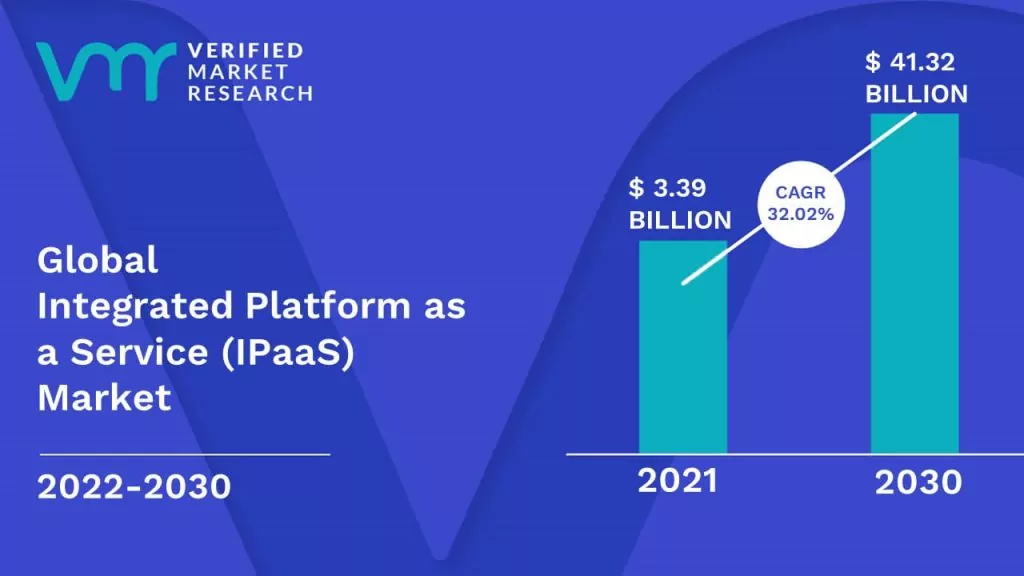
The Booming iPaaS Industry: 2026 Market Landscape
The competitive landscape includes both established enterprise players and innovative challengers:
Leaders:
- Dell Boomi: Strong AI-driven automation focus with extensive pre-built connectors
- MuleSoft (Salesforce): API-led connectivity embedded within Salesforce ecosystem
- IBM App Connect: Hybrid multicloud integration with Watson AI capabilities
- Informatica: Data-centric approach with strong ETL heritage and CLAIRE AI engine
- Microsoft Azure Integration Services: Cloud-native platform tightly integrated with Azure ecosystem
- SAP Integration Suite: Composable, AI-assisted approach with comprehensive Business Accelerator Hub
- Workato: Leading low-code platform with strong workflow automation capabilities
Challengers and Visionaries:
- SnapLogic: Modern, cloud-native platform with event-driven architecture
- Jitterbit: Balanced ease-of-use with powerful customization (Gartner #1 for implementation)
- Oracle: Deep integration with Oracle applications ecosystem
- Talend: Open-source roots with strong data integration capabilities
The market continues to evolve with specialized players emerging in embedded iPaaS (Paragon, Prismatic, Pandium) and unified API platforms (Merge, APIdeck) serving specific B2B SaaS needs.
Importance of iPaaS
iPaaS is an essential tool for organizations in today’s fast-paced business environment. It allows them to connect and integrate various systems and applications, improving communication and data flow, and streamlining processes. This results in increased efficiency and effectiveness, enabling organizations to focus on their core business activities and achieve their goals more easily. Additionally, iPaaS is a cost-effective solution compared to custom integration development. Its flexibility allows organizations to connect to a wide range of systems and applications, both cloud-based and on-premise. Organizations leveraging iPaaS can stay ahead of the curve and remain competitive in an ever-changing market.
Use cases for iPaaS
iPaaS (Integration Platform as a Service) helpimprove business operations in several ways:
- Integrating different systems and applications.
- Streamlining processes and automating repetitive tasks.
- Improving data flow and accuracy.
- Enhancing business intelligence through data analysis.
- Improving customer experience by integrating customer-facing systems.
- Supporting digital transformation initiatives.
You may also like: Choosing Between Legacy Integration & New Implementation
How IPaaS solution works
An example of how an IPaaS (Integration Platform as a Service) solution might work with systems integration is as follows:
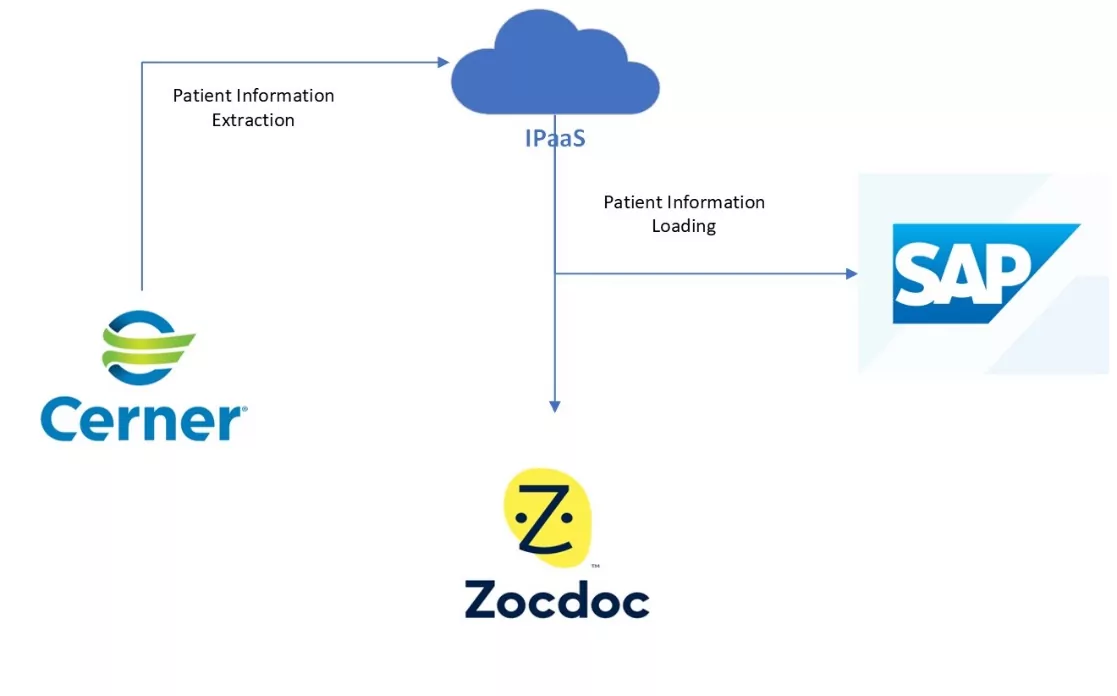
- A healthcare organization wants to integrate its electronic health records (EHR) system, built on Cerner, with its financial management system on SAP, and its patient scheduling system built on ZocDoc.
- The organization signs up for an IPaaS solution and connects all three systems using pre-built connectors provided by the IPaaS solution.
- Once the systems are connected, users can use the IPaaS solution to set up integrations that automatically extract patient information from the EHR system and load it into the financial management system and patient scheduling system in real time.
- The IPaaS solution can also be used to set up data transformation rules that ensure that the data is formatted correctly before it is loaded into the financial management and scheduling system.
- The organization can use the web-based interface of the IPaaS solution to monitor the status of the integrations and troubleshoot any issues that may arise. They can also use the solution’s security features to ensure that the data is transmitted securely and only accessible by authorized users and systems.
As a result, the organization can now view accurate and up-to-date patient information in their financial management and scheduling system, which can help them better manage their finances, schedule patient appointments and keep track of patient information in a more streamlined way.
Strategic iPaaS Positioning: iPaaS vs. ESB vs. Embedded iPaaS
iPaaS vs. Enterprise Service Bus (ESB): The Architectural Paradigm Shift:
Enterprise Service Bus (ESB) dominated integration strategies before cloud computing became prevalent. While ESB remains relevant for specific on-premises legacy scenarios, the architectural differences reveal why iPaaS has become the modern standard:
Deployment and Infrastructure Philosophy:
- ESB operates as on-premises middleware requiring significant hardware investment, dedicated IT resources for maintenance, and complex configuration. Organizations must provision servers, manage upgrades, and handle patches internally.
- iPaaS delivers cloud-native integration as a fully managed service where the vendor handles infrastructure, scaling, security patches, and platform updates automatically. This eliminates infrastructure overhead and allows IT teams to focus on business logic rather than system maintenance.
Scalability Architecture:
- ESB scales vertically, meaning you add more resources (CPU, memory) to existing systems. Because ESB runs on-premises with complex architectures, scaling requires considerable resources, planned downtime, and often involves procuring additional hardware.
- iPaaS scales horizontally through cloud elasticity, automatically adding capacity as integration volume increases. Engineers can integrate new applications into the ecosystem relatively easily without architectural constraints.
Development Paradigm:
- ESB demands code-heavy development with proprietary tools requiring specialized technical expertise. Integration projects can take months to complete and require deep knowledge of messaging protocols, transformation engines, and ESB-specific development environments.
- iPaaS offers visual, low-code/no-code interfaces that empower both technical and business users. Pre-built connectors, drag-and-drop workflow builders, and intuitive interfaces enable rapid integration deployment, often reducing development time by up to 75%.
Cost Structure and ROI:
- ESB involves substantial upfront capital expenditure for hardware, software licenses, and implementation services, plus ongoing operational expenses for maintenance, upgrades, and specialized staff.
- iPaaS operates on subscription-based pricing with pay-as-you-go models that align costs with actual usage. Organizations switching from ESB to platforms like Boomi achieve 307% ROI over three years while dramatically reducing time-to-market.
When ESB Still Makes Sense: ESB remains appropriate for organizations with extensive on-premises legacy systems that require complex message-level integration with strict governance requirements, especially in regulated industries like financial services. Many enterprises adopt a hybrid approach, using ESB as the backbone for legacy systems while deploying iPaaS for cloud and modern application integration.
Discover Expert Integration with AlphaBOLD
Looking for top-tier iPaaS solutions tailored for API or event-driven integration? Let our experts guide you. Schedule a consultation with AlphaBOLD today!
Schedule Free ConsultationThe Emergence of Embedded iPaaS: Integration as a Product Feature
A transformative category has emerged specifically for B2B SaaS companies: Embedded iPaaS. This represents a fundamental shift from integration as an internal capability to integration as a product feature.
Strategic Differentiator: Traditional iPaaS focuses on improving internal workflows for end users. Embedded iPaaS serves software vendors who want to offer native integrations as part of their product experience. This distinction is crucial:
- Internal iPaaS helps Company X connect their Salesforce to their SAP system
- Embedded iPaaS helps Company X offer pre-built integrations so their customers can connect Company X’s product to their own Salesforce/SAP/NetSuite systems
Business Impact for SaaS Companies:
Companies face a critical competitive disadvantage when they cannot integrate with their customers’ existing tech stacks. According to recent industry data, businesses selling standalone software get cut from enterprise deals early in the evaluation process. The alternative-building custom integrations case-by-case-creates endless API development cycles that pull engineering resources away from core product innovation.
Why Embedded iPaaS Became Essential:
Around 63% of companies invest in integrations to improve customer retention. Organizations building their own integration infrastructure face:
- Months of development time per integration
- Ongoing maintenance burden as third-party APIs change
- Authentication and token management complexity across hundreds of customer instances
- No standardized approach to error handling, logging, and monitoring
Embedded iPaaS platforms (Paragon, Prismatic, Workato Embedded, Tray Embedded) solve this by providing white-label integration capabilities that appear native to your product while the platform handles all technical complexity behind the scenes.
Key Architectural Advantages:
- Native User Experience – Customers configure integrations without leaving your application
- Multi-Tenancy at Scale – Handle authentication and data isolation for thousands of customers automatically
- Managed Authentication – Platform handles OAuth tokens, refresh policies, and secure credential storage
- Infrastructure Scalability – Leading platforms are load-tested to handle millions of concurrent requests
- Full API Control – Access underlying APIs for custom integration logic while leveraging platform features
Strategic Selection Criteria:
When evaluating embedded iPaaS vendors, SaaS companies should prioritize:
- Extensibility – Can you build custom integrations beyond pre-built connectors?
- White-Labeling – Does the platform support fully branded experiences, or will customers see third-party branding?
- Developer Experience – How easily can your engineering team deploy, monitor, and debug integrations?
- Infrastructure Robustness – What scale can the platform handle as your business grows?
- Implementation Flexibility – Native SDK, headless, or embedded options?
The embedded iPaaS market has exploded from a handful of vendors in 2019 to over 40 options today, reflecting the strategic importance of product integrations in modern SaaS go-to-market strategies.
Choosing the right iPaaS solution
When choosing an iPaaS solution, it’s important to consider the following factors:
- Integration requirements: Evaluate the systems and applications that need to be integrated and the type of integration required (e.g., real-time, batch).
- Scalability: Ensure that the iPaaS solution can scale to meet the growing needs of your organization.
- Security: Consider the security measures to protect sensitive data during integration.
- Ease of use: Ensure the solution is user-friendly and easy to use so that integration can be done quickly and efficiently.
- Integration capabilities: Consider the types of integrations the iPaaS solution supports (e.g., application-to-application, application-to-data) and the number of integrations it can handle.
- Cost: Compare the cost of different iPaaS solutions and choose one that offers the best value for money.
- Technical support: Evaluate the level of technical support offered by the iPaaS provider and ensure that it meets your organization’s needs.
Struggling with Cloud Silos and Disconnected Systems?
iPaaS is the answer, but selecting the right one can be challenging. AlphaBOLD’s team of DevOps specialists is ready to help you identify and implement the perfect solution. Request a consultation now and discover how we can simplify your integration process.
Request a ConsultationThe Pros and Cons of Using an iPaaS
| Pros of iPaaS | Cons of iPaaS |
|---|---|
|
Increased efficiency: iPaaS streamlines processes by automating repetitive tasks, reducing manual effort, and freeing up time for more valuable activities. |
Dependency on the cloud: iPaaS solutions rely on the cloud, which can be a concern for organizations that are not yet fully committed to cloud computing. |
|
Improved data flow and accuracy: iPaaS helps improve the flow of datadata between systems, reducing the risk of errors and ensuring data accuracy. |
Limited customization options: While iPaaS solutions offer a wide range of integrations, they may not offer the level of customization that some organizations require. |
|
Scalability: iPaaS solutions can easily scale to meet the growing needs of an organization, without requiring additional hardware or software. |
Integration challenges: Integrating complex systems and applications can be challenging and may require the assistance of a specialized iPaaS consultant. |
|
Easy to use: iPaaS solutions are user-friendly and easy to use, making integration quick and efficient. |
Security concerns: Integrating sensitive data between systems can raise security concerns, and organizations should carefully evaluate the security measures in place when choosing an iPaaS solution. |
Measuring iPaaS Success: KPIs and Business Value Realization
Financial Metrics: Quantifying ROI:
- Integration Development Cost Reduction: Track the cost per integration before and after iPaaS implementation. Include developer time, infrastructure costs, and third-party services. Leading organizations report 50-70% reduction in per-integration costs using modern iPaaS platforms versus custom development.
- Time-to-Market Acceleration: Measure how quickly new integrations can be deployed from requirement gathering to production. Pre-iPaaS implementations often require 3-6 months per complex integration. With iPaaS, organizations typically achieve the same results in 2-6 weeks, representing a 75-90% time reduction.
- Infrastructure Cost Savings: Calculate savings from eliminating on-premises integration infrastructure, including server costs, data center expenses, backup systems, and associated maintenance. Organizations migrating from ESB to iPaaS typically reduce infrastructure costs by 40-60%.
- Opportunity Cost Recovery: Quantify the value of IT resources freed from integration maintenance who can now focus on strategic initiatives. If senior developers spending 60% of their time on integration maintenance can redirect that time to product innovation, what’s the business impact?
- Total Cost of Ownership (TCO): Calculate 3-5 year TCO including subscription costs, implementation services, training, ongoing maintenance, and platform fees. Compare against the TCO of alternatives (custom development, ESB, point-to-point integrations). Organizations typically achieve 307% ROI over three years according to Forrester Total Economic Impact studies.
Operational Metrics: Measuring Performance
- Integration Reliability and Uptime: Track integration availability, success rates, and failure frequency. Leading platforms maintain 99.9% uptime with sophisticated monitoring and self-healing capabilities. Establish baselines and set targets for improvement.
- Data Synchronization Latency: Measure how quickly data flows between systems. Real-time integrations should complete within seconds; batch integrations should meet defined SLA windows. Track any degradation over time that might indicate performance optimization needs.
- Integration Maintenance Burden: Quantify hours spent maintaining integrations monthly. This includes troubleshooting failures, updating integration logic due to API changes, and performance tuning. iPaaS platforms with AI-powered self-healing capabilities can reduce maintenance burden by 60%.
- Error Rate and Recovery Time: Track integration error frequency and mean time to resolution (MTTR). AI-powered platforms with autonomous agents can detect, diagnose, and remediate errors in minutes versus hours or days with manual intervention.
- Platform Adoption Metrics: Monitor the number of integrations deployed, active users, integration executions per month, and data volumes processed. Growth trends indicate value realization and platform stickiness.
Business Impact Metrics: Demonstrating Strategic Value
- Process Automation Rate: Calculate the percentage of manual processes successfully automated through integration. Example: If 80% of order-to-cash processes are now automated versus 30% pre-iPaaS, quantify the hours saved and error reduction achieved.
- Data Accuracy and Quality: Measure improvements in data consistency across systems. Automated integrations with validation rules typically reduce data errors by 70-90% compared to manual data entry or file-based transfers.
- Business Agility Indicators: Track how quickly your organization can respond to market opportunities. Can you launch in a new geography in weeks instead of months because integration infrastructure scales easily? Can you onboard enterprise customers faster because integration requirements don’t require custom development?
- Customer and Partner Satisfaction: For organizations using embedded iPaaS, measure customer satisfaction scores, time-to-onboard new customers, and integration-related support ticket volume. Customers who can self-service integrations report 40% higher satisfaction scores.
- Innovation Velocity: Track the rate of new product features, services, or business models enabled by integration capabilities. Organizations with mature iPaaS platforms can experiment rapidly because integration isn’t a constraint.
Unravel the Power of Seamless Integration
From connectors to intricate routing, orchestration, and data mapping, AlphaBOLD offers a comprehensive suite of iPaaS capabilities. Dive deeper into how we can transform your integration processes.
Book Your Consultation NowConclusion
Explore Recent Blog Posts