


Introduction
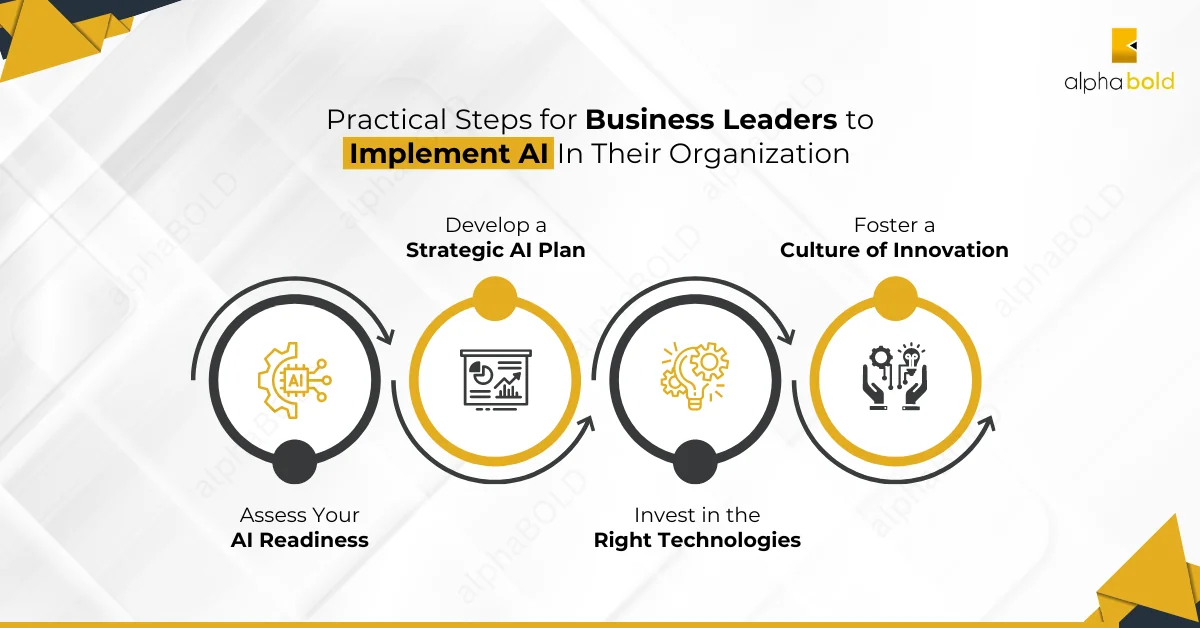
This blog post outlines four practical steps for business leaders to implement AI in their organization in a way that delivers real value, not just experimentation.
Artificial intelligence is no longer something businesses are merely exploring out of curiosity. It has become a core part of how companies improve efficiency, make better decisions, and stay competitive. Studies continue to show that organizations using AI in at least one business function are more likely to see positive revenue impact and operational gains.
While well-known companies like Coca-Cola, Amazon, and Netflix have successfully embedded AI into their operations, many business leaders still struggle with where to start and how to apply AI in a way that fits their own organization. The challenge is rarely about access to AI tools. It is about understanding how to introduce AI into existing processes, systems, and teams without creating disruption or uncertainty.
Challenges Leaders Encounter While Implementing Business Strategies for AI Implementation

Even though AI adoption is increasing, many organizations struggle to move from interest to real execution. The challenges business leaders face are often practical rather than technical, which is why a clear implementation approach is essential.
- Unclear expectations and outcomes
Many AI initiatives begin with broad objectives such as improving efficiency or innovation. Without clearly defined success metrics tied to business goals, these initiatives often remain experimental and fail to gain long-term leadership support. - Data that exists but is not usable
While organizations collect large volumes of data, it is often fragmented across systems, outdated, or inconsistent. Poor data quality limits the accuracy of AI insights and reduces trust in AI-driven recommendations. - Limited integration with existing systems
AI tools that operate separately from core platforms like CRM, ERP, or reporting systems rarely influence daily decision-making. When AI insights are not embedded into existing workflows, adoption remains low and business impact is minimal. - Skill gaps and internal resistance
Employees may lack the training or confidence needed to use AI effectively. In some cases, hesitation comes from uncertainty about how AI will affect roles and responsibilities, slowing adoption across teams. - Difficulty demonstrating return on investment
AI projects often require time to show measurable results. When early ROI is unclear, it becomes harder for business leaders to justify continued investment, causing initiatives to lose momentum.
These challenges explain why many organizations struggle with the steps for business leaders to implement AI effectively. Addressing them early creates a stronger foundation for execution, which is exactly what the four steps in the next section are designed to do.
Further Reading: Top AI Implementation Challenges in 2026 and How to Solve Them
Step 1: Define Clear Business Objectives for AI
Before investing in tools or technology, business leaders need to be clear about what AI is expected to achieve. AI initiatives are far more likely to succeed when they are tied to specific business outcomes rather than broad ambitions.
Start with real business problems, not AI ideas
Instead of asking where AI can be used, start by identifying where the business is struggling. This could include slow decision-making, manual processes, inconsistent forecasting, customer churn, or operational inefficiencies. AI should be positioned as a way to address these challenges, not as an experiment running in parallel to them.
Define what success looks like in measurable terms
Clear objectives help keep AI initiatives focused and accountable. Business leaders should define success using metrics they already track, such as reduced processing time, improved forecast accuracy, lower operating costs, or higher customer retention. This makes it easier to evaluate progress and justify continued investment.
Prioritize use cases based on impact and feasibility
Not all AI opportunities carry the same value or risk. Leaders should prioritize initiatives that offer meaningful business impact while remaining realistic to implement. Starting with high-impact, achievable use cases helps build confidence and momentum before expanding further.
Assign ownership early
Every AI initiative should have a clear business owner responsible for outcomes. When ownership is unclear, AI projects often stall or remain isolated within technical teams. Clear accountability ensures AI stays aligned with business priorities rather than becoming a purely technical exercise.
Defining clear objectives at the outset creates a strong foundation for the rest of the implementation journey. Once business goals are established, the next step is to evaluate whether the organization’s data, systems, and processes are ready to support AI in a meaningful way.

Step 2: Assess AI Readiness Across Data, Systems, and Workflows
Once business objectives are clearly defined, the next step is to assess whether the organization is actually ready to support AI. Many AI initiatives struggle not because the idea is wrong, but because the underlying data, systems, or workflows are not prepared to absorb AI-driven insights.
Evaluate data quality and accessibility
AI relies heavily on data, but having large volumes of data does not automatically mean it is usable. Business leaders should assess whether data is accurate, up to date, and accessible across teams. Identifying gaps early helps avoid unreliable outputs and reduces rework later in the implementation process.
Review existing systems and platforms
It is important to understand where AI will operate within the organization. Core systems such as CRM, ERP, analytics tools, and operational platforms should be reviewed to ensure they can support AI integration. If AI insights cannot flow into these systems, they are unlikely to influence real decisions.
Assess workflow readiness
AI delivers value only when it fits naturally into how work is done. Leaders should identify key decision points within existing workflows where AI insights could support or improve outcomes. This helps prevent AI from becoming an isolated tool that teams rarely use.
Clarify data ownership and governance
Clear ownership of data and defined governance practices are essential for maintaining data quality and trust. Business leaders should ensure responsibilities around data management, access, and compliance are clearly assigned before scaling AI initiatives.
Identify readiness gaps early
Not every organization will be fully ready for AI at the same time, and that is expected. The goal of this step is not to delay progress, but to understand where improvements are needed so they can be addressed alongside AI implementation.
Assessing readiness early creates a realistic foundation for implementation. With a clear understanding of data, systems, and workflow readiness, business leaders are better positioned to select the right AI approach and avoid unnecessary complexity in the next stage.
Discover Tailored AI Solutions for Your Business
Every business is unique, and so are your AI needs. At AlphaBOLD, we specialize in creating customized AI strategies that align with your business goals. Discover the steps for business leaders to implement AI effectively. Request a consultation now, and let us help you unlock new opportunities, enhance customer experiences, and achieve operational excellence with AI.
Request a ConsultationStep 3: Select and Apply the Right AI Approach
After confirming readiness, business leaders need to decide how AI should be applied within the organization. One of the most common mistakes at this stage is over-investing in complex solutions when simpler approaches would deliver the same or better results.
Start with AI already embedded in existing platforms
Many organizations already have access to AI capabilities within systems they use every day, such as CRM, ERP, analytics, or productivity tools. Activating and adopting these features often delivers quick value with minimal disruption, as teams are already familiar with the platforms.
Extend AI using your organization’s data where deeper insight is needed
When embedded AI is not enough, the next step is to enhance it with enterprise data. Connecting AI to financial, operational, or customer data allows insights to reflect how the business actually operates, leading to more relevant and actionable outcomes.
Build custom AI only where it truly adds value
Custom AI solutions should be reserved for use cases that require differentiation, industry-specific logic, or regulatory compliance. Building AI for every problem increases cost and complexity without guaranteeing better results. Leaders should be selective and intentional when deciding to invest in custom development.
Match the level of AI investment to the business problem
Not every challenge requires the same depth of AI capability. Some problems can be addressed through simple automation, while others benefit from predictive or advanced analytics. Choosing the right approach helps control costs and keeps AI initiatives aligned with business priorities.
Avoid treating all AI initiatives the same
Applying a single strategy across all use cases often leads to inefficiencies. Business leaders should evaluate each AI initiative individually and choose the approach that best fits the expected impact, risk, and effort involved.
Selecting the right AI approach helps organizations balance value and complexity. With a clear understanding of where to enable, extend, or build AI, the final step is to ensure these initiatives are embedded into daily operations and managed responsibly over time.
Step 4: Operationalize, Monitor, and Scale AI Responsibly
The final step focuses on turning AI initiatives into part of everyday business operations. Without clear ownership, monitoring, and structure, even successful pilots can lose momentum or fail to deliver long-term value.
Integrate AI into existing workflows and systems
AI delivers impact when insights are embedded into the tools teams already use, such as CRM systems, ERP platforms, or operational dashboards. When AI outputs sit outside these workflows, adoption drops and decision-making remains unchanged.
Establish clear ownership and accountability
Each AI initiative should have a defined business owner responsible for performance and outcomes. Clear accountability ensures AI remains aligned with business priorities and does not become a disconnected technical exercise.
Monitor performance and adoption continuously
AI models require regular review to ensure accuracy, relevance, and reliability over time. Business leaders should track both technical performance and how teams are actually using AI insights to support decisions.
Measure and communicate return on investment
Ongoing measurement helps maintain leadership support and ensures AI investments remain justified. Monitoring improvements in efficiency, cost reduction, revenue impact, or decision quality provides a clear picture of value.
Scale only what works and retire what does not
Not every AI initiative should be expanded. Leaders should scale solutions that consistently deliver value and phase out those that fail to meet expectations, keeping the AI portfolio focused and sustainable.
This final step ensures that the steps for business leaders to implement AI result in measurable outcomes rather than short-term experimentation. According to a 2025 McKinsey Global Survey, most organizations report that they are still in early stages of AI adoption and have not yet moved beyond pilot projects into widespread operational impact. When AI is treated as an operational capability and managed with discipline, it becomes a reliable driver of long-term business value.
Further Reading: Cost Analysis: Implementing Generative AI in Your Organization
Maximize Your Artificial Intelligence ROI with AlphaBOLD
Worried about the ROI of your AI investments? Let AlphaBOLD help you maximize returns and drive tangible business value. Book a consultation with our AI specialists today to discuss your goals and discover tailored strategies for achieving exceptional ROI. Invest in success with AlphaBOLD’s proven AI solutions.
Request a ConsultationConclusion
Leaders today need deliberate business strategies for AI implementation to fully realize the potential of the latest tech. Business executives can use AI to create change and accomplish their objectives by implementing the four practical steps for business leaders to implement AI in this blog.
If you want to stay ahead of the competition, it’s crucial to keep up with the most recent developments in AI, as well as best practices and ethical issues. To navigate the AI ecosystem and its complexities effectively, research and learn from the insights provided by industry professionals and academic research. Following these steps, you’ll be well-positioned to lead your company into the future and realize AI’s full potential if you accomplish this.
Explore Recent Blog Posts