

AI for Nonprofits: Driving Impact, Efficiency, and Sustainable Growth

Table of Contents
Introduction
Nonprofits operate under constant pressure to do more with limited resources while delivering measurable outcomes. These constraints make efficiency and impact not just important, but essential.
As a result, AI for nonprofits is gaining attention as a practical way to address these challenges. The real question is no longer whether AI can be used, but where it delivers measurable value and what it takes to implement it effectively.
This blog explores where AI creates real impact, the operational changes it drives, and what leaders should consider before making an investment.
Where Does AI Deliver the Most Value in Nonprofits?
AI for nonprofits delivers the most value in fundraising, program delivery, operations, and engagement when applied to clear use cases supported by reliable data. It helps organizations target the right donors, allocate limited resources more effectively, reduce manual work, and maintain consistent communication without increasing staff workload.
This impact is not theoretical. Recent research from McKinsey & Company shows that AI-driven personalization can increase revenue by 5 to 8 percent while reducing the cost to serve by up to 30 percent. For nonprofits, this translates directly into better use of constrained budgets and more efficient delivery of outcomes.
The results, however, depend on data quality and focus. When data is structured and the use case is specific, even simple AI tools can improve outcomes. Without that foundation, results are inconsistent, and adoption slows.
These benefits become clearer when we look at how AI is applied across specific nonprofit functions.
1. How Does AI Improve Fundraising Outcomes?
AI helps nonprofits move from broad outreach to targeted donor engagement using data insights. Instead of allocating limited fundraising budgets across large, undifferentiated audiences, organizations can prioritize donors based on likelihood to give, engagement history, and behavioral patterns. This improves response rates and increases return on fundraising spend.
What Changes in Practice?
Traditional fundraising relies on manual segmentation and broad campaigns. AI introduces a more structured, data-driven approach where outreach is guided by predictive insights rather than assumptions. Teams can focus on high-value opportunities instead of distributing effort across low-probability donors.
Real Impact Areas:
AI in nonprofits delivers measurable improvements across key fundraising activities:
- Donor propensity modeling (likelihood to give or churn)
- Outreach message personalization
- High-value donor segmentation
Over time, this leads to more predictable campaign performance and better use of limited fundraising resources.
Practical Insight:
The effectiveness of these models depends on data quality. In many nonprofit environments, donor data is:
- Fragmented across multiple tools
- Incomplete or outdated
Without a reliable data foundation, even advanced models will produce inconsistent results.
What to Do Instead?
2. How Does AI Support Better Program Decisions?
AI implementation for nonprofits improves decision-making by helping organizations act earlier and allocate resources more effectively. By analyzing historical and real-time data, AI can identify risks, demand patterns, and service gaps that would otherwise go unnoticed.
This is especially important in environments where resources are limited and demand is unpredictable. AI allows organizations to direct support where it has the highest impact rather than reacting after issues occur.
Examples
Common nonprofit AI use cases in program delivery include:
- Risk prediction for vulnerable beneficiaries
- Resource optimization (food distribution, medical supplies)
- Identification of underserved or underprivileged areas
What Really Changes:
Decision-making becomes more structured and evidence-based. Teams shift from reactive responses to proactive interventions, improving both efficiency and program outcomes.
Key Challenge:
AI adoption strategy for nonprofits must address trust and fairness concerns. Poor-quality or biased data can reinforce existing inequalities, and lack of transparency can reduce confidence in AI-driven decisions.
What to Do Instead:
Start with interpretable models and clearly defined use cases. Ensure that outputs can be explained to stakeholders and validated against real-world outcomes. Avoid unnecessary complexity in early stages of adoption.
Turn AI into Measurable Impact for Your Nonprofit
AlphaBOLD helps nonprofits design practical AI implementation strategies, from fundraising optimization to program decision support, ensuring every initiative is aligned with real operational outcomes.
Request a Consultation3. How Does AI Reduce Admin Overhead in Operations Without Fully Replacing Work?
Nonprofit automation tools and copilot-style systems can significantly reduce manual effort, but expectations need to remain realistic. The primary benefit is improved speed and consistency in routine tasks, not full automation of workflows.
Where These Tools Deliver Value?
AI tools are most effective in structured, repeatable tasks where inputs and outputs are predictable.
- Grant proposal drafting
- Document summarization
- Repetitive documentation and reporting
These improvements reduce administrative burden and allow teams to focus on higher-value work without increasing operational costs.
Where These Tools Fall Short
AI struggles in workflows that require judgment, approvals, or context-sensitive decisions.
- Complex processes requiring human sign-off
- Decisions involving multiple stakeholders or changing conditions
Important Clarification:
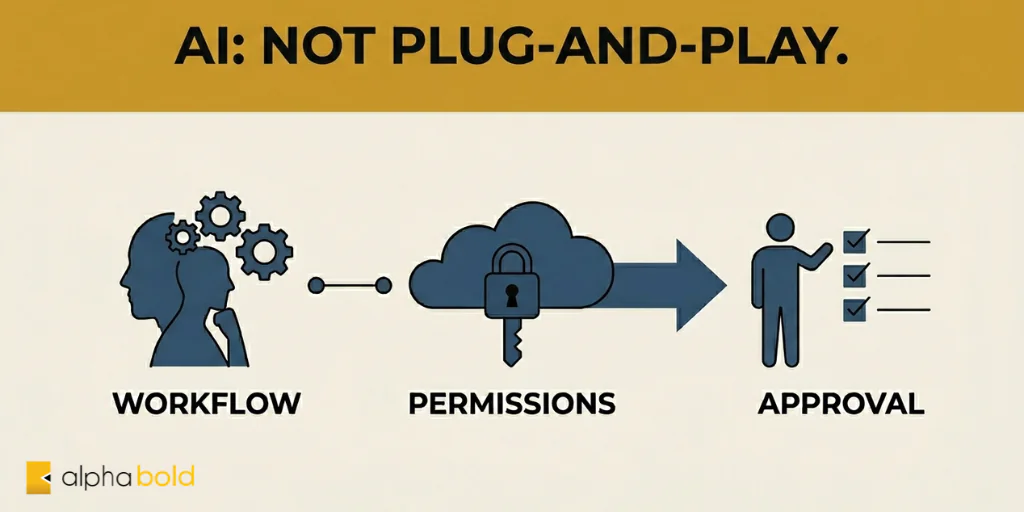
AI implementation for nonprofits is not plug-and-play. These systems require:
- Thoughtful workflow and prompt design
- Proper data access and permissions
- Defined review and approval processes
What Actually Changes:
AI shifts how work is done rather than eliminating it. Routine execution is automated, while human effort moves toward validation, refinement, and decision-making.
4. How Does AI for Nonprofits Enable Personalized Engagement at Scale?
Maintaining consistent and meaningful engagement with donors and volunteers is a persistent challenge for nonprofits with limited staff and time. As interaction volume increases, responsiveness often declines.
AI for nonprofits addresses this by enabling scalable, personalized communication without increasing headcount.
How AI Supports Engagement at Scale?
- Automated personalized email responses
- Chatbots for donor and volunteer queries
- Smart scheduling and volunteer matching
These tools improve responsiveness and maintain consistency across large audiences.
Where the Risk Shows Up?
Over-automation can reduce authenticity. When every interaction feels system-generated, trust and long-term engagement can decline.
What Works in Practice?
The most effective approach is a hybrid model:
- Use AI for initial interactions and routine responses
- Keep human involvement in relationship-building and ongoing engagement
This balance allows nonprofits to scale communication efficiently while preserving personal connection.
What Should Leaders Know Before Implementing AI?
Artificial intelligence in nonprofits requires more than selecting the right tools. It demands clear planning, data readiness, and alignment with measurable outcomes. AI implementation for nonprofits is an operational shift that impacts data, workflows, and people.
Without this alignment, organizations risk investing in tools that deliver limited value, slowing adoption, and increasing costs without improving outcomes.
Is AI Plug-and-Play for Nonprofits?
AI tools do not deliver instant value. They require setup, configuration, and integration with existing workflows to produce reliable results.
What Successful Implementation Requires?
An effective AI adoption strategy for nonprofits depends on preparing both systems and teams:
- Data preparation
- Workflow integration
- Staff training
- Continuous monitoring
Without these foundations, even well-designed tools fail to produce consistent outcomes.
Time to Value: The timeline for results depends on the complexity of the use case and the maturity of the data environment:
- Simple use cases (content generation): weeks
- Complex use cases (predictive analytics): months
Organizations that start with focused, well-defined use cases typically see faster and more reliable returns.
2. Why Is Data Readiness the Biggest Barrier?
Data readiness is the most common challenge in AI implementation for nonprofits. Many organizations underestimate the effort required to clean, structure, and unify their data before it can support reliable AI outputs.
Common Issues
In most nonprofit environments, data is:
- Siloed across systems such as CRM platforms, spreadsheets, and email tools
- Inconsistent due to lack of standardization
- Incomplete or missing historical context
Why This Matters?
Poor data quality leads to inaccurate outputs and low trust in AI systems. This slows adoption and increases the risk of wasted investment, particularly for organizations operating with limited budgets.
3. How Should Nonprofits Evaluate AI Cost vs. Impact?
AI for nonprofits should be evaluated based on measurable impact, not just technology adoption. The goal is to ensure that every investment improves efficiency, supports mission outcomes, or reduces operational strain.
Costs to Consider
Organizations need to account for both direct and indirect costs:
- Licensing and tool costs
- Integration and implementation costs
- Ongoing operational overhead
Where to Focus First
To maximize return on investment, nonprofits should prioritize AI use cases that:
- Increase funding and fundraising efficiency
- Improve beneficiary outcomes
- Reduce critical operational bottlenecks
Starting with high-impact, clearly defined use cases helps ensure that AI adoption delivers measurable value without unnecessary complexity or cost.
Build a Strong Foundation for AI Implementation
Ensure your data, workflows, and systems are ready to support AI initiatives that deliver consistent and reliable results. Integrate AI into existing processes so teams can adopt it without disruption and see immediate value.
Launch Your AI ImplementationWhat Is a Practical Framework for AI Adoption?
An effective AI implementation framework for nonprofits starts with focused use cases, validates results early, and scales gradually. This approach reduces risk, limits unnecessary spending, and ensures that AI initiatives are tied to measurable operational outcomes rather than isolated experimentation.
For organizations working with constrained resources, this structured approach is critical to avoid investing in solutions that fail to deliver value.
Step 1: Identify High-Impact Use Cases
The first step in defining nonprofit AI use cases is selecting areas where AI can deliver clear, measurable improvements in day-to-day operations.
Focus on problems where outcomes are already understood and data is available. This allows organizations to validate results quickly and build confidence in early-stage adoption.
Prioritize areas where:
- Manual effort is high
- Relevant data already exists
- Outcomes can be measured
Starting with practical, well-defined use cases helps avoid unnecessary complexity and ensures early wins.
Step 2: Start Small with a Pilot
A pilot allows organizations to test AI in a controlled environment before committing additional resources. It helps identify gaps, validate performance, and refine workflows without disrupting core operations.
Avoid full-scale rollouts at the start. Instead, limit scope to accelerate learning and reduce risk.
Run a focused pilot with:
- One team
- One workflow
- Clearly defined success metrics
This approach ensures that AI implementation for nonprofits remains manageable and outcome-driven.
Step 3: Measure Real Outcomes
AI adoption strategy for nonprofits should be evaluated based on measurable impact, not activity or usage metrics.
Tracking the right outcomes ensures that AI investments contribute to real organizational value rather than perceived efficiency gains.
Focus on metrics such as:
- Increase in donations or fundraising efficiency
- Improvement in program reach or delivery
- Reduction in operational delays or bottlenecks
This keeps AI aligned with mission outcomes and resource optimization.
Step 4: Scale Gradually
Scaling should only occur after the pilot demonstrates consistent value and teams are comfortable using the solution.
Premature scaling often leads to wasted investment, low adoption, and operational disruption.
Expand only when there is:
- Proven return on investment
- Strong team adoption
- Stable and repeatable processes
A gradual, evidence-based approach ensures sustainable growth without overextending limited resources.
Assess Your Readiness for AI Implementation
Before investing in new tools, organizations should evaluate their readiness across data, systems, and processes. Understanding current gaps helps define a practical adoption path and reduces the risk of failed implementation.
Get an AI Strategy ConsultationConclusion
Efficiency matters, but adopting AI for nonprofits is not about using more tools. It is about delivering measurable impact with the resources available.
Organizations that see real results are not those implementing the most advanced systems, but those applying AI with clear intent, well-defined use cases, and a strong data foundation. They focus on solving specific operational challenges, improving fundraising efficiency, and making better resource decisions.
This approach reduces risk, avoids unnecessary spending, and ensures that every AI initiative contributes to mission outcomes.
When implemented with this level of discipline, AI becomes more than a productivity tool. It becomes a practical way to scale impact, improve decision-making, and do more with limited resources.
FAQs
Small nonprofits can start with low-cost or existing tools for tasks such as email drafting or donor analysis. The focus should be on one clear use case where data is already available, rather than investing in multiple tools at once.
Teams do not need deep technical expertise, but they do need basic data understanding, tool usage skills, and the ability to interpret outputs. Training should focus on practical usage rather than theory.
Organizations should define clear data-use policies, regularly review outputs, and involve human oversight in decision-making. Transparency in how data is used is key to maintaining trust.
Most AI tools can connect with common systems like CRMs and email platforms, but the integration effort depends on how structured and accessible the data is. Poor system alignment can slow down adoption.
AI should be avoided when there is no reliable data, unclear objectives, or when the process depends heavily on human judgment and context that cannot be standardized.
Explore Recent Blog Posts