Prompt, Context, and Harness Engineering: What Business Leaders Need to Know Before Scaling AI Agents

Table of Contents
For CIOs, IT directors, and operations leaders evaluating AI copilots and autonomous agents, a confusing pattern keeps showing up: two teams license the exact same underlying AI model and get completely different results. One team ships reliable, auditable automation. Another gets inconsistent output, rework, and frustrated stakeholders. The gap isn’t the model; it’s how the model is set up to work.
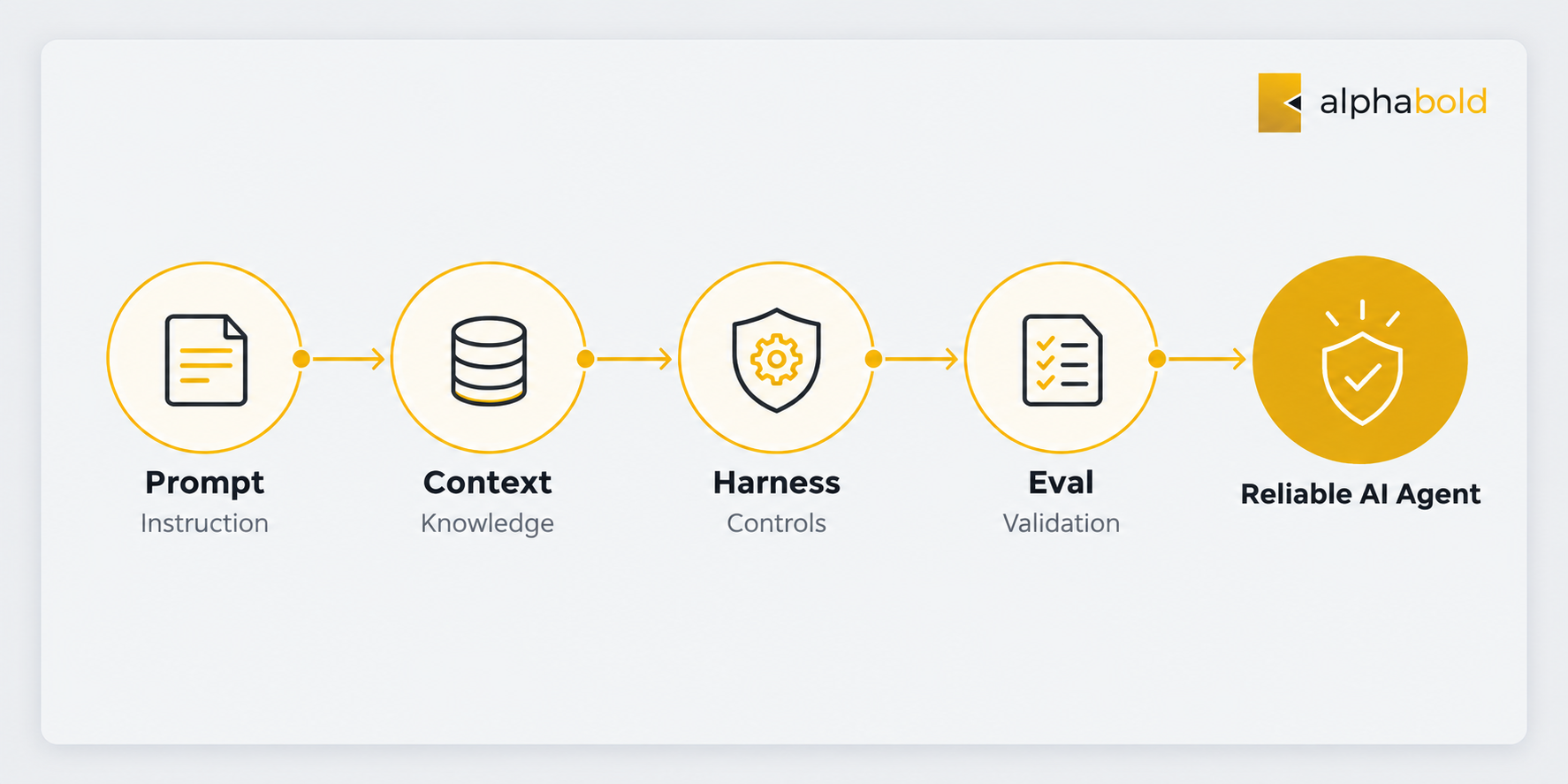
Three interconnected disciplines determine whether AI reduces cost and risk, or quietly adds both: prompt engineering, context engineering, and harness engineering, alongside a fourth emerging discipline, eval engineering. For leaders comparing prompt engineering vs context engineering, that distinction is only the starting point; harness and eval engineering determine whether those capabilities hold up in production. Understanding these disciplines helps business and IT leaders ask the right questions before committing budget to an AI initiative.
Why the Same AI Model Produces Different Business Results
When an AI agent drafts client communications, processes financial data, or writes production code, “it usually works” isn’t good enough for regulated industries or client-facing operations. Inconsistent AI output creates three business risks: cost risk (rework and wasted spend), compliance risk (unreviewed outputs in audited processes), and reputational risk (a client-facing agent giving a confidently wrong answer).
OpenAI’s own July 2026 benchmark research shows the scale of this gap: the identical GPT-5.6 model scored just 13.3% on a standardized reasoning benchmark under a generic setup, but 38.3%, nearly triple, once the surrounding infrastructure was engineered around it, using a fraction of the output tokens. Same model, dramatically different result. That single data point is the business case for treating context and harness design with the same rigor as model selection.
Prompt Engineering: Necessary, Not Sufficient
Prompt engineering, the original discipline, means carefully wording an instruction to get a better single response. It still matters. A well-structured prompt reduces errors and back-and-forth. But for a business, relying on prompt engineering alone means quality depends on whoever happens to be typing that day, with no institutional memory and no audit trail.
That is a governance gap as much as a technical one: knowledge sits in one employee’s prompt history instead of in a documented, repeatable system the organization can review, standardize, and improve over time.
Context Engineering: Turning Company Knowledge Into a Governed Asset
Context engineering, a discipline Anthropic formally defined in its September 2025 engineering research, is about designing everything an AI model sees before it answers, including company documents, policies, prior records, and live data, not just the instruction itself.
For a business, this is where governance and accuracy get built. A finance assistant that only “prompts well” is guessing; one built with context engineering pulls from the approved chart of accounts and the current close checklist automatically, for every user, every time.
That difference shows up directly in cost (fewer errors to fix), risk (traceable inputs for audit), and customer experience (accurate answers instead of plausible-sounding ones). Analyst firm Gartner has advised enterprise leaders to prioritize this, citing context-aware architecture as a driver of improved agent accuracy.
The practical takeaway for IT leaders: context engineering is where data governance, security permissions, and AI accuracy intersect, and it typically requires a data and integration strategy rather than a smarter prompt.
Harness Engineering: The Infrastructure Behind Reliability and Scale
If context engineering decides what the AI sees, harness engineering decides what it’s allowed to do, how it recovers from mistakes, and how its work gets verified before a human or client sees it.
OpenAI’s own engineering team demonstrated this at scale: over five months, a three-person team shipped roughly one million lines of production code across 1,500 pull requests without writing code by hand, by investing entirely in the surrounding harness, including verification checkpoints, automated testing, and clear rules of engagement, rather than in prompts.
LangChain, a widely used framework for enterprise AI agents, frames it simply: an agent equals the model plus its harness. The model provides raw capability; the harness makes that capability safe and repeatable enough for production.
In operational terms, that means fewer escalations, predictable throughput, and a system that can be reviewed and improved like any other piece of enterprise software, rather than a black box that occasionally gets it right.
Eval Engineering: A Fourth Discipline for Governance and Compliance
A newer, related discipline is emerging alongside these three: eval engineering, the practice of building automated checks that grade an AI system’s output and its reasoning path before it ships or acts.
Rather than reviewing output after something has already gone wrong, eval engineering builds a quality-control gate directly into the workflow. Industry analysis from Splunk and SiliconANGLE both describe this as production-grade evaluation infrastructure that governs AI behavior at scale, closely tied to agentic AI governance.
For regulated industries such as healthcare, finance, and insurance, this is the discipline that turns “we trust the AI” into “we can demonstrate why the AI’s output met our standard,” which matters as much to auditors and clients as to engineers.
Build the Right Foundation for Enterprise AI
Moving from a capable model to a reliable business system requires more than better prompting. AlphaBOLD helps organizations design the data, controls, verification, and evaluation layers that support AI in production.
Request a ConsultationWhat This Means When Evaluating AI Copilots and Coding Assistants
This explains a question IT leaders ask often: why do tools like Claude Code, GitHub Copilot, and Cursor feel so different, even when they run comparable underlying models?
Developer comparisons consistently find that the harness, including how a tool indexes a codebase, what it’s permitted to execute, and how it checks its own work, drives the experienced difference more than model choice alone.
The practical implication for procurement: evaluating an AI tool on “which model does it use” is an incomplete question. The better question is how that vendor has engineered context, harness, and evaluation around the model, because that is what actually determines reliability, security, and total cost of ownership inside your environment.
Where AlphaBOLD's Consulting Value Comes In
This is the gap AlphaBOLD helps clients close. Rather than treating AI adoption as “turn on Copilot and see what happens,” AlphaBOLD’s consulting engagements design the context layer, with secure, governed data and document access within Microsoft Azure AI Foundry, Dynamics 365, and Power Platform environments; the harness layer, with verification steps and human-in-the-loop checkpoints appropriate to the client’s industry; and the evaluation layer, with measurable quality gates before an AI-generated output reaches a customer, a general ledger, or a compliance report.
For clients already running Microsoft’s ecosystem, this means AI initiatives are built to the same standards of security, auditability, and change management as any other enterprise system, giving leadership a defensible answer to “how do we know it’s working,” rather than a demo that looked good once.
Build AI That Holds Up Beyond the Demo
If your AI initiative needs to operate inside real workflows, permissions, and compliance requirements, AlphaBOLD can help design the surrounding architecture for reliability, governance, and scale.
Request a ConsultationThe Takeaway for Decision-Makers
FAQs
AI reliability should not sit with a single technical team. IT, data, security, business process owners, and risk or compliance teams all have a role because changes to source data, permissions, workflows, policies, or models can affect how an agent behaves after deployment. Clear ownership also determines who responds when performance falls outside an acceptable threshold.
Reviews should be triggered whenever the model, data sources, connected applications, permissions, workflows, or business requirements change. Enterprises should also establish a regular review cycle so that performance drift, new failure patterns, and changes in risk are identified before they affect users or business processes.
Explore Recent Blog Posts
Related Posts