How to Validate AI Outputs: Catching Hallucinations Before They Reach Users

Table of Contents
To validate AI outputs, cross-check them against source documents, verify what retrieval-augmented generation (RAG) systems actually retrieved, add a second review pass for high-stakes content, keep humans in the loop, and monitor continuously. Hallucinations can look just as credible as correct answers, so validation, not intuition, is what catches them.
Introduction
One of the first things I tell clients rolling out an AI tool is this: just because it sounds right doesn’t mean it is.
We worked with a financial services firm that had deployed an AI assistant to summarize loan documents. The team was saving hours each week, and the summaries appeared accurate on the surface.
Then a manager noticed that a figure in one AI-generated summary did not match the original document. When we investigated, we found that the model had occasionally generated incorrect figures that were not present in the source material. Because the summaries were written confidently and looked credible, the issue had gone unnoticed for weeks.
That is the nature of AI hallucinations. They do not always fail loudly. They can produce incorrect information that looks completely normal until someone validates it against the source.
What is an AI Hallucination?
An AI hallucination is when a model generates information that sounds credible but is factually wrong, an invented figure, a fabricated policy detail, or a citation that doesn’t exist.
A model may present incorrect information without clearly signaling that the answer is uncertain. It delivers fabricated information with the same tone and confidence as a verified fact.
In a business setting, this creates real exposure. AI is now embedded in workflows that matter, summarizing contracts, handling customer queries, generating financial reports, and supporting clinical decisions.
One wrong figure reaching the wrong person at the wrong time can mean a compliance failure, a client escalation, or an operational mistake that takes significant time and money to unwind.
Deloitte’s 2026 State of AI in the Enterprise research found that 53% of organizations report improved insights and decision-making from AI, even as businesses continue to face readiness gaps across areas such as data, infrastructure, risk, and talent.
You may also like: Predictive Quality Testing for Dynamics 365
Why Can Traditional QA Miss AI Hallucination
Traditional deterministic QA alone may not catch AI hallucinations because generative AI can produce variable outputs, and many AI tasks do not have one predetermined correct response.
Conventional software testing often compares system behavior against defined expected outcomes. AI validation requires an additional layer: checking whether generated information is accurate, grounded in the appropriate sources, and compliant with the rules of the specific use case.
The same prompt can return different wording on different runs, and many generative AI tasks do not have one fixed response to test against. And critically, the model itself has no reliable way to signal when it’s working from solid ground versus filling in a gap.
In practice, this means organizations deploying AI without a dedicated validation process are trusting the system to be accurate without ever verifying it, a risk most businesses wouldn’t accept from any other tool in their stack.
Validate AI Outputs Without Losing the Efficiency Gains
The right validation process catches errors early without adding overhead that cancels out what AI was supposed to save you.
Request a ConsultationWhat are the Best Ways to Validate AI Outputs?
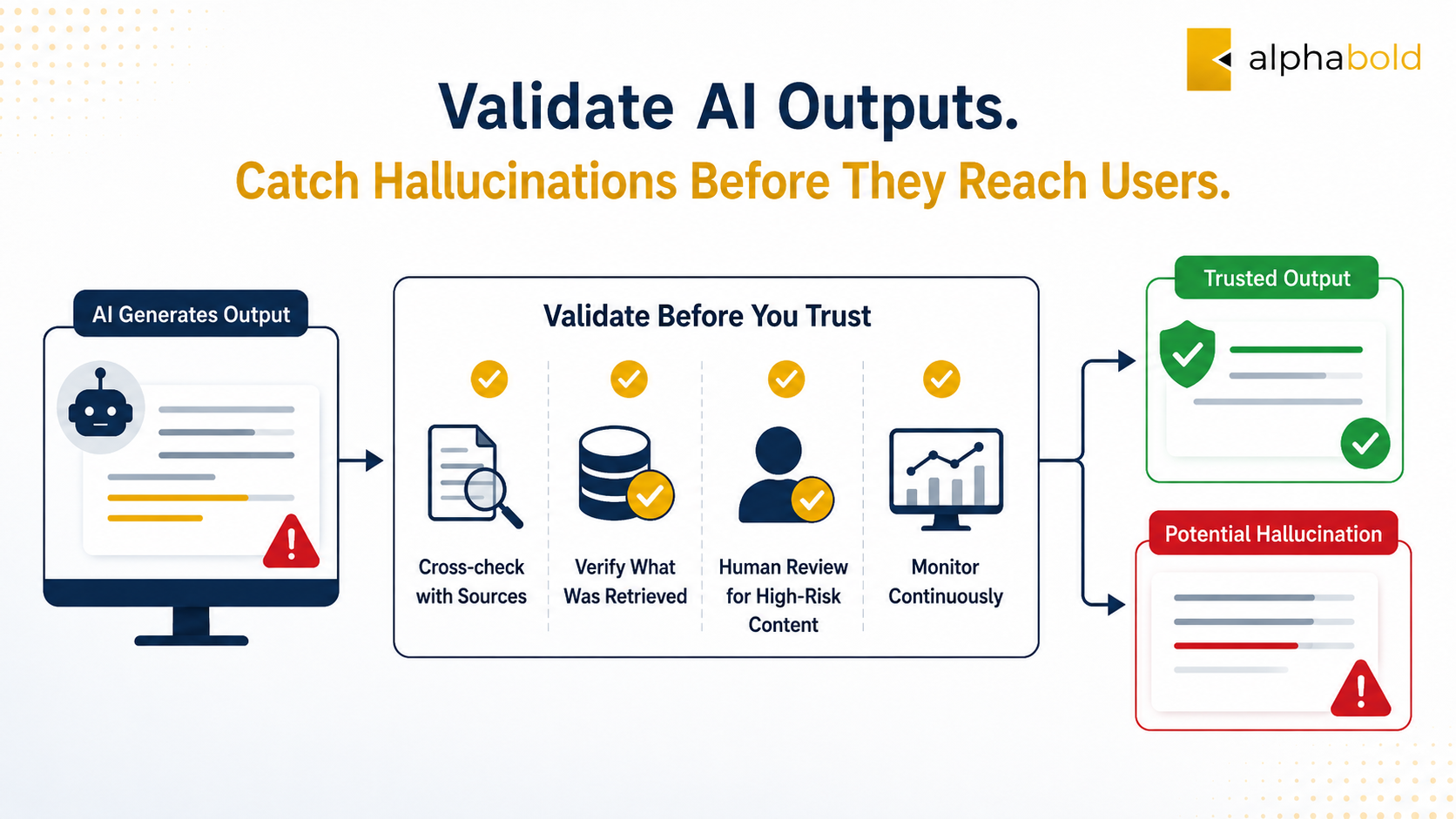
Compare outputs against source documents:
If the AI works from a defined set of materials, such as internal policies, product documentation, or client records, cross-check its outputs against those sources directly. Validation rules can then flag material claims that cannot be traced back to an approved source.
Verify what the model actually retrieved:
Many enterprise AI systems use retrieval-augmented generation (RAG) to pull from a knowledge base before responding. Even so, models still add details that weren’t in what they retrieved. Validation should confirm that material factual claims expected to come from the knowledge base are supported by the content the system actually retrieved.
Add a second review pass for high-stakes outputs:
For outputs that carry real business risk, such as compliance documentation, financial summaries, and customer-facing responses, run them through an additional check before use. This might be a rules-based system, a second model, or a structured human review step. For high-risk outputs, this additional validation layer can reduce the likelihood of incorrect information reaching users or downstream business processes.
Keep humans in the loop where it matters:
For decisions and outputs that carry significant business risk, human review remains an important control. Even reviewing a defined sample of outputs can help identify recurring errors and generate feedback that improves the system over time.
Use risk-based validation and escalation
Not every AI output requires the same level of review. Organizations can use signals such as retrieval quality, citation coverage, automated evaluation results, business rules, and model confidence indicators where appropriate to identify outputs that need additional scrutiny.
Higher-risk or poorly supported responses can then be routed to a review queue rather than being sent directly to the end user.
You may also like: Multimodal AI Testing: Why AI QA Is a Competitive Advantage
Why Does AI Output Validation Need to Be Ongoing?
Validation needs to run continuously because AI models, prompts, and data sources can change after launch; a system that performs well on day one can quietly degrade months later.
Providers push updates to the underlying model. Teams add new prompts over time. The data the system pulls from evolves. A model performing well at launch can start producing more errors months later, and if nobody’s monitoring for that, you won’t know until a user or client finds it first.
We build ongoing monitoring into every AI validation framework we set up, because the alternative is essentially hoping nothing changes. In our experience, something always does.
How Does AlphaBOLD Help Validate AI Outputs?
AlphaBOLD helps organizations build AI validation into the workflows where AI is actually being used. Rather than applying the same controls to every output, we design validation around the use case, the underlying data and systems, and the level of business risk involved.
That can include tracing generated claims back to approved source content, building automated review and validation pipelines, routing higher-risk outputs for human review, and monitoring performance after deployment. The goal is to catch inaccurate or poorly supported responses without adding unnecessary review steps to every interaction.
We also work with teams to define where automated checks are sufficient and where stronger controls are needed. For example, a low-risk internal summary may require a different validation process than a financial figure, compliance response, or customer-facing recommendation.
Because AI systems continue to evolve after launch, validation should not stop at implementation. AlphaBOLD can help establish ongoing monitoring and review processes so changes in prompts, models, data sources, or output quality can be identified before they create downstream issues.
Build a Validation Framework That Fits Your Workflows
Create an AI validation approach that combines source tracing, automated checks, human review, and ongoing monitoring based on the risks that matter to your business.
Talk to an ExpertConclusion
After working on AI implementations across industries, the pattern we keep coming back to is this: the organizations that trust AI most effectively are the ones that verify it most consistently.
Catching hallucinations isn’t about being suspicious of the technology. It’s about applying the same standard of care you’d apply to anything else your business depends on. You check it, you monitor it, and you don’t mistake confidence for accuracy.
It’s a solvable problem. Most organizations just need the right process built around it.
FAQs
Explore Recent Blog Posts
Related Posts