
AI Agents for Fraud Detection: Use Cases, ROI, and Implementation for Banks

Table of Contents
AI agents for fraud detection help financial institutions identify, investigate, and respond to fraud in real time by analyzing transaction data, identity signals, behavioral patterns, device activity, and historical case data. Unlike rule-based fraud systems, these agents can adapt to new tactics, reduce false positives, and trigger governed next steps such as case creation, payment holds, account review, or analyst escalation.
For banks, lenders, insurers, and FinTech companies, the strongest use cases include synthetic identity detection, account takeover prevention, deepfake fraud review, transaction monitoring, fraud alert triage, and compliance reporting. Successful implementation depends on clean data access, explainable AI, human-in-the-loop controls, audit trails, and continuous model monitoring.
What AI-Powered Fraud Threats Are Financial Institutions Facing in 2026?
Financial institutions are facing three major AI-enabled fraud threats in 2026: deepfake-driven impersonation, synthetic identity fraud, and data-harvesting scams that support larger financial crime schemes.
Reported fraud losses continue to rise. FTC data shows that consumers reported about $16 billion in fraud losses in 2025, the highest amount on record. Imposter scams were the most reported fraud category, with losses of $3.5 billion. For banks, this matters because many impersonation scams begin with fake security alerts, fake bank communications, or requests to move money.
- Deepfake-Driven Impersonation: Fraudsters are using GenAI tools to create fake voices, videos, and identity documents that can bypass basic verification checks. FinCEN has warned financial institutions about deepfake media being used in identity verification, phishing, business email compromise, and payment fraud schemes.
- Synthetic Identity Fraud: Synthetic identity fraud combines real and fabricated personal information to create fake identities. The Federal Reserve Bank of Boston notes that GenAI is making this harder to detect by helping criminals automate fake identity creation, produce convincing documents, and exploit stolen data at scale.
- Data-Harvesting Scams: Phishing, fake job offers, impersonation scams, and account takeover attempts collect credentials, PII, and bank details. That stolen data can then support synthetic identities, mule accounts, fraudulent applications, and unauthorized transfers.
These risks show why financial institutions need fraud systems that continuously analyze identity, behavior, transaction, device, and case data instead of relying only on static rules.
How Do Autonomous AI Agents Detect and Prevent Fraud?
Autonomous AI agents detect and prevent fraud by connecting real-time data signals, historical fraud patterns, risk models, and governed response workflows. Instead of waiting for a rule to be triggered, these agents can analyze activity continuously and recommend or initiate the next best action.
A fraud detection agent usually works through four connected layers:
- Data Intake: The agent reviews transaction streams, login behavior, device signals, customer profiles, support interactions, and case history to identify unusual activity.
- Context and Memory: It compares current behavior against known fraud patterns, previous alerts, customer history, and institutional risk rules. This helps separate suspicious activity from legitimate customer behavior.
- Decision and Orchestration: The agent evaluates risk and decides what should happen next. For example, it may approve the transaction, request step-up verification, hold the payment, create a case, or escalate the issue to an analyst.
- Action and Oversight: Low-risk actions can be automated, while high-risk decisions should remain human-reviewed. The agent can support analysts by summarizing evidence, preparing case notes, and routing suspicious activity documentation for review.
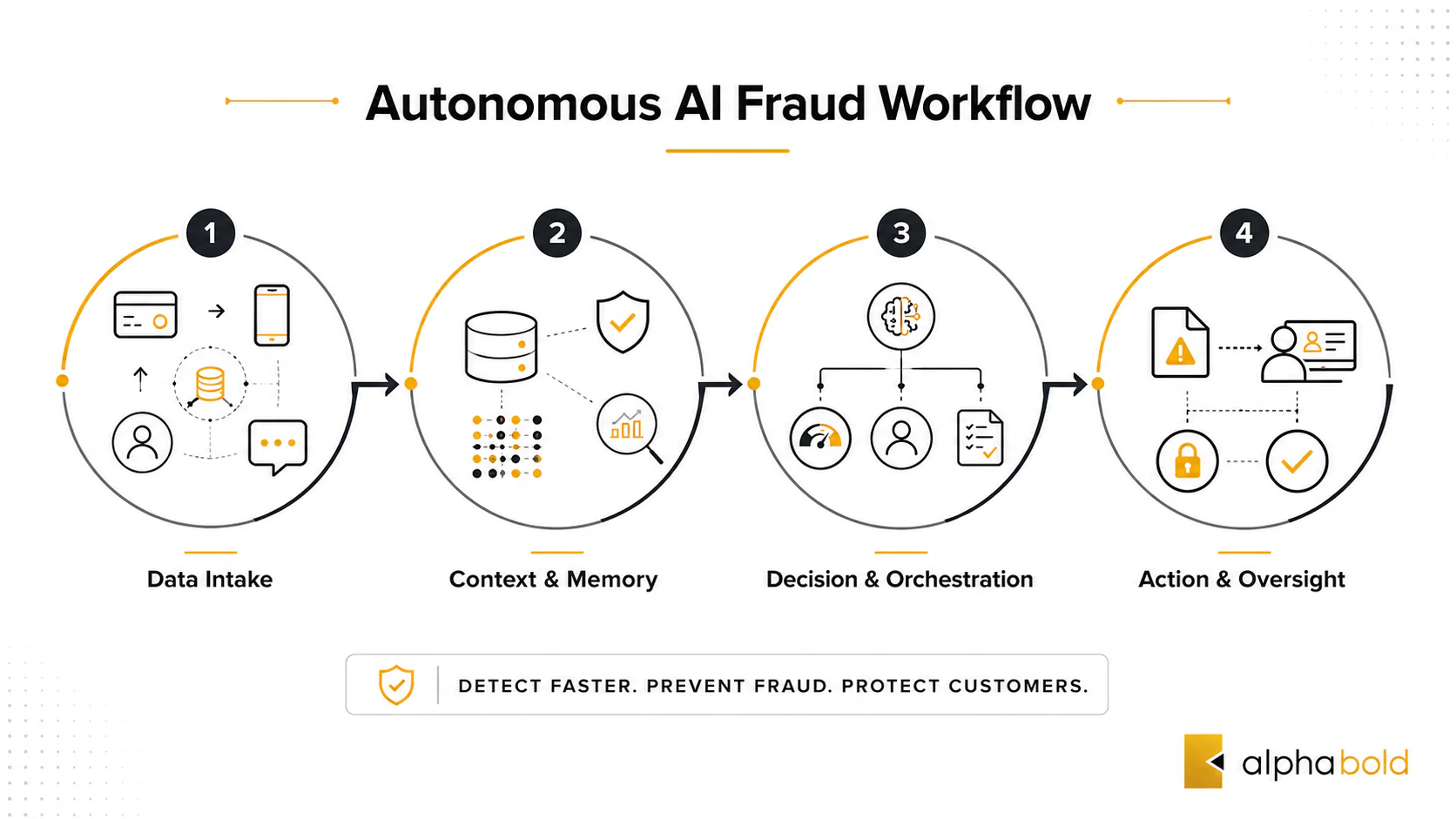
This is where AI agents for fraud detection improve traditional systems. They help institutions move from static alerts to faster, context-aware fraud response.
Build Governed AI Fraud Detection Workflows with AlphaBOLD
AlphaBOLD helps financial services teams assess fraud detection gaps, connect enterprise data sources, design secure AI agent workflows, and implement human-in-the-loop governance for high-risk decisions.
Schedule My AI ConsultationHow Do Multi-Agent Systems Combat Coordinated Fraud?
Multi-agent systems help financial institutions detect fraud that moves across accounts, devices, channels, and customer identities. Each agent focuses on a specific risk area and shares context with the others, making it easier to detect patterns that a single system may miss.
For example:
- Transaction Agent: Reviews payment activity, transfer timing, transaction value, and account movement.
- Behavior Agent: Monitors login behavior, device signals, location changes, and unusual customer activity.
- Compliance Agent: Checks whether activity may indicate money laundering, mule accounts, sanctions risk, or reporting needs.
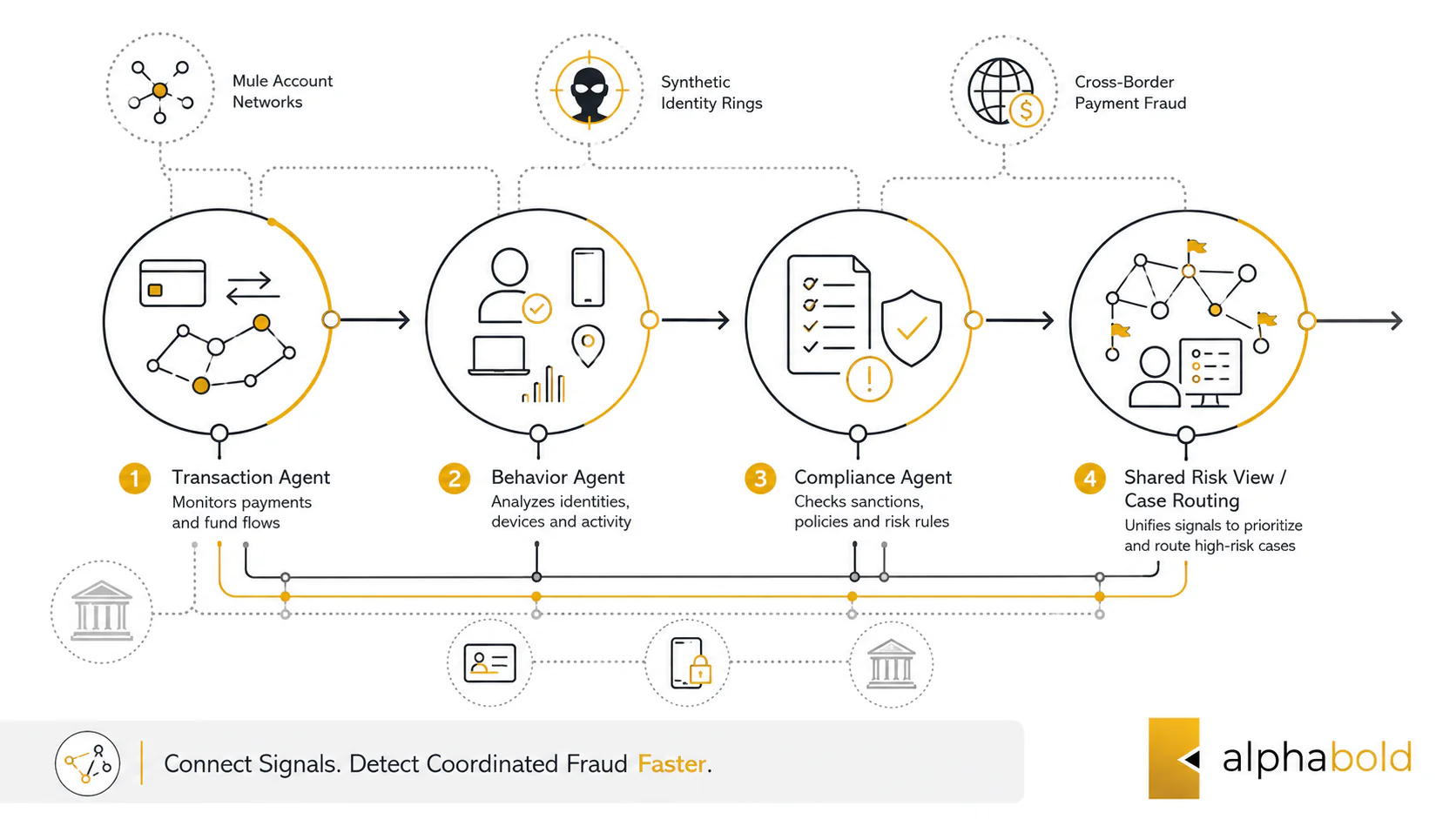
Together, these agents can connect signals that look normal in isolation but suspicious as part of a wider pattern. This is useful for synthetic identity rings, account takeover attempts, cross-border payment fraud, and coordinated mule account networks.
For banks, lenders, insurers, and FinTech teams, multi-agent systems improve fraud detection by connecting related signals, prioritizing high-risk cases, and routing the right issues to human analysts faster.
What AI Techniques Enable Real-Time Fraud Detection?
Real-time fraud detection depends on AI techniques that can connect signals, learn from outcomes, and evaluate more than transaction data. For financial institutions, three techniques matter most:
- Graph Neural Networks for Connected Fraud: Fraud rarely happens in isolation. A single account, payment, or login may look normal, but the wider network may reveal shared devices, repeated transfer patterns, mule accounts, or links to previously flagged identities. Graph Neural Networks help map these relationships across customers, accounts, devices, and transactions so teams can detect coordinated fraud earlier.
- Deep Reinforcement Learning for Adaptive Defense: Fraud tactics change as criminals test system weaknesses. Static rules often become outdated because they only respond to known patterns. Deep Reinforcement Learning helps fraud systems improve based on real outcomes, such as which alerts were valid, which transactions were cleared, and which thresholds created unnecessary reviews. This helps institutions adjust detection logic without relying only on manual rule updates.
- Multimodal Detection for Deepfakes and Behavior: AI-enabled fraud can involve fake documents, voice cloning, unusual login behavior, device changes, or suspicious contact center activity. Multimodal detection analyzes these signals together instead of treating them as separate events. This helps fraud teams spot risks that may not appear in transaction data alone.
Together, these techniques help AI agents for fraud detection move from basic rule matching to real-time, context-aware decision support. For banks, lenders, insurers, and FinTech companies, this means faster detection, fewer false positives, and better prioritization for human review.
What ROI Can Organizations Expect from AI Fraud Detection Agents?
The ROI of AI fraud detection agents comes from faster detection, lower manual review effort, fewer false positives, and stronger fraud case prioritization. For banks, lenders, insurers, and FinTech companies, the business case is strongest when teams are managing high alert volumes, synthetic identity risk, account takeover attempts, payment fraud, or compliance-heavy investigations.
AI is already being treated as a practical fraud and risk tool across financial services. In 2026, the Bank for International Settlements noted that AI can help financial systems identify unusual patterns, flag suspicious activity, and support faster intervention, especially in payments. The Federal Reserve also noted in 2026 that AI use in banking depends on strong governance, risk management, data quality, and human oversight.
For financial institutions, ROI is usually measured through:
- Lower Fraud Losses: Fewer unauthorized payments, fraudulent applications, account takeovers, and synthetic identity losses.
- Reduced False Positives: Fewer legitimate customers are blocked, delayed, or sent into unnecessary manual review.
- Faster Case Handling: Analysts receive connected signals, summarized evidence, and prioritized cases instead of disconnected alerts.
- Better Compliance Support: Teams can maintain clearer audit trails, escalation paths, and review documentation.
- Improved Customer Experience: Genuine customers face fewer unnecessary declines, delays, and verification loops.
The goal is not to automate every fraud decision. The stronger return comes from using AI agents to improve speed, prioritization, and decision quality while keeping high-risk actions under human review.
Bonus reading: AI for Banking: Benefits, Risks, & Use Cases in 2026
How Should Organizations Implement AI Fraud Detection Agents?
Organizations should implement AI fraud detection agents in controlled phases. The goal is to prove value, reduce risk, and make sure every automated action is explainable, auditable, and aligned with internal policies.
The six-step path includes:
Assess Current Fraud Workflows: Review existing fraud rules, alert volumes, false positives, investigation queues, data gaps, and escalation paths.
Define Clear Goals: Set measurable targets such as reducing manual review time, improving case prioritization, lowering false positives, or detecting synthetic identity fraud earlier.
Prepare Data and Integrations: Connect the right transaction, identity, device, behavioral, customer, and case data so the agent can evaluate risk in context.
Start With A Limited Pilot: Begin with a specific fraud use case, such as alert triage, account takeover detection, or suspicious transaction review, before expanding.
Train Teams For Oversight: Help fraud analysts understand agent outputs, review supporting evidence, challenge recommendations, and manage exceptions.
Monitor and Optimize Continuously: Track accuracy, drift, false positives, escalation quality, analyst feedback, and audit logs to improve performance over time.
AI agents should not be deployed as unmanaged automation. They work best when they support analysts, improve decision quality, and keep high-risk fraud actions under human review.
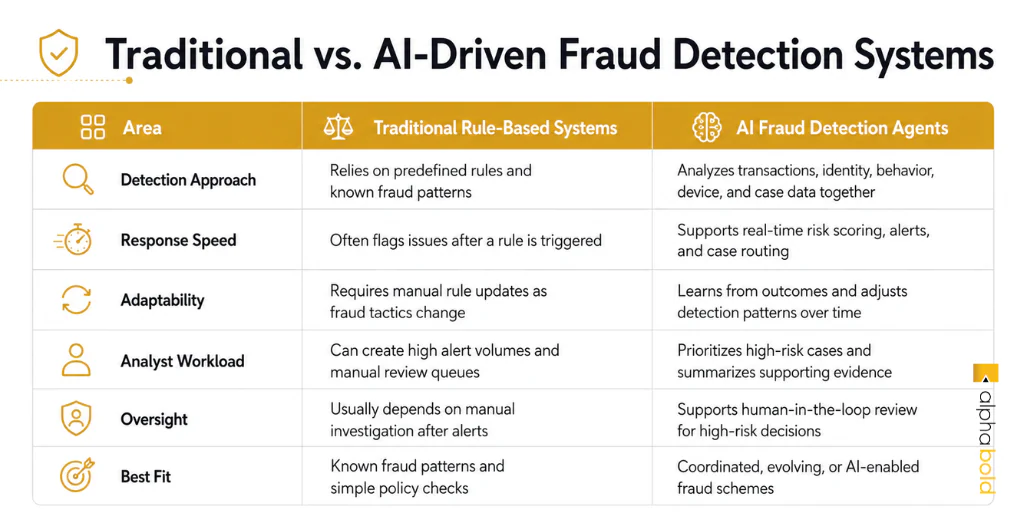
Traditional vs. AI-Driven Fraud Detection Systems
Traditional fraud systems are useful for known patterns and policy-based checks, but AI fraud detection agents are better suited for coordinated, evolving, and AI-enabled fraud. The comparison below shows how the two approaches differ across detection, response speed, adaptability, workload, oversight, and best fit.
Bonus Reading: AI-Powered Predictive Maintenance in Manufacturing
What Governance Frameworks Ensure Safe AI Agent Operations?
Safe AI agent operations require clear governance, human oversight, and continuous monitoring. For financial institutions, this means every fraud decision should be explainable, auditable, and controlled according to risk level.
- AgentOps: AgentOps is the operating model for managing AI agents in production. It defines what the agent can access, which actions it can take, when human approval is required, and how performance is monitored. This helps prevent uncontrolled automation in high-risk fraud workflows.
- Explainable AI: Fraud teams need to understand why an alert was created or why a transaction was flagged. Explainable AI provides the supporting signals behind each decision, such as unusual device activity, account behavior, transaction timing, or links to known fraud patterns. This improves analyst review and supports compliance documentation.
- Human-in-the-Loop Controls: Not every action should be automated. Low-risk actions, such as alert summaries or case routing, can be automated, but high-risk actions, such as account restrictions, payment holds, or regulatory reporting, should involve human review.
- Adversarial Resilience: AI systems must be protected from poisoned data, manipulated inputs, and attempts to trick the model. Strong data validation, access controls, drift monitoring, and audit logs help keep fraud agents reliable over time.
These controls help financial institutions use AI agents for fraud detection without losing visibility, accountability, or regulatory control.
Deploy Autonomous AI Fraud Detection in Your Financial Environments.
We help enterprises build secure, compliant, and explainable fraud detection systems. Our AgentOps frameworks ensure safe deployment with continuous monitoring and optimization.
Start My AI Fraud Detection ImplementationConclusion
AI agents for fraud detection give financial institutions a more practical way to respond to fraud that is faster, more coordinated, and harder to catch with static rules alone. By connecting transaction, identity, device, behavior, and case data, these systems can help teams detect suspicious patterns earlier and prioritize the risks that need immediate attention.
The real value is not full automation. It is better decision support. AI agents can summarize evidence, connect related signals, reduce manual review effort, and route high-risk cases to the right analysts faster. For banks, lenders, insurers, and FinTech companies, this can improve fraud response while supporting stronger audit trails, compliance documentation, and customer experience.
Successful adoption depends on the right foundation. Financial institutions need clean data access, explainable AI, human-in-the-loop controls, adversarial resilience, and ongoing monitoring before moving agentic fraud workflows into production.
As fraud tactics continue to evolve, organizations that modernize their detection systems now will be better prepared to identify coordinated fraud, reduce false positives, and respond with greater speed and control.
FAQs
Pilots take about 2 to 4 months. Full rollouts typically require 6 to 12 months, depending on the system’s complexity.
Analysts shift to supervising AI outputs, reviewing edge cases, and managing AgentOps dashboards. Most teams complete 4 to 8 weeks of training.
They employ multimodal checks that analyze voice signals, behavioral patterns, and real-time irregularities that humans may overlook.
Strong AgentOps controls utilize strict data checks, adversarial testing, and drift monitoring to maintain clean training data.
Explore Recent Blog Posts



Related Posts