From Tug Jobs to Profitability: Building a Unified Data Foundation for a Harbor Services Provider

Table of Contents

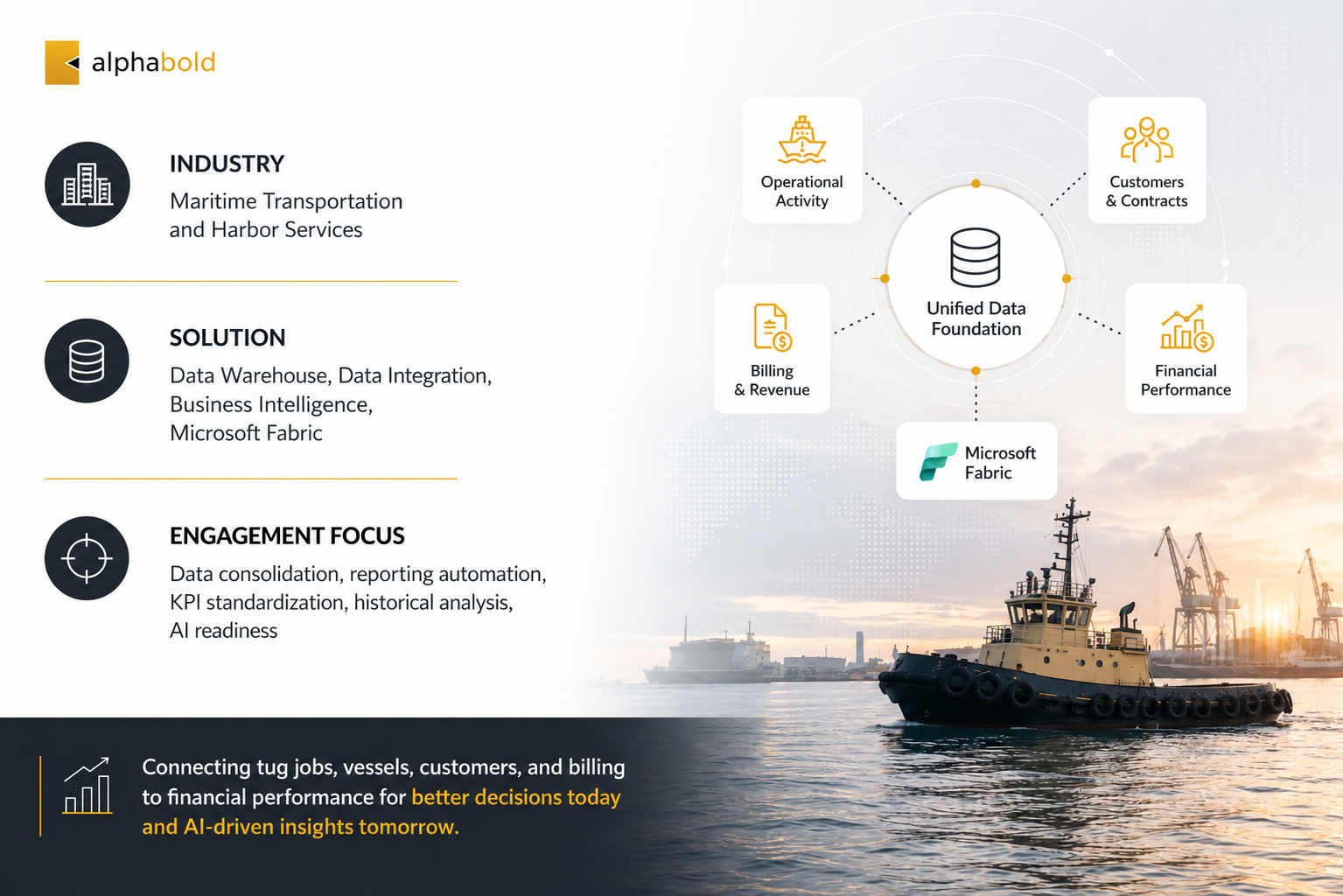
  • Industry: Maritime Transportation and Harbor Services
  • Solution: Data Warehouse, Data Integration, Business Intelligence, Microsoft Fabric
  • Engagement Focus: Data consolidation, reporting automation, KPI standardization, historical analysis, AI readiness

Overview

A long-established U.S. harbor tug and ship-assist services provider needed a more reliable way to understand performance across its operations.

The company manages complex maritime activities that must be executed safely, efficiently, and on schedule. However, the information required to evaluate those activities was distributed across multiple operational, billing, commercial, and financial systems.

Reporting teams frequently prepared reports and calculated key performance indicators manually. Some data requests required significant effort, while others could not be completed because the necessary information could not be connected across legacy systems.

AlphaBOLD helped the company establish a centralized data warehouse that brings previously fragmented information into one trusted reporting foundation. The new environment supports automated reporting, on-demand access to information, historical analysis, and a clearer connection between operational activity and financial performance.

It also provides the foundation the company needs to expand its use of Microsoft Fabric and explore future AI-enabled reporting capabilities.

The Client

The client is a multigenerational maritime services company providing harbor tug, towing, and ship-assist services across several U.S. coastal markets.

Its teams support critical activities such as vessel docking and undocking, escorts, standby services, and other harbor operations. These services require close coordination between commercial, operational, and financial teams.

As the organization grew, so did the amount of information generated across its locations, vessels, jobs, customers, and back-office processes. The company had substantial operational knowledge, but accessing and connecting that information had become increasingly difficult.

The Challenge: Critical Information Was Separated Across Legacy Systems

Before the data warehouse implementation, many reports and KPIs were prepared manually.

Operational information could be stored in one system, while billing, commercial, and financial records were maintained elsewhere. This made it difficult to create a complete view of business performance.

A report that appeared straightforward could require teams to collect information from several systems, reconcile differences, and manually calculate the required metrics. In some cases, the organization could not easily complete a data request because the relevant datasets could not be joined.

These challenges affected more than reporting efficiency. They limited the company’s ability to answer important business questions, including:

  • How does operational activity translate into revenue?
  • Which services, locations, or customer activities contribute most to profitability?
  • How is performance changing over time?
  • Where are billing and operational trends beginning to diverge?
  • What information does leadership need to make faster commercial decisions?

The company needed more than another dashboard. It needed a trusted data foundation that could connect the different parts of the business.

The Solution: One Data Foundation Across Operations and Finance

AlphaBOLD worked with the client to create a centralized data warehouse that consolidates information from its previously disconnected systems.

The implementation established a common reporting foundation for operational, billing, commercial, and financial information. Instead of repeatedly collecting and reconciling data for individual reports, teams can now access information through a central environment.

The solution supports the company’s ability to:

  • Automate existing reports and KPI calculations
  • Consolidate data from multiple legacy systems
  • Provide users with reports on demand
  • Analyse historical performance and long-term trends
  • Connect operational activity with billing outcomes
  • Compare service activity with financial performance
  • Support reporting requirements across commercial, finance, operations, and leadership teams

The project also included supporting documentation to help the client maintain and continue developing its reporting environment.

By focusing first on the underlying data foundation, the company gained an environment that can support new reporting requirements without recreating the same manual reconciliation process each time.

From Tug Jobs to Profitability Unified Data Foundation for Harbor Services

The Impact: From Manual Reporting to Connected Performance Insight

The data warehouse has changed how the company accesses and uses its information.

Reports and calculations that previously depended on manual work can now be automated or developed from a centralized source. Users can access information when needed rather than relying entirely on one-off reporting requests.

The organization can also work with historical and trend data that was previously difficult or impossible to combine with current information.

Most importantly, operational and financial performance no longer need to be analysed in isolation.

The company is establishing the ability to follow the complete story of its services, from maritime activity and job execution through billing and financial results. This creates a stronger foundation for analysing commercial performance, service profitability, and changing business trends.

Key Business Outcomes

  • Reduced dependence on manually prepared reports
  • More consistent KPI calculations
  • Easier access to information through a central reporting point
  • Improved data accuracy and reporting reliability
  • Stronger historical and trend analysis
  • Better visibility across operational and financial information
  • Faster support for commercial, finance, operations, and leadership reporting
  • A scalable foundation for future analytics and AI initiatives

A Partnership Built Through a Complex Implementation

The engagement required the project team to work through a complex data and reporting environment while remaining responsive to the client’s evolving requirements.

Despite those challenges, the initial implementation was delivered on schedule and within budget.

The client awarded AlphaBOLD a verified five-star review, providing perfect scores for quality, schedule, cost, and willingness to recommend the team.

“AlphaBOLD’s knowledge, expertise, and willingness to devote time to the project and our team stand out.”

The client also recognised the team’s responsiveness throughout the engagement and the improvement in data accuracy and access to information resulting from the work.

The relationship has continued beyond the initial data warehouse project, with the two organisations now discussing additional reporting, commercial analysis, and AI opportunities.

The Next Chapter: Commercial Intelligence and AI-Ready Reporting

With the core data foundation in place, the client can shift its attention from collecting information to using it more strategically.

Future reporting priorities are expected to focus on commercial performance, profitability, and trend analysis. These capabilities can help the company better understand how individual jobs, customers, service categories, and operating patterns contribute to financial outcomes.

Because the organisation is already using Microsoft Fabric, it also has an opportunity to extend the reporting semantic model into future AI-supported experiences.

Over time, this could allow business users to explore information more naturally, identify emerging trends, and receive faster answers without relying on manual analysis for every request.

The immediate achievement is a centralized data warehouse. The longer-term value is a connected information foundation that can support better decisions across the business.

Explore Recent Case Studies