Integrating IoT Devices with Dynamics 365 Field Service

Table of Contents
Introduction
Field service is entering a new era. In 2026, service operations are judged not just by speed, but by intelligence, accuracy, and predictive outcomes. By combining IoT with Dynamics 365 Field Service, organizations shift from reactive service to proactive and autonomous operations. Real-time telemetry, AI-powered alerts, and automated dispatching enable service teams to act on issues before customers notice them.
With Microsoft 2025 release wave and Connected Field Service, you can now trigger work orders directly from device alerts, integrate edge insights into dispatch logic, and surface copilot-driven summaries in mobile apps. These enhancements lower costs, improve uptime, and build a new class of customer trust.
This blog covers the latest Microsoft innovations, how to architect Dynamics 365 IoT Integration, and how to build future-proof operations for 2026 and beyond.

What Did Microsoft Release for Dynamics 365 Field Service in 2025?
Microsoft delivered key AI and automation capabilities that directly support IoT-driven field service operations.
2025 Release Wave 1:
Microsoft’s 2025 Release Wave 1 introduced AI-driven enhancements and tighter integration across Field Service roles.
Key updates include:
- Copilot work order summaries and recaps: Field technicians and managers now receive AI-generated summaries in mobile and web, so they can understand key details without jumping through multiple screens.
- Inspection builder and digital checks: The new inspection builder automates the creation of inspections from templates, digitizing previously paper-based workflows.
- Better scheduling tools: Enhancements to the schedule board and matching engine improve usability and resource matching across locations.
- Offline data and selective sync: Technicians working in low or no connectivity environments gain improved offline capabilities, with admins selecting which table data to sync.
These features set the stage for IoT and dispatch automation. The AI recaps and inspection builder streamline field workflows, while scheduling and offline enhancements handle the complexity of real-world operations.
You may also like: Transitioning from Legacy Systems to Dynamics 365 Field Service.
2025 Release Wave 2:
Dynamics 365 2025 Release Wave 2 (October 2025 to March 2026) delivers innovations that directly support IoT integration:
- AI-powered agents and deeper scheduling tools: Dispatchers get more autonomous assistance in matching resources with demand, factoring in asset health, technician skill, and IoT signal severity.
- Stronger Microsoft 365 integration: Tighter embedding of Field Service into Outlook, Teams, and Office workflows reduces context switching and boosts productivity.
- Mobile usability improvements: The mobile experience continues to be refined, supporting modern UI, faster state transitions, and better handling of streaming data.
- Vendor Coordination and Inspections: New capabilities enable more complex field service scenarios, particularly when IoT data needs to flow across systems.
Why Does This Matter for IoT Integration?
These updates show Microsoft’s direction: Field Service is becoming a connected intelligence layer, not just a dispatch tool. With Copilot-driven insights, smart dispatch, and improved mobile UX, IoT signals can now feed directly into operations automatically.
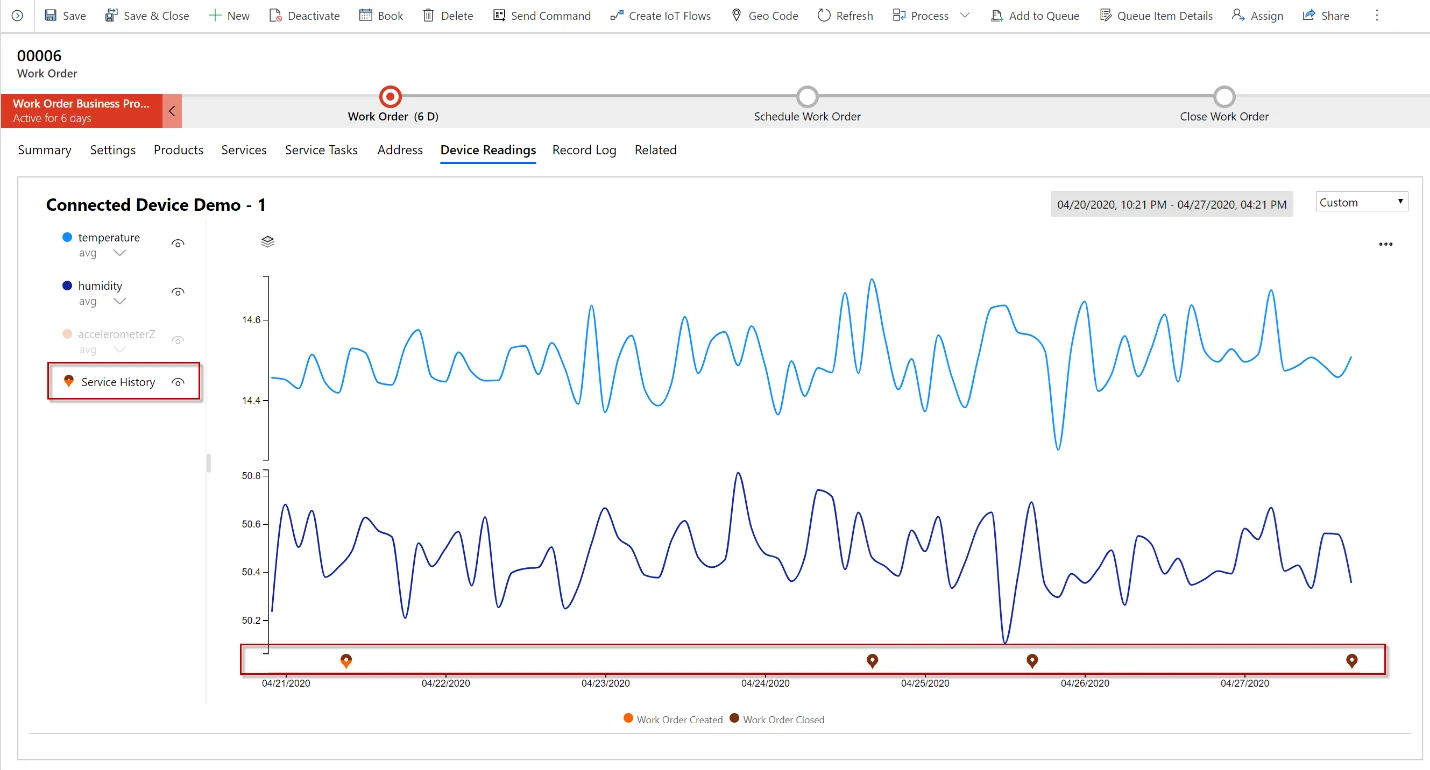
Connected Field Service, Microsoft’s architecture for IoT integration, supports bidirectional flows where device data triggers alerts and actions, and commands can be sent back to devices.
As these features roll out, your IoT integration must anticipate change. Design for modular upgradeability, build strong telemetry pipelines, and align with Microsoft’s roadmap so you can plug into new capabilities as they arrive.
What are the Benefits of Integrating IoT Devices with Dynamics 365 Field Service?
Integrating IoT with Dynamics 365 Field Service is the new operational baseline for service-driven enterprises. Microsoft’s Connected Field Service and Copilot capabilities have redefined how field data translates into action.
1. Real-Time Visibility Across Assets
IoT-connected devices continuously send data on asset health, performance, and usage directly to Dynamics 365 Field Service. This allows technicians and managers to see the full picture before any issue escalates. Real-time visibility prevents downtime, enables proactive customer communication, and supports smarter resource planning.
2. Predictive Maintenance and Automated Work Orders
With AI and IoT signals feeding into the system, potential issues are detected before they disrupt operations. Dynamics 365 Field Service automatically generates work orders when sensor thresholds are exceeded, ensuring maintenance happens at the optimal time. Predictive maintenance extends equipment life, reduces service costs, and improves reliability.
You may also like: Benefits of Adopting Dynamics 365 Field Service for Your Business
3. Intelligent Dispatch and Scheduling
AI-powered scheduling considers IoT alerts, technician skill sets, and asset priority to assign work orders efficiently. As Microsoft enhances Predictive Service Scheduling and Copilot capabilities in 2026, dispatchers rely less on manual coordination and more on real-time intelligence from connected assets.
4. Data-Driven Efficiency and Cost Reduction
Integrating IoT with Dynamics 365 Field Service eliminates manual data collection and guesswork. Continuous insights from equipment performance help reduce unnecessary site visits, optimize energy consumption, and minimize spare parts inventory. The result is leaner operations and measurable cost savings across departments.
5. Enhanced Customer Experience and Retention
Customers benefit from faster resolution times and fewer service interruptions. Automated updates, transparent reporting, and remote diagnostics create a seamless experience that builds trust and loyalty. For service-driven organizations, this integration turns customer satisfaction into a predictable business outcome.
6. Sustainability and Compliance Advantages
Smart routing, reduced truck rolls, and better energy management align field operations with sustainability goals. Microsoft’s cloud-based architecture ensures compliance with data governance and security standards, reinforcing operational integrity.
Optimize Field Operations with IoT and Dynamics 365 Field Service
Discover how Dynamics 365 Field Service can transform your operations with AlphaBOLD's personalized demo. From scheduling optimization to predictive analytics, see how it delivers measurable results for your business.
Request a DemoHow Did AlphaBOLD Build IoT-Ready Field Service Operations?
AlphaBOLD’s work with Voytko Mechanical, a California-based HVAC contractor, shows how strong digital foundations prepare organizations for IoT-driven service management. Before transformation, Voytko’s operations relied on manual processes for bids, tickets, and field tasks, leading to duplication, delays, and limited visibility.
The Challenge
Voytko needed a unified system to streamline communication, eliminate manual data handling, and improve decision-making across field and back-office teams.
The Solution
AlphaBOLD implemented a connected, cloud-based field service ecosystem built on:
- Dynamics 365 Sales and Field Service: Centralized all customer and service workflows into one platform.
- AlphaBOLD’s BUILDFitters solution: Automated scheduling, quoting, and field reporting for complete operational control.
- Mobile accessibility: Enabled technicians to capture data, report issues, and sync with dispatchers in real time.
The Results
The transformation replaced paper-based workflows with a fully digital system that improved collaboration, visibility, and responsiveness. Key benefits included:
- Real-time monitoring of service activity through dashboards.
- Faster dispatch coordination and reduced task duplication.
- Improved accuracy in reporting and customer communication.
Future Outlook: Building for IoT Readiness
While IoT sensors were not yet deployed, this architecture established the groundwork for future IoT readiness by:
- Digitizing service workflows to enable predictive maintenance and connected asset management.
- Creating centralized data visibility for integrating telemetry and sensor-based insights.
- Supporting scalability for AI and edge-based automation in upcoming Microsoft Connected Field Service releases.
This engagement demonstrates AlphaBOLD’s ability to design and implement IoT-ready strategies that evolve with each client’s digital maturity.
What Are the Best Practices for IoT and Field Service Integration?
Start with a Clear Use Case:
Identify specific business problems IoT will solve. Focus on high-impact scenarios, such as reducing equipment downtime, asset monitoring, or implementing preventive maintenance. Link key metrics, such as uptime, first-time fix rate, or cost per service call, directly to financial outcomes.
Select the Right Sensors:
Choose sensors based on the metrics you need to monitor. Common sensor types include temperature, vibration, pressure, power consumption, and flow rate. Collaborate with industrial IoT vendors or system integrators to select devices that are compatible with Azure IoT Hub.
Define Realistic Thresholds:
Set alert thresholds based on equipment manufacturer specifications and historical performance. Start conservative and refine based on technician feedback. This prevents alert fatigue while catching real issues early.
Build for Scalability:
Begin with a pilot deployment on one asset type or location. Test the integration, prove ROI, and refine workflows. Then expand systematically to more assets, locations, and device types.
Train Your Team:
Involve technicians early in the design process. Provide clear training on how IoT data helps them work more efficiently. Show how predictive alerts reduce emergency calls and enhance work-life balance.
Why Choose AlphaBOLD for IoT and Dynamics 365 Integration?
At AlphaBOLD, we build connected solutions that turn IoT with Dynamics 365 Field Service into measurable business impact.
- Tailored Solutions: We customize Dynamics 365 Field Service implementations to your goals, aligning IoT integrations with operational efficiency and customer satisfaction.
- Seamless Integration: Our team connects Dynamics 365, Azure IoT Hub, and Power BI into a unified ecosystem that eliminates data silos and improves real-time visibility.
- Predictive Intelligence: We deploy AI-driven and IoT-enabled tools that anticipate issues, trigger preventive maintenance, and keep field operations running smoothly.
- Reliable Support: Our experts provide on-demand assistance, continuous optimization, and strategic guidance as your field service operations evolve.
Build Your IoT-Ready Field Service Foundation
Our experts help B2B enterprises design IoT strategies, deploy Connected Field Service, and integrate real-time sensor data with Dynamics 365 for predictive operations.
Request a ConsultationConclusion
The question isn’t whether to integrate IoT with Dynamics 365 Field Service, but rather how quickly you can transition from reactive repairs to predictive operations. Every unplanned equipment failure, every delayed dispatch, and every missed maintenance window represents lost revenue and customer trust.
Organizations that connect their assets today build competitive advantages that their competitors will spend years trying to replicate. The technology exists. The ROI is proven. The only variable is execution.
AlphaBOLD helps businesses turn IoT data into operational intelligence through strategic planning, technical expertise, and continuous optimization.
FAQs
It connects Azure IoT Hub with Dynamics 365 Field Service to monitor devices in real time and trigger automated work orders.
Yes, you can connect any IoT provider through Dataverse APIs, Azure Event Hubs, or multicloud setups like AWS IoT and Google Cloud IoT.
Pilot setups typically take 4-8 weeks, while multi-site enterprise rollouts usually take 3-6 months.
Any sensor using MQTT or HTTPS works, including temperature, vibration, power, flow, and GPS, with industrial protocols supported through gateways.
It reviews real-time sensor data and historical trends to spot early issues and create preventive work orders before equipment fails.
Explore Recent Blog Posts