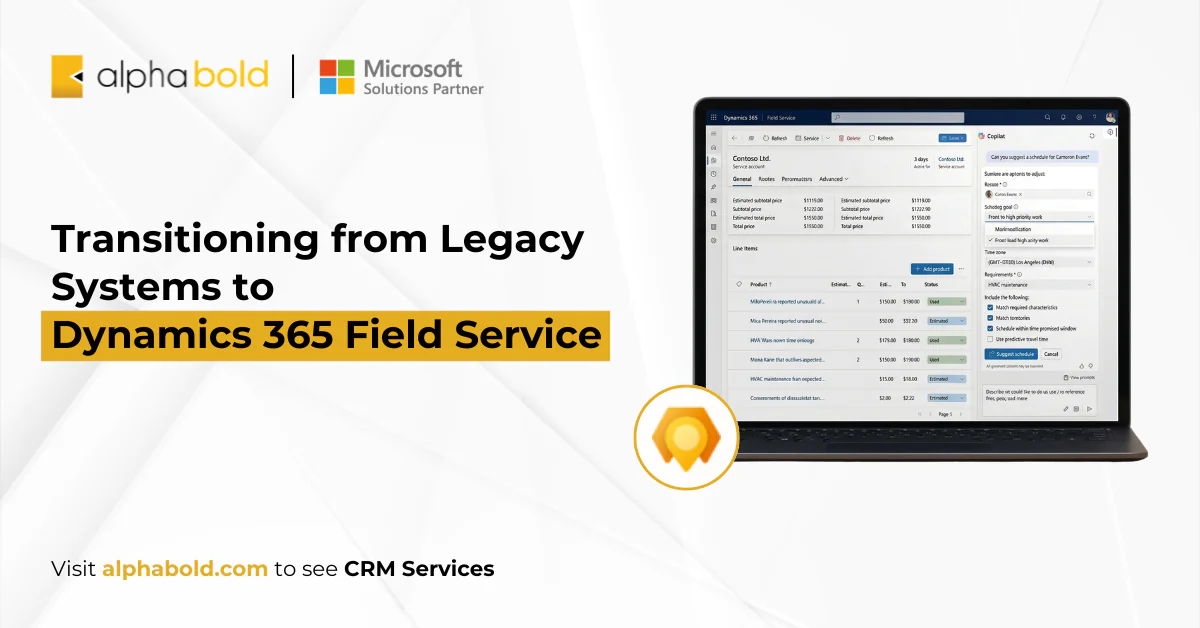
Benefits of Adopting Dynamics 365 Field Service for Your Business

Table of Contents
Introduction
Dynamics 365 Field Service in 2026 introduces several enhancements to improve mobile usability and scheduling efficiency. Key updates include a new Simple Lookup control, Mobile Notes, and an upgraded Booking Status control for mobile.
The Schedule Board gains bulk move and assign capabilities, full-screen map view, week numbers display, and expanded Scheduling Operations Agent functions. Android performance has also improved by over 25%, ensuring faster form load times.
This blog explores how these 2026 updates help business leaders modernize service operations, improve workforce visibility, reduce downtime, and strengthen customer relationships. Adopting Dynamics 365 Field Service now supports operational intelligence and sustained efficiency.
What Are the Key Feature Updates in Dynamics 365 Field Service 2026?
Field service software has moved beyond simple dispatch and scheduling into a connected, data-driven ecosystem. The 2026 Wave 1 updates focus on boosting technician productivity, optimizing resource scheduling, enhancing work order management, and deeper integration with Microsoft 365 apps.
Here are significant shifts and supporting stats:
Key Shifts
From Scheduling to Full Lifecycle Management
Dynamics 365 Field Service now manages asset lifecycles, service agreements, real-time mobile workforce data, predictive maintenance, and performance analytics.From Standalone to Unified Ecosystem
Field Service integrates with ERP, CRM, Teams, Outlook, and IoT devices, making field operations seamless within enterprise workflows.From Reactive to Proactive & Predictive
With predictive maintenance, Copilot work order assistance, and IoT integration, service teams move from “fix when broken” to preventing issues before they occur.
Field Service Through Numbers
Gartner’s guide notes growing adoption of use-case-specific functionalities in field service management.
IDC Assessment highlights advanced capabilities like blended workforce dispatching and contractor ecosystems.
The global field service management market is projected to grow from USD 5.64 billion in 2025 to USD 9.68 billion by 2030, reflecting an ~11.4% CAGR.
How Does Dynamics 365 Field Service Add Value for Businesses in 2026?
Beyond the core updates, Dynamics 365 Field Service 2026 helps organizations translate these capabilities into measurable business outcomes. It emphasizes operational efficiency, workforce empowerment, and actionable insights that improve decision-making and customer satisfaction.
Business Impact and Value:
- Enhanced Technician Productivity: Mobile app improvements, offline access, and contextual Copilot prompts reduce time spent on administrative tasks, allowing technicians to focus on service delivery.
- Data-Driven Decision Making: Built-in analytics and IoT insights provide real-time visibility into asset performance, SLA compliance, and service costs.
- Proactive Maintenance: Predictive alerts from IoT-connected assets minimize downtime and extend equipment life.
- Cross-Department Collaboration: Teams and Outlook integration streamline communication between dispatchers, field staff, and managers, accelerating response times.
- Industry-Specific Efficiency Gains: From manufacturing to healthcare, organizations can tailor workflows to optimize resource allocation, reduce travel, and increase first-time fix rates.
Here’s a comparison table of key Field Service capabilities in 2025 vs 2026 (Wave 1 / early‑2026) based on official release plans and feature lists from Microsoft.
| Feature Area | What It Was in 2025 | What It Is in 2026 (Wave 1 / Early 2026) |
|---|---|---|
|
Mobile Productivity |
Access online data with offlinefirst sync; ability to choose table columns in offline sync; improved mobile app usability. |
Improved Android form load performance (25% faster); show column labels before values in mobile lists; disable clickthrough on lookup values; enhanced Booking Status control on mobile. |
|
Microsoft 365 Integration |
Outlook and Teams integration for bookings. |
Continued Outlook/Teams bookings integration. |
|
Scheduling Enhancements |
Multiday scheduling in Resource Scheduling Optimization; improved board usability; Scheduling Operations Agent; improved schedule assistant matching. |
Improved schedule board performance; refresh short booking visuals; share schedule board tab; streamlined skills/characteristics; address organizational unit locations. |
|
Work Order Management |
Keyboard and screen reader support improvements; Copilot work order recap support. |
Serialized inventory tracking between Field Service and Finance & Operations; connect Field Service to finance & operations; link work orders to projects for unified financials. |
|
AI / Assistance Capabilities |
Copilot summaries and AI work order assists introduced. |
Continued enhancements (implicitly via integration improvements and backend connectivity). |
These capabilities help businesses not just operate more efficiently, but also create consistent service experiences that strengthen customer relationships and support long-term growth.
Industry Applications:
- Field Service and Maintenance Providers: Optimize technician assignments, reduce travel, and increase first-time fix rates with predictive work order insights.
- Telecommunications and Utilities: Manage multi-location projects with integrated Teams and Outlook workflows for real-time field coordination.
- Healthcare and Medical Equipment Services: Maintain regulatory compliance and reduce downtime by tracking assets, capturing service history, and automating maintenance reminders.
- Manufacturing: Improve uptime and production continuity via predictive maintenance alerts, sensor data integration, and centralized equipment performance visibility.
- IT and Technology Services: Automate work order creation, technician dispatch, and real-time SLA tracking across service hubs.
- Construction and Heavy Equipment Services: Coordinate field crews, track machinery, and link project operations with financial and asset data.
- Property and Facility Management: Automate maintenance scheduling, manage service contractors, and provide tenants with transparent service updates through mobile and Teams.
By leveraging these 2026 updates, organizations across industries can gain greater operational control, improve workforce visibility, and enhance service efficiency, enabling proactive maintenance, faster response times, and measurable gains in customer satisfaction.
Implementing Dynamics 365 Field Service: ACS HVAC Success Story
ACS HVAC partnered with AlphaBOLD to transform its service operations using Dynamics 365 Field Service. The goal was to move from reactive maintenance to a proactive, data-driven approach, improving scheduling, work order management, and asset tracking across multiple locations.
Key Outcomes:
- Real-time visibility into mobile workforce activities
- Optimized technician assignments and travel routes
- Predictive maintenance to reduce equipment downtime
- Streamlined work order management and service dispatch
- Enhanced customer satisfaction through faster, more reliable service
- Integration with existing systems for seamless operations
By leveraging Dynamics 365 Field Service, ACS HVAC achieved measurable efficiency gains while improving service quality. This case highlights how AlphaBOLD helps businesses modernize field service operations and drive better outcomes.
Let Experts Manage and Support Your Field Service Platform
Ongoing maintenance, updates, and performance monitoring are critical for long-term success. Ensure your system stays aligned with changing business needs.
Request a DemoHow Does Dynamics 365 Field Service Support C-Level Executives?

Dynamics 365 Field Service gives executives real-time visibility, operational control, and actionable insights across field operations, helping align strategy with service delivery.
- CFOs – Driving Financial Control and ROI: Automated scheduling, resource optimization, and predictive maintenance reduce costs. Analytics and reports provide visibility into budgets, forecasts, and cost centers for accurate financial planning.
- COOs – Operational Excellence: Manage distributed teams and assets through a connected platform integrating scheduling, dispatch, and maintenance, improving service consistency and first-time fix rates.
- CMOs – Customer Experience: Real-time service tracking, proactive notifications, and Teams/Outlook integration enable faster, more transparent service and support customer retention programs.
- CTOs and CIOs – Digital Transformation: Integration with Microsoft 365, Dynamics 365, and IoT systems allows predictive analytics, streamlined workflows, and actionable intelligence from service data.
- CHROs – Workforce Empowerment: Mobile app with AI-assisted summaries, schedule visibility, and performance dashboards supports workforce planning, engagement, and accountability.
Why is Choosing the Right Implementation Partner for Dynamics 365 Field Service Important?
When implementing D365 Field Service, the partner you choose directly impacts how well the solution fits your business and how quickly you see results:
- Customized Solutions: Partners tailor the setup to match your processes and industry needs, instead of applying a generic configuration.
- Local Support and Understanding: A specialized partner understands your market and provides faster, more relevant support.
- Industry Expertise: experience in specific industries helps address common challenges and avoid implementation gaps.
- Long-term Support: Ongoing guidance, updates, and improvements ensure the system continues to meet your business needs over time.
| Feature | Microsoft Direct Services | Certified Partner |
|---|---|---|
|
Customization |
Standard offerings, limited customization |
Tailored solutions specific to industry needs |
|
Local Support |
Global support, may lack local insights |
Localized support, understanding of market dynamics |
|
Industry Expertise |
Broad, across various industries |
Deep expertise in specific sectors |
|
Long-term Relationship |
Transactional support |
Ongoing, long-term support and partnership |
|
Implementation Approach |
Standardized process |
Flexible, adaptable to business specifics |
|
Training and Onboarding |
Generic training modules |
Customized training suited to team needs |
|
Cost |
Potentially higher due to standardization |
Cost-effective through tailored solutions |
|
Responsiveness |
Structured response times |
Agile and responsive to immediate needs |
Voytko Mechanical: A Success Story with BUILDFitters
Choosing the right partner for Dynamics 365 Field Service matters. As a certified Microsoft partner, AlphaBOLD delivers tailored implementations focused on long-term results.
Our work on the Voytko Mechanical project with BUILDFitters shows how we connect Dynamics 365 Sales and Field Service to streamline operations and improve service delivery.
- Challenge: Voytko Mechanical needed a unified system to enhance its sales processes and field service efficiency.
- Solution: Our BUILDFitters solution, integrating Dynamics 365 Sales and Field Service, provided a cohesive platform that streamlined their operations.
- Outcome: The implementation led to improved operational efficiency, better customer engagement, and enhanced service delivery, showcasing the capabilities of our tailored solutions. Read full case study here.
Partnering with AlphaBOLD for your Dynamics 365 Field Service implementation ensures you benefit from our deep expertise, customized approach, and commitment to long-term success.
Implement Dynamics 365 Field Service with a Clear Plan
Avoid delays, rework, and low adoption with a structured implementation approach. From data setup to user training, ensure every phase is aligned with your operational goals
Request a DemoConclusion
Dynamics 365 Field Service helps businesses improve efficiency, service quality, and decision-making with connected data and automation. It addresses key challenges across operations, finance, IT, and customer experience.
Working with the right partner, such as AlphaBOLD, ensures a structured implementation, tailored setup, and ongoing support. Adopting Dynamics 365 Field Service is a practical step toward more consistent and scalable field operations.
FAQs
Timelines vary based on complexity, integrations, and data readiness. Most mid-sized implementations take 8–16 weeks, while enterprise deployments may extend further due to customization and system dependencies.
Key challenges include poor data quality, unclear service processes, resistance to change, and integration gaps with existing systems. Addressing these early reduces delays and rework.
Yes. It supports integration via APIs, middleware, and Power Platform tools, enabling businesses to connect legacy ERP, CRM, and third-party systems without a full replacement.
Technicians typically need hands-on training for the mobile app, work order updates, and scheduling workflows. Role-based training ensures faster adoption across dispatchers, managers, and field staff.
Success is tracked through KPIs such as first-time fix rate, technician utilization, response time, service cost per job, and SLA compliance. These metrics show operational improvements over time.
Yes, but the value depends on service complexity. Smaller teams benefit most when they manage multiple assets, locations, or service contracts that require structured tracking and scheduling.