7 Reasons to Adopt Dynamics 365 Business Central Project Management

Table of Contents
Introduction
In this blog, we break down where traditional project management approaches fall short, what Business Central Project Management changes in practice, and the key benefits it delivers across financial control, resource planning, and project execution.
Project management is one of the most invested-in areas across businesses. You likely already have tools, frameworks, dashboards, and processes in place. On paper, everything should work.
It usually doesn’t.
Projects still run over budget. Resource planning breaks down mid-cycle. Financial visibility comes too late to act on. And decisions are made based on incomplete or outdated information. This is not a tooling problem. It is an expectation problem.
Most organizations, including yours in many cases, are still managing projects as isolated workflows, while operations, financials, and execution have already moved into a far more connected and AI-driven environment. The result is predictable. New tools are introduced, but the underlying gaps remain.
This is where Business Central Project Management addresses what most other tools don’t.
Within Microsoft Dynamics 365 Business Central, project management is not treated as a standalone function. It is directly connected to financials, resource utilization, procurement, and billing. That shift is critical because project success is not defined solely by task completion. It is defined by how well execution aligns with cost, timelines, and business outcomes in real time.
Why Traditional Project Management Still Fails
The challenge is not that your team lacks tools. It is that those tools are not designed to work together.
In many organizations:
- Project plans live in one system
- Financials sit in another
- Resource allocation is managed separately
- Reporting depends on manual consolidation
By the time this data is brought together, it is often already outdated or inconsistent. This is where project issues begin, not only during execution, but much earlier when visibility breaks down.
Even after investing in better tools, many businesses carry forward the same outdated assumptions:
- Project management is treated as a tracking function
- Financial oversight happens too late
- Teams react to issues instead of preventing them
This is the gap modern ERP systems are meant to close, but only when they are used to connect execution, financials, and decision-making in real time.
What Business Central Project Management Actually Changes
This is where Business Central Project Management starts to operate differently.
Instead of adding another layer of tracking, it connects the core elements that determine project success:
- Financials are updated alongside project activity
- Resource usage directly impacts cost visibility
- Procurement and job supplies are tied to project timelines
- Invoicing reflects actual progress and delivery
Within Microsoft Dynamics 365 Business Central, these are not separate workflows. They operate within the same system, which means decisions are based on live data rather than delayed reports.
This changes how projects are managed.
- You are not waiting until the end of a cycle to understand costs
- You are not reconciling multiple systems to get a complete view
- You are not relying on static reports to make operational decisions
Instead, project performance becomes visible as it happens, allowing you to act before issues compound.

From Visibility to Execution
Most project management systems stop at visibility. They show you what is happening, but they do not help you act on it.
This is where many teams still struggle.
- Reports highlight budget variances, but no action is triggered
- Resource constraints are visible, but adjustments are manual
- Delays are identified, but too late to correct course
Within Microsoft Dynamics 365 Business Central, the value comes from moving beyond visibility.
Because project data, financials, and operations exist within the same system, it becomes possible to:
- Identify issues earlier, while there is still time to act
- Align financial impact with operational decisions
- Reduce dependency on manual follow-ups and reconciliations
When combined with tools like Power Platform and Power BI, this extends further into workflow automation and decision support, allowing teams to respond faster without adding operational overhead.
This shift is subtle but important. It is the difference between managing projects after the fact and managing them as they unfold.
Our Business Central Experts can Help you!
Whether you’re looking for Microsoft Dynamics 365 Business Central pricing information, searching for a Business Central partner, or interested in learning more about Business Central capabilities, we’ve got you covered.
Request a DemoAre you a project leader confused about the Dynamics 365 Business Central implementation process and how it helps C-level executives? If you're evaluating how implementation impacts outcomes, see our guide on Navigating Dynamics 365 Business Central Implementation.
7 Benefits of Business Central Project Management
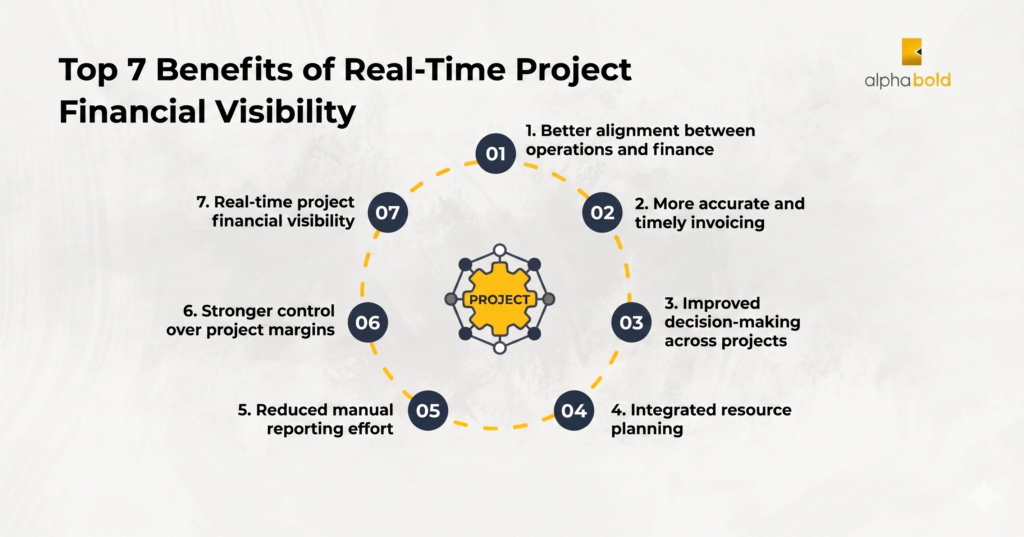
The value of Business Central Project Management is not in isolated features, but in how it improves control, visibility, and execution across projects.
1. Real-Time Project Financial Visibility
- Track budgets, actual costs, and profitability as work progresses
- Identify financial risks early instead of after project completion
- Reduce dependency on delayed financial reporting
2. Stronger Control Over Project Margins
- Connect project activity directly to financial outcomes
- Detect cost overruns and margin erosion early
- Improve overall project profitability
3. Integrated Resource Planning
- Align resource allocation with real-time project demand
- Monitor utilization across multiple projects
- Adjust assignments before bottlenecks impact delivery
4. Reduced Manual Reporting Effort
- Eliminate the need to consolidate data across systems
- Reduce spreadsheet dependency
- Improve reporting accuracy and consistency
5. Better Alignment Between Operations and Finance
- Ensure operational activity reflects financial impact in real time
- Improve coordination between project teams and finance
- Enable faster, more informed decision-making
6. More Accurate and Timely Invoicing
- Generate invoices based on actual progress or milestones
- Reduce billing errors and delays
- Improve cash flow predictability
7. Improved Decision-Making Across Projects
- Access consistent, real-time data across all projects
- Reduce reliance on static or outdated reports
- Support faster, more confident leadership decisions
Within Microsoft Dynamics 365 Business Central, these capabilities are not isolated modules. They are part of a connected system where financials, operations, and project execution continuously inform each other.
This is what enables better control, not just better tracking.
Business Impact and ROI
When implemented correctly, Business Central Project Management delivers measurable improvements across both operations and financial performance.
At a practical level, businesses typically see:
- Reduced time spent on manual data consolidation and reporting
- Earlier identification of budget overruns and cost leakage
- Improved resource utilization across multiple projects
- Faster and more accurate invoicing cycles
These changes compound over time.
- Finance teams spend less time reconciling data and more time analyzing it
- Project managers can act earlier instead of reacting late
- Leadership gains a clearer view of project profitability and risk
More importantly, the impact is not limited to efficiency. It directly affects how the business operates:
- Decisions are based on real-time data instead of delayed reports
- Project performance is managed continuously, not reviewed after completion
- Cash flow improves as billing becomes more aligned with actual delivery
This level of impact is reflected in broader industry findings. A Forrester Total Economic Impact study on Microsoft Dynamics 365 Business Central reports that organizations can achieve over 200% return on investment within three years, with payback in less than six months.
Within the platform, this level of control is possible because project activity, financial data, and operational workflows are connected by design.
The result is not just better project management. It is more predictable execution across the business.
The Reality Check: Complexity, Implementation, and What Most Businesses Miss
Business Central Project Management is powerful, but it is not simple.
Unlike basic project management tools or accounting systems, it is a full ERP platform. That means more capability, but also more complexity in how it needs to be configured and used.
In practice, this is where many implementations fall short.
- The system is deployed without aligning it to actual business processes
- Data is migrated without being cleaned or structured for reporting
- Project workflows are replicated instead of being improved
- Teams are not trained on how to use the system beyond basic tasks
As a result, businesses end up with a system that technically works, but does not deliver the visibility or control they expected.
This is not a limitation of Microsoft Dynamics 365 Business Central. It is a gap in how it is implemented.
To get real value from Business Central Project Management, three things need to be addressed early:
- Process alignment: Project workflows should be redesigned, not simply transferred into a new system
- Data readiness: Financial and operational data must be structured to support real-time visibility
- User adoption: Teams need to understand how their inputs impact project outcomes, not just how to use the interface
Without these, even the most capable system will behave like a basic tracking tool.
Why Implementation Determines Success
At this stage, the question is no longer whether Business Central Project Management can support your projects. It is whether it is implemented in a way that reflects how your business actually operates.
This is where most outcomes are determined.
Two organizations can deploy the same system and see completely different results. In one case, it becomes a centralized source of truth for project financials and execution. In another, it functions as little more than a reporting tool layered on top of existing inefficiencies.
The difference comes down to how the system is approached:
- Whether project workflows are restructured or simply replicated
- Whether financial and operational data are connected from the start
- Whether integrations across systems are treated as core, not optional
- Whether the focus is on long-term execution, not just go-live
This is the role of an implementation partner.
An experienced partner does more than configure Microsoft Dynamics 365 Business Central. They help align the system with your operating model, ensuring that project management is connected to financial performance, resource planning, and overall business outcomes.
This is also where firms like AlphaBOLD differentiate. The focus is not on deploying features, but on structuring the system so that it supports real-time visibility, decision-making, and execution across projects.
Want to Know How your Company Can Use BC?
Want to see how industry leaders are driving efficiency and profitability with Dynamics 365 Business Central? We understand starting an ERP journey can feel overwhelming, but we've helped countless businesses in your industry overcome challenges.
Request a DemoConclusion
Project management does not fail because of a lack of tools. It fails when those tools are disconnected from how the business actually operates.
Business Central Project Management addresses this by bringing financials, operations, and execution into a single system, allowing teams to manage projects with greater visibility and control. When implemented correctly, it enables earlier decision-making, improved cost management, and more predictable outcomes across projects.
The real value, however, is not in the system alone. It is in how well it is aligned to your processes, your data, and your operating model.
If you are evaluating how to move beyond fragmented project management and build a more connected approach to execution, this is where a structured implementation makes the difference.
FAQs
It improves profitability by connecting project execution directly to financial data. Costs, resource usage, procurement, and billing are tracked within the same system, allowing you to identify margin issues early and adjust before they impact overall project performance.
Most issues come from how the system is implemented, not the system itself. Common gaps include misaligned project workflows, poor data structure, limited integration between financials and operations, and low user adoption. These prevent the system from delivering real-time visibility and control.
Yes, but the value comes from consolidation, not replacement alone. By bringing project tracking, financial management, and operational workflows into one system, it eliminates data silos and reduces the need for manual reconciliation across tools.
You should assess process readiness, data quality, and integration requirements. It is critical to define how project financials, resources, and workflows will be structured within the system before implementation begins. This determines whether the system will support execution or simply replicate existing inefficiencies.