Dynamics 365 Business Central Essentials vs. Premium Licenses Explained

Introduction
Businesses comparing Dynamics 365 Business Central Essentials vs Premium are usually trying to answer one question: which license fits their operations without overspending.
Both plans include core ERP capabilities, but the difference lies in manufacturing and service management needs. This guide breaks down features, pricing, and when to choose each option based on real business scenarios.
Why Do Businesses Choose Dynamics 365 Business Central?
Dynamics 365 Business Central is widely adopted because it combines financials, operations, and CRM in a single cloud platform. It supports real-time reporting, integrates with Microsoft tools, and reduces dependency on fragmented legacy systems.
Often, the decision to select the right ERP solution falls to the CFO. This decision can be mind-boggling as they must select an ERP that aligns with their current business needs and scales effectively as the company grows.
Amid this situation, Dynamics 365 Business Central is trending as the platform of choice for a broad spectrum of businesses, from small and medium-sized businesses (SMBs) to large enterprises.
The appeal lies in Business Central Essentials features and its comprehensive suite of capabilities, including:
- Financials
- Sales
- Operations
A key advantage is that Business Central’s cloud-based nature enables:
- Real-time insights
- Streamlined business processes
- Reduced IT overheads
Moreover, Business Central offers unmatched utility, integrating seamlessly with other Microsoft products and third-party applications and easily fitting into diverse business ecosystems. This adaptability is particularly valuable for CFOs looking to ensure seamless data flow and unified reporting across departments.
To support this, as Kyle Johanson, VP, J-Systems, Inc., Lombard, Illinois, stated: “With Dynamics 365 Business Central, we no longer have to store data in separate systems that don’t work together, it’s all integrated.”
- For SMBs, Business Central offers an affordable entry point to advanced ERP functionality previously accessible only to larger organizations with substantial IT budgets.
- For enterprises, Business Central’s scalability and customization capabilities make it a solution for handling complex, large-scale operations.
What Is the Difference Between Business Central Essentials vs Premium?
The main difference between Essentials and Premium is functionality. Essentials covers core ERP capabilities, while Premium includes additional modules for manufacturing and service management. Pricing also varies based on these extended features.
After selecting the preferred ERP system, the next step in a CFO’s pipeline is to carefully examine the available licensing options. The good thing is that the Business Central licensing structure is not confusing at all.
It offers two types of licenses:
- Dynamics 365 Business Central Essentials – $80 user/month – paid yearly
- Dynamics 365 Business Central Premium – $110 user/month – paid yearly
Business Central also offers Team Member licenses for limited-access users and a free trial, but the primary comparison for full ERP functionality is between Essentials and Premium.
What’s the difference, and which licensing is right for your business? Have a look at each one’s functionality, then assess whether making the jump from Essentials to Premium is a smart move.
What Does Dynamics 365 Business Central Essentials Include?
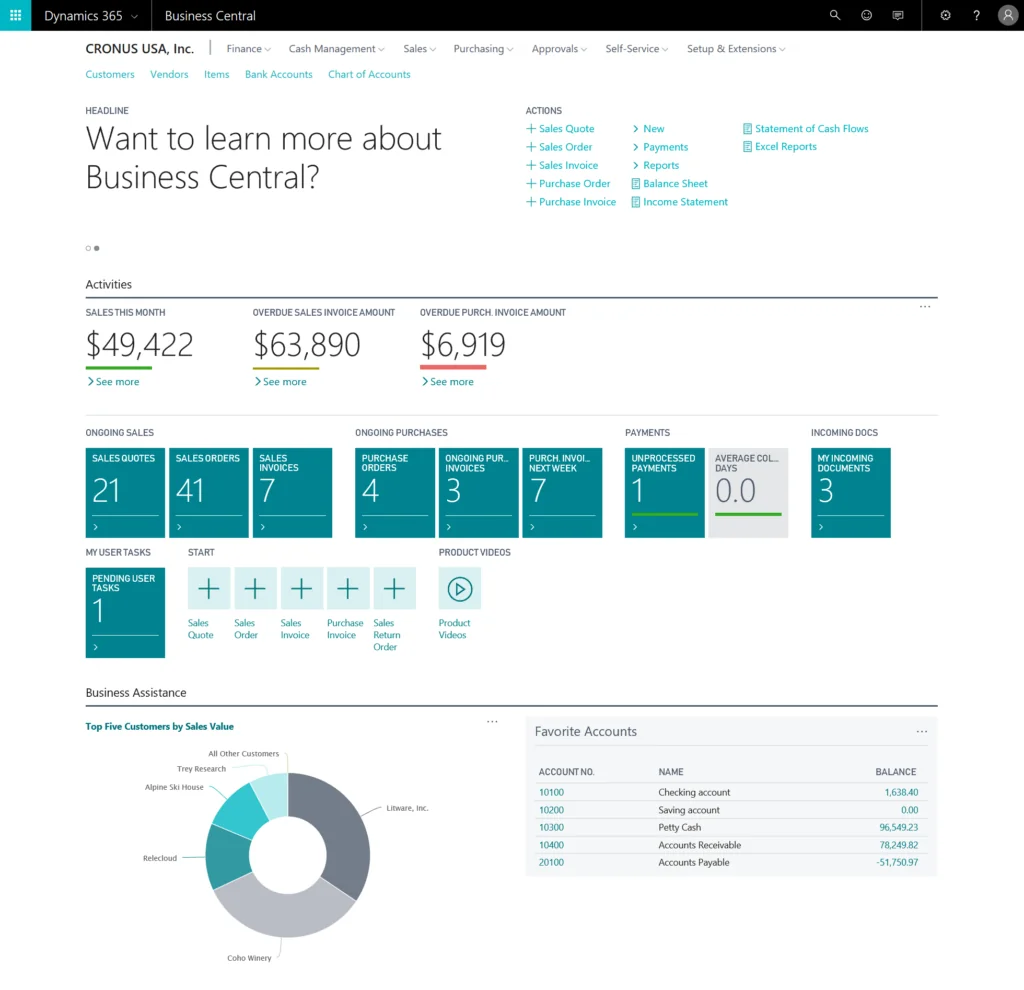
Business Central Essentials offers multiple management and operational capabilities, designed for businesses that need a complete ERP without manufacturing or service modules.
Core Capabilities:
- Financial Management: Manage general ledger, budgeting, cash flow, and financial reporting in a centralized system.
- Human Resources Management: Handle employee records, payroll-related data, and workforce administration processes.
- AI-Supported Forecasting: Use built-in intelligence to predict trends, demand, and financial outcomes.
- Customer Relationship Management: Track customer interactions, manage sales pipelines, and improve relationship visibility.
- Project Management: Plan, track, and control project costs, timelines, and resource allocation.
- Supply Chain Management: Oversee procurement, vendor management, and end-to-end supply chain operations.
- E-Services: Enable online services and integrations to support digital business operations.
- Warehouse Management and Inventory: Monitor stock levels, manage warehouse operations, and optimize inventory control.
What are the Benefits of the Essentials License?
Opting for the Dynamics 365 Business Central Essentials license offers several benefits, making it an ideal choice for a variety of businesses.
- Comprehensive Functionality at a Lower Cost:
Because it provides a wider range of functionalities covering finance, sales, purchasing, inventory, and project management. This makes it a cost-effective solution for SMBs. - Scalable:
It supports the evolving needs of growing businesses. The license is adaptable and can accommodate changes in business size and complexity, making it suitable for businesses with expansion plans. - Ease of Integration:
Essentials integrates seamlessly with other Microsoft products and services, enhancing productivity and streamlining operations. - User-Friendly Interface:
The platform is known for its intuitive design, making it easier for employees to adapt and use efficiently, thereby reducing training time and costs.
What Does Dynamics 365 Business Central Premium Include?
The Dynamics 365 Business Central Premium license extends the capabilities of the Essentials package by adding specialized features in Service Order Management and Manufacturing.
Service Management Capabilities:
- Planning and Dispatching: Schedule and assign service tasks to resources based on availability and priority.
- Service Contract Management: Manage service agreements, track contract terms, and monitor service commitments.
- Service Item Management: Maintain detailed records of serviceable items, including history and warranties.
- Service Order Management: Create, track, and manage service orders from request to completion.
- Service Price Management: Define pricing structures for services, including contracts, labor, and parts.
Manufacturing Capabilities:
- Standard Cost Worksheets: Calculate and manage standard costs for materials, labor, and production processes.
- Production Bill of Materials: Define components and materials required to manufacture finished goods.
- Basic Capacity Planning: Plan production capacity based on available resources and demand forecasts.
- Machine Centers: Track and manage machine-level operations within the production process.
- Version Management: Maintain and control different versions of production data and configurations.
- Production Orders: Create and manage orders for manufacturing goods through various stages.
- Finite Loading: Schedule production tasks based on real-time capacity constraints and resource availability.
Note: While Assembly Management is a feature of the Premium license, it is also included in the Business Central Essentials License.
Who Should Choose the Premium License?
The Premium license of Dynamics 365 Business Central is ideally suited for businesses with specific service management and manufacturing needs. It provides the tools necessary for in-depth management of service operations and complex manufacturing processes, making it a valuable asset for companies in these sectors.
Not Sure Which License Fits Your Business?
Get a quick assessment based on your operations, users, and growth plans.
Request a ConsultationDynamics 365 Business Central Essentials and Premium User Licenses Include:
Both Essentials and Premium licenses include a defined set of user rights and capabilities designed to support core business operations, financial controls, and collaboration with external stakeholders. The inclusions below outline what is available under each license type in a clear breakdown.
| Capability | What It Includes |
|---|---|
|
Team Member Access |
Full access for Business Central Team Members to view data and perform light tasks across the system. |
|
External Accountant Licenses |
Up to 3 licenses per tenant for external accountants, allowing secure access to financial data without admin or user setup permissions. |
|
Multi-Company Support |
Multi-Company Support |
|
Azure AI Access |
30 minutes (1800 seconds) per tenant for Azure AI usage to combine data sources and generate insights and analytics. |
Business Central Essentials vs Premium: Feature Comparison
Both editions share the same core ERP foundation, but Premium extends functionality into manufacturing and service operations. Essentials focuses on core business management, while Premium adds advanced operational control for more complex industries.
| Feature | Essentials | Premium |
|---|---|---|
|
Financial Management |
Included |
Included |
|
Sales & Marketing |
Included |
Included |
|
Purchasing & Payables |
Included |
Included |
|
Inventory Management |
Included |
Included |
|
Supply Chain Planning |
Included |
Included |
|
Project Management |
Project Management |
Project Management |
|
Warehouse Management |
Included |
Included |
|
Manufacturing |
Not included |
Included (production orders, BOM, capacity planning) |
|
Service Management |
Not included |
Included (service orders, contracts, dispatching) |
|
Target Use Case |
Finance and operations-focused businesses |
Manufacturing or service-driven organizations |
When Should You Choose Essentials vs. Premium?
Choosing between Business Central Essentials and Premium depends on how complex your operations are today and how far you plan to scale. Essentials covers core business processes, while Premium extends capabilities into manufacturing and service operations for more advanced operational control.
Choose Essentials if:
- You need core ERP functionality such as finance, sales, inventory, and project management
- You do not run manufacturing operations
- Service management is not a core business requirement
- You want a lower-cost entry point into a full ERP system
Choose Premium if:
- You manage manufacturing processes such as production and shop floor control
- You require service order management and service contract handling
- You need production planning, scheduling, and capacity tracking
- Your operations involve complex, multi-step supply chain workflows
Plan Your Business Central Licensing the Right Way
Avoid overpaying or selecting the wrong license. Get expert guidance aligned to your operations.
Talk to a Business Central ExpertConclusion
Selecting between Business Central Essentials and Premium depends on how your business operates today and what capabilities you will need next.
FAQS
Yes, if you need manufacturing or service management. Otherwise, Essentials is sufficient for most businesses.
Yes, businesses can switch licenses as requirements evolve.
Yes, Essentials includes full inventory and warehouse capabilities.
Yes, Essentials is designed as a cost-effective ERP for SMBs.
Yes, both integrate with Microsoft 365, Power Platform, and other tools.