Penetration Testing for Microsoft Business Applications: Protecting CRM, ERP, Cloud, and Customer Data

Table of Contents
Most business-critical systems now sit inside connected cloud environments. CRM platforms store customer records, ERP systems manage financial and operational data, SharePoint holds internal documents, and Power Platform apps often connect workflows across departments.
Penetration testing helps organizations understand whether these systems are properly protected. It identifies weaknesses in access controls, configurations, integrations, and user permissions before attackers can exploit them.
For companies using Microsoft technologies such as Dynamics 365, Business Central, Microsoft 365, SharePoint, Power Platform, and Azure, penetration testing is not just a cybersecurity task. It is a way to protect customer data, reduce compliance risk, and validate whether business applications are secure enough to support daily operations.
What Does Penetration Testing Mean For Microsoft Business Applications?
Penetration testing for Microsoft business applications means testing the systems your business relies on every day to identify security weaknesses before they can be exploited.
For B2B companies, this is important because business applications often store sensitive customer, financial, operational, and employee data. A weak permission setting, exposed integration, misconfigured portal, or over-permissioned user account can create a serious risk across the organization.
Microsoft’s 2025 Digital Defense Report reinforces this urgency, noting that cyberattacks now affect business continuity, public trust, and organizational resilience. The report also highlights common attacker targets, including exposed services, unpatched assets, identity weaknesses, and sensitive data access, all of which are highly relevant to connected Microsoft business environments.
In Microsoft environments, penetration testing is especially useful because many systems are connected. Dynamics 365 may connect with Outlook, Teams, Power BI, SharePoint, Power Platform, Business Central, and Azure. If one area is misconfigured, it can affect how data is accessed across the business.
Penetration testing helps organizations answer practical security questions such as:
- Can users access CRM or ERP records they should not see?
- Are customer, financial, or employee records exposed through weak permissions?
- Are SharePoint files or Microsoft 365 resources shared too broadly?
- Can a Power Platform app or connector expose sensitive business data?
- Are APIs, portals, and third-party integrations properly secured?
- Do identity controls, MFA, and Conditional Access policies work as intended?
- Can attackers move from one weak point to a larger system compromise?
This makes penetration testing more than a technical assessment. It becomes a way to validate whether business systems are secure, compliant, and ready to support daily operations without exposing the company to unnecessary risk.
Which Business Systems Should Be Included In A Penetration Test?
A penetration test should include the business systems that store, process, or transfer sensitive data, including CRM, ERP, Microsoft 365, SharePoint, Power Platform apps, Azure environments, customer portals, and APIs.
For most B2B companies, risk does not sit in one system. Customer data may start in a CRM, move into an ERP for billing, appear in Power BI dashboards, and be shared through Microsoft 365 or SharePoint. If access controls, integrations, or permissions are weak at any point, sensitive information can be exposed.
This is why penetration testing should focus on business workflows, not just infrastructure. The goal is to understand how users, applications, integrations, and data move across the environment.
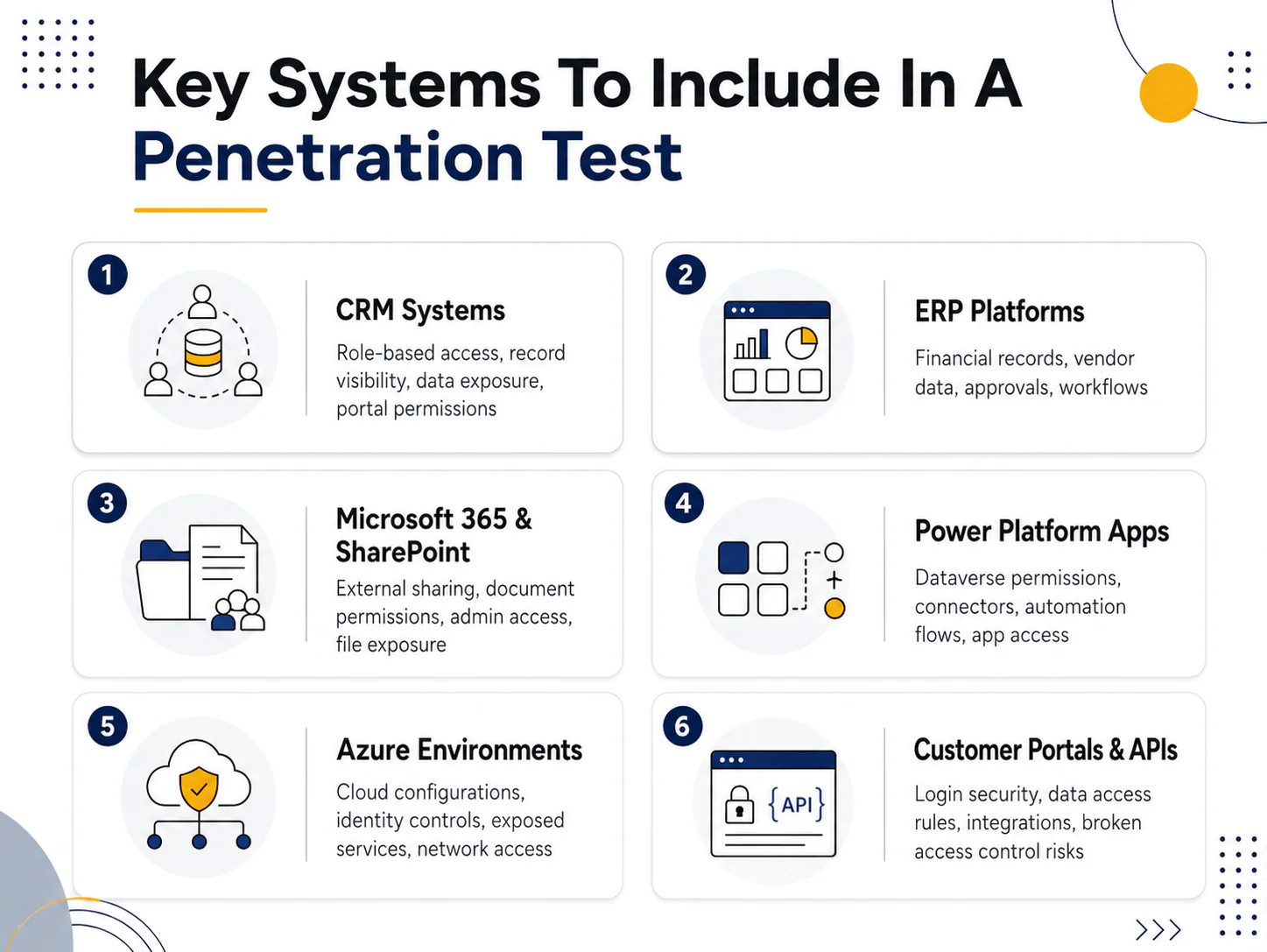
Key systems to include are:
- CRM systems: Test role-based access, customer record visibility, sales data exposure, and portal permissions.
- ERP platforms: Review access to financial records, vendor data, purchase approvals, and operational workflows.
- Microsoft 365 and SharePoint: Check external sharing, document permissions, admin access, and sensitive file exposure.
- Power Platform apps: Assess Dataverse permissions, connectors, automation flows, and app-level access.
- Azure environments: Test cloud configurations, identity controls, exposed services, and network access.
- Customer portals and APIs: Validate login security, data access rules, integrations, and broken access control risks.
Further Reading: Best Pen Testing Tools
Secure The Business Systems That Run Your Operations
Your CRM, ERP, Microsoft 365, SharePoint, Power Platform, Azure, portals, and integrations all hold critical business data. AlphaBOLD helps organizations assess these connected environments, identify security gaps, and strengthen access controls before vulnerabilities affect operations, compliance, or client trust.
Request a ConsultationWhat Security Risks Can Penetration Testing Find In Business Applications?
Penetration testing can find access control gaps, exposed data, weak authentication, misconfigured cloud settings, insecure integrations, and vulnerabilities that could allow unauthorized users to access business-critical systems.
For B2B companies, these risks often appear inside daily workflows. A sales user may have access to records outside their territory. A SharePoint folder may be shared with the wrong external users. A Power Platform app may expose Dataverse data through an unsecured connector. An API may allow one customer or partner to view another customer’s information.
These issues are serious because they affect the systems that hold customer, financial, operational, and employee data.
Common risks penetration testing can uncover include:
- Broken access controls: Users can view, edit, or export data they should not access.
- Over-permissioned accounts: Employees, vendors, or admins have broader access than required.
- Weak authentication: MFA, password policies, or session controls are not properly enforced.
- Exposed customer data: CRM, ERP, portal, or API data can be accessed without proper authorization.
- Misconfigured cloud services: Azure resources, storage, or network settings are exposed or too broadly accessible.
- Insecure integrations: Third-party tools, APIs, or connectors create hidden data leakage risks.
- Unsafe file sharing: SharePoint or Microsoft 365 files are shared externally without enough control.
- Unmonitored attack paths: A small weakness in one system can lead to broader access across the environment.
Why Is Penetration Testing More Important In The AI World?
Microsoft’s 2025 Digital Defense Report highlights that AI is changing both sides of cybersecurity. Defenders are using AI to detect and respond to threats faster, but attackers are also using AI to increase the speed and sophistication of attacks. The report also points to exposed services, unpatched assets, identity weaknesses, and sensitive data access as major areas of concern.
This matters for B2B companies because AI is not operating in isolation. It is often connected to the same systems that store customer records, financial data, sales activity, service tickets, contracts, documents, and operational workflows.
Penetration testing helps organizations assess AI-related risks such as:
- Sensitive data exposure: AI tools may access customer, financial, or employee data from CRM, ERP, SharePoint, or Microsoft 365.
- Over-permissioned AI access: Copilot, agents, or automation tools may surface data based on permissions that are too broad.
- Prompt injection risks: Attackers may manipulate AI inputs to influence outputs or bypass expected behavior. OWASP lists prompt injection as a key risk for large language model applications.
- Insecure integrations: AI systems connected to APIs, plugins, portals, or third-party tools may create hidden access points.
- Weak identity controls: Poor MFA, Conditional Access, or role-based access settings can expose AI-connected systems.
- Unmonitored automation: AI agents or workflows may take actions without enough approval, logging, or governance.
- Model and data governance gaps: NIST’s Generative AI Profile notes that organizations need structured ways to identify and manage the unique risks introduced by generative AI systems.
For companies using Microsoft technologies, this is especially relevant. AI tools such as Microsoft Copilot, Copilot Studio agents, Dynamics 365 AI capabilities, Power Platform automation, and Azure AI services all rely on secure data access and properly governed environments.
Penetration testing helps validate whether those environments are ready for AI by verifying that users, systems, applications, and integrations have the appropriate levels of access. It gives leaders confidence that AI adoption is not exposing sensitive business data or creating new attack paths across the organization. As environments become increasingly connected, penetration testing needs to be carefully scoped and interpreted. This is where expert guidance becomes important.
Further Reading: Essential Security Testing Practices for Cloud Applications
Why Should Businesses Work With A Microsoft Penetration Testing Consultant?
Businesses should work with a Microsoft penetration testing consultant because expert guidance helps them test the right systems, avoid disruption, understand risks clearly, and fix vulnerabilities based on business impact.
For companies using CRM, ERP, Microsoft 365, SharePoint, Power Platform, Azure, AI tools, and customer portals, security testing can become complex. These systems are connected through permissions, workflows, APIs, and data flows, so automated scans alone may miss important risks.
A Microsoft penetration testing consultant helps businesses:
- Define the right scope across cloud, applications, portals, and integrations.
- Test safely without disrupting daily operations.
- Translate findings into business, compliance, and operational risk.
- Prioritize fixes based on data exposure and attack paths.
- Validate remediation through retesting.
- Strengthen governance across users, permissions, and connected systems.
For AlphaBOLD clients, this means penetration testing is not treated as a one-time checklist. It becomes a practical way to secure Microsoft business applications, AI-enabled workflows, and cloud environments with clear next steps.
Work With a Microsoft Penetration Testing Consultant
Security testing should give your team clear direction, not just a long list of vulnerabilities. AlphaBOLD helps businesses scope penetration testing, assess Microsoft business applications, prioritize risk, and validate remediation across cloud, AI-enabled workflows, portals, and connected systems.
Request a ConsultationConclusion
Penetration testing is no longer limited to networks and infrastructure. For modern B2B companies, it plays a critical role in protecting CRM, ERP, Microsoft 365, SharePoint, Power Platform, Azure, AI-enabled workflows, customer portals, and connected business data.
As Microsoft environments become more integrated, every permission, API, workflow, and identity control matters. A well-planned penetration test helps organizations find weaknesses before they affect compliance, operations, customer trust, or business continuity.
With the right Microsoft penetration testing consultant, businesses can move beyond basic vulnerability checks and build a stronger, safer foundation for growth, innovation, and AI adoption.
Explore Recent Blog Posts



Related Posts