

Table of Contents
Introduction
AI in the AEC industry is now being applied directly to core project functions such as design coordination, cost control, scheduling, safety monitoring, and risk management. Instead of sitting in standalone tools or pilots, AI is increasingly embedded within BIM environments, project controls, and construction management systems where day-to-day decisions are made.
In practical terms, AI in the AEC industry is used to analyze design constraints, forecast budget and schedule risks, flag constructability issues, and surface site-level exceptions using live project data. Its value depends less on advanced algorithms and more on data quality, system integration, and clearly defined decision boundaries between automated insight and human approval.
This article focuses on how AI is being applied inside active AEC projects today, where it delivers measurable operational value, and where limitations around data, governance, and accountability still require disciplined oversight.
How AI Actually Operates Inside AEC Project Workflows
AI in the AEC industry operates inside existing project systems rather than as a separate layer of tools. It is embedded within BIM coordination environments, cost management systems, schedules, and site reporting platforms where design changes, budget updates, and construction decisions already occur. AI processes live project data to identify clashes, forecast cost overruns, flag schedule slippage, and surface site-level exceptions that require attention.
In most AEC workflows, AI does not make autonomous decisions. It analyzes patterns across drawings, quantities, progress data, and historical project records, then produces risk indicators, recommendations, or alerts. Project managers, estimators, superintendents, and engineers remain responsible for approving actions such as change orders, resequencing work, or adjusting procurement plans.
The effectiveness of AI in AEC workflows depends on data consistency across BIM, scheduling, and financial systems. When project data is fragmented, outdated, or manually maintained, AI outputs lose reliability and become difficult to trust or act upon.
Core AI Use Cases by AEC Function
AI in the AEC industry delivers the most value when applied to specific project functions rather than deployed as general-purpose technology. Its role is to support decision-making across design coordination, cost and schedule control, site operations, and safety management using project-specific data.
Design Coordination and Planning
AI supports design teams by identifying clashes, constructability risks, and constraint conflicts across BIM models before they reach the field. It can evaluate design alternatives against cost, schedule, and material constraints, helping teams resolve issues earlier without replacing engineering judgment.
Cost, Schedule, and Risk Management
In project controls, AI analyzes historical and live data to forecast budget overruns, schedule slippage, and change order risk. These insights allow project managers to intervene earlier by adjusting sequencing, procurement timing, or scope assumptions before impacts escalate.
Construction Site Operations
AI is used on active job sites to track progress, compare planned versus actual work, and highlight deviations that require attention. Image analysis, sensor data, and daily reports are processed to surface exceptions rather than generate continuous noise for site teams.
Safety and Compliance
AI supports safety management by identifying high-risk patterns based on site activity, equipment usage, and environmental conditions. Instead of relying solely on reactive reporting, AI enables proactive alerts tied to predefined safety policies and compliance thresholds.
Let's Discuss Your Use Case:
Further Reading: Robotic Process Automation
Looking to transform your construction management experience with AI?
Collaborate with AlphaBOLD and acquire ideal AEC AI Solutions customized for your business.
Request a ConsultationDigital Twins as Operational Control Systems
In AEC projects, digital twins are increasingly used as operational control systems rather than static visualization models. They connect design data, schedules, cost information, and site inputs to provide a live representation of project conditions that can be monitored and adjusted as work progresses.
When properly implemented, digital twins support forecasting and decision-making by identifying deviations between planned and actual performance. They can highlight emerging cost exposure, schedule conflicts, or constructability issues as conditions change on site. This allows project teams to assess impact scenarios before committing to corrective actions such as resequencing work or approving change orders.
The effectiveness of digital twins depends on data continuity across BIM, project controls, and field reporting systems. Without reliable inputs and disciplined update processes, digital twins quickly degrade into static models that offer limited operational value.
New Industry Trends & Advancements of AI in the AEC Industry
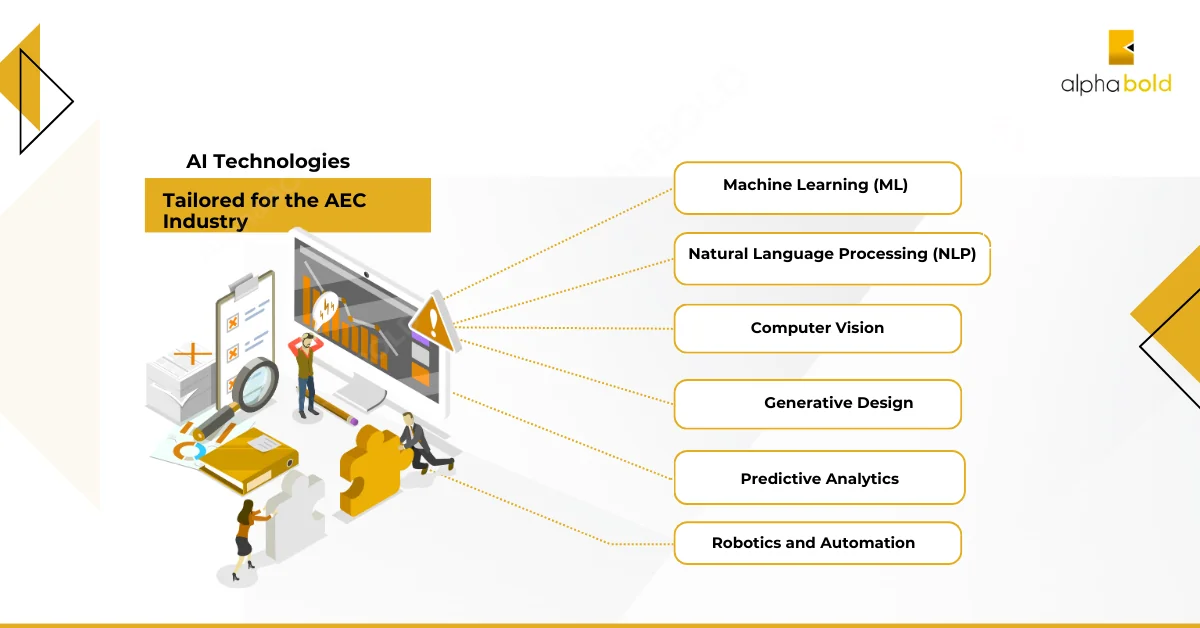
AI-Powered BIM:
AI-powered BIM is now used to support coordination, validation, and risk identification rather than acting as a standalone intelligence layer. AI analyzes model changes, quantities, and dependencies to flag constructability risks, scope inconsistencies, and potential cost or schedule exposure before issues move downstream. Its value depends on consistent model governance and disciplined update cycles across design and construction teams.
Generative Design:
Generative design is increasingly applied within defined constraints such as cost targets, zoning rules, material availability, and constructability requirements. Rather than producing unlimited design options, AI supports comparative analysis by evaluating trade-offs and narrowing feasible alternatives. Final design decisions remain with architects and engineers, with AI used to accelerate evaluation rather than replace judgment.
Performance Analysis:
AI supports performance analysis by evaluating environmental and operational factors using simulation data and historical project outcomes. These insights help teams assess thermal behavior, daylighting, and airflow earlier in the design process, allowing performance considerations to be addressed before designs are finalized. The accuracy of these insights depends on validated assumptions and reliable input data.
Sustainability:
AI contributes to sustainability efforts by supporting material optimization, waste reduction, and energy performance analysis within project constraints. Rather than recommending idealized solutions, AI is used to compare realistic options based on availability, cost impact, and compliance requirements. Sustainability outcomes improve when AI insights are aligned with procurement and construction realities.
AI-Powered CAD:
AI-powered CAD tools are used to automate repetitive drafting tasks, validate geometry, and identify inconsistencies across drawings. This reduces manual rework and coordination errors while allowing designers to focus on complex problem-solving. AI assists with efficiency and accuracy but does not replace the need for design review and approval processes.
Virtual Reality (VR) and Augmented Reality (AR):
VR and AR are primarily used as visualization and coordination aids rather than core AI systems. When combined with project data, they help teams review spatial constraints, sequencing, and site conditions more effectively. Their value is strongest during stakeholder reviews, constructability assessments, and training scenarios, rather than continuous operational control.
Accident Prediction:
AI supports accident prediction by analyzing historical incident data, work sequencing, equipment usage, and site conditions to identify elevated risk scenarios. These insights help safety teams prioritize inspections and interventions, but they do not eliminate the need for on-site supervision and established safety protocols.
Real-time Monitoring:
AI-assisted monitoring systems process inputs from sensors, cameras, and wearables to surface safety-related exceptions rather than continuously tracking individual workers. Alerts are typically tied to predefined thresholds and policies, with human review required before corrective action is taken. Adoption is often limited by privacy considerations, data accuracy, and site readiness.
Further Reading: AI-Driven Predictive Analytics Via Power BI Insights

AI Adoption Barriers
Despite growing investment, AI in the AEC industry continues to face adoption barriers that are more operational than technological. The most common challenges relate to data readiness, system integration, and governance rather than the availability of AI tools themselves.
Key adoption barriers include:
- Fragmented project data across BIM, scheduling, cost, and field systems
- Inconsistent data ownership and manual data maintenance
- Limited system integration across the project lifecycle
One of the primary obstacles is fragmented project data. Design models, schedules, cost systems, and field reports often operate in silos, making it difficult for AI to generate reliable insights across the full project lifecycle. Inconsistent data ownership, manual updates, and outdated information reduce trust in AI outputs and limit their usefulness in active projects.
Organizational challenges further slow adoption:
- Lack of defined workflows for acting on AI-generated insights
- Unclear approval and escalation paths
- Uncertainty around responsibility for AI-informed decisions
Organizational readiness is another constraint. Many AEC teams lack clear processes for incorporating AI-generated insights into decision-making workflows. Without defined approval paths, accountability, and escalation rules, AI recommendations are either ignored or applied inconsistently, increasing risk rather than reducing it.
Regulatory and contractual considerations add additional friction:
- Explainability requirements for AI-supported decisions
- Auditability and documentation expectations
- Liability concerns tied to safety, cost, and schedule outcomes
Regulatory requirements and contractual liability also slow adoption. AEC firms must ensure that AI-supported decisions remain explainable, auditable, and compliant with project agreements and safety standards.
Ethical Concerns of AEC AI Tools
Ethical concerns around AI in AEC focus primarily on accountability, transparency, and appropriate use within project workflows. Because AI influences decisions related to safety, cost, and schedule, responsibility for outcomes must remain clearly assigned to qualified professionals rather than automated systems.
Key ethical considerations include:
- Clear ownership of decisions informed by AI outputs
- Defined boundaries between AI recommendations and human approval
- Documentation of how AI insights are reviewed and applied
These concerns are especially relevant given the current adoption landscape. According to a global survey of AEC professionals, only 27 % of firms currently use AI in their operations, yet 94 % of those users plan to increase AI investment in the next year, indicating cautious adoption today with strong growth intent ahead. As usage expands, the need for clear accountability and defensible decision-making becomes more critical.
Data use and monitoring also raise concerns:
- Worker privacy related to cameras, sensors, and wearables
- Appropriate limits on continuous monitoring
- Policies governing data access, retention, and consent
Many AEC firms address these risks by limiting AI use to exception-based alerts and applying governance controls that prioritize transparency, human judgment, and auditable decision paths.
Supercharge Your Construction Operations with AI
Contact us today and experience the transformative power of AI in the AEC industry.
Request a ConsultationThe Financial Aspect: ROI & Cost Implications
ROI from AI in AEC is driven less by broad transformation and more by targeted improvements in project control, risk mitigation, and operational efficiency. The strongest financial returns typically come from use cases that reduce rework, prevent schedule slippage, and surface cost exposure early, rather than from fully autonomous automation.
Where AI tends to deliver near-term ROI:
- Early detection of budget and schedule risks
- Reduction in design coordination errors and rework
- Improved productivity through exception-based reporting
- Proactive safety interventions that reduce incident-related costs
Initial costs are not limited to technology licensing. Meaningful investment is required for data preparation, system integration, process definition, and training. Projects that underestimate these foundational costs often struggle to translate AI insights into financial value.
Common cost and value considerations include:
- Integration effort across BIM, scheduling, and cost systems
- Ongoing data governance and maintenance
- Time required for teams to adopt new decision workflows
Longer-term value emerges when AI is applied consistently across multiple projects, allowing firms to standardize risk detection, improve forecasting accuracy, and reduce variability in project outcomes. In this context, ROI is cumulative and operational rather than tied to a single deployment.
AI Adoption by Capability, Not Company Size
AI adoption in AEC is driven more by operational capability than by firm size. AI in the AEC industry delivers consistent value only when data, workflows, and governance are in place to support reliable decision-making across projects.
- Foundational Capability
Firms at this stage focus on stabilizing project data and standardizing workflows. AI is primarily used to surface coordination issues, schedule risks, and safety concerns in an advisory role. The objective is to build trust in AI outputs before applying them to higher-impact decisions. - Operational Capability
At this level, AI in the AEC industry is integrated into active project workflows. Teams use AI insights to support cost control, sequencing, procurement timing, and risk mitigation, with clear approval paths and accountability in place. - Advanced Capability
More mature adopters apply AI across multiple projects to improve forecasting accuracy and reduce variability. Governance, auditability, and explainability are embedded, allowing AI-supported decisions to scale without increasing risk exposure.
Progression between these stages depends on data quality, integration maturity, and organizational discipline rather than company size.
What AI Should Not Be Used For in AEC
While AI can support many aspects of project delivery, there are clear limits to where it should be applied in AEC environments. Misuse often occurs when AI outputs are treated as decisions rather than inputs to professional judgment.
AI should not be used for:
- Autonomous safety decisions that bypass on-site supervision or established safety protocols
- Final approval of change orders, budgets, or claims without qualified human review
- Regulatory or code-compliance determinations that require licensed accountability
- Poorly governed cost or schedule decisions based on incomplete or unverified data
- Continuous worker surveillance without clear purpose, consent, and policy controls
AI performs best when it identifies risks, patterns, and exceptions early. It performs poorly when asked to replace responsibility, professional judgment, or contractual accountability. In AEC projects, the cost of error is high, making human oversight essential wherever AI insights influence safety, cost, or legal outcomes.
Conclusion
AI in the AEC industry is most effective when it is treated as operational support rather than a replacement for professional judgment. Its value comes from improving visibility across design, cost, schedule, safety, and site conditions, allowing teams to identify risks earlier and make more informed decisions.
Successful adoption depends on data quality, system integration, and clear governance. Firms that apply AI within well-defined workflows, with accountability and oversight in place, are better positioned to realize consistent value while managing risk. As AI use continues to expand, disciplined execution and responsible controls will matter more than the sophistication of the technology itself.
Explore Recent Blog Posts