

Table of Contents
Introduction
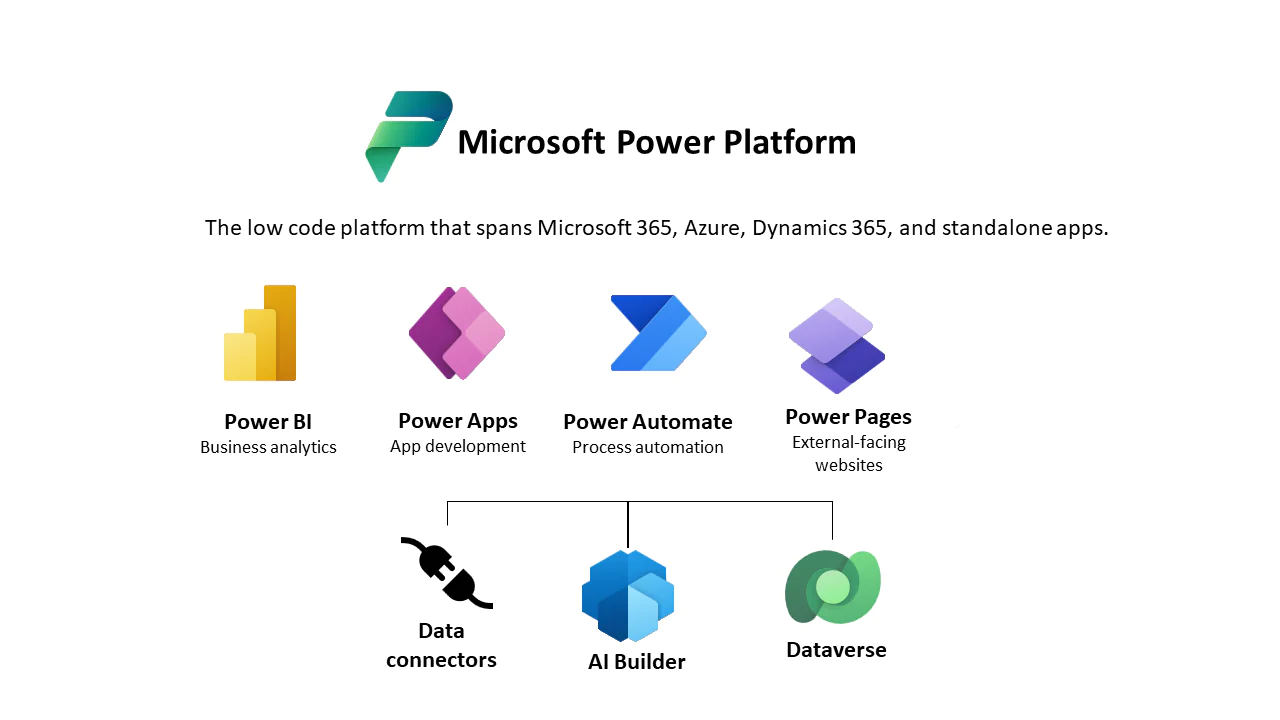
Artificial intelligence (AI) transforms business operations by streamlining workflows and enhancing decision-making. With its tools like Power BI, Power Apps, Power Automate, and Power Virtual Agents, Microsoft Power Platform harnesses AI to help enterprises innovate efficiently. Both technical and non-technical users can leverage AI’s capabilities by integrating machine learning in a low-code/no-code environment.
Tools such as AI Builder and Azure AI features enable organizations to automate tasks, build intelligent applications, and generate actionable insights through AI-enhanced reporting. This leads to creating adaptive workflows that optimize processes and deliver measurable value.
The impact of AI on power platforms is profound; for example, McKinsey & Company found that generative AI could boost sales productivity by 3% to 5% of global sales expenditures. Moreover, workers’ productivity increased by 66% with AI tools, resulting in significant productivity gains.
Incorporating AI is essential not just for competitiveness but also for achieving tangible outcomes. With AI integration with Microsoft Power Platform, businesses can modernize systems, enhance customer interactions, and unlock data potential, all while ensuring scalability and ease of adoption. This leads to a measurable return on investment (ROI) in a fast-evolving market.
What are The Key Components of AI Integration in Power Platform?
AI Builder:
AI Builder stands at the forefront of AI integration with Microsoft Power Platform. This tool provides prebuilt and customizable AI models that address common business needs, including object detection, text classification, and sentiment analysis. With its intuitive design, AI Builder empowers users to create and deploy AI models without requiring extensive data science expertise, making AI accessible to business users and enabling them to drive innovation directly within their workflows.
Azure AI Services:
Azure AI Services, such as Azure Cognitive Services, seamlessly integrate with the Power Platform to deliver advanced capabilities like natural language processing, computer vision, and predictive analytics. These services enable enterprises to enhance applications and workflows with cutting-edge AI functionalities, driving smarter decision-making and improving operational efficiency.
Copilot in Power Platform:
The introduction of Copilot strengthens AI integration with Microsoft Power Platform by embedding generative AI into app development and workflow automation. Copilot streamlines complex tasks by offering intelligent suggestions and prebuilt components, significantly reducing development time. This feature enhances productivity and empowers organizations to achieve faster results with minimal effort.
Power BI and AI Insights:
Power BI’s AI-powered features enable users to extract deeper insights from their data. With tools such as automated machine learning, natural language querying, and anomaly detection, Power BI helps organizations uncover trends, predict outcomes, and make data-driven decisions more effectively. These AI integrations turn raw data into actionable intelligence, enabling leaders to respond swiftly to business challenges and opportunities.
What are Some Benefits of AI in Power Platform?
Integrating AI within Microsoft Power Platform offers enhanced efficiency by automating repetitive tasks, enabling teams to focus on high-value activities, and reducing manual errors. As part of AI integration with Microsoft Power Platform, Power Automate’s AI-driven workflows save time and improve accuracy.
It also drives improved decision-making through AI-enhanced analytics in Power BI, empowering organizations to leverage predictive insights and anomaly detection for proactive strategies. The platform empowers non-technical users by providing tools like AI Builder and low-code/no-code capabilities, making it easier to integrate AI into workflows without requiring coding expertise.
Additionally, AI enables personalized user experiences with Power Virtual Agents, which use natural language understanding to create intelligent chatbots that deliver tailored responses, improving customer satisfaction.
The platform ensures scalability and flexibility, allowing AI-driven solutions to adapt seamlessly as business needs evolve without requiring significant redevelopment.
You may also like: Scale Innovation with Microsoft Power Platform and AI
Empower Your Business With AI-Powered Solutions.
Partner with AlphaBOLD today and learn how Power Platform with AI integration can enhance your operations.
Request a ConsultationWhat Are Some Real-World Applications of Power Platform?
Power Platform AI use cases show how AI integration in Microsoft Power Platform supports diverse, real-world applications across industries. In customer service automation, companies deploy Power Virtual Agents to create AI-powered chatbots that manage routine inquiries, freeing human agents to focus on more complex issues.
In predictive maintenance, manufacturing firms utilize AI models built with AI Builder to forecast equipment failures and schedule timely maintenance, reducing costly downtime and operational disruptions.
For sales forecasting, AI-enhanced Power BI dashboards provide predictive analytics that enables sales teams to project revenue accurately and identify high-value leads, driving more strategic decision-making. Additionally, organizations leverage AI Builder’s form processing capabilities in document processing to automate data extraction from invoices, contracts, and other critical documents, streamlining operations and improving efficiency.
Further Reading: AI and IoT Integration: Exploring Smarter Business Solutions
How to Get Started with AI in Power Platform?
Define your goals to successfully integrate AI into your business operations with Microsoft Power Platform. Identify specific challenges you aim to address, such as automating workflows or enhancing customer experiences, to guide your AI strategy. Begin with AI Builder, where you can experiment with prebuilt AI models and tailor them to meet your organization’s unique needs.
For more advanced use cases, integrate Azure AI services into your Power Platform solutions to unlock additional cognitive capabilities like natural language processing and predictive analytics. It’s also critical to train your team ensure they understand how to leverage AI tools effectively, even if they don’t have a technical background. Lastly, remember to iterate and optimize. Continuously refine your AI models and workflows to align with your evolving business objectives, driving ongoing innovation and improved outcomes.
Further Reading: A Guide for Power Apps Integration with SharePoint
Are You Ready to Implement AI In Your Organization?
Begin with a consultation to define your goals and set up your AI model with Power Platform.
Request a ConsultationConclusion
AI integration with Microsoft Power Platform represents a transformative opportunity for businesses to unlock new efficiency, innovation, and agility levels. Organizations can overcome barriers traditionally associated with AI adoption by combining low-code development with powerful AI capabilities, empowering teams to drive smarter, faster decisions.
Whether you’re streamlining operations, enhancing customer interactions, or uncovering hidden insights in your data, the Power Platform equips you with the tools needed to turn your AI-driven vision into reality. AlphaBOLD helps you optimize workflows, improve decision-making, and position your business to thrive by Integrating AI with Microsoft Power Platform.
FAQs
No, Power Platform enables AI use through low-code and no-code tools for non-technical users.
AI Builder, Copilot, Power BI AI features, and Azure AI Services are the core AI components.
AI-powered analytics in Power BI deliver predictive insights and anomaly detection for faster, informed decisions.
Use cases include chatbots, predictive maintenance, sales forecasting, document processing, and workflow automation.
Yes, AI solutions on Power Platform scale with business needs without major redevelopment.