

Table of Contents
Introduction
Business intelligence has always been a leadership asset. But in today’s technology-robust era, AI has fundamentally shifted what that means. Power BI is no longer just a reporting tool. With Microsoft Fabric, Copilot integration, and real-time semantic modelling at its core, it has become an intelligent decision layer that surfaces answers executives did not know to ask for. This blog is for C-level leaders who need to move from exploratory AI interest to deliberate enterprise BI transformation and. What follows is a governance-first, AI-driven Power BI adoption strategy to align your people, data, and platforms before the competitive gap widens further.
The challenge is not the technology. It is the readiness gap. Many organizations are sitting on Power BI Premium or Fabric SKUs but still running static dashboards and manual refreshes. The capability exists. The adoption strategy does not.
Understand What Has Actually Changed in Power BI
Before committing budget and organizational change for AI-Driven Power BI adoption strategy, leaders need clarity on the architectural shift underway in the Microsoft ecosystem.
Microsoft Fabric, now the unified data platform underpinning Power BI, consolidates data engineering, data science, real-time analytics, and warehousing into a single SaaS layer. Your BI environment can now ingest data from operational systems, lakehouse stores, and streaming sources without the traditional ETL bottleneck.
Copilot in Power BI allows business users to query data in natural language, auto-generate DAX measures, and receive narrative summaries of report insights. As of early 2026, Copilot is embedded across report authoring, the Q&A visual, and the Power BI mobile experience.
The boundary between data analyst and business user is dissolving. Executives, finance teams, and operations leads can now interrogate data without waiting for report requests to be fulfilled. The question is whether your data infrastructure can support that trust.
Diagnose Your Current AI Readiness
A failed AI BI deployment almost always traces back to the same root causes: unstructured data governance, misaligned semantic models, or a workforce that distrusts the outputs.
Before scaling Copilot or AI-driven analytics across the enterprise, run an honest diagnostic across four dimensions.
- Data Quality and Semantic Model Health: Copilot and AI-powered visuals are only as accurate as the semantic models they query. If your Power BI datasets have inconsistent naming conventions, deprecated measures, or undocumented relationships, your AI outputs will be unreliable. Conduct a semantic layer audit before enabling Copilot for business users.
- Governance and Access Architecture: Row-level security, workspace governance, and sensitivity labeling must be in place before AI expands data access. In Microsoft Fabric, this includes managing OneLake permissions and data domain boundaries. Without this foundation, AI democratization creates compliance exposure rather than business value.
- Organizational Capability: Does your analytics team understand DAX, dataflows gen2, and Fabric capacity management? Are your business analysts trained to validate AI-generated insights rather than accept them uncritically? Capability gaps at both the technical and user layer will undermine ROI.
- Executive Alignment: AI-Driven Power BI adoption strategy fail when they are treated as IT projects. The most successful enterprise BI transformations have a named executive sponsor, defined business outcomes tied to specific KPIs, and a steering committee that reviews adoption metrics quarterly.
Build the Strategic Adoption Roadmap
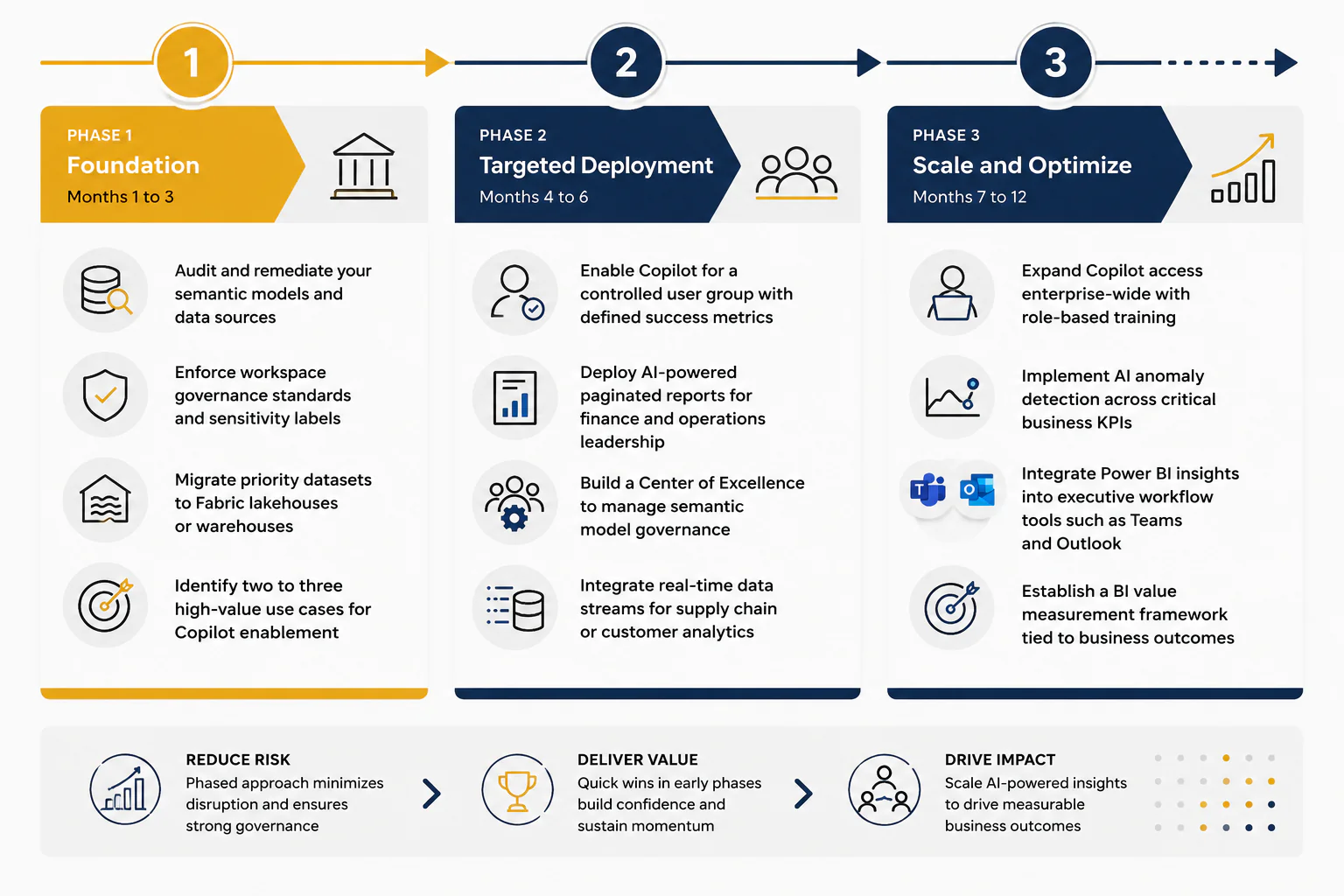
A phased approach reduces deployment risk and creates visible wins that sustain internal momentum. The following three-phase model reflects what AlphaBOLD has deployed across enterprise clients.
Phase 1: Foundation (Months 1 to 3)
- Audit and remediate your semantic models and data sources
- Enforce workspace governance standards and sensitivity labels
- Migrate priority datasets to Fabric lakehouses or warehouses
- Identify two to three high-value use cases for Copilot enablement
Phase 2: Targeted Deployment (Months 4 to 6)
- Enable Copilot for a controlled user group with defined success metrics
- Deploy AI-powered paginated reports for finance and operations leadership
- Build a Center of Excellence to manage semantic model governance
- Integrate real-time data streams for supply chain or customer analytics
Phase 3: Scale and Optimize (Months 7 to 12)
- Expand Copilot access enterprise-wide with role-based training
- Implement AI anomaly detection across critical business KPIs
- Integrate Power BI insights into executive workflow tools such as Teams and Outlook
- Establish a BI value measurement framework tied to business outcomes
Ready to Implement Your AI-Driven Power BI Adoption Strategy?
AlphaBOLD helps enterprise leaders design and deploy AI-integrated Power BI environments that align with your governance frameworks, data architecture, and business goals. From Copilot enablement to Fabric migration roadmaps, we bring implementation depth you can act on.
Request a ConsultationGovern the AI Output, Not Just the Data
One of the most consequential oversights in AI-Driven Power BI adoption strategy is treating governance as a data problem rather than an output problem.
Copilot and AI-generated insights introduce a new category of risk: plausible but incorrect answers delivered with visual confidence. Leaders need to establish output governance practices, not just input controls.
This means creating validation workflows for AI-generated KPIs before they reach executive reporting, defining escalation paths when AI outputs conflict with ground-truth data, and building audit trails for decisions made based on Copilot recommendations.
In regulated industries such as financial services, healthcare, and manufacturing, this is not optional. The SEC and FCA are actively reviewing how AI-generated analytics are used in reporting and disclosure contexts. Your governance framework needs to reflect that exposure.
Is Your Power BI Architecture Ready for AI at Scale?
Most enterprises have the licensing. Few have the foundation. AlphaBOLD’s AI-Driven Power BI adoption strategy gives your leadership team a clear picture of where your semantic models, governance, and Fabric architecture stand today and what it will take to deploy AI-powered Power BI with confidence.
Request your AI Readiness AssessmentRethink the BI Talent Model
AI-driven Power BI adoption changes the skills your organization needs and the roles that create the most value.
The traditional model of a centralized BI team producing reports for passive consumers is no longer fit for purpose. The emerging model centers on three distinct capabilities working in parallel.
Data engineers own the Fabric architecture, lakehouse structure, and pipeline reliability. Semantic model architects design and govern the analytical layer that AI queries against. Business-embedded analysts serve as translators who combine domain knowledge with the ability to validate and extend AI-generated insights.
For C-suite leaders, this means evaluating whether your current analytics headcount maps to these capabilities or whether it is concentrated in legacy reporting skills that AI is rapidly displacing. Retraining investments made now will determine competitive differentiation twelve months from now.
Measure What Actually Matters
AI-Driven Power BI adoption strategy metrics that focus on dashboard views and user logins tell you almost nothing about the business value of AI BI transformation.
The KPIs your steering committee reviews should connect directly to decision velocity and outcome quality. Consider tracking the following at an executive level:
- Reduction in time from data event to decision action
- Percentage of strategic decisions supported by real-time rather than historical data
- Analyst hours redirected from report production to analytical work
- Revenue or cost outcomes attributable to AI-surfaced insights
Organizations that tie BI investment to these metrics consistently outperform those that measure adoption by seat count. The ROI case becomes defensible at the board level when it speaks in business outcomes, not platform capabilities.

Ready to Lead Your AI-Powered BI Transformation?
AlphaBOLD helps enterprise leaders design and deploy AI-integrated Power BI environments that align with your governance frameworks, data architecture, and business goals. From Copilot enablement to Fabric migration roadmaps, we bring implementation depth you can act on.
Request a ConsultationConclusion: The Window to Lead Is Now
The organizations that will define enterprise BI leadership over the next three years are not the ones with the largest data teams or the most Power BI licenses. They are the ones whose executive layer made deliberate, governance-first decisions about how AI integrates into their decision-making infrastructure.
The technology is mature. Microsoft Fabric and Copilot in Power BI are production-ready. The competitive variable now is organizational readiness: clean semantic models, clear governance, capable people, and a leadership team willing to own the outcome rather than delegate it.
The gap between organizations that are driving AI-powered BI and those still exploring it is widening every quarter. The right time to close it was six months ago. The next best time is now.
Frequently Asked Questions
Earlier Power BI required analysts to build and distribute reports. Today, with Copilot and Microsoft Fabric, business users can query data in natural language and receive auto-generated insights in real time. The platform has shifted from a visualization layer to an active decision layer.
Output trust. AI-generated insights can be acted on without adequate validation. The accuracy of a Copilot summary depends entirely on semantic model integrity and data freshness. Establishing output validation workflows before wide deployment is the single most critical governance step.
Not immediately, but strategically yes. The full AI stack including real-time intelligence, OneLake integration, and Fabric-native models requires the Fabric platform. A phased migration with a clear architectural target is the recommended approach.
Nine to twelve months for mid-to-large enterprises following a phased roadmap. Organizations with strong data governance in place can compress Phase 1 to six to eight weeks. Fragmented data environments should plan for up to eighteen months.
The CIO owns infrastructure, licensing, and security architecture. The CDO owns data strategy and semantic model governance. The most effective deployments have both roles jointly accountable through a shared steering structure.