


Table of Contents
Introduction
We recently worked with a client whose Power BI environment looked mature at first but had a problem many enterprises eventually face: inconsistent business definitions.
The organization already had Power BI in place. Sales, finance, operations, and leadership teams had their own dashboards, and users relied on reports for day-to-day decisions. On the surface, the analytics environment looked mature.
But when leadership started asking broader business questions, the gaps became clear. Revenue did not mean the same thing in every report. Customer counts changed depending on which dashboard was opened. Some measures were built directly inside reports, others were copied from older models, and many lacked clear ownership or documentation.
Before discussing Copilot, the client first needed to address the consistency of its business definitions.
The client wanted to explore AI-driven analytics, but the real question was not which AI tool to use. It was whether the business could trust the definitions AI would rely on. If revenue, margin, pipeline, and customer data are interpreted differently across reports, AI will not fix the problem. It will scale it.
A Power BI semantic model helps address this by creating a governed layer for measures, relationships, hierarchies, business logic, and security rules. Instead of allowing every report to carry its own version of the truth, an enterprise semantic layer creates shared meaning across users, dashboards, and AI experiences.
What Is a Semantic Layer in Power BI?
A Power BI semantic model is the governed business layer that sits between source data and the reports, dashboards, Copilot experiences, and AI agents that use that data.
At a practical level, it defines:
- Core business measures such as revenue, margin, pipeline, churn, and customer count
- Relationships between tables, entities, and business processes
- Hierarchies for reporting across departments, regions, products, or time periods
- Security rules that control access to sensitive information
- Reusable business logic that prevents every report from creating its own version of a KPI
This is what makes the semantic layer Power BI conversation different from a standard reporting discussion. The goal is not only to build cleaner dashboards. The goal is to create a shared business language that can be reused across analytics and AI.
For a deeper technical walkthrough of accessing, editing, and managing semantic models in Power BI Desktop, Power BI Service, XMLA endpoints, and Microsoft Fabric, refer to our detailed Power BI semantic model guide.
The strategic point is simple: a semantic model is no longer only a reporting asset. When connected to Fabric IQ, Copilot, and data agents, it becomes part of the enterprise semantic layer that supports an AI ready data model.
Why Semantic Layers Matter for Enterprise AI
Despite what many organizations still assume, AI does not automatically solve reporting inconsistency. In many cases, it exposes it.
We have seen this happen in Power BI environments where companies are eager to introduce Copilot, Fabric data agents, or AI-driven analytics before addressing the quality of the underlying business model. The technology may be advanced, but if revenue, margin, pipeline, and customer definitions are inconsistent, AI will still work from inconsistent logic.
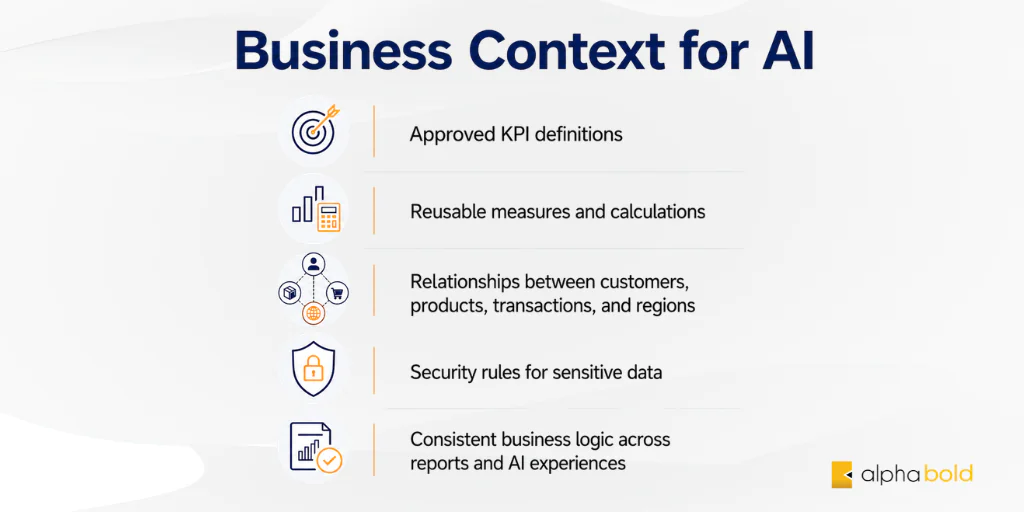
That is why the semantic layer Power BI discussion matters. A governed semantic layer gives AI systems the business context they need to interpret data correctly, including:
- Approved KPI definitions
- Reusable measures and calculations
- Relationships between customers, products, transactions, and regions
- Security rules for sensitive data
- Consistent business logic across reports and AI experiences
The business impact is direct. A robust Power BI semantic model helps reduce conflicting answers, builds trust in AI-assisted analysis, and provides leaders with a more reliable basis for decision-making.
Where companies often go wrong is treating AI as a shortcut around data governance. It is not. If the semantic model is weak, AI may only make flawed definitions easier to access and harder to control.
Gartner’s 2026 research reinforces the same point: AI agents need semantic context, including the relationships and rules within an organization’s data, to deliver accurate responses and avoid unreliable outputs.
Before expanding Copilot or AI-driven analytics, enterprises should first validate whether their enterprise semantic layer is governed, documented, and aligned with business owners. That is what turns reporting infrastructure into an AI ready data model.
Build a Trusted Semantic Foundation for Enterprise AI
AI-driven analytics is only as reliable as the business logic behind it. AlphaBOLD helps enterprises assess their Power BI semantic models, standardize KPI definitions, strengthen governance, and prepare their analytics environment for Copilot, Fabric data agents, and future AI use cases.
Request a ConsultationWhy Semantic Layers Matter for Enterprise AI
A Power BI semantic model standardizes business meaning by moving key definitions out of individual reports and into a governed, reusable layer.
This matters because most reporting conflicts do not start with bad dashboards. They start when teams define the same metric differently. Sales may calculate pipeline based on open opportunities, finance may focus on booked revenue, and operations may measure performance through delivery or utilization. Without a shared model, each team can be “right” within its own context while leadership still lacks one trusted answer.
A strong semantic model helps standardize:
- Measures: Revenue, margin, churn, pipeline value, utilization, and other KPIs are defined once and reused across reports.
- Relationships: Customers, products, regions, projects, and transactions are connected consistently, reducing context errors.
- Hierarchies: Users can analyze performance by time, geography, department, or product without rebuilding logic.
- Security rules: Sensitive financial, customer, or operational data is controlled at the model level.
- Certified datasets: Teams know which models are approved for reporting and AI-driven analysis.
The business impact is clear. Leaders spend less time questioning numbers, analysts spend less time rebuilding calculations, and teams make decisions using the same performance language.
Where enterprises often go wrong is allowing report-level logic to grow unchecked. Over time, every dashboard becomes its own version of the truth. In our projects, we define ownership for core KPIs, certify trusted models, and review semantic logic regularly so the enterprise semantic layer remains accurate, governed, and ready for AI use.
Common Mistakes Enterprises Make When Building Semantic Layers
A semantic layer can improve trust in reporting, but only if it is designed with governance and business adoption in mind. Many enterprises struggle because they treat the model as a technical build instead of a shared business asset.
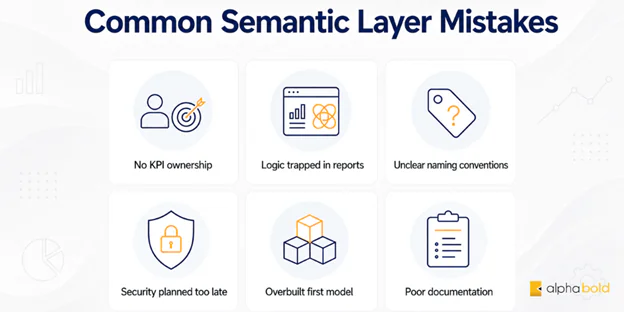
Common mistakes include:
- Defining KPIs without business ownership: IT may build the model, but finance, sales, operations, and leadership must validate what metrics like revenue, margin, pipeline, and churn actually mean.
- Keeping too much logic inside reports: When calculations live in individual dashboards, every report can become its own version of the truth.
- Using unclear naming conventions: Technical field names, abbreviations, and inconsistent labels make it harder for users and AI tools to interpret the model correctly.
- Ignoring security early: Row-level security, object-level security, and sensitivity rules should be planned before the model is widely adopted.
- Overbuilding the first model: Some teams try to include every table, field, and use case at once, which makes the model harder to manage and slower to use.
- Skipping documentation: Without clear descriptions for measures, relationships, and business logic, users lose trust and future maintenance becomes difficult.
The larger risk is that these issues do not stay limited to reporting. Once Copilot, Fabric data agents, or AI-driven analytics use the same model, unclear definitions can influence automated answers and decisions.
From what we have seen, it is a good idea to start with the business-critical KPIs, assign ownership, document definitions, certify trusted models, and review the semantic layer regularly as reporting and AI use cases expand.
Avoid Costly Semantic Layer Mistakes
A weak semantic layer can create inconsistent reporting, poor adoption, and unreliable AI outputs. AlphaBOLD helps enterprises assess existing Power BI semantic models, clean up duplicated logic, define KPI ownership, strengthen governance, and build a semantic foundation that supports reporting and AI use cases with confidence.
Request a ConsultationIs Your Power BI Semantic Layer Ready for AI?
Before expanding Copilot, Fabric data agents, or AI-driven analytics, enterprises should confirm whether their semantic layer can support trusted answers at scale. An AI ready data model needs more than connected data. It needs governed definitions, clear ownership, and reusable business logic.
Use this quick readiness check:
- KPI ownership: Are revenue, margin, pipeline, churn, and customer metrics approved by business owners?
- Centralized measures: Do core calculations live in the Power BI semantic model, or are they scattered across reports?
- Clear naming: Can business users understand tables, fields, and measures without relying on technical teams?
- Governed access: Are row-level security, object-level security, and sensitivity labels applied where needed?
- Certified models: Do users know which models are approved for reporting and AI use?
- Documented logic: Are key measures, relationships, and business rules easy to review and maintain?
If these areas are weak, AI adoption should not start with another tool rollout. It should start with strengthening the enterprise semantic layer that those tools will depend on.
How Microsoft Fabric and Fabric IQ Extend the Semantic Layer?
Microsoft’s direction with Fabric makes the semantic layer more strategic. A Power BI semantic model is no longer limited to dashboards and reports. It can now support a broader analytics and AI architecture across OneLake, Copilot, Fabric data agents, and Fabric IQ.
In practical terms, Fabric helps enterprises move from isolated reporting models to a connected data foundation where business meaning can be reused across more experiences.
This matters because AI needs more than access to tables. It needs context. Fabric IQ builds on this idea by helping organize business data around entities, relationships, rules, and actions, so AI systems can better understand how the business operates.
For enterprise teams, this creates several opportunities:
- Reusable business context: Core definitions can support reports, Copilot experiences, and AI agents.
- Stronger governance: Semantic logic can be managed as part of a broader data and analytics strategy.
- Less duplication: Teams can reduce repeated modeling work across departments and use cases.
- Better AI reliability: AI tools can reference governed business meaning instead of fragmented report logic.
- Scalable architecture: Power BI, Fabric, and OneLake can work together to support larger data estates.
The implementation risk is assuming Fabric automatically creates semantic consistency. It does not. Enterprises still need clear KPI ownership, model governance, security planning, and documentation.
We suggest treating Fabric IQ as an extension of your semantic strategy, not a replacement for it. The stronger your enterprise semantic layer, the more value you can get from Fabric, Copilot, and AI-driven analytics.
Conclusion
The client conversation that opened this article is not unusual. Many enterprises already have Power BI, active dashboards, and strong reporting adoption. The real issue appears when those reports are asked to support bigger decisions, AI-driven analysis, or Copilot experiences.
That is when inconsistent definitions become a business risk.
A semantic layer helps address that risk by giving the organization a governed place to define the metrics, relationships, and security rules that reporting and AI depend on. For enterprise leaders, the priority is not to add AI on top of fragmented logic. It is to first make sure the business can trust the model behind the answer.
AlphaBOLD helps organizations assess, design, and optimize Power BI semantic models and Microsoft Fabric environments so their analytics foundation is ready for reporting today and AI-driven decision-making tomorrow.
FAQs
Fabric IQ expands the role of semantic models beyond traditional reporting. A Power BI semantic model helps define business measures, relationships, and reporting logic. Fabric IQ builds on that foundation by organizing business data around shared terminology, entities, relationships, and context that can support analytics, AI agents, and applications. For enterprises, this means the semantic layer is no longer only about dashboard consistency. It becomes part of a broader AI architecture where business meaning can be reused across reporting, planning, operations, and agent-driven workflows.
Yes. Copilot performs better when the semantic model is clean, well-structured, and designed for business interpretation. If tables, measures, relationships, or field names are unclear, Copilot may produce answers that look useful but are based on incomplete or inconsistent logic. Before using Copilot broadly, organizations should review KPI definitions, simplify naming, document key measures, apply the right security rules, and validate outputs against known business answers. Microsoft also recommends preparing semantic models before using Copilot to reduce the risk of inaccurate or misleading outputs.
The first step is to assess where business logic currently lives. If revenue, margin, customer, pipeline, or operational KPIs are scattered across reports, spreadsheets, and departmental models, the organization should address that before scaling AI. Enterprises should identify their most important metrics, assign business ownership, centralize reusable measures in approved semantic models, document logic, and apply governance controls. If the environment is already complex, working with a Power BI and Microsoft Fabric partner can help prioritize the cleanup, define the architecture, and prepare the semantic layer for AI use cases without disrupting current reporting.