
Dynamics 365 Sales vs Salesforce Sales Cloud: Features, Flexibility & Pricing

Mohsin Mirza
Table of Contents
Which CRM Suits Your Enterprise Better: Dynamics 365 Sales or Salesforce Sales Cloud?
Choosing the right CRM can feel overwhelming, as both Dynamics 365 Sales and Salesforce Sales Cloud are industry leaders in sales automation. However, their ecosystems, flexibility, and pricing vary significantly.
Let’s break down Dynamics 365 Sales vs. Salesforce Sales Cloud to compare key features, deployment options, and total cost of ownership to make an informed decision.
What are the Core Features of Dynamics 365 Sales vs. Salesforce Sales Cloud?
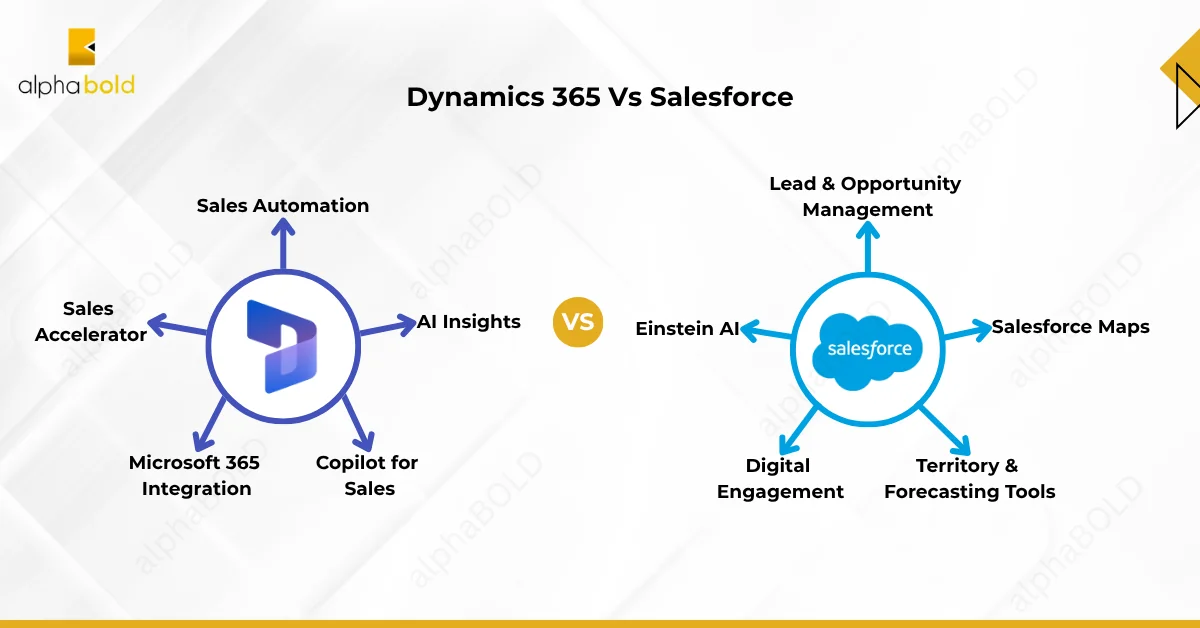
Dynamics 365 Sales offers deep Microsoft 365 integration and AI-driven sales acceleration, while Salesforce emphasizes pipeline visibility, predictive analytics, and a vast app marketplace.
Dynamics 365 Sales:
Microsoft has created Dynamics 365 Sales, a comprehensive CRM platform built to increase productivity and refine sales processes. Some of its key features include:
- Sales Automation: Custom workflows auto-assign leads based on behavior.
- AI Insights: Predicts risks and recommends next steps.
- Microsoft 365 Integration: Natively connects with Outlook, Teams, and Excel.
- Sales Accelerator: Prioritize leads and overdue follow-ups.
- Copilot for Sales: Auto-logs emails, calls, tasks.
Salesforce Sales Cloud:
Salesforce Sales Cloud is known for its versatility and extensive feature set. Some of its key features include:
- Lead & Opportunity Management: Visual pipeline drag‑and‑drop.
- Einstein AI: Predictive scoring and auto-fill.
- Territory & Forecasting Tools: Visual revenue targeting.
- Salesforce Maps: Geo-optimized field planning.
- Digital Engagement: SMS, social, and chatbot integration.
Transform Your Sales Team with the Right CRM
AlphaBOLD helps you implement the perfect solution for your business.
See My CRM FitDynamics 365 Sales vs. Salesforce Sales Cloud: Which CRM Offers Better Deployment Flexibility and Ecosystem Integration?
Dynamics 365 Sales:
Dynamics 365 supports cloud, on-premises, and hybrid deployment. Salesforce is cloud-only, with faster setup but less hosting control.
Microsoft Dynamics 365 Sales supports cloud, on-premises, and hybrid deployment models, allowing organizations to align CRM implementation with their IT policies and data governance requirements.
- Cloud Deployment allows businesses to benefit from Microsoft’s secure, scalable infrastructure with automatic updates, reduced maintenance overhead, and remote accessibility, which is ideal for organizations adopting a cloud-first strategy.
- On-Premises Deployment suits industries with stringent compliance needs (e.g., finance, healthcare) that require full control over data storage and internal access.
- Hybrid Deployment combines cloud agility with on-prem control, making it ideal for regulated industries needing localized data storage while still leveraging cloud-based capabilities like Copilot and Power BI.
From an ecosystem integration standpoint, Dynamics 365 Sales is a natural fit for businesses already using Microsoft 365 tools, including Outlook, Teams, Excel, and Power BI. This tight integration allows users to work seamlessly across communication, collaboration, and reporting platforms, enhancing user adoption and minimizing disruption during CRM rollout.
Salesforce Sales Cloud:
Salesforce offers a cloud-only deployment model, prioritizing fast setup and scalability but offering less flexibility for on-premises or hybrid environments.
Salesforce Sales Cloud is built as a fully cloud-native CRM platform, enabling organizations to deploy quickly without infrastructure overhead. It supports fast onboarding, automatic updates, and remote accessibility, beneficial for fast-growing or distributed teams that prefer SaaS-based solutions.
- Cloud Deployment eliminates the need for server management and allows companies to focus on CRM adoption and customization instead of infrastructure setup.
- Scalability and Accessibility are core strengths; businesses can scale usage up or down as needed, while remote teams can access the system from anywhere, on any device.
- Automatic Updates ensure the CRM always runs the latest version with improved features, security patches, and UI enhancements, without IT intervention.
Salesforce’s ecosystem is anchored by the AppExchange, its expansive marketplace of over 7,000 pre-integrated third-party applications. From industry-specific add-ons to advanced sales automation and analytics tools, AppExchange enables organizations to expand CRM functionality with minimal development.
This makes Salesforce a strong fit for businesses seeking a highly extensible, plug-and-play CRM system with broad integration capabilities across marketing, service, and analytics platforms.
How Do Dynamics 365 Sales and Salesforce Sales Cloud Pricing Plans Compare?
| Plan | Dynamics 365 Sales | Salesforce Sales Cloud |
|---|---|---|
|
Entry-level |
Sales Professional – $65/user/month (Annual) |
Starter Suite – $25/user/month |
|
Mid-tier |
Sales Enterprise – $105/user/month |
Pro Suite – $100/user/month
|
|
Advanced |
Sales Premium – $150/user/month
|
Enterprise – $175/user/month
|
|
All‑in |
n/a |
Unlimited – $350/user/month
|
|
AI add‑on |
Included (Copilot) |
Einstein 1 Sales – $550/user/month |
Note: Pricing varies based on bundles and region. Always request a custom quote.
Let's Discuss What Works for Your Sales Team.
Partner with AlphaBOLD to implement an advanced sales solution tailored to your business needs.
CRM Match for MeConclusion
When comparing Dynamics 365 Sales vs. Salesforce, the right choice depends on how tightly your CRM needs to align with your existing tools, team workflows, and long-term digital strategy.
Choose Dynamics 365 Sales if you’re in the Microsoft ecosystem. Choose Salesforce for marketplace flexibility and fast SaaS onboarding.
Choose Dynamics 365 Sales if:
- You’re already using Teams, Outlook, Excel, or Power BI
- You require a hybrid or on-prem deployment
- You want Copilot AI baked into your tools
Choose Salesforce Sales Cloud if:
- You need AppExchange’s 7,000+ integrations
- You prefer a cloud-only, scalable CRM
- You want fast time-to-value and robust field tools
FAQs: Choosing Between Dynamics 365 Sales vs. Salesforce Sales Cloud
If your organization uses Outlook, Teams, Power BI, or Excel, Dynamics 365 Sales provides native integration for streamlined workflows. Salesforce offers extensive third-party integration via AppExchange for a more diverse tech stack.
Both platforms support process customization. Dynamics 365 offers low-code customization via Power Platform. Salesforce provides a wide range of configurable workflows and prebuilt apps. Both platforms support extensibility via development for advanced logic, but low-code options minimize IT dependency.
Salesforce may offer quicker deployment due to its cloud-native design and prebuilt modules. Dynamics 365 Sales delivers higher value if your team already uses Microsoft tools, as it reduces onboarding time and improves adoption through familiar interfaces.
Adoption often depends on interface familiarity. Dynamics 365 performs well in Microsoft-centric organizations. Salesforce leads in companies prioritizing sales operations and using diverse devices or tools. Adoption success also hinges on training, configuration, and partner-led rollout support.
Dynamics 365 Sales leverages Power BI and Copilot to surface predictive insights, while Salesforce’s Einstein AI supports advanced forecasting and pipeline visibility. Both platforms can align sales performance metrics with your KPIs through customizable dashboards and reporting tools.
Explore Recent Blog Posts