How Dynamics 365 Contact Center Improves Agent Productivity With Copilot

Table of Contents
Introduction
Customer service leaders are under pressure to improve response times, reduce operational costs, and introduce AI into service operations without weakening customer experience. Gartner reports that 91% of customer service and support leaders feel executive pressure to implement AI in 2026, with leaders prioritizing customer satisfaction, operational efficiency, and self-service success.
This makes contact center modernization a business priority, not just a technology upgrade. Many organizations still rely on disconnected phone systems, manual case notes, fragmented customer data, and agents who switch between multiple tools to resolve a single issue. That creates delays, inconsistent answers, and limited visibility for supervisors.
Microsoft Dynamics 365 Contact Center addresses this challenge as a Copilot-first, cloud-based contact center that brings AI, automation, omnichannel engagement, routing, and operational insights into the customer relationship management system a business already uses. The real value is not only that Copilot can summarize conversations or draft responses. The value is that service teams can reduce repetitive work, improve resolution quality, and give agents the context they need to support customers faster.
What Is Dynamics 365 Contact Center?
Dynamics 365 Contact Center is Microsoft’s cloud-based contact center solution for voice, chat, digital messaging, self-service, agent assistance, routing, analytics, and supervisor visibility. Microsoft describes it as a Copilot-first product that works with the CRM solution of your choice, which means businesses can use it with Dynamics 365, Salesforce, or other CRM environments.
For service teams, this matters because the contact center is no longer just a place where calls are answered. It is where customer issues, account history, service requests, complaints, follow-ups, and business-critical interactions come together. If agents do not have the right context, the customer experience suffers.
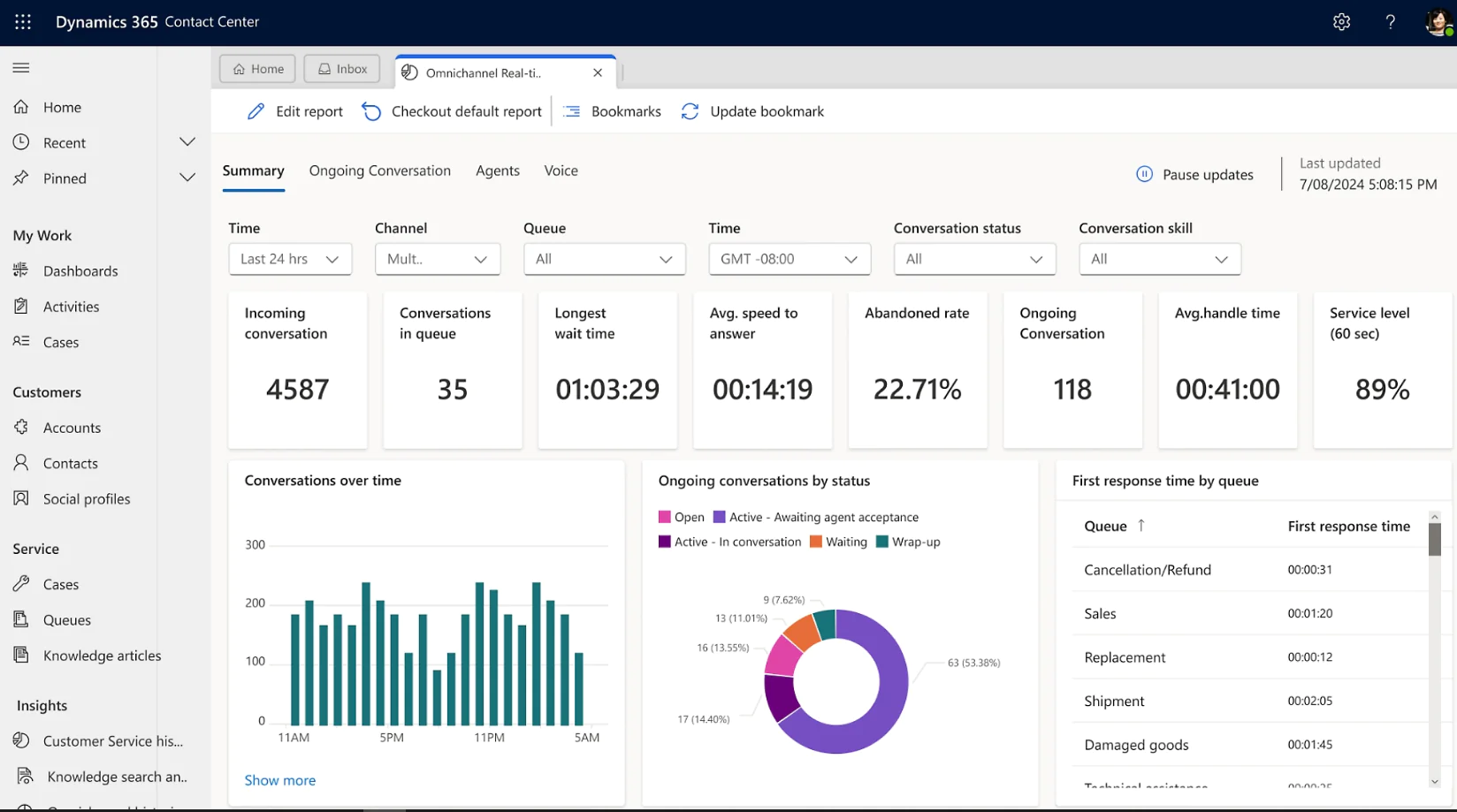
Dynamics 365 Contact Center helps connect these interactions across channels. It includes capabilities such as conversation summaries, IVR, AI agents, sentiment analysis, live transcription, translation, unified routing, dashboards, reports, and Microsoft Teams collaboration.
Why Does Agent Productivity Matter More Now?
Agent productivity is not just about handling more tickets. It is about helping agents resolve the right issues faster, with better context and fewer manual steps.
In many contact centers, agents lose time because they have to:
- Search multiple systems for customer history
- Manually summarize calls or chats
- Re-enter information into case records
- Escalate issues because routing is unclear
- Ask customers to repeat information
- Look for approved knowledge articles during live conversations
- Wait for supervisor input without real-time guidance
These delays affect more than internal efficiency. They increase handle time, reduce first-contact resolution, frustrate customers, and make it harder for supervisors to identify service bottlenecks.
This is why the current conversation around AI in customer service is shifting. Businesses are not only asking whether AI can automate support. They are asking whether AI can improve the way human agents work. Gartner notes that service organizations are entering a period where AI and human expertise must work together, with many organizations planning to reshape frontline roles as routine work becomes more automated.
How Does Copilot Help Contact Center Agents Work Faster?
Copilot supports agents by reducing the manual work that slows down customer service. In Dynamics 365 Contact Center, Copilot can help summarize conversations, draft responses and emails, surface relevant knowledge, and support agents during customer interactions.
For agents, this can mean less time spent writing notes, searching for answers, or switching between applications. For customers, it can mean fewer repeated questions and faster movement toward resolution.
The productivity benefit becomes stronger when Copilot is connected to reliable knowledge, case data, routing logic, and service workflows. A generic AI assistant may provide suggestions, but a contact center Copilot connected to business systems can support service work in context.
For example, an agent handling a billing, reservation, warranty, or service issue should not have to manually reconstruct the customer journey. Copilot can assist with summaries and suggested next steps, while the platform keeps the interaction connected to the customer record and case history.
What Makes Dynamics 365 Contact Center Different For Microsoft-First Businesses?
For organizations already using Microsoft technologies, Dynamics 365 Contact Center has a practical advantage: it fits into a broader Microsoft ecosystem.
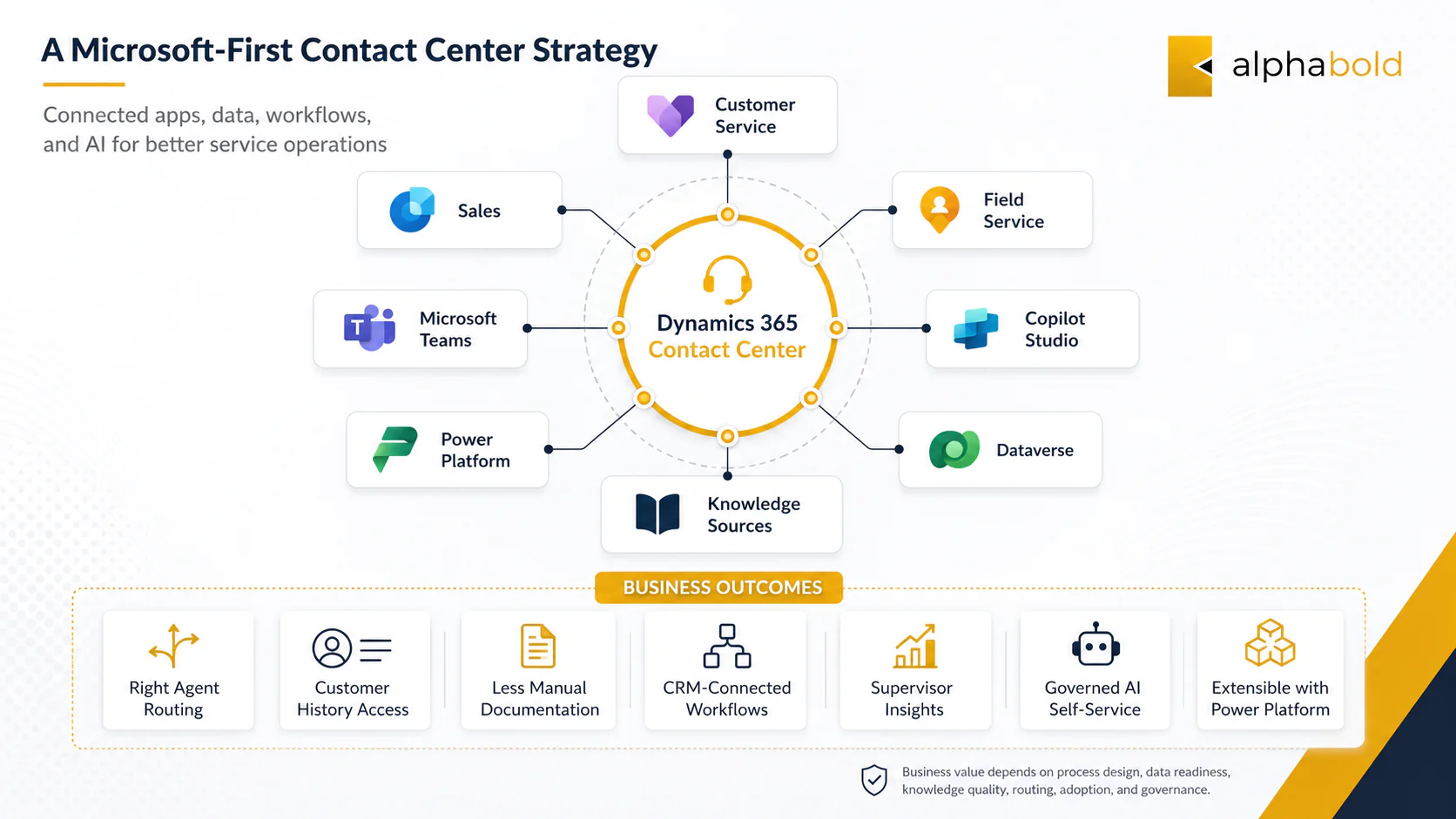
It can connect customer service with Dynamics 365 Customer Service, Sales, Field Service, Microsoft Teams, Copilot Studio, Power Platform, Dataverse, and existing knowledge sources. This matters because agent productivity is rarely solved by a contact center tool alone. It depends on how well customer data, cases, workflows, knowledge, and communication channels work together.
A Microsoft-first contact center strategy can help businesses:
- Route customers to the right agent or queue
- Give agents access to relevant customer history
- Use Copilot to reduce manual documentation
- Connect service workflows with CRM records
- Improve supervisor visibility with dashboards and insights
- Introduce AI self-service with governed escalation paths
- Extend processes through Power Platform and Copilot Studio
This is where implementation quality matters. The platform provides the capabilities, but the business value depends on process design, data readiness, knowledge quality, routing strategy, user adoption, and governance.
What Should Buyers Evaluate Before Implementing Dynamics 365 Contact Center?
Before investing in Dynamics 365 Contact Center, businesses should evaluate where productivity is actually being lost.
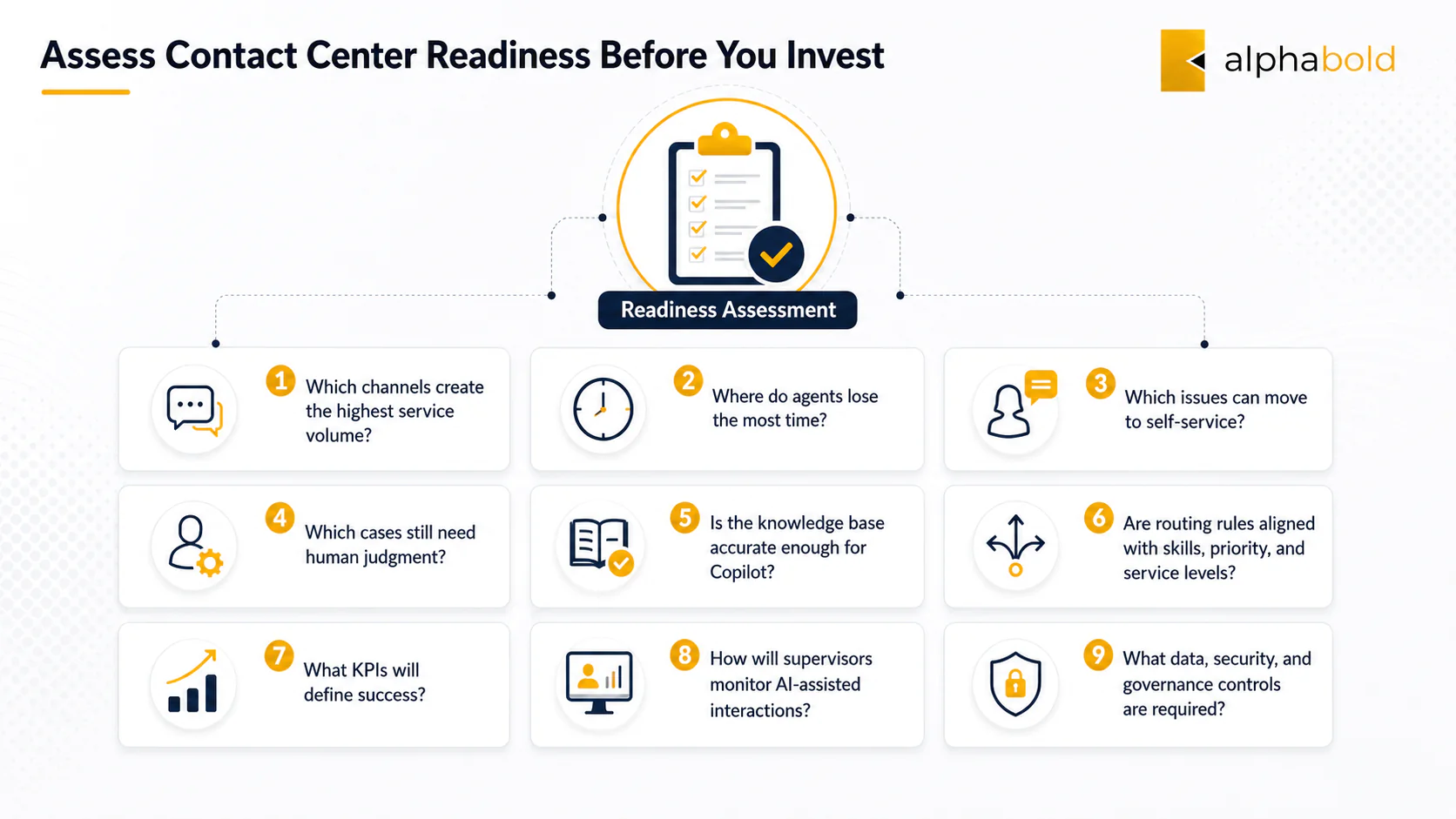
A good assessment should ask:
- Which channels create the highest service volume?
- Where do agents lose the most time?
- Which customer issues can safely move to self-service?
- Which cases still need human judgment?
- Is the knowledge base accurate enough for Copilot?
- Are routing rules aligned with skills, priority, and service levels?
- What KPIs will define success?
- How will supervisors monitor AI-assisted interactions?
- What data, security, and governance controls are required?
The strongest use cases are usually the ones tied to measurable service outcomes. These can include average handle time, first-contact resolution, containment rate, escalation rate, CSAT, agent utilization, quality scores, and case backlog.
This is also where many AI initiatives fail. Businesses adopt AI features before cleaning up the workflows, data, and knowledge sources that AI depends on. Dynamics 365 Contact Center is most effective when implemented as part of a service operating model, not as an isolated AI tool.
Want To Evaluate Your Contact Center Readiness?
Before investing in Dynamics 365 Contact Center, AlphaBOLD can help you assess your current service workflows, agent pain points, routing needs, knowledge quality, and Copilot use cases. Our Dynamics 365 experts can help you identify where AI-assisted service can create measurable value.
Request a DemoHow Has AlphaBOLD Helped Businesses Modernize Service Operations?
AlphaBOLD’s work with service-focused organizations shows how customer service modernization becomes more valuable when contact center technology is connected to business process design.
For Avelo Airlines, AlphaBOLD delivered a live, AI-assisted Dynamics 365 Contact Center platform for more than 70 users handling over 1,000 calls per day. The solution helped move service operations away from fragmented Jira and email-based case handling toward a unified Microsoft platform for voice, chat, web cases, customer data, knowledge, routing, automation, SLA tracking, escalation, transcript summaries, and CSAT capture.
For JWC Environmental, AlphaBOLD supported a Dynamics CRM and Customer Service modernization that helped the business handle approximately 3,500 additional cases without adding headcount. The solution also supported faster quote handling, reduced manual service effort, and helped the organization avoid unnecessary staffing costs.
These examples show the real buyer value behind Dynamics 365 Contact Center and related service platforms. The goal is not just to deploy AI. The goal is to improve how agents, supervisors, systems, and customers move through the service journey.
Where Does AlphaBOLD Fit In?
Dynamics 365 Contact Center gives businesses the foundation for AI-assisted service, but implementation decisions determine whether the investment produces measurable results.
AlphaBOLD helps organizations assess their current contact center processes, identify automation opportunities, connect service workflows with CRM data, configure omnichannel engagement, implement Copilot-assisted experiences, and design governance around AI-enabled support.
This includes:
- Contact center readiness assessment
- Dynamics 365 Contact Center implementation
- Customer Service and CRM integration
- Copilot Studio configuration
- AI self-service and chatbot design
- Voice, chat, web, and case workflow setup
- Knowledge base migration and optimization
- Routing, SLA, and escalation design
- Reporting and supervisor dashboard setup
- Training, adoption, and continuous improvement
For buyers, this means the conversation does not start with licensing or features. It starts with the business problem: where service teams are losing time, where customers are experiencing friction, and where AI can safely improve productivity.
Ready To Improve Agent Productivity With Dynamics 365 Contact Center?
AlphaBOLD helps businesses connect customer data, service workflows, routing, knowledge sources, and Copilot capabilities into one practical contact center strategy. Work with our experts to reduce manual effort, improve visibility, and support faster customer resolution.
Request a DemoConclusion
Dynamics 365 Contact Center is relevant because customer service teams are being asked to do more with less while adopting AI responsibly. Copilot can support agents with summaries, suggested responses, knowledge, and real-time assistance, but the larger value comes from connecting those capabilities to routing, case management, customer data, self-service, and supervisor insights.
For businesses evaluating contact center modernization, the question is not simply whether they need a cloud contact center. The better question is whether their current service model gives agents the tools, context, and AI support they need to resolve issues efficiently.
With the right implementation strategy, Dynamics 365 Contact Center can help organizations reduce repetitive work, improve service consistency, support self-service, and give supervisors better visibility into performance. AlphaBOLD helps businesses make that shift with a practical, governed approach to Dynamics 365, Copilot, and AI-assisted customer service.
FAQs
Dynamics 365 Contact Center is Microsoft’s Copilot-first, cloud-based contact center solution for voice, digital channels, self-service, routing, agent assistance, analytics, and supervisor visibility. It can work with Dynamics 365 or another CRM system.
Copilot helps agents by summarizing conversations, drafting responses, surfacing knowledge, and providing real-time assistance during customer interactions. This reduces manual work and helps agents focus on resolving customer issues.
No. Microsoft positions Dynamics 365 Contact Center as a solution that can work with the CRM system a business already uses. However, organizations already using Dynamics 365 may benefit from tighter integration across Customer Service, Sales, Field Service, Teams, Dataverse, Power Platform, and Copilot Studio.
Businesses should modernize when agents are spending too much time on manual notes, disconnected systems, repetitive requests, poor routing, or limited customer context. AI can help, but only when it is connected to reliable knowledge, workflows, governance, and measurable service KPIs.
Explore Recent Blog Posts