Copilot in Dynamics 365 Field Service: Features, Use Cases, and Implementation.

Table of Contents
Quick Answer
Copilot in Dynamics 365 Field Service helps technicians, dispatchers, and service managers access service information and reduce administrative work. It can summarize work orders, answer questions about records, and assist with supported updates. Microsoft’s Scheduling Operations Agent extends AI assistance into scheduling optimization. However, some capabilities remain in preview or require additional configuration, permissions, and costs. Businesses should assess feature availability and operational readiness before implementation.
Introduction
Field service teams spend considerable time reviewing work orders, documenting completed jobs, and responding to scheduling changes. Even with a field service management system, these processes can create administrative bottlenecks.
Copilot helps address specific parts of this workload through AI-assisted service operations. But which features can businesses use today, and which are still evolving?
This guide examines Copilot’s capabilities, practical applications, implementation requirements, and limitations to help organizations make informed adoption decisions.
What Can Copilot Do in Dynamics 365 Field Service?
Copilot in Dynamics 365 Field Service helps users understand work orders, retrieve relevant information, and complete supported administrative tasks. Related AI agents extend these capabilities into operational processes such as scheduling optimization. Both complement standard Field Service functionality rather than replacing existing scheduling, inventory, or workflow management systems.
There are three important distinctions:
- Copilot assistance: Helps users understand records, generate summaries, and interact with service information using natural language.
- AI agents: Perform defined operational tasks, such as evaluating scheduling changes, within configured constraints.
- Standard Field Service automation: Manages processes such as booking updates, inventory transactions, and notifications that do not necessarily require Copilot.
Organizations already using Dynamics 365 Field Service should identify where AI assistance reduces repetitive work without introducing unnecessary complexity.
Further Reading: Dynamics 365 Field Service Features & Capabilities
Which Copilot Features Matter Most to Field Service Teams?
The most useful Copilot features address recurring service tasks: understanding work orders, finding relevant information, updating records, and preparing inspections. However, availability differs by feature, environment, and release status. Organizations should distinguish established functionality from preview capabilities before planning implementation.
| Capability | Primary Users | Practical Application |
|---|---|---|
| Work order summaries | Technicians and managers | Generate on-demand summaries of job details, service history, and activities |
| Natural-language assistance | Dispatchers and service teams | Ask questions about accessible work orders and related records in the web application |
| Mobile work order updates (preview) | Field technicians | Suggest changes through typed or spoken descriptions, subject to confirmation |
| Inspection template creation (preview) | Administrators | Convert supported PDFs or images into draft inspection templates |
| Scheduling Operations Agent (preview) | Dispatchers | Evaluate and optimize technician schedules using configured priorities |
Work Order Summaries and Contextual Assistance
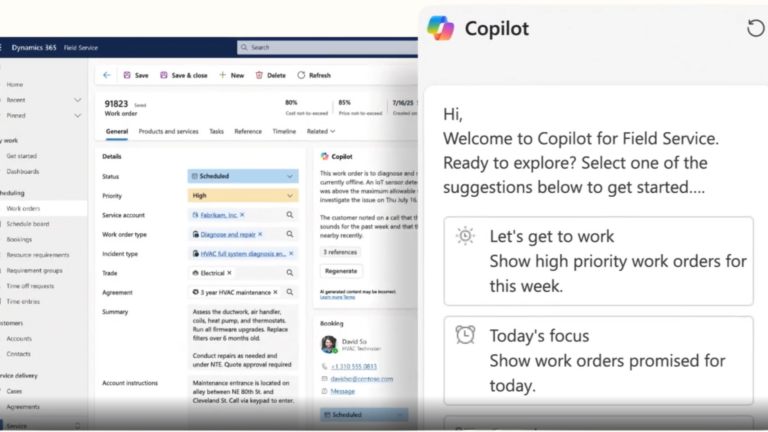
Copilot can generate work order summaries using available information from service records and related activities. For example, a technician preparing for an appointment can review relevant service history and job requirements without manually opening every associated record.
These summaries are generated on demand and are not automatically saved as permanent work order notes. Their accuracy depends on the quality of the underlying records and the user’s data access.
Mobile Work Order Updates
AI-powered mobile work order updates allow technicians to describe completed work using text or speech. Copilot interprets the information and suggests changes to supported fields, such as task completion, service duration, or booking status. Technicians review and confirm suggested changes before records are updated.
As of November 2026, this feature remains in preview and requires an internet connection. Microsoft’s documentation limits availability to environments in North America and the United Kingdom. It is disabled by default and supports only predefined fields.
These developments demonstrate how AI assistance and agentic AI solutions can support service operations, although individual capabilities differ in availability and autonomy.
How Does AI Scheduling Work in Dynamics 365 Field Service?
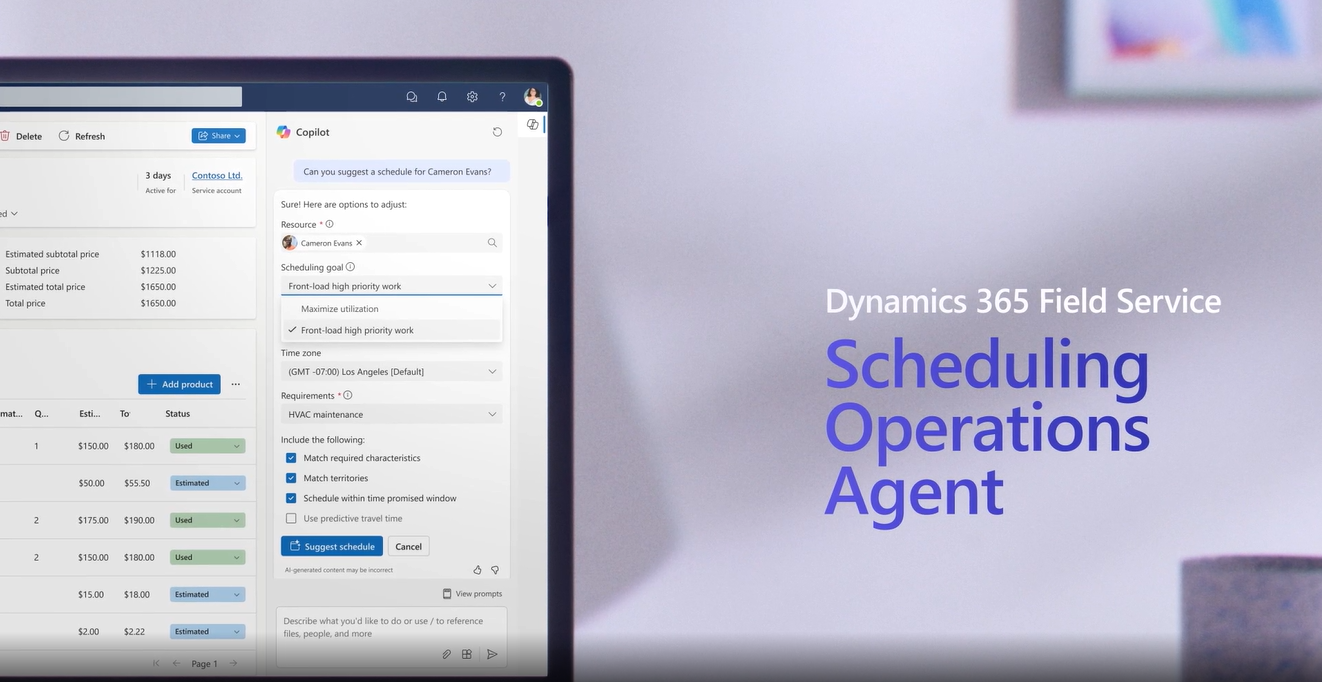
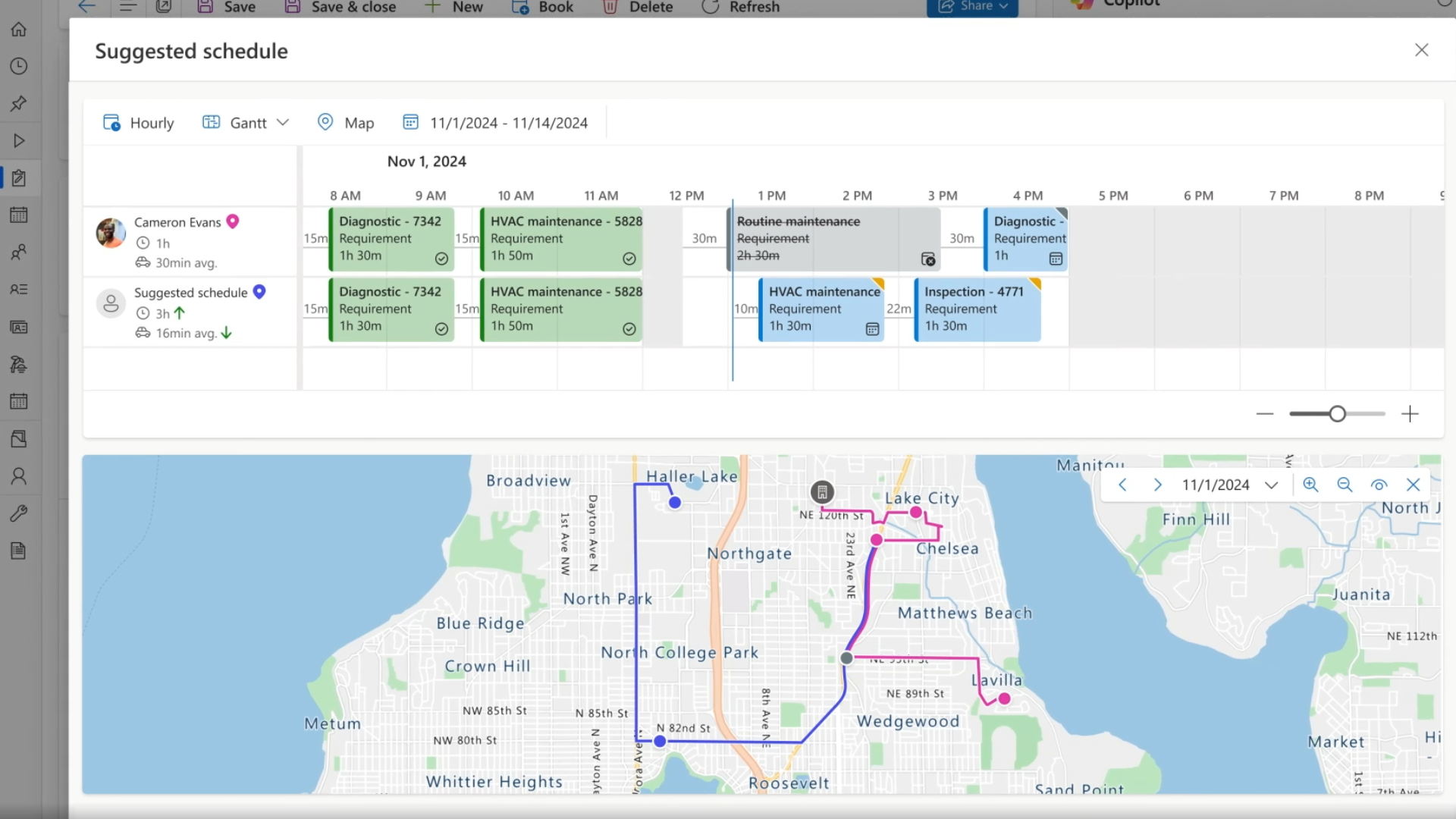
The Scheduling Operations Agent helps dispatchers evaluate and adjust technician schedules using resource availability, existing bookings, and configured scheduling priorities. It supports interactive optimization for targeted changes and batch optimization for larger scheduling plans. Organizations can also configure recurring optimization, subject to the agent’s preview restrictions.
What Happens When an Urgent Service Request Disrupts the Schedule?
Consider a dispatcher managing eight technicians when an urgent equipment repair request arrives.
The dispatcher needs to identify an available, qualified technician without unnecessarily disrupting existing appointments.
In an appropriately configured environment, the Scheduling Operations Agent can help evaluate:
- Technician availability and existing bookings
- Scheduling priorities and optimization objectives
- Resource and booking constraints
- Potential changes to the selected schedule
With interactive optimization, the dispatcher reviews the proposed schedule before applying changes.
For batch optimization, organizations can configure approval requirements before suggested changes are applied. Recurring plans execute at configured intervals rather than continuously responding to every scheduling event.
The quality of these recommendations depends on accurate technician records, resource calendars, booking rules, and business priorities.
Find Out Where Copilot Can Improve Your Field Service Operations
Not every scheduling or documentation challenge requires AI. AlphaBOLD can assess your existing Field Service processes and identify where Copilot, AI agents, or standard automation can deliver practical operational improvements.
Request a ConsultationWhat Should Businesses Check Before Enabling Copilot?
Successful Copilot adoption requires suitable data, security permissions, licensing, and operational controls. Organizations should assess these requirements before enabling AI capabilities across their workforce, especially where recommendations can affect customer appointments or service records.
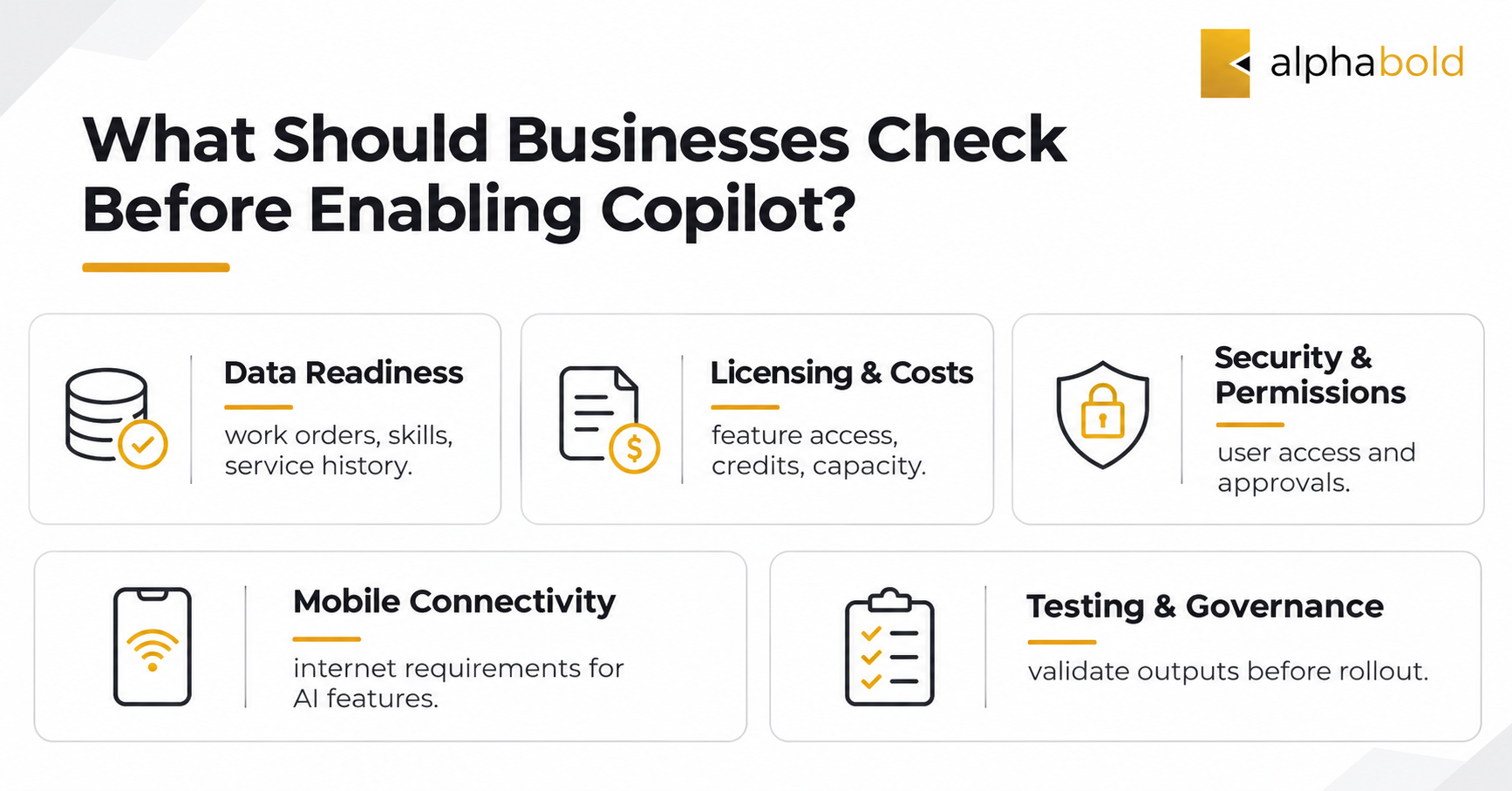
Five areas deserve attention:
- Data readiness: Check work order completeness, technician skills, service history, and resource availability. Inaccurate records can lead to incomplete summaries or unsuitable scheduling recommendations.
- Licensing and costs: Copilot chat is included in the Dynamics 365 Field Service web application without requiring a separate Copilot license. Other AI capabilities can have different requirements. For example, the Scheduling Operations Agent uses consumption-based Copilot Studio credits. Verify feature-specific licensing, capacity, and availability before implementation.
- Security and permissions: Review access to customer records, work order changes, and scheduling approvals.
- Mobile connectivity: Core Field Service mobile workflows can support offline scenarios, but AI-powered mobile work order updates require connectivity.
- Testing and governance: Validate generated outputs, scheduling exceptions, and approval workflows before broader deployment.
Important: Preview features are not intended for production use. Businesses should evaluate them in appropriate test environments and verify Microsoft’s latest release and deployment restrictions before planning operational adoption.
Gartner’s 2026 research on AI-based field service scheduling examines the importance of operational maturity when organizations evaluate more autonomous scheduling capabilities. This reinforces the need to address data and process readiness alongside technical configuration.
Further Reading: Transitioning from Legacy Systems to Dynamics 365 Field Service
How Can Businesses Measure Copilot ROI in Field Service?
Measuring Copilot ROI requires comparing the cost and performance of specific AI-assisted tasks against existing workflows. Rather than evaluating overall Field Service productivity, organizations should track whether work order summaries, assisted updates, and scheduling recommendations reduce effort without increasing errors or review time. A controlled evaluation should measure:
| KPI | What to Measure |
|---|---|
| Administrative time per work order | Time spent reviewing service information and documenting activities |
| Scheduling effort | Dispatcher time spent adjusting bookings and reviewing recommendations |
| Work order data quality | Missing information, incorrect updates, and documentation corrections |
| Technician adoption | Feature usage, acceptance of suggestions, and user feedback |
Businesses should establish baseline measurements before introducing supported capabilities and compare results across similar workloads. Licensing, consumption, implementation, training, and ongoing support costs should also be included when calculating ROI.
For example, reducing work order documentation time only creates sustainable value when the resulting records remain accurate and technicians consistently use the capability.
How Can AlphaBOLD Help Implement Copilot in Dynamics 365 Field Service?
AlphaBOLD helps businesses assess and implement Dynamics 365 Field Service capabilities based on their operational requirements, existing systems, and business goals. Our approach prioritizes practical use cases, supported functionality, and measurable outcomes rather than introducing AI into every process.
Implementation considerations include:
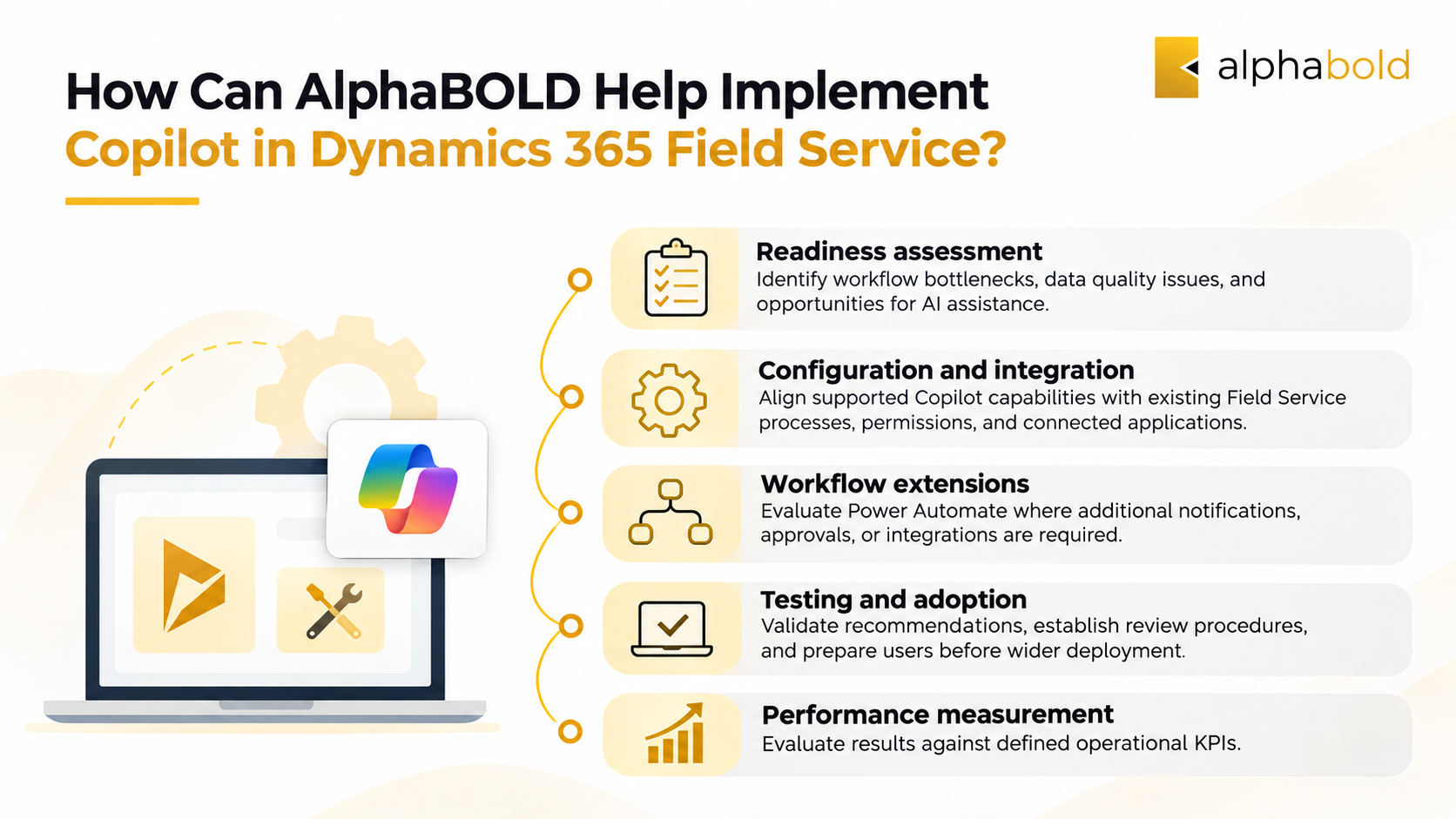
- Readiness assessment: Identify workflow bottlenecks, data quality issues, and opportunities for AI assistance.
- Configuration and integration: Align supported Copilot capabilities with existing Field Service processes, permissions, and connected applications.
- Workflow extensions: Evaluate Power Automate consulting where additional notifications, approvals, or integrations are required.
- Testing and adoption: Validate recommendations, establish review procedures, and prepare users before wider deployment of production-ready features.
- Performance measurement: Evaluate results against defined operational KPIs.
Through our AI consulting services, we also help organizations assess how Copilot and AI agents fit within broader technology and business requirements.
The objective is to reduce avoidable administrative work while maintaining operational control and reliable service data.
Further Reading: Benefits of Adopting Dynamics 365 Field Service for Your Business
Plan Your Copilot Implementation with AlphaBOLD
Whether you are evaluating Copilot for the first time or improving an existing Dynamics 365 Field Service environment, AlphaBOLD can help assess feature suitability, implementation requirements, and measurable business outcomes.
Request a ConsultationConclusion
Copilot in Dynamics 365 Field Service can reduce administrative effort, improve access to work order information, and support selected service workflows. The Scheduling Operations Agent introduces additional possibilities for AI-assisted dispatching.
However, organizations must distinguish available features from preview capabilities and evaluate data quality, licensing, configuration, and human oversight before deployment. A focused, measurable implementation approach helps determine where Copilot provides practical business value.
FAQs
No, AI-powered mobile work order updates require an internet connection. Dynamics 365 Field Service Mobile supports certain offline workflows, but this does not mean Copilot features work offline. Businesses with technicians operating in low-connectivity locations should confirm the supported offline functionality of their specific mobile configuration.
Copilot chat is included in the Dynamics 365 Field Service web application without requiring a separate Copilot license. However, other AI capabilities may have different requirements. The Scheduling Operations Agent, for example, uses consumption-based Copilot Studio credits. Businesses should verify feature-specific licensing, availability, and usage costs before deployment.
Customization depends on the capability. Some Copilot experiences support configuration of summary content, while others have predefined limitations. Copilot chat extensions through Copilot Studio are also subject to feature availability and preview restrictions. Additional workflows can be implemented using supported Power Platform tools, but these should not be confused with native Copilot functionality.
Organizations should use appropriate test environments and representative service scenarios, including incomplete records, scheduling conflicts, different security permissions, and urgent booking changes. Compare AI-generated recommendations with expected results, verify approval requirements, and document errors. Preview capabilities should remain outside production use until Microsoft confirms their suitability and release status.
Explore Recent Blog Posts




Related Posts