
Dynamics 365 Field Service Mobile App: Features & Limitations

Table of Contents
Introduction
Field service operations rarely go exactly as planned. Technicians may encounter unexpected equipment issues, last-minute schedule changes, or limited connectivity while working at customer locations. Without access to accurate service information, even routine assignments can become difficult to manage.
The Dynamics 365 Field Service mobile app addresses many of these challenges by connecting technicians with work orders, asset information, and service documentation wherever their work takes them.
However, its effectiveness depends on more than the features available. Understanding how the mobile experience works, where its limitations lie, and what configuration decisions matter is essential before deployment.
What Is the Dynamics 365 Field Service Mobile App?
The Dynamics 365 Field Service mobile app is a model-driven application built on Microsoft Power Platform. Available on supported iOS, Android, and Windows devices, it connects technicians with the information needed to complete service visits.
The app provides access to assigned bookings, work orders, customer details, asset records, and on-site service activities. Its mobile experience differs from desktop Field Service functions, which support broader scheduling, dispatching, configuration, and management responsibilities.
Organizations implementing Dynamics 365 Field Service can configure the experience around technician responsibilities, operational requirements, and connectivity conditions.
What Can Technicians Do with the Dynamics 365 Field Service Mobile App?
The Dynamics 365 Field Service mobile app supports technician workflows from receiving assignments to documenting completed work. Its capabilities include work-order access, mobile inspections, service documentation, parts usage, and navigation.
| Mobile Capability | How Technicians Use It |
|---|---|
| Work orders and bookings | Review assigned jobs, customer information, service instructions, and booking details. |
| Asset information | Access equipment records and relevant service history before performing maintenance. |
| Mobile inspections | Complete digital inspection forms and record structured results. |
| Service documentation and reports | Record notes, photos, time entries, and work performed. Generate service reports and capture customer signatures when the required custom reporting solution is installed and configured. |
| Parts and services | Record products and services used during supported work-order workflows. |
| Maps and navigation | View scheduled appointments on a map and navigate to service locations. |
| Barcode scanning | Identify assets or populate supported records through barcode scanning. |
For example, an HVAC technician can review an assigned maintenance visit, check equipment history, complete an inspection, record replacement parts, and update the work order before leaving the site.
These activities depend on configuration, permissions, and the selected mobile experience.
Further Reading: Dynamics 365 Field Service Features & Capabilities
How Does Offline Access and Synchronization Work?
Dynamics 365 Field Service mobile supports offline operations through configured mobile offline profiles. These profiles determine which records technicians can access without connectivity and how changes synchronize when the device reconnects.
Microsoft’s mobile experiences have an important distinction:
- Classic Unified Interface: Supports configured offline access, allowing technicians to work with downloaded records without internet connectivity.
- Refreshed mobile experience: Provides updated navigation and controls but does not currently support offline operation.
Administrators configure offline profiles to control downloaded tables, related records, data filters, and synchronization behavior.
When connectivity returns, locally stored changes synchronize with Dataverse. However, businesses must plan for unavailable records, synchronization failures, and conflicting updates.
When a technician and dispatcher modify the same record, synchronization behavior depends on conflict-detection settings. With conflict detection disabled by default in the relevant system settings, offline changes can overwrite server-side updates.
Organizations should review these settings and test conflicting updates before deployment to reduce the risk of unintended data loss.
Further Reading: Transitioning from Legacy Systems to Dynamics 365 Field Service
What Are the Limitations of Dynamics 365 Field Service Mobile?
The application’s limitations depend on the mobile experience, device platform, connectivity, and configuration. Organizations should evaluate these differences rather than assume desktop functionality is fully available on mobile.
Key limitations include:
- Experience differences: The refreshed experience does not support offline functionality, which requires the configured classic Unified Interface.
- Platform differences: The refreshed mobile experience is unavailable in the Windows application, which continues to use the classic interface.
- Connectivity-dependent features: Certain integrations, document access, and validation processes require an internet connection.
- Offline data availability: Technicians can access only the records included in their configured offline profiles.
- Customization requirements: Specialized forms, controls, and business processes may require additional configuration and testing.
Selecting the appropriate mobile experience should therefore be part of deployment planning.
Need Field Service Mobile to Work Reliably in the Field?
AlphaBOLD can help assess offline requirements, configure technician workflows, and address mobile deployment challenges before they affect service operations.
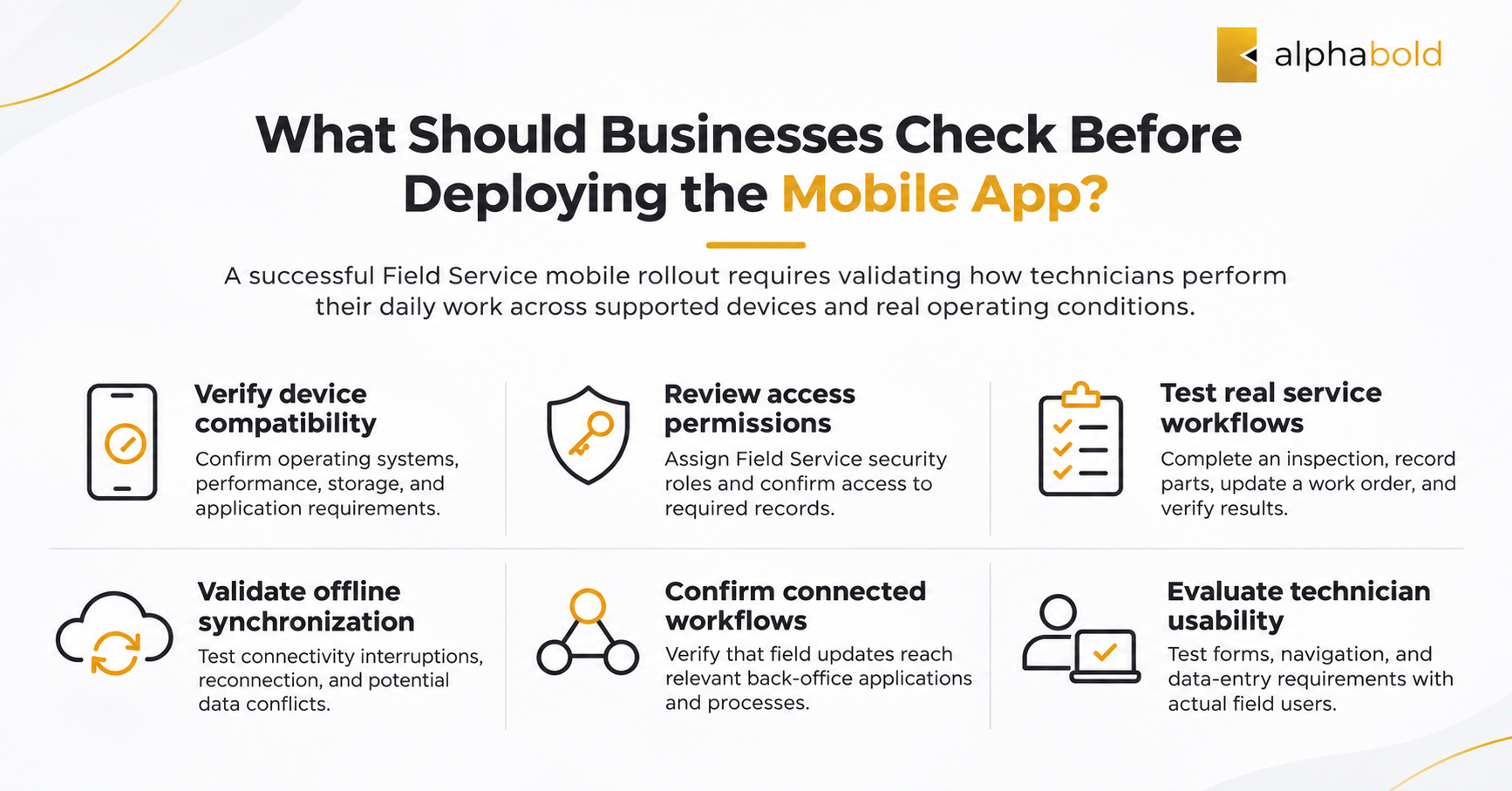
Request a ConsultationWhat Should Businesses Check Before Deploying the Mobile App?
A successful Field Service mobile rollout requires validating how technicians perform their daily work across supported devices and real operating conditions.
Organizations should complete the following checks:
- Verify device compatibility: Confirm operating systems, performance, storage, and application requirements.
- Review access permissions: Assign appropriate Field Service security roles and confirm access to required records.
- Test real service workflows: Complete an inspection, record parts, update a work order, and verify the resulting information.
- Validate offline synchronization: Test connectivity interruptions, reconnection, and potential data conflicts.
- Confirm connected workflows: Verify that field updates reach relevant back-office applications and processes.
- Evaluate technician usability: Test forms, navigation, and data-entry requirements with actual field users.
Mobile usability also affects how frontline employees receive information. Gartner’s 2026 research on frontline mobile communication highlights the importance of personalization and appropriate timing, principles organizations can consider when designing technician-facing experiences.
Organizations can use Power Apps consulting to configure supported mobile forms and workflows. Dynamics 365 integration and customization services can also help connect technician activities with existing business systems.
Further Reading: Using Copilot with Dynamics 365 Field Service
How Can AlphaBOLD Support Your Field Service Mobile Implementation?
AlphaBOLD helps organizations configure Dynamics 365 Field Service mobile experiences around technician requirements, including work-order access, mobile data capture, connected workflows, and deployment validation.
Our work with Air Control Systems demonstrates this approach. Through aDynamics 365 Field Service modernization project, AlphaBOLD improved mobile access to job information and simplified technician data entry for an environment supporting more than 100 field technicians.
The project also used Power Automate to streamline connected work-order and invoicing processes, reducing administrative handoffs between field and office teams.
Planning a Dynamics 365 Field Service Mobile Rollout?
Work with AlphaBOLD to assess your mobile requirements, configure the appropriate experience, validate integrations, and prepare technicians for deployment.
Request a ConsultationConclusion
The Dynamics 365 Field Service mobile app provides practical tools for managing technician work, but deployment success depends on selecting the appropriate experience and configuring it correctly. Organizations should prioritize connectivity requirements, usable workflows, reliable synchronization, and real-world testing before rolling out the application.
FAQs
Yes. The mobile app is included with Dynamics 365 Field Service licensing without a separate mobile-app charge. Users still need appropriate licensing, environment access, and security permissions.
Yes. External contractors can access the app through Microsoft Entra B2B collaboration with appropriate Field Service or Field Service Contractor licensing, environment access, and permissions. However, guest accounts have limitations involving offline synchronization and security-role enforcement. Organizations should validate contractor access and required workflows before deployment.
Yes, subject to organizational policies and supported device requirements. Businesses should evaluate application management, security controls, and data protection before allowing personally owned devices.
No. The mobile app primarily supports technicians performing on-site service activities. Dispatchers, administrators, and service managers generally use desktop Field Service experiences for scheduling, configuration, operational oversight, and broader management tasks.
Explore Recent Blog Posts