
QA Readiness Assessment: What It Reveals About Your Software Delivery Partner

Table of Contents
A QA readiness assessment can tell business and technology leaders far more than whether a software provider knows how to test. It can reveal whether the partner knows how to identify delivery risks, validate complex systems, and prepare a solution for real production conditions.
That matters when selecting a software development or implementation partner. The value is not in learning every detail of QA. It is in recognizing whether a prospective provider treats quality as a final testing phase or as a discipline built into architecture, development, integration, deployment, and support.
A mature approach indicates that the partner has the processes and technical depth required to deliver a stable, secure, and supportable solution.
What Does a QA Readiness Assessment Reveal About a Technology Partner?
A QA readiness assessment evaluates whether a product and the environment around it are prepared for launch. It typically considers business-critical workflows, architecture, data, integrations, security, performance, deployment, monitoring, and recovery.
More importantly, it reveals how the delivery partner thinks.
A provider that performs this type of assessment is less likely to view a project as a set of features that only need to pass predefined test cases. It is more likely to consider how those features depend on APIs, cloud services, identity systems, databases, third-party platforms, and operational teams.
That distinction matters when a project includes custom software, Microsoft Dynamics 365, ERP or CRM integrations, data platforms, AI capabilities, or regulated workflows. In these environments, failures often occur between systems or under production conditions that are difficult to reproduce through functional testing alone.
Why Does a QA Readiness Process Signal a More Capable Delivery Partner?
It Identifies Delivery Risks Before They Become Expensive:
A mature technology partner involves QA early enough to influence requirements, architecture, integration planning, and acceptance criteria.
This helps surface unclear workflows, incomplete data rules, unsupported dependencies, environment differences, and security concerns before they become embedded in the solution. Finding these issues during planning or development gives the team more options. Finding them during final testing can lead to rework, delayed launches, and difficult trade-offs.
Early QA involvement also improves estimation. When a provider understands what must be validated, it can account for test environments, data preparation, automation, performance testing, and specialist review in the delivery plan rather than treating them as unexpected additions.
It Designs for Production, Not Just for a Successful Demo:
A solution can work well during a demonstration and still be unprepared for real users and operational pressure.
Providers with strong QA readiness practices consider production conditions throughout delivery. They ask whether authentication will work with live identity configurations, whether integrations can handle transaction volumes, whether users have appropriate access, whether migration rules preserve data relationships, and whether failures will be visible in logs and alerts.
They also consider deployment dependencies, feature flags, database changes, backups, and rollback options. This does not guarantee that every release will be perfect. It shows that the provider is planning for reliability and recovery rather than assuming that successful functional testing removes all risk.
NIST’s March 2026 DevSecOps guidance similarly emphasizes automating and standardizing security practices throughout the software development lifecycle to improve efficiency and strengthen software supply chain assurance.
It Understands How Connected Systems Behave Together:
Complex technology projects rarely operate within one application. A customer-facing workflow may depend on CRM, ERP, payment, identity, reporting, cloud, and third-party services.
A less mature provider may validate each component independently. A readiness-led provider tests the complete journey, including how information moves between systems and what happens when one dependency is slow, unavailable, or incorrectly configured.
This approach is particularly important for Microsoft business applications and other configurable platforms. A workflow may involve custom plugins, APIs, Power Automate flows, data mappings, security roles, and external systems. Each component can appear correct on its own while the end-to-end process still fails.
Build Production Readiness Into Your Project
AlphaBOLD helps organizations identify architecture, integration, data, performance, and deployment risks throughout delivery, helping complex systems reach production with fewer surprises.
Request a ConsultationIt Makes Go-Live Decisions More Defensible
A strong delivery partner does not recommend launch simply because the deadline has arrived or the test pass rate looks acceptable.
It gives leadership a clear view of what has been validated, which risks remain, how those risks could affect the business, and what conditions must be met before release. The recommendation may be ready, ready with conditions, or not ready.
This gives business leaders a more useful basis for making a decision. They do not need to inspect individual test cases, but they should expect evidence that critical processes, integrations, data, security controls, performance, and recovery plans have been considered.
It Is Better Prepared to Support the Solution After Launch:
Quality does not end when the deployment succeeds.
A provider with mature QA readiness practices also considers monitoring, alerting, documentation, escalation paths, and post-launch validation. It should be clear how the team will detect failed transactions, performance degradation, integration errors, security events, or unexpected user behavior.
This reduces dependence on customers finding issues first. It also makes diagnosis faster because support teams have access to useful logs, ownership information, and agreed response procedures.
For AI-enabled applications, post-launch readiness is especially important because model behavior can change as data, prompts, model versions, and external services evolve.
You may also like: QA Strategy for AI-Powered Applications
Why Does This Matter More for Software, Healthcare, Biotech, and AI Projects?
The underlying principle is the same across industries: the more complex or consequential the system, the more important it is to choose a partner that treats QA as part of delivery.
For software and SaaS companies, the partner may need to validate scalability, tenant isolation, subscription workflows, APIs, background processes, availability, and frequent release cycles.
For healthcare, biotech, and life sciences technology, technical quality may also depend on data integrity, traceability, access controls, audit records, regulated workflows, and reliable integrations with clinical, laboratory, or operational systems.
For AI-enabled products, traditional pass-or-fail testing is not enough. The partner may need to evaluate output quality, data coverage, prompt and model changes, privacy, misuse scenarios, human review, and production monitoring.
These are different technical environments, but they require the same delivery mindset: understand the business risk, validate the complete system, and prepare for how the technology will behave after launch.
You may also like: Agentic AI Testing for Dynamics 365: Autonomous Agents That Test Themselves
What Should You Ask a Prospective Software Partner?
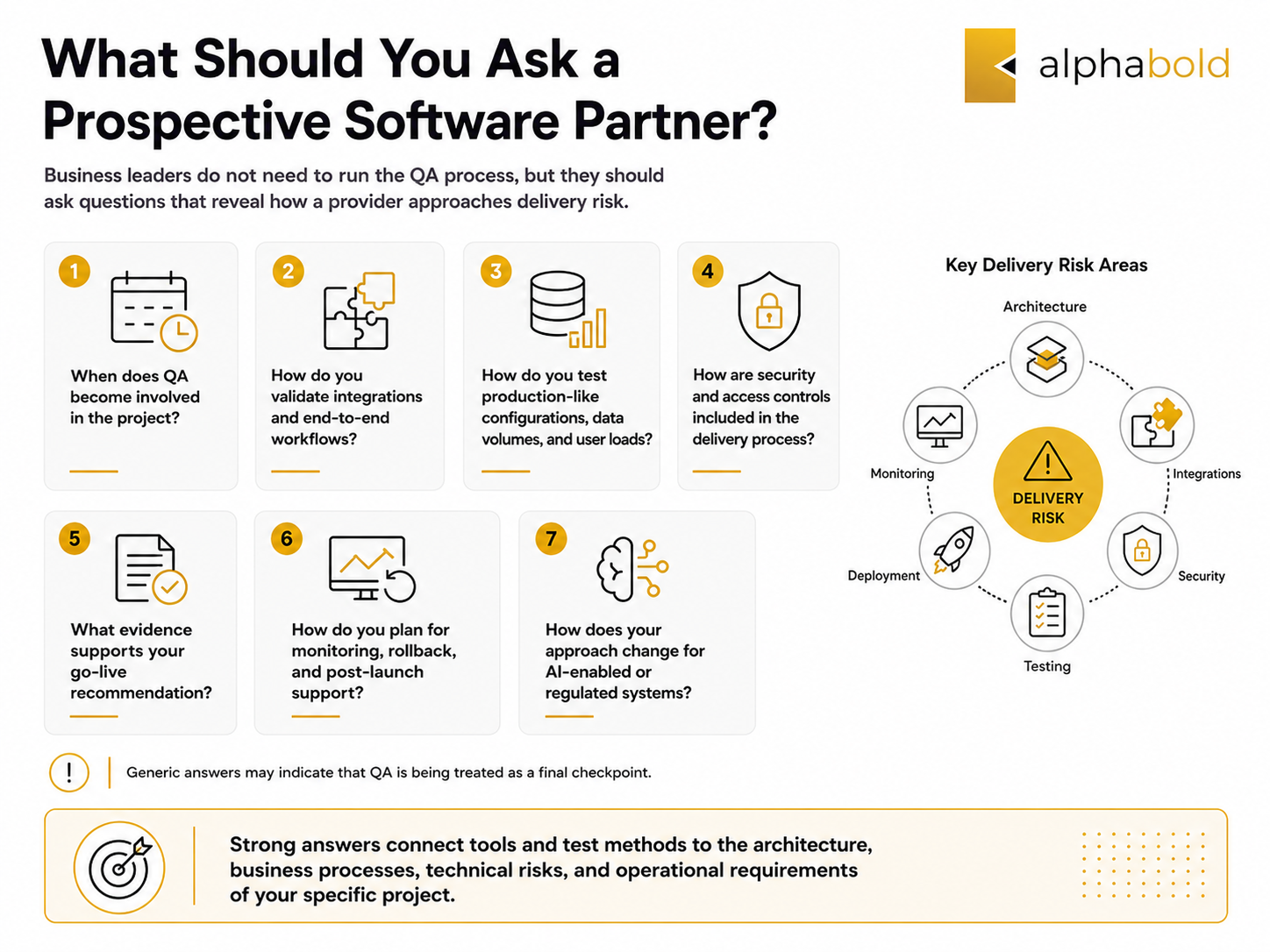
Business leaders do not need to run the QA process, but they should ask questions that expose how the provider approaches delivery risk:
- When does QA become involved in the project?
- How do you validate integrations and end-to-end workflows?
- How do you test production-like configurations, data volumes, and user loads?
- How are security and access controls included in the delivery process?
- What evidence supports your go-live recommendation?
- How do you plan for monitoring, rollback, and post-launch support?
- How does your approach change for AI-enabled or regulated systems?
How Does AlphaBOLD Approach QA Readiness?
AlphaBOLD integrates quality assurance services with software delivery, implementation, integration, data, cloud, and AI work. The objective is not only to find defects before launch. It is to help clients understand and reduce the risks that could affect adoption, operations, security, or customer experience.
Depending on the project, this can include QA strategy, risk-based testing, automation, API and integration validation, data testing, performance assessment, security coordination, deployment checks, and post-launch monitoring.
Because AlphaBOLD works across Microsoft Dynamics 365, Power Platform, Microsoft Fabric, Azure, NetSuite, custom software, and AI applications, its QA teams can assess quality within the broader technology environment rather than reviewing one isolated application.
Evaluate More Than a Vendor’s Development Capabilities
Work with a technology partner that considers architecture, QA, deployment, and operational readiness as part of one delivery process.
Request a ConsultationConclusion
A QA readiness assessment matters to business leaders because of what it reveals about the company delivering the project.
Providers that build quality and readiness into delivery are better positioned to identify risks early, understand connected systems, make evidence-based launch recommendations, and support the solution after it reaches production.
When evaluating a software partner, do not ask only whether it can build the requested functionality. Ask how it will prove that the complete solution is ready to operate.
FAQs
A QA readiness assessment is a structured review that determines whether a software product and its supporting environment are prepared for production. It examines testing results alongside integrations, data, security, performance, deployment, monitoring, and operational readiness.
Ask when QA becomes involved, how the partner tests complete workflows, how it validates integrations and production-like conditions, what evidence supports its go-live recommendations, and how it prepares for monitoring and support after launch.