
Table of Contents
Introduction
A marketing manager may want new form submissions added to a campaign list. An HR specialist may need employee documents routed for approval. A project manager may want overdue tasks escalated through Microsoft Teams without manually contacting every assignee.
Power Automate connectors make these workflows possible by allowing applications and services to exchange information, respond to events, and complete defined actions.
However, choosing a connector involves more than finding the right trigger. Licensing, connection ownership, API limits, security policies, data volume, and long-term maintenance can all affect whether an automation works reliably at scale.
This guide explores eight widely used Power Automate connectors, whether they are standard or premium, their practical applications, and the factors AlphaBOLD considers when designing manageable business automation.
What Is a Power Automate Connector?
A Power Automate connector allows a flow to communicate with an application, platform, or data service. Connectors provide predefined triggers and actions that users can combine to automate business processes.
For example, a flow may use:
- A trigger when a new SharePoint list item is created
- An action to send a Microsoft Teams notification
- Another action to create a task in Microsoft Planner
The connection is the authenticated account that allows Power Automate to access the service and complete those actions.
Microsoft now uses connectors across Power Automate, Power Apps, Copilot Studio, and Azure Logic Apps. Microsoft also describes connectors as agent-ready because their actions can be used by agents to complete tasks across connected systems.
Bonus read: Uncover how to leverage the Copilot for Power Automate: Building Workflows with Copilot for Power Automate
What Is the Difference Between Standard and Premium Power Automate Connectors?
Standard and premium are primarily licensing classifications, not descriptions of connector quality.
Standard connectors include many commonly used Microsoft 365 services, such as SharePoint, Microsoft Teams, Office 365 Outlook, Planner, OneDrive for Business, Excel Online Business, and Power BI.
Premium connectors commonly provide access to enterprise applications, advanced services, databases, and external platforms. Custom connectors, which organizations create to communicate with their own APIs, are also treated as premium capabilities.
| Connector Classification | What It Generally Covers | Licensing Consideration |
|---|---|---|
|
Standard |
Common Microsoft and third-party services |
May be covered by eligible Microsoft 365 or Power Automate rights |
|
Premium |
Enterprise systems and advanced services |
Requires an appropriate premium entitlement |
|
Custom |
Organization-specific REST or SOAP APIs |
Requires premium licensing |
|
On-Premises |
Supported local systems accessed through a gateway |
Depends on the connector and automation scenario |
A flow that does not use premium connectors may be covered through eligible Microsoft 365 rights. When an instant flow uses premium connectors, each user who runs it generally needs an appropriate Power Automate Premium license unless the automation is covered through a Process license or another valid licensing arrangement.
Before purchasing additional licenses, organizations should review the Power Automate rights already available in their Microsoft environment. Our guide explains how to maximize your Power Automate licenses before adding new subscriptions.
Is the SharePoint Power Automate Connector Standard or Premium?
SharePoint is a Standard connector in Microsoft Power Automate.
However, this does not automatically make the entire flow standard. A SharePoint-triggered flow may still require premium licensing when it also uses a premium connector, a custom connector, or another premium capability.
For example:
- SharePoint to Microsoft Teams is normally a standard connector scenario.
- SharePoint to Office 365 Outlook is normally a standard connector scenario.
- SharePoint to Azure DevOps includes a premium connector.
- SharePoint to a proprietary API through a custom connector includes a premium capability.
The licensing requirement must therefore be evaluated across the complete flow rather than from its starting connector alone. Microsoft currently lists SharePoint as Standard across Power Automate regions.
| Power Automate Connector | Tier | Best Used For | Important Consideration |
|---|---|---|---|
|
SharePoint |
Standard |
Document, list, approval, and content workflows |
Online and on-premises scenarios differ |
|
Microsoft Teams |
Standard |
Notifications, collaboration, and task escalation |
Channel type and user access affect some actions |
|
Office 365 Outlook |
Standard |
Business email, calendar, and mailbox workflows |
Use the enterprise connector rather than Outlook.com |
|
Microsoft Planner |
Standard |
Task creation, assignment, and reminders |
The connector currently supports basic plans only |
|
OneDrive for Business |
Standard |
Cloud file creation, movement, and storage |
File and trigger limits apply |
|
Excel Online Business |
Standard |
Small-scale spreadsheet and reporting workflows |
Concurrent editing and volume can create reliability issues |
|
Power BI |
Standard |
Alerts, refresh actions, and reporting workflows |
It supports defined triggers, not every report change |
|
Azure DevOps |
Premium |
Work items, development, and project workflows |
Premium licensing and REST API limitations apply |
Microsoft’s current connector references classify SharePoint, Teams, Office 365 Outlook, Planner, OneDrive for Business, Excel Online Business, and Power BI as Standard. Azure DevOps is classified as Premium.
How Does AlphaBOLD Evaluate Power Automate Connectors?
At AlphaBOLD, connector selection begins with the complete business process, not simply the list of available actions.
A connector may technically support a workflow but still introduce licensing, ownership, security, performance, or maintenance problems when the automation is deployed across an organization.
Before recommending a connector, AlphaBOLD evaluates the following areas:

Business Fit
What event should start the process? What information needs to move, and what business outcome should the flow produce?
Licensing
Does the workflow use only standard connectors, or does it introduce premium, custom, desktop, or process-level licensing requirements?
Connection Ownership
Will the flow depend on an individual employee’s account? What happens if that employee changes roles, leaves the business, or loses access to the connected system?
Business-critical flows may require centralized ownership, service-account planning, or another managed connection strategy.
Security and Governance
Which systems will exchange data? Do the connectors comply with the organization’s Data Loss Prevention policies, environment strategy, access controls, and compliance requirements?
Scale and Reliability
Can the connector support the expected transaction volume, file sizes, polling frequency, concurrent activity, and API usage?
Monitoring and Support
Who will receive failure alerts? How will exceptions be investigated? Who will update credentials, connections, and flow logic after deployment?
AlphaBOLD’s Power Automate consulting services address workflow architecture, connector and API integration, governance, deployment, monitoring, and long-term optimization.
Choose Power Automate Connectors with Confidence
AlphaBOLD can assess your business process, identify the required connectors, evaluate licensing, and design an automation that remains secure and manageable as usage grows.
Request a DemoTop Power Automate Connectors for Business Automation
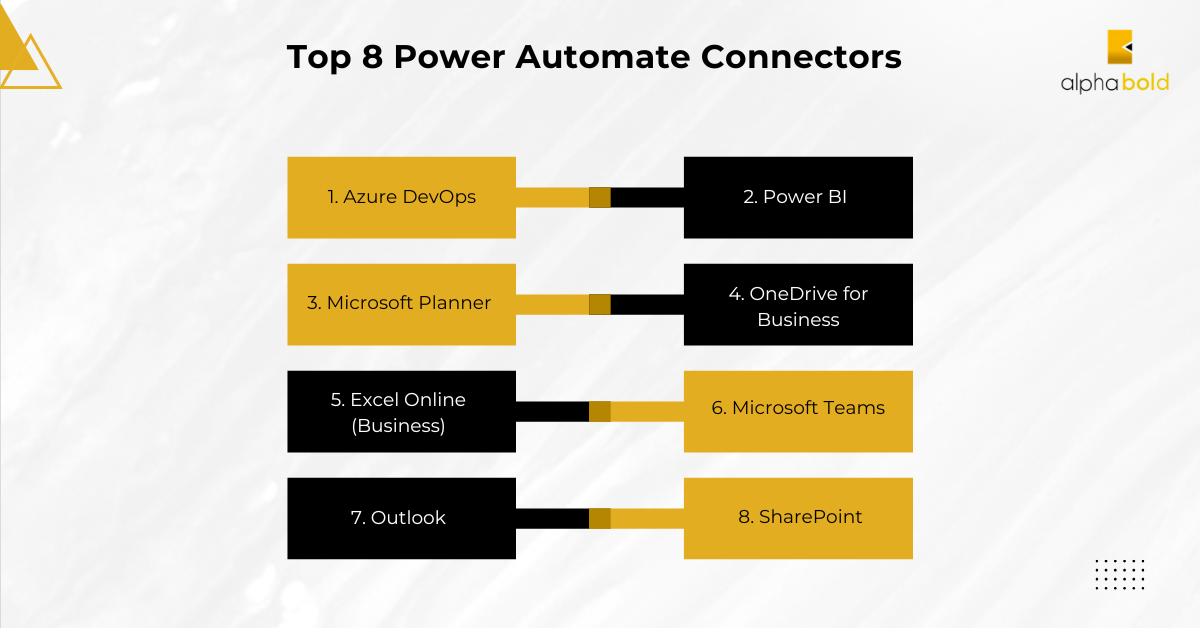
It’s time to explore the top Power Automate connectors and their uses.
1. SharePoint Power Automate Connector
SharePoint helps organizations manage documents, lists, content, and collaborative business information. Its Power Automate connector allows flows to respond when files or list items are created or modified and then perform actions across SharePoint or other connected services.
The SharePoint connector is classified as Standard.
SharePoint Connector Use Cases
With the SharePoint Power Automate connector, you can:
- Create a list item when a form is submitted
- Route documents through an approval process
- Notify teams when files or records are updated
- Copy documents between supported libraries
- Update list information when another business event occurs
- Create structured processes around requests, contracts, and records
Business Applications
Legal teams can route contracts for review and notify the appropriate decision-makers when an approval is pending.
HR teams can manage onboarding requests, employee documents, and policy acknowledgments through SharePoint lists and libraries.
Operations teams can track internal requests and automatically escalate records that remain unresolved beyond an agreed period.
Important Limitations
SharePoint Online connects directly through the cloud connector. Supported on-premises SharePoint 2016 and 2019 environments require the On-Premises Data Gateway.
Microsoft also advises organizations not to use deprecated SharePoint actions or triggers in new solutions. Conditional Access policies may block connector operations, and list or query design can affect whether complete information is returned.
AlphaBOLD implementation note: SharePoint may be an effective choice for document and list-based processes, but it should not automatically be treated as the operational database for every high-volume workflow. Data structure, transaction volume, reporting requirements, and future integration needs should be evaluated first.
Bonus read: How to Maximize Your Power Automate Licenses
2. Microsoft Teams Power Automate Connector
Microsoft Teams is frequently where employees communicate, coordinate work, and respond to operational updates. The Teams connector allows Power Automate to bring workflow information directly into that workspace.
The Microsoft Teams connector is classified as Standard.
Microsoft Teams Connector Use Cases
With the Teams connector, you can:
- Post a message when a new task or request is created
- Notify a channel when an approval is required
- Send reminders for overdue activities
- Create Teams meetings through automated processes
- Turn selected messages into follow-up actions
- Deliver adaptive cards that allow users to respond without leaving Teams
Business Applications
Project managers can notify delivery teams when milestones change or approvals are delayed.
Customer service teams can alert supervisors when cases exceed an escalation threshold.
Operations managers can send targeted notifications when inventory, service, or production conditions require attention.
Important Considerations
Teams automations should be designed carefully. Sending every workflow update to the same channel can create notification fatigue, causing users to ignore the alerts that actually require action.
Connector behavior may also differ depending on whether the flow involves standard, private, or shared channels, as well as guest or external users. Permissions and channel structure should therefore be reviewed before development.
AlphaBOLD implementation note: A useful Teams workflow should tell the right person what happened, why it matters, and what they need to do next. It should not simply reproduce every system event in a chat channel.
3. Office 365 Outlook Power Automate Connector
The Office 365 Outlook connector allows organizations to automate business email, calendar, contact, and mailbox activities.
It is classified as a Standard connector.
The original Outlook.com connector is intended for personal Microsoft accounts. Microsoft advises enterprise users to use the Office 365 Outlook connector for organizational mailboxes.
Office 365 Outlook Connector Use Cases
With the Office 365 Outlook connector, you can:
- Send an email when a workflow reaches a defined stage
- Create calendar events from approved requests
- Monitor a shared mailbox for specific messages
- Save email attachments to SharePoint or OneDrive
- Route messages according to sender, subject, or other conditions
- Send reminders before deadlines or scheduled events
Business Applications
Customer service teams can monitor shared mailboxes and create follow-up activities when new requests arrive.
HR departments can categorize job applications and save relevant attachments to a controlled location.
Project managers can create calendar events after meeting or resource requests have been approved.
Important Considerations
The flow must use an account with appropriate mailbox access. Shared-mailbox membership, Conditional Access policies, message encryption, attachment types, and mailbox configuration can all affect whether an action succeeds.
AlphaBOLD implementation note: Email-based flows should include controls that prevent duplicate processing, unwanted automated replies, and repeated actions when a message is moved or updated.
4. Microsoft Planner Power Automate Connector
Microsoft Planner brings together tasks, assignments, due dates, and team coordination. Its connector allows Power Automate to create and update tasks as part of a wider business process.
The Planner connector is classified as Standard.
Microsoft Planner Connector Use Cases
With the Planner connector, you can:
- Create a task when a request is approved
- Add a task to a defined bucket
- Assign tasks to selected users
- Send reminders when due dates approach
- Notify a team when a task is completed
- Create project actions from forms, emails, or SharePoint records
Business Applications
Project managers can create implementation tasks automatically after a project stage is approved.
Marketing teams can assign content-development activities when campaign requests are submitted.
Team leaders can receive notifications when important tasks remain incomplete near their due dates.
Important Limitation
The Power Automate Planner connector currently supports basic plans only. Premium Planner plans are not supported through the same connector experience and may require a different design or API-based approach.
AlphaBOLD implementation note: Confirm the organization’s Planner plan type before building the flow. A workflow designed and tested against a basic plan may not continue to work as expected if the plan is later converted to premium.
Explore Power Automate Solutions with AlphaBOLD
Ready to use automation to revolutionize your company? Get a live demo of Power Automate to see firsthand how our potent connectors can streamline your workflow and save you time. Our staff will customize the demo to your unique needs.
Request a Demo5. OneDrive for Business Power Automate Connector
OneDrive for Business provides cloud-based file storage and synchronization for organizational users. Its connector allows flows to create, retrieve, update, copy, move, and delete supported files.
The connector is classified as Standard.
OneDrive for Business Connector Use Cases
With the OneDrive for Business connector, you can:
- Create files from form or system-generated information
- Move approved documents into designated folders
- Copy files between supported cloud locations
- Send notifications when new files are created
- Convert supported files as part of a document process
- Maintain organized storage for individual business workflows
Business Applications
Finance teams can create and distribute scheduled reports.
Sales teams can save generated proposals or account documents in designated folders.
Administrative teams can move approved files into structured storage locations without manually organizing every document.
Important Limitations
The Extract Archive action supports archives of up to 50 MB and 100 files. Some file-created or file-modified triggers skip files larger than 50 MB. Files moved within OneDrive may also not be treated as newly created files.
AlphaBOLD implementation note: OneDrive for Business is generally suited to user-centered document workflows. SharePoint may be a more appropriate destination when documents require wider team ownership, structured metadata, formal retention, or centralized collaboration.
6. Excel Online Business Power Automate Connector
The Excel Online Business connector allows Power Automate to work with supported Excel files stored in OneDrive for Business, SharePoint, and Microsoft 365 Groups.
The connector is classified as Standard.
Excel Online Business Connector Use Cases
With the Excel connector, you can:
- Add form submissions to a structured table
- Update rows when information changes in another service
- Generate recurring reports from spreadsheet data
- Send alerts when values meet defined conditions
- Read table information as part of a wider workflow
- Transfer small datasets between Excel and another application
Business Applications
Finance teams can collect expense information and notify managers when spending approaches an approved threshold.
Marketing teams can populate reporting workbooks with campaign information.
Operations teams can capture small sets of structured information without manually re-entering every record.
Important Limitations
The connector supports Excel files up to 25 MB. A file may remain locked for up to six minutes after connector use, and Microsoft does not support simultaneous modifications from multiple connectors or users.
These limitations can create delays, conflicts, or failed flows when several users and automations write to the same workbook.
AlphaBOLD implementation note: Excel can be convenient for small and controlled workflows, but convenience should not be confused with scalability. Dataverse, SharePoint, SQL Server, or another structured platform may be more suitable when multiple processes depend on the same operational information.
7. Power BI Power Automate Connector
With the Power BI connector, you can:
- Trigger a semantic-model refresh after source data is updated
- Start a flow through a Power Automate visual
- Respond to a configured data-driven alert
- Send notifications when a defined reporting threshold is reached
- Coordinate dataflow and semantic-model refresh activities
- Add workflow actions to selected reporting processes
Business Applications
Finance teams can initiate a budget review when a defined reporting threshold is reached.
Operations managers can notify responsible teams when performance falls outside an accepted range.
Analysts can coordinate refresh activities so that reports are updated after upstream data processes complete.
Important Considerations
The connector does not provide a universal trigger for every change made inside a Power BI report. Data-driven alert flows require an alert to be configured in advance, and the connector exposes specific actions and triggers rather than unrestricted access to all report content.
AlphaBOLD implementation note: Power BI alerts should be connected to an agreed business response. Sending an email about a declining KPI provides information; creating an assigned, traceable escalation process turns that insight into action.
You may also like: How to Deploy PowerApps Solutions Using Azure DevOps
8. Azure DevOps Power Automate Connector
Azure DevOps supports work tracking, source control, testing, and software delivery. Its Power Automate connector allows development and project events to initiate actions across Azure DevOps and other connected services.
Azure DevOps is classified as a Premium connector in Power Automate.
Azure DevOps Connector Use Cases
With the Azure DevOps connector, you can:
- Create work items from forms, emails, or support requests
- Update work items when related business information changes
- Notify Teams channels about development events
- Create bugs after defined testing failures
- Connect approval or request processes with development backlogs
- Provide stakeholders with automated project updates
Business Applications
Development teams can create work items automatically when approved requests enter the delivery pipeline.
Quality assurance teams can generate bugs when test processes identify defined failures.
Project managers can send selected work-item updates to business stakeholders without requiring them to monitor Azure DevOps directly.
Important Limitations
The connector requires access to an Azure DevOps organization with the necessary permissions. Microsoft also notes that work-item triggers and the Get Work Item Details action may omit certain fields because of Azure DevOps REST API limitations.
AlphaBOLD implementation note: Before using Azure DevOps in a widely distributed business process, organizations should determine who requires premium licensing and whether every user needs to trigger the flow directly.
What Does a Multi-Connector Power Automate Workflow Look Like?
The strongest automations often involve more than one connector.
Imagine that a customer request arrives through an Office 365 Outlook shared mailbox. Power Automate could:
- Create a SharePoint record for the request.
- Save relevant attachments to a SharePoint document library.
- Create a Planner task for the responsible employee.
- Notify the service team through Microsoft Teams.
- Escalate the request if the task remains incomplete.
- Update reporting information used in Power BI.
The value does not come from one connector in isolation. It comes from designing the complete process so that information moves between the right systems, employees understand their responsibilities, and exceptions remain visible.
AlphaBOLD approaches these scenarios as connected business processes rather than a collection of unrelated flows.
How Should You Choose the Right Power Automate Connector?
Before selecting a connector, ask the following questions:
Does It Support the Required Trigger and Actions?
A connector may provide access to an application without exposing the exact trigger or action needed for the process.
Is It Standard or Premium?
A premium connector can change the licensing requirement for every user or process that depends on the flow.
A premium connector can change the licensing requirement for every user or process that depends on the flow.
Premium costs may also appear as usage grows, automations expand to more employees, or API activity increases. Review the potential hidden Power Automate pricing costs before finalizing the architecture.
Who Owns the Connection?
A flow should not become unusable because its original creator leaves the organization or loses access to a mailbox, folder, or system.
What Data Will Move Between Services?
Data Loss Prevention policies can control which connectors are allowed to exchange business information. Sensitive data should not be moved into unapproved applications simply because a connector exists.
Can the Connector Support the Expected Volume?
Review file-size limits, API calls, polling behavior, throttling, concurrent updates, and transaction volume before treating a workflow as production-ready.
How Will Failures Be Managed?
Flows should include meaningful failure notifications, exception handling, retry logic, and ownership for ongoing support.
Is Power Automate the Right Automation Tool?
Organizations using Dynamics 365 should also determine whether a requirement belongs in Power Automate, Dataverse, a plug-in, an application feature, or another workflow technology. Read our comparison of Power Automate and Dynamics 365 workflows for additional guidance.
When Do You Need a Custom Power Automate Connector?
A custom connector may be required when an application provides a REST or SOAP API but does not have a suitable prebuilt connector.
Custom connectors can expose selected API operations as triggers and actions that users can access through Power Automate, Power Apps, and Copilot Studio. Microsoft documents more than 1,000 prebuilt connectors across its wider connector ecosystem, but business-specific and proprietary systems may still require custom development.
A custom connector may be appropriate when:
- The organization uses a proprietary business application
- An existing connector does not expose the required operations
- A legacy system provides an accessible API
- Authentication or data handling requires custom configuration
- A third-party platform needs to participate in a wider Microsoft workflow
For a practical example, explore how AlphaBOLD built a custom Power Automate connector for Marketo to call supported REST API operations.
Custom connectors require careful planning around authentication, licensing, API limits, error handling, ownership, security, and future changes to the underlying service.
How Are Power Automate Connectors Changing?
Power Automate connectors are expanding beyond traditional “when this happens, do that” workflows.
Connectors can now support agent-led processes through Copilot Studio, allowing agents to use approved actions to retrieve information and complete tasks across connected services. Microsoft describes Copilot Studio as a low-code environment for creating agents and agent flows, with prebuilt and custom connectors extending their access to organizational systems.
This reflects a broader shift in how organizations approach automation. In an April 2026 survey, Gartner reported that 80% of CEOs expected AI to require a high-to-medium degree of change to their organizations’ operational capabilities, with attention moving from digital business toward autonomous business.
However, intelligent automation does not remove the need for governance. As agents gain access to more connectors, organizations must decide:
- Which actions an agent may perform
- Which data sources it may access
- When human approval is required
- How agent activity will be monitored
- Who is responsible when an automated action fails
- How licensing and usage will be managed
For a closer look at generative actions, Copilot Studio, autonomous agents, and AI-assisted workflow development, explore AI and Copilot in Microsoft Power Platform.
Build Power Automate Workflows That Remain Manageable
AlphaBOLD helps organizations assess processes, select the right connectors, evaluate licensing, establish governance, and implement Power Automate workflows across Microsoft 365, Dynamics 365, Power Platform, and external business systems.
Request a DemoConclusion
Power Automate connectors can help organizations move information between applications, automate repetitive activities, and respond more quickly to business events.
SharePoint, Teams, Outlook, Planner, OneDrive, Excel, Power BI, and Azure DevOps each support different parts of the workflow. The best connector is not simply the one with the most actions. It is the one that fits the business process, licensing model, data requirements, expected volume, security policies, and long-term support plan.
As Power Automate continues to expand into AI- and agent-assisted automation, connector selection will become even more important. Businesses must understand not only what a connector can do but also who owns it, which systems it can access, how it will be governed, and what happens when the process does not run as expected.
With the right planning, Power Automate connectors can support workflows that are not only faster but also more reliable, visible, and manageable as the organization grows.
FAQs
Microsoft documents more than 1,000 connectors across Azure Logic Apps, Power Automate, Power Apps, and Copilot Studio.
The number available specifically in Power Automate may differ by product, region, preview status, and connector availability. Microsoft continually adds, updates, reclassifies, and retires connectors, so organizations should verify the current connector reference before beginning development.
Microsoft 365 may provide Power Automate rights for standard connector scenarios, but it does not automatically provide unrestricted use of premium and custom connectors.
Premium scenarios may require a Power Automate Premium user license, a Process license assigned to the automation, or another eligible entitlement depending on the flow type and users involved.
Yes. Power Automate includes connectors for Microsoft and non-Microsoft applications. When a suitable prebuilt connector is unavailable, organizations may create a custom connector for a supported REST or SOAP API.
Explore Recent Blog Posts