Copilot for Power Automate: How to Build AI-Powered Workflows Faster?

Caroline Mayou
Table of Contents
Introduction
Copilot for Power Automate is Microsoft’s AI assistant for creating, modifying, and managing workflows using natural language. Instead of manually configuring triggers, actions, and connectors, users can describe a business process in plain English, and Copilot generates the workflow automatically.
Organizations use Copilot for Power Automate to automate approvals, notifications, document processing, customer onboarding, CRM updates, and other repetitive business processes across Microsoft 365, Dynamics 365, SharePoint, Teams, and hundreds of third-party applications.
As Microsoft expands its AI ecosystem through Azure AI Foundry, Microsoft Fabric, and agent-based automation, Copilot for Power Automate is becoming a critical component of enterprise workflow automation strategies.
Why Does Copilot for Power Automate Matter for Your Business?
Traditional workflow automation required specialized skills and significant time investment. A single flow might take hours to configure, test, and troubleshoot. Copilot collapses that cycle dramatically, but the real business value goes deeper:
- Faster automation cycles: Flows that once took hours now take minutes
- Lower barrier to entry: citizen users and non-technical staff can automate their own processes
- Enterprise-grade governance: every flow runs within your organization’s compliance and permissions framework
- Agentic orchestration: Copilot doesn’t just build flows; it coordinates AI agents across your Microsoft stack
- Continuous improvement: post-deployment, Copilot monitors performance and surfaces optimization opportunities
Organizations adopting this level of automation are moving toward what Microsoft calls Frontier Firm maturity: AI and automation become part of how work happens, not just tools that support it.
How to Build Workflows with Copilot for Power Automate? Step-by-Step:
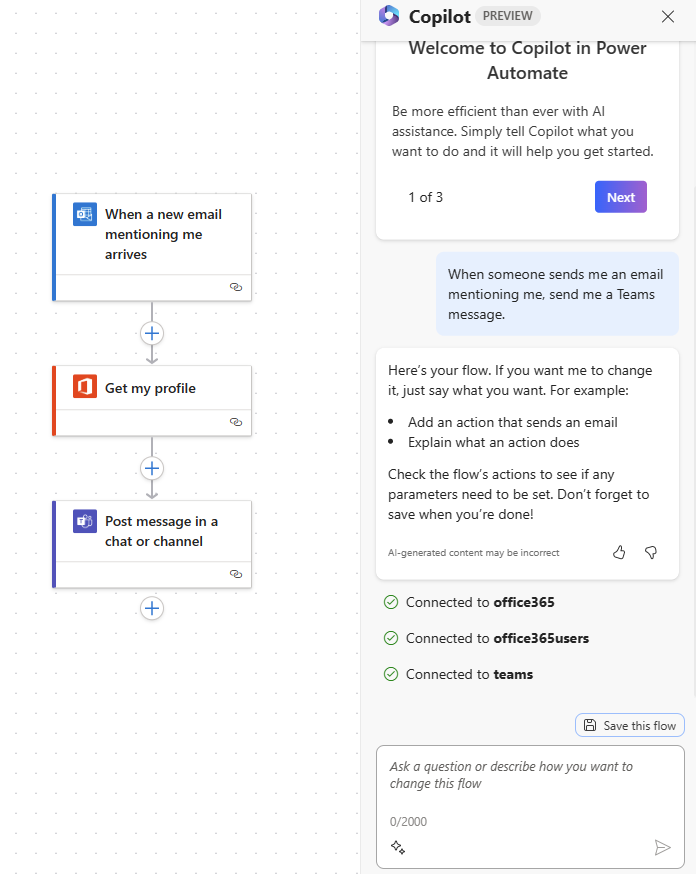
Creating an automated workflow with Copilot follows a simple, conversational process. Instead of manually configuring triggers, actions, and connectors, you describe the business process in natural language, and Copilot generates the workflow for you.
This reduces development time and makes automation accessible to both business users and technical teams.
Sign in to Power Automate:
Navigate to powerautomate.microsoft.com and sign in with your Microsoft credentials. Copilot is integrated directly into the workspace; no separate setup required.
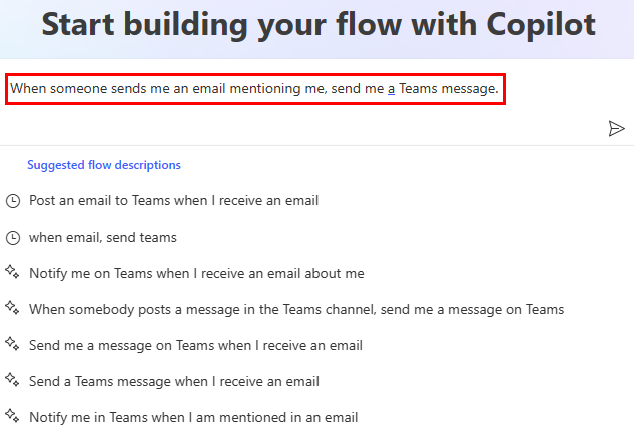
Describe What You Want To Automate:
Use plain language to define your workflow. Example: “When a new lead is added to Dynamics 365 with a score above 80, send a Teams message to the sales manager and create a task in Planner.” Copilot generates a draft flow immediately.
Review The Suggested Flow:
Copilot automatically sets up triggers, selects connectors, and maps actions. You can accept the draft as-is or refine it by adding conditions, approval steps, or natural-language notification logic.
Configure And Connect Your Data:
Copilot links to your Microsoft 365 and Power Platform data via Dataverse, assigning the appropriate connectors and credentials so your flow has the necessary permissions to run.
Test And Adjust:
Run a test. If adjustments are needed, describe the change conversationally: “Route the notification to the marketing team instead.” Copilot updates the flow instantly.
Publish, Monitor, and Improve:
After publishing, Copilot monitors flow performance through the Automation Center. It flags bottlenecks, suggests optimizations, and can recommend AI Builder actions to add predictive intelligence to existing flows.
Building automation has never been this simple. With Copilot for Power Automate, you describe the outcome, and it handles the rest.
Build Enterprise Workflows Without Complexity
Design and update Power Automate flows using simple prompts instead of complex configuration steps.
Request a DemoHow to Write Effective Prompts for Copilot?
The quality of your automation depends on how clearly you communicate your intent. Well-structured prompts help Copilot understand the process, select the right connectors, and generate workflows that require fewer revisions.
The more context you provide, the more accurate and useful the resulting flow will be.
Use the “When X Happens, Do Y” Structure:
This pattern maps directly to Power Automate’s trigger-action model. Example: “When a new support ticket is submitted in SharePoint, send an approval request to the IT manager and log it in Dataverse.”
Using this format helps Copilot quickly identify the event that starts the workflow and the actions that should follow. It also reduces ambiguity, making the generated flow easier to review and deploy.
Name the Specific Apps Involved:
Instead of “send a message when there’s a new task,” say “When a task is created in Planner, send a message in the #projects channel in Teams.” Specificity reduces ambiguity and produces more accurate flows.
Mentioning the exact applications, data sources, and destinations helps Copilot select the correct connectors and configure the workflow correctly on the first attempt.
Include Conditions in the Prompt:
You can embed filters directly: “When a lead is added to Dynamics 365 with a score above 80, notify the regional sales manager.” Copilot automatically translates conditions into flow logic.
Adding business rules upfront helps Copilot generate workflows that better align with real-world processes, reducing the need for manual adjustments later.
Iterate With Natural Language:
If the first draft needs work, refine it conversationally. Ask Copilot to “add an approval step before the notification fires” or “try another version with a 24-hour delay.” Each iteration improves the output.
Rather than rebuilding a workflow from scratch, you can modify it through simple instructions. This makes testing and refining automation significantly faster than traditional development approaches.
Explore Options Before You Build:
Use Copilot as a planning tool, not just a builder. Questions like “What’s the best way to handle approval escalations in Power Automate?” or “How do I connect Outlook with SharePoint for document routing?” surface design options before you commit to a flow structure.
This approach helps identify better workflow patterns, governance considerations, and automation opportunities early in the design process, resulting in more scalable and maintainable solutions.
What are Some Real-World Use Cases for Copilot in Power Automate?
These examples illustrate how organizations are applying Copilot for Power Automate across common enterprise scenarios:
| Use Case | Prompt Example | Business Value |
|---|---|---|
|
Client email routing |
When an email from a client arrives, post the subject and link in the #Project-Updates Teams channel |
Reduces response lag; keeps project teams aligned without manual forwarding |
|
Support request intake |
When a new item is added to the SharePoint Support Requests list, send a Teams message and log it in Dataverse |
Centralizes intake tracking; eliminates manual triage steps |
|
Document approval |
When a contract is uploaded to OneDrive, send it to legal for approval and move it to the Approved folder when signed |
Enforces approval governance; reduces document management overhead |
|
Sales-to-success handoff |
When a deal closes in Dynamics 365, create a Planner task for the customer success team with the deal summary |
Eliminates handoff gaps; ensures immediate onboarding action |
Is Copilot for Power Automate Right for Your Organization?
Before committing to a rollout, here are the practical considerations that matter to IT leaders and business owners:
Licensing and Costs:
Copilot features in Power Automate are available through Microsoft 365 E3/E5 plans and Power Automate Premium licensing. The cost structure depends on the number of flows, connectors used, and whether you require premium or standard connectors. Organizations scaling automation across departments will want to evaluate per-user vs. per-flow licensing against projected usage.
Implementation Timeline:
Most organizations can deploy basic Copilot-assisted automation within days of enabling it in their Power Platform tenant. More complex enterprise deployments, those involving custom connectors, Dataverse configuration, or multi-department rollout, typically require 4 to 12 weeks of structured implementation work.
IT Governance Requirements:
Before rollout, IT teams should audit connector permissions, define DLP policies, and configure environment-level access controls. Without this foundation, Copilot flows may inadvertently expose sensitive data or bypass approval processes.
Change Management:
Citizen user adoption requires more than technical deployment. Teams need to know which processes are automation candidates, how to write effective prompts, and who to contact when a flow needs adjustment. Structured enablement programs accelerate time-to-value significantly.
Measuring ROI:
Track metrics such as manual hours saved per process, error rates before and after automation, approval cycle times, and cross-system data latency. The Automation Center provides baseline performance data that makes ROI measurement straightforward.
Improve Productivity with Smarter Automation Design
Copilot supports faster workflow creation and adjustment, helping teams reduce setup time and focus on execution.
Request a DemoConclusion
Copilot for Power Automate has become a key part of Microsoft’s AI ecosystem, helping organizations build, manage, and optimize workflows using natural language. By combining automation, AI, and governance, teams can automate processes faster while maintaining control and security.
Beyond task automation, Copilot helps organizations connect systems, reduce manual effort, and improve operational efficiency across departments. As businesses continue adopting AI-driven workflows, Copilot for Power Automate provides a practical foundation for scalable, intelligent automation.
At AlphaBOLD, we help organizations maximize the value of Copilot through Power Platform governance, data readiness, and enterprise automation strategy.
FAQs
Copilot automates repetitive tasks and connects systems such as Dynamics 365, Teams, and SharePoint, reducing manual work and improving cross-departmental visibility.
Organizations should review data governance, permissions, and connector configurations to ensure secure and reliable automation.
Business users can build flows with natural language, while developers can extend them with custom connectors, AI models, and advanced logic.
Copilot connects automation, data, and AI across Microsoft services, helping organizations prepare for more advanced AI-driven business processes.
Explore Recent Blog Posts