Use Cases for Power BI NetSuite Integration

Table of Contents

Introduction

NetSuite is a robust ERP designed to centralize financial and operational data. Yet centralization alone does not create intelligence. The real value lies in how effectively that data can be structured, analyzed, and operationalized across the enterprise.

The use cases of Power BI NetSuite integration go beyond dashboard visualization. They address how organizations transform ERP data into governed, AI-ready financial intelligence that supports predictive forecasting, automated variance explanations, and executive-level decision-making. Native ERP reporting was built to manage transactions, not to deliver cross-functional analytics on a scale.

Integrating Power BI with NetSuite elevates ERP data from static reporting to a structured analytics layer that enables real-time insight and strategic clarity. This blog explores practical integration scenarios and how organizations design their NetSuite data architecture to support executive-grade analytics.

Why ERP Analytics Expectations Have Changed

Enterprise analytics expectations have matured. Gartner’s recent finance research shows that predictive forecasting, automated insight generation, and AI-assisted analysis are now core priorities for CFO organizations. Yet native ERP reporting environments were built for transaction management, not forward-looking intelligence.

Today, finance leaders expect ERP data to support:

  • Predictive revenue and cash flow forecasting
  • Automated variance detection and anomaly alerts
  • AI-generated executive summaries
  • Cross-system intelligence across ERP, CRM, and operations
  • Governed semantic models with consistent KPIs

At the same time, enterprise data strategies are consolidating around unified analytics platforms like Microsoft Fabric, where Lakehouse storage, semantic modeling, and AI workloads operate within a governed environment.

In this model:

  • ERP systems such as NetSuite serve as systems of record
  • Intelligence is generated in structured analytics layers
  • AI copilots operate on curated, enterprise-grade datasets

Research from McKinsey reinforces this shift, showing measurable gains in forecast accuracy and efficiency when AI-driven analytics are embedded into finance workflows. Achieving that outcome requires modeling and integrating ERP data into a modern analytics architecture.

This is where the use cases of Power BI NetSuite integration become strategically important. The integration enables ERP data to move beyond static reporting and participate in AI-ready financial intelligence frameworks that support predictive modeling and executive decision-making.

Here is a bonus read: CFO’s Guide to NetSuite: Navigating the ERP Investment for those considering switching from legacy systems to ERP software like NetSuite.

How Power BI and Microsoft Fabric Modernize NetSuite Data

Modern analytics discussions are no longer about building better dashboards. They are about building the right architecture.

Microsoft Power BI now operates as the modeling and visualization layer within Microsoft Fabric, a unified analytics platform that consolidates data engineering, Lakehouse storage, real-time pipelines, semantic models, and AI workloads into a governed ecosystem.

When NetSuite data is integrated into Fabric, organizations gain:

  • Lakehouse scalability to handle growing financial and operational datasets
  • Direct Lake performance that reduces traditional import and refresh bottlenecks
  • Centralized semantic models that standardize KPIs across departments
  • Cross-system analytics connecting ERP, CRM, supply chain, and external data
  • AI-assisted insights through Copilot operating on curated financial models
  • Enterprise-grade role-based governance and access control

Within this architecture, NetSuite continues to serve as the system of record. Intelligence, however, is generated within a structured analytics layer designed for performance, governance, and AI-readiness.

The result is a shift from isolated ERP reporting to an integrated financial intelligence framework that supports predictive modeling, automated insight generation, and executive-level decision-making.

Further Read: How Power BI and NetSuite Integration Help Businesses

Want to Integrate Power BI with Your NetSuite Enviorment?

Our experts can set your business up for continuous success with a smooth integration of NetSuite and Power BI. Get your personalized demo from our industry experts and see how we can make a difference for you.

Request a Demo

The Strategic Case for Integration

Integrating Power BI with NetSuite is not just a reporting upgrade. It is a structural shift in how ERP data supports decision-making.

Instead of relying on static reports or month-end exports, finance and operations teams operate on governed analytics models that reflect current performance. ERP data moves from transactional visibility to continuous intelligence.

Strategically, this integration enables:

  • Faster detection of revenue and margin risks
  • Standardized KPIs across departments
  • Reduced manual reporting effort
  • Greater confidence in executive-level analysis

When NetSuite data participates in a modern analytics architecture, it becomes part of a broader financial intelligence framework rather than an isolated reporting system.

The next section explores the practical use cases of Power BI NetSuite integration that translate this strategic shift into measurable outcomes.

Power BI NetSuite Integration Use Cases

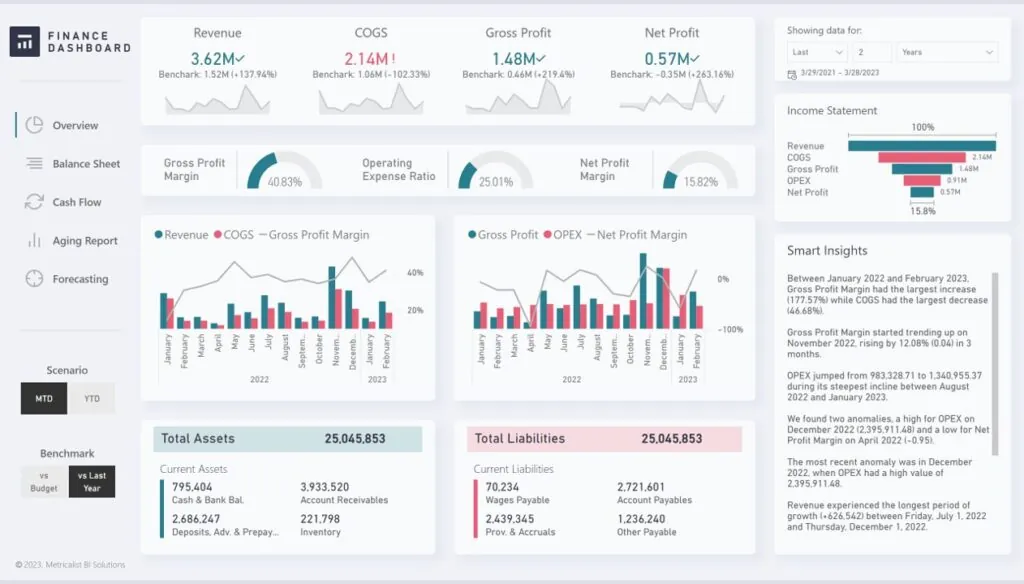
1. Financial Consolidation and Executive Reporting:

Modern finance leaders require more than month-end reporting. They need continuous visibility across subsidiaries, currencies, and cost centers with confidence in metric consistency.

By integrating NetSuite with Power BI and Microsoft Fabric, organizations can:

  • Standardize KPI definitions across entities using governed semantic models
  • Consolidate multi-entity financials in near real time
  • Automatically generate executive-ready financial summaries
  • Reduce manual reconciliation across intercompany transactions

Example:

A multi-subsidiary organization operating in USD, EUR, and GBP consolidates financial data daily instead of monthly. Currency fluctuations are modeled dynamically, and Copilot generates an executive briefing explaining margin shifts before the CFO meeting. What once required days of Excel reconciliation is now visible in minutes.

Impact:

  • Faster close cycles
  • Reduced reporting risk
  • Improved board-level confidence
This image shows Financial Reporting

2. AI-Driven Forecasting and Variance Detection:

Forecasting in 2026 is no longer static. It is rolling, predictive, and continuously refined by live ERP data.

With NetSuite data modeled in Fabric and surfaced through Power BI, organizations can:

  • Implement rolling revenue and expense forecasts
  • Detect expense anomalies and margin erosion automatically
  • Generate plain-language variance explanations
  • Trigger cash runway alerts based on live performance

Example:

If operating expenses exceed forecast by 4 percent mid-quarter, an automated alert identifies the cost center driving the variance. Copilot produces a natural-language explanation outlining root causes and projected quarterly impact. Finance leaders intervene before the issue compounds.

Impact:

  • Higher forecast accuracy
  • Earlier risk detection
  • Reduced reliance on manual analysis

3. Revenue and Sales Intelligence:

Revenue analytics must move beyond top-line reporting to profitability intelligence.

By combining NetSuite financials with CRM and marketing data inside Fabric, organizations gain:

  • Margin analysis by customer cohort and product line
  • Revenue leakage detection across discounts and commissions
  • Commission liability forecasting
  • Customer lifetime value versus acquisition cost alignment

Example:

A SaaS company identifies that a high-growth customer segment is driving revenue but eroding margins due to aggressive discounting. The integrated model surfaces the margin compression in real time, allowing leadership to adjust pricing and commission structures before the next sales cycle.

Impact:

  • Improved profitability
  • More strategic pricing decisions
  • Alignment between finance and revenue teams

4. Inventory and Operational Optimization:

For manufacturing and distribution organizations, inventory is often the largest working capital exposure.

When NetSuite operational data flows into a governed analytics layer, leaders can:

  • Monitor inventory aging and turnover in real time
  • Identify slow-moving stock impacting working capital
  • Forecast stockout risks using demand modeling
  • Analyze procurement performance and supplier variance

Example:

A distribution company discovers that 18 percent of inventory value is tied to aging stock in two regional warehouses. Predictive demand modeling identifies upcoming demand shifts, allowing the company to reallocate inventory and reduce holding costs before quarter-end.

Impact:

  • Reduced working capital strain
  • Lower carrying costs
  • Improved supply chain responsiveness

Further Reading: Common Pitfalls in NetSuite and Power BI Integration and How to Avoid Them

How AI and Copilot Transform NetSuite Financial Intelligence

The question executives are asking in 2026 is no longer whether dashboards can be built. It is whether financial intelligence can be automated, governed, and scaled across the enterprise.

NetSuite has embedded AI capabilities within its ERP workflows. Features such as conversational queries, predictive planning, and context-aware insights enhance operational decision-making directly inside transactional processes. This embedded intelligence improves productivity within finance, procurement, and operations workflows.

However, embedded ERP intelligence and enterprise financial intelligence serve different purposes.

Copilot within Power BI and Microsoft Fabric operates on governed semantic models that extend beyond ERP boundaries. When NetSuite data is structured within Fabric, it becomes part of a broader analytics architecture that connects finance, CRM, supply chain, and external datasets.

In this model, Copilot enables:

  • Natural-language exploration across curated financial models
  • Automated variance explanations grounded in approved KPIs
  • AI-generated executive briefings based on live performance data
  • Predictive revenue and margin modeling across multiple systems
  • Cash flow risk alerts triggered by cross-functional signals

Rather than replacing NetSuite’s embedded AI, Copilot augments it. NetSuite improves intelligence within workflows. Fabric and Power BI extend that intelligence across the enterprise, enabling structured financial reasoning, cross-system visibility, and board-level reporting automation.

Without a governed analytics layer, ERP data remains confined to transactional insight. With modern AI embedded into an enterprise architecture, financial intelligence becomes continuous, predictive, and decision-ready.

NetSuite AI vs. Copilot + Fabric: Complementary Intelligence Layers

Dimension NetSuite Embedded AI Power BI + Copilot (via Microsoft Fabric)

Primary Scope

Intelligence within ERP workflows

Enterprise-wide financial intelligence

Data Coverage

NetSuite transactional data

NetSuite + CRM + supply chain + external data

Core Purpose

Operational assistance and automation

Cross-system modeling and executive analytics

Typical Outputs

Contextual insights, predictive planning, workflow prompts

Variance explanations, predictive models, executive summaries

User Interaction

Embedded inside ERP screens

Conversational analytics across governed semantic models

Governance Model

Role-based ERP access

Centralized semantic models with enterprise governance

Strategic Value

Improves task-level productivity

Enables board-level financial reasoning and risk visibility

BOLDSuite Analytics: A Purpose-Built Integration Layer

There are several ways to connect NetSuite to Power BI, but many involve manual exports, infrastructure-heavy pipelines, or generic connectors that struggle at scale. These approaches often introduce trade-offs in performance, governance, and long-term maintainability.

BOLDSuite Analytics was built to eliminate those trade-offs and accelerate the use cases of Power BI NetSuite integration within a modern analytics architecture.

As a purpose-built integration layer, BOLDSuite provides:

  • Serverless deployment with no virtual machines or on-premise infrastructure
  • Secure token-based REST authentication without storing credentials
  • Optimized data handling for large NetSuite datasets
  • Automatic schema mapping, including custom fields and record types
  • Pre-modeled datasets aligned with executive reporting scenarios

Instead of spending months designing ETL pipelines and mapping data structures, organizations can move quickly from extraction to governed analytics.

For teams without dedicated data engineering resources, this reduces complexity while preserving scalability and AI-readiness. Most clients move from integration to live executive dashboards in days, not quarters.

BOLDSuite ensures NetSuite data is structured correctly from the start, supporting predictive modeling, Copilot-assisted analysis, and enterprise-grade financial intelligence.

How Does BOLDSuite Differ from Other NetSuite Power BI Connectors?

Most NetSuite Power BI connectors focus only on raw data extraction. They move data between systems but leave modeling, governance, and performance tuning to internal teams. This often leads to inconsistent KPIs, fragmented reporting logic, and growing maintenance overhead.

BOLDSuite is designed to eliminate that downstream complexity.

It differentiates itself by delivering:

  • Structured schema alignment across standard and custom NetSuite fields
  • Optimized performance for large financial and operational datasets
  • Pre-modeled reporting frameworks built around executive use cases
  • Serverless deployment that reduces infrastructure and maintenance costs
  • Architecture that supports governance, scalability, and AI-readiness

The result is faster time to value, lower long-term maintenance burden, and greater confidence in enterprise reporting.

Rather than acting as a simple connector, BOLDSuite functions as a purpose-built integration layer that prepares NetSuite data for advanced analytics, Copilot-assisted insight, and executive decision-making.

Further Reading: BOLDSuite Analytics vs. NetSuite Power BI Connector Competitors

How Does NetSuite + Power BI Integration Help Different Industries?

Modern enterprises are no longer asking whether they can report on performance. They are asking whether their ERP data can power predictive, AI-assisted decision-making across the organization.

When NetSuite data is integrated into Microsoft Fabric and modeled in Power BI, industry-specific intelligence becomes scalable, governed, and automation-ready.

Manufacturing: Predictive Production and Working Capital Optimization

Manufacturers operate in environments where margin sensitivity and supply volatility demand continuous visibility.

With NetSuite integrated into Fabric, manufacturing leaders can:

  • Monitor inventory aging and working capital exposure using Lakehouse-backed models
  • Track cost-of-goods variance in near real time with automated anomaly detection
  • Use predictive demand forecasting to anticipate stockouts and production bottlenecks
  • Leverage Copilot to generate operational summaries for plant-level performance

In 2026, this moves production analytics from historical reporting to forward-looking risk management.

SaaS: Revenue Intelligence and Forecast Confidence

For SaaS organizations, recurring revenue predictability defines valuation and growth strategy.

By combining NetSuite financial data with CRM and product telemetry inside Fabric, leaders can:

  • Model ARR trends and expansion revenue across customer cohorts
  • Detect churn risk using AI-driven behavioral signals
  • Forecast subscription margin under multiple pricing scenarios
  • Generate board-ready summaries explaining revenue movement

This transforms NetSuite from a billing system into a structured revenue intelligence engine.

Distribution: Supply Chain Risk and Procurement Intelligence

Distribution businesses face margin pressure driven by inventory costs and supplier variability.

With integrated analytics architecture, organizations can:

  • Track warehouse turnover and regional demand volatility using Direct Lake performance
  • Identify procurement inefficiencies and supplier variance automatically
  • Predict inventory shortages based on historical and real-time signals
  • Use Copilot to analyze margin impact across fulfillment channels

The result is proactive working capital management instead of reactive inventory reporting.

Professional Services: Margin Visibility and Resource Optimization

In services organizations, profitability depends on utilization and project discipline.

When NetSuite project and financial data is modeled within Fabric:

  • Project margin erosion is detected automatically
  • Resource utilization trends are surfaced across practice areas
  • Revenue recognition timing risks are flagged
  • AI-generated financial summaries prepare leadership for portfolio reviews

This enables continuous portfolio optimization rather than post-project analysis.

Ready to See BOLDSuite Analytics in Action

Tell us about your future project, and AlphaBOLD will provide you with a curated demo and complimentary consultation within a few business hours. 

Request a Demo

Netronix Success with BOLDSuite Analytics

Netronix (now Pavion), a technology solutions provider, faced challenges managing complex project and financial data within Oracle NetSuite. Reporting required manual effort, and leadership lacked a consolidated view of project budgets, timelines, and overall performance.

By implementing BOLDSuite Analytics to integrate NetSuite with Microsoft Power BI, Netronix established a structured and automated reporting environment. Key improvements included:

  • Project and financial data flowing directly into centralized dashboards
  • Reduced manual data preparation and reconciliation
  • Enhanced visibility across departments and teams

As a result, Netronix streamlined project management processes, gained clearer insight into budget performance and resource allocation, and accelerated decision-making. The integration shifted reporting from reactive analysis to proactive performance management, demonstrating how a structured NetSuite analytics layer can strengthen both operational control and executive oversight.

Drive Better Business Decisions Like Netronix

AlphaBOLD's tailored Power BI NetSuite data integration services enhance your analytical capabilities and streamline operations.

Request a Demo

Conclusion

NetSuite remains a powerful system of record. But in 2026 and beyond, competitive advantage does not come from storing transactions. It comes from structuring those transactions into governed, predictive, and AI-enabled financial intelligence.

The true value behind the use cases of Power BI NetSuite integration lies in architectural alignment. When ERP data flows into Microsoft Fabric and is modeled within Power BI, organizations move beyond static reporting and into continuous, enterprise-grade intelligence. Forecasts have become dynamic. Variances are explained automatically. Margin risk is detected earlier. Executive reporting becomes structured and defensible.

This transformation is not about adding another dashboard. It is about ensuring NetSuite data is prepared for predictive modeling, Copilot-assisted analysis, and scalable governance across the enterprise.

With a purpose-built integration layer such as BOLDSuite Analytics, organizations can accelerate this transition while preserving performance, security, and long-term maintainability.

For finance and operations leaders evaluating their analytics roadmap, the question is no longer whether integration is possible. It is whether their ERP data is structured to support the intelligence demands of the next decade.

FAQs

Does NetSuite provide a native Power BI connector?

Oracle NetSuite has not released a native, first-party Power BI connector. While third-party options exist in Microsoft AppSource, most focus primarily on data extraction rather than governance, modeling, or performance optimization. Purpose-built solutions such as BOLDSuite Analytics are designed specifically to align NetSuite data with enterprise analytics architecture requirements.

Will Power BI’s AI and Copilot features work with data integrated through BOLDSuite Analytics?

Yes. Once NetSuite data is loaded into a governed Power BI semantic model, all native capabilities are available. This includes Copilot for natural-language queries, automated summaries, anomaly detection, and predictive modeling. The integration layer does not limit AI functionality; it prepares data to support it.

How does NetSuite data behave inside Microsoft Fabric compared to traditional ETL pipelines?

Traditional ETL pipelines often rely on multiple staging layers and manual transformations. In Microsoft Fabric, NetSuite data can be ingested into a governed Lakehouse and modeled through centralized semantic layers. This reduces latency, improves scalability, and enables AI-driven analytics across systems.

How frequently can NetSuite data be refreshed in Power BI?

Refresh frequency depends on API constraints, data volume, and business priorities. Many organizations adopt tiered strategies, with near real-time refreshes for cash flow and revenue metrics and scheduled updates for operational reporting.

What governance model should enterprises apply to ERP analytics?

Best practice includes standardized semantic modeling, certified datasets, role-based access control, and separation between ingestion layers and curated executive reporting models. Governance ensures consistency, auditability, and long-term scalability.


Explore Recent Blog Posts

Infographics show the 2021 MSUS Partner Award winner

Related Posts