B2GNow Modernizes Analytics at Scale with a Microsoft Fabric–First Architecture

Table of Contents

Client Overview

B2GNow is a SaaS platform that helps public-sector organizations manage supplier diversity, compliance reporting, and procurement transparency. As the platform scaled across new customers and regulatory requirements, the reliability and scalability of its analytics environment became critical to day-to-day operations.

The Challenge: Scaling Analytics Without Increasing Risk or Overhead

B2GNow’s analytics platform faced three core challenges as customer adoption grew.

  • First, data refreshes were inefficient and unreliable. On-premises SSIS packages and SQL stored procedures supported large data volumes, but full refresh patterns led to long execution times, frequent failures, and operational disruptions during peak usage.
  • Second, customer onboarding was highly manual. Each new customer required repeated effort to configure semantic models, reports, and data visibility rules. This slowed onboarding timelines and increased the risk of inconsistency across deployments.
  • Finally, the platform faced scalability constraints tied to legacy capacity models. With Microsoft signaling the retirement of Power BI Premium Per Capacity (P-SKU) in favor of Microsoft Fabric capacities, the existing architecture lacked a clear path for long-term alignment with Microsoft’s unified analytics direction.

B2GNow needed an analytics architecture that could scale, reduce operational overhead, and align with Microsoft’s evolving platform roadmap without disrupting customers.

The Approach: Designing for Fabric, Scale, and Automation

AlphaBOLD approached the engagement with a platform-first mindset rather than treating analytics as a collection of standalone reports.

The strategy centered on three principles:

  • Fabric-first architecture to ensure long-term platform support and centralized capacity management
  • Incremental processing to reduce refresh time, stabilize workloads, and optimize resource usage
  • Automation by design to support repeatable, large-scale customer onboarding

This approach ensured the solution addressed both immediate operational issues and future growth requirements.

The Solution: A Fabric-Centric, Automated Analytics Platform

AlphaBOLD implemented a Microsoft Fabric–first analytics architecture, migrating all Power BI semantic models and reports to Fabric capacity-backed workspaces. This enabled centralized capacity governance, improved scalability, and eliminated reliance on the retiring P-SKU model.

To stabilize and optimize data movement, AlphaBOLD refactored on-prem SSIS packages and SQL stored procedures, introducing incremental data loading across both SSIS and Power BI. This significantly reduced refresh execution time, minimized Fabric capacity strain, and prevented refresh failures caused by full dataset reloads.

To address onboarding scalability, AlphaBOLD built a custom .NET-based automation framework using template-driven schemas. This framework automatically publishes and updates Power BI semantic models and reports through YAML-based CI/CD pipelines, allowing new customers to be onboarded quickly and consistently.

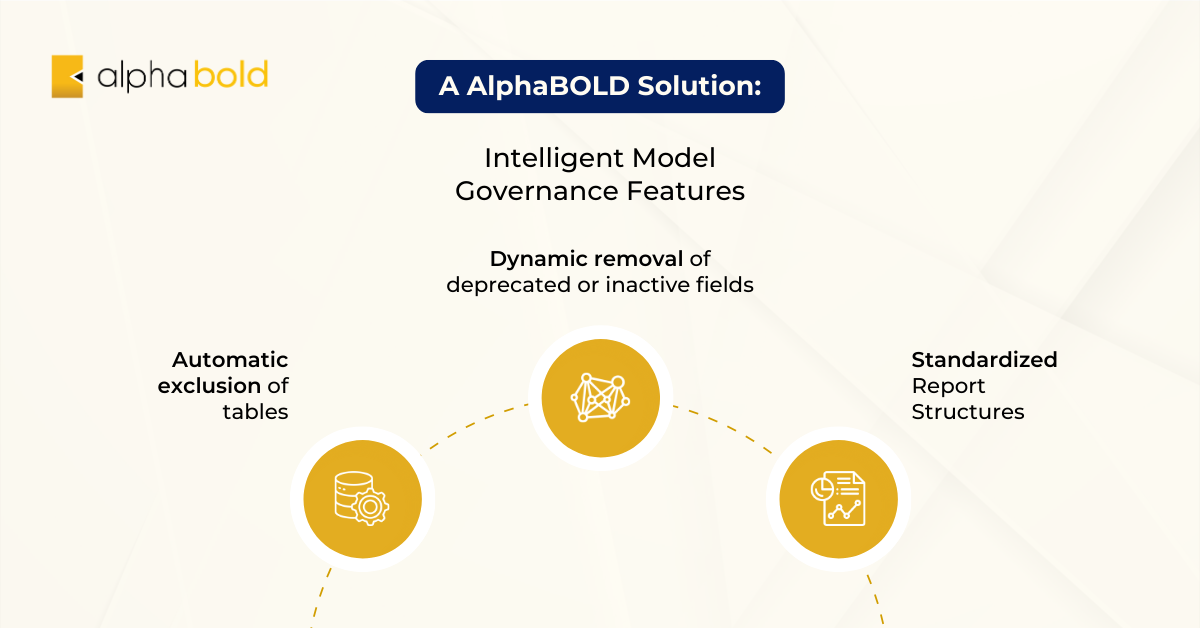
The solution also included intelligent model governance features:

  • Automatic exclusion of tables for modules not licensed by a customer
  • Dynamic removal of deprecated or inactive fields to keep semantic models clean
  • Standardized report structures to ensure consistency across customers

Together, these capabilities transformed analytics deployment from a manual process into a governed, repeatable pipeline.

B2GNow intelligent model governance features:

The Impact: Faster Refreshes, Scalable Onboarding, and Platform Readiness

The Fabric-centric architecture delivered measurable and operationally meaningful results.

  • Data processing time was reduced by nearly 70%, with SSIS-driven data migration workflows dropping from approximately seven hours to a fraction of that time through incremental loading
  • Operational overhead decreased, as automated deployments replaced manual report and model configuration
  • Customer onboarding scaled reliably, enabling B2GNow to support growth without increasing analytics support burden
  • Platform risk was reduced, with full alignment to Microsoft Fabric ensuring long-term compatibility and capacity governance

Most importantly, B2GNow gained a modern analytics foundation designed not just for reporting, but for sustained scale within Microsoft’s unified analytics ecosystem.

By shifting to a Fabric-first, automation-driven analytics architecture, AlphaBOLD helped B2GNow modernize its reporting platform, stabilize operations, and prepare confidently for Microsoft’s next-generation analytics landscape. The result is a scalable, governed analytics environment that supports growth without sacrificing reliability or control.

Explore Recent Case Studies