Microsoft Fabric for Construction and AEC: Building Project Intelligence Across ERP, Scheduling & Field Data

Table of Contents
Microsoft Fabric construction analytics helps AEC firms connect ERP, scheduling, field, and asset data within one governed analytics foundation. Instead of reviewing costs, schedules, field updates, and operational signals separately, teams can relate them through a shared project model and analyze project performance more consistently.
The value is not simply centralizing data. Construction firms also need aligned project IDs, cost codes, schedules, business definitions, and access controls so reporting remains trustworthy across systems. Fabric can support this through OneLake, semantic models, Power BI, and Real-Time Intelligence, depending on the workload.
For construction leaders, the result is better visibility into emerging cost, schedule, and operational risks, with a stronger data foundation for reporting, decision-making, and future AI use.
Introduction
Construction firms rarely lack project data. The harder problem is getting cost, schedule, field, and asset information to describe the same project simultaneously.
Microsoft Fabric construction analytics can provide AEC organizations with a governed data foundation to connect those signals across systems. But the value does not come from moving data to a single platform. It comes from creating a reliable project model that helps leaders see where cost, schedule, or operational risk is developing early enough to act.
For firms evaluating that architecture, AlphaBOLD’s Microsoft Fabric consulting services focus on the data, governance, and decisions the platform must support, rather than treating Fabric as just another reporting tool.
Who Needs a Unified Project Data Foundation?
Construction firms need a unified project data foundation when leadership spends more time reconciling systems than acting on project information.
An ERP may hold job costs, commitments, invoices, and contracts. Scheduling tools track activities, milestones, critical path, and float. Field systems capture daily progress, labor, inspections, equipment information, and site events.
Each system can be useful on its own. The problem is that they often organize the project differently.
This is where Microsoft Fabric construction analytics becomes useful. It does not replace the ERP, scheduler, or field platform. Instead, it can provide the data and analytics foundation needed to evaluate information across those systems together.
That matters across AEC environments where owners, general contractors, subcontractors, and field teams need different views of the same work. AlphaBOLD’s AEC practice works across connected sales, project, field, finance, and reporting processes through solutions including BUILDFitters.
Why Doesn't Connecting Systems Automatically Create a Single Source of Truth?
Integration alone does not create a single source of truth. Project intelligence depends on aligning the business meaning behind the data.
A project may have one identifier in finance, another structure in the scheduler, and different task or location references in field applications. Cost codes may not map cleanly to schedule activities. Change events may exist before they become approved financial transactions.
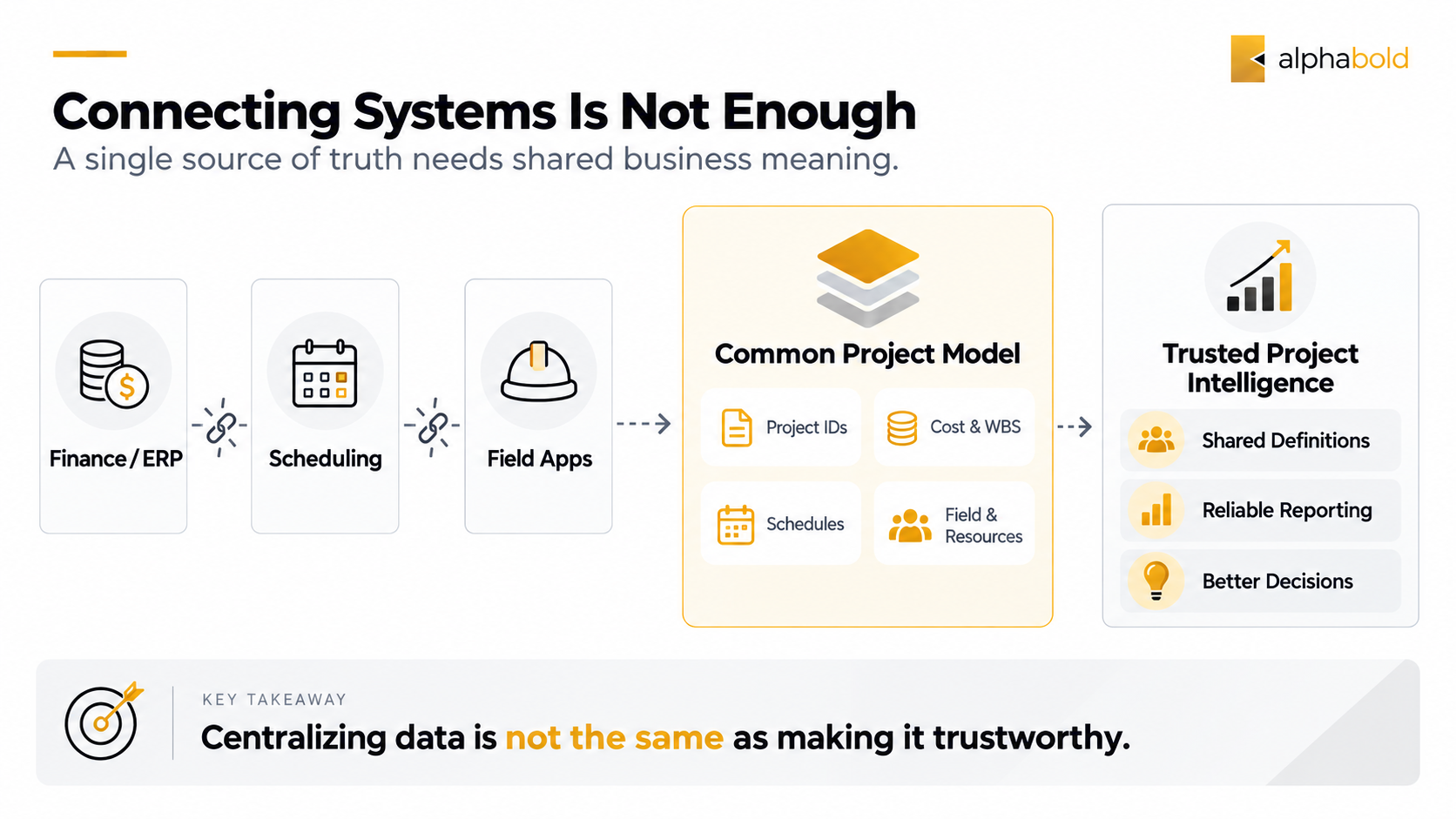
A useful Fabric architecture therefore needs a common project model that can relate dimensions such as:
- Project and contract IDs
- Cost codes and work breakdown structures
- Schedule activities and milestones
- Vendors and subcontractors
- Commitments, actuals, and forecasts
- Change orders and pending exposure
- Labor, equipment, and locations
This is the difference between centralizing data and making it trustworthy. AlphaBOLD explores the same issue in its work in the business context and shared definitions in Fabric.
How Can Microsoft Fabric Construction Analytics Surface Project Risk Earlier?
The goal of Microsoft Fabric construction analytics should not simply be a larger dashboard. It should be to connect signals that are incomplete when viewed in isolation.
A rising committed cost becomes more useful when leadership can compare it with physical progress. Float erosion matters more when it affects activities tied to high-value work. Increased equipment downtime becomes more actionable when the affected asset supports a critical project activity.
Depending on the source and latency required, Fabric can use pipelines, shortcuts, mirroring where supported, or Real-Time Intelligence patterns to ingest, virtualize, replicate, or stream project data for analysis. OneLake provides the shared data foundation across Fabric, while high-volume event and telemetry scenarios can use Eventhouse for real-time analytics.
Not every signal needs the same speed. General-ledger actuals may be appropriate for scheduled processing, while safety events, equipment telemetry, or operational exceptions may justify lower-latency monitoring.
The architecture should follow the decision, not a blanket goal of making everything “real time.”
Is Your Project Data Ready for Microsoft Fabric?
Connecting systems is only part of the work. AlphaBOLD can help you assess how project, cost, schedule, and field data should be structured, governed, and integrated before you commit to a broader Fabric architecture.
Request a ConsultationHow Should Microsoft Fabric Construction Analytics Be Architected?
A Microsoft Fabric construction analytics architecture should be designed around the decisions leaders need to make, not simply around consolidating as much data as possible.
Once project data has been reconciled and governed, Power BI can consume shared semantic models for portfolio, cost, schedule, and operational reporting. This separates two responsibilities: Fabric provides the broader data and analytics foundation, while Power BI remains the business-intelligence experience for analyzing and communicating performance.
For construction organizations already investing in Power BI, this distinction matters. Microsoft Fabric construction analytics can extend the architecture around Power BI by supporting broader data engineering, governance, real-time workloads, and shared project data without requiring teams to abandon the reporting experience they already use.
How Should Construction Firms Govern Shared Project Data?
Construction governance must define both access and ownership. People can participate in the same project without needing the same commercial, financial, or operational information.
Leadership may need cross-project margin visibility. Project managers may need detailed cost and schedule information. Field teams may require operational data without access to sensitive contractual or corporate financial information.
Fabric can support granular access to shared project information so teams can work from common data without automatically receiving access to every underlying financial or contractual field.
Governance also needs clear business ownership. Someone must define what “forecast cost,” “percent complete,” or “project at risk” means and determine which source and calculation are authoritative.
This matters particularly in Microsoft Fabric construction analytics because centralizing access to more data does not automatically make that data reliable. Without shared definitions and clear ownership, organizations can simply make conflicting versions of the same KPI more accessible.
Why Does This Matter Before Construction Companies Add AI?
AI cannot repair ambiguous project data simply by being applied to it. It inherits the definitions, relationships, quality, and security of the information it receives.
If one system defines project completion differently from another, or cost codes and schedule structures cannot be reconciled, an AI assistant or agent may produce a fluent answer from unreliable context.
This is a broader enterprise issue. Gartner reported in April 2026 that organizations reporting successful AI initiatives invest up to four times more as a percentage of revenue in foundational areas such as data quality, governance, AI-ready people, and change management than organizations experiencing poor AI outcomes.
For construction leaders, the practical lesson is straightforward: the AI roadmap should start with a trustworthy project context, not just an AI interface.
A governed semantic layer can help standardize the measures, relationships, and business logic that analytics and AI depend on. A well-designed Microsoft Fabric construction analytics environment can then give analytics and AI services access to governed project context rather than disconnected source data.
You may also like: How Agentic AI Can Reduce Administrative Work in Construction
Where Does AlphaBOLD Add Value?
The difficult part of a construction data program is rarely connecting one more source. It is deciding how systems, project definitions, security, reporting, and operational decisions should work together.
AlphaBOLD brings experience on both sides of that problem.
Its AEC work includes MechCo Group, where BUILDFitters addressed disconnected project oversight, labor tracking, scheduling, invoicing, and visibility across contractor operations. That engagement demonstrates construction-process experience; it should not be interpreted as a Fabric implementation.
Separately, AlphaBOLD is a Microsoft Fabric Featured Partner. Qualifications for the designation included Data & AI specialization, at least one verifiable customer deployment on Microsoft Fabric, and five or more professionals holding DP-600 or DP-700 Fabric certifications.
That combination matters because construction data architecture needs both platform expertise and an understanding of how AEC teams manage projects.
Build a Fabric Architecture Around the Decisions That Matter
AlphaBOLD combines Microsoft Fabric expertise with experience across AEC processes, analytics, and connected business systems to help construction organizations build a trusted data foundation for reporting, operational intelligence, and AI.
Request a ConsultationConclusion
The strongest case for Microsoft Fabric in construction is not that it puts more information on one screen. It can provide the governing foundation needed to understand cost, schedule, field, and asset information together.
For AEC firms, that requires more than integration. Project identifiers must align. Business definitions need owners. Access must reflect commercial reality. Reporting needs a trusted model, and lower-latency processing should only be used where faster information changes a decision.
When those foundations are in place, Microsoft Fabric construction analytics can give leadership a more connected view of project performance, emerging risk, and operational signals while creating a stronger foundation for future analytics and AI.
FAQs
Start with workloads rather than user count alone. Estimate ingestion, transformation, semantic-model processing, reporting, real-time analytics, and data-science activity, then test and monitor actual capacity consumption. Fabric capacity, storage, and any applicable Power BI per-user licensing should all be considered when estimating total cost. Capacity should therefore be based on workload patterns rather than company size alone.