
Business Impact through Workflow Automation in Dynamics 365 Field Service

Table of Contents
Introduction
Field service automation creates the most value when it connects the entire service lifecycle rather than automating isolated administrative tasks.
Dynamics 365 Field Service can coordinate service requests, work orders, scheduling, technician activity, customer communication, and downstream updates through a shared operational platform. Microsoft positions the application around workflow automation, scheduling, mobility, and Copilot-assisted field operations.
For executives, the objective is not simply to introduce more automation. It is to reduce the time and friction between identifying a service need and completing, documenting, and billing the work.
This guide explains which workflows to automate first, where scheduling and AI fit, and how to build a field service automation roadmap tied to measurable business outcomes.
What Is Dynamics 365 Field Service Automation?
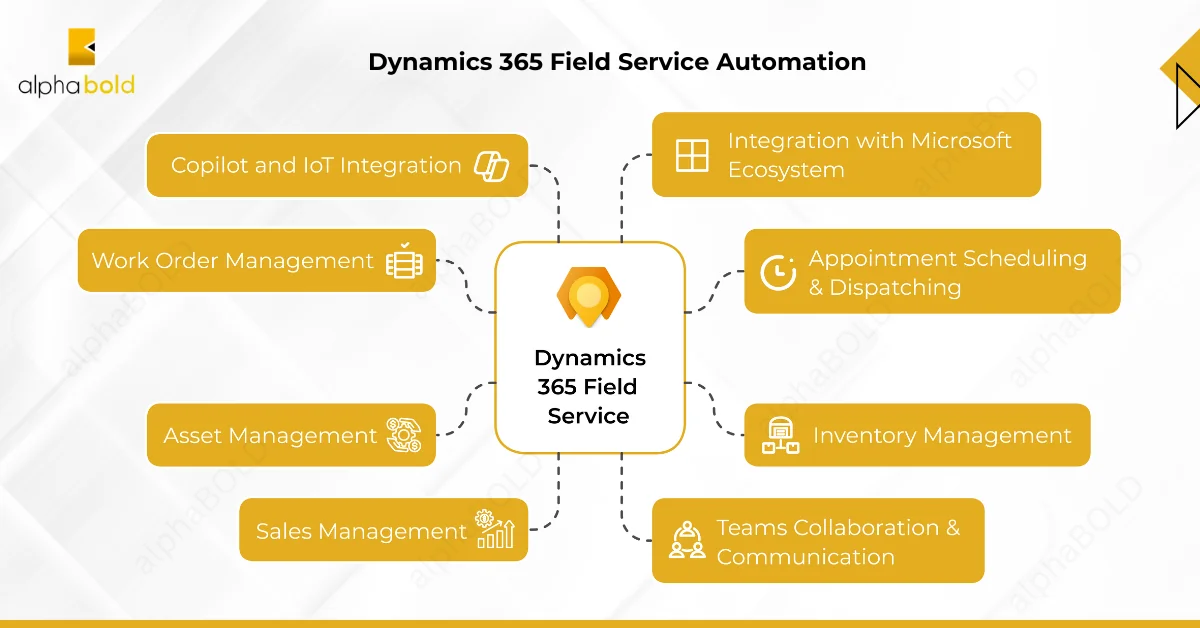
Dynamics 365 Field Service automation uses workflow rules, scheduling tools, mobile capabilities, Power Automate, and AI-assisted features to coordinate onsite service operations.
Depending on the process, organizations can use Dynamics 365 Field Service to:
- Create work orders from customer requests, maintenance schedules, cases, forms, or connected-system events
- Apply consistent priorities, service tasks, skills, and resource requirements
- Recommend or optimize technician bookings
- Give mobile workers access to customer, asset, and work order information
- Trigger notifications, approvals, surveys, and follow-up activities
- Exchange completed service information with inventory, finance, customer service, and analytics systems
The platform does not remove the need for dispatchers, technicians, or service managers. It reduces repetitive work and directs their attention toward scheduling exceptions, customer decisions, and service issues that require human judgment.
Which Field Service Workflows Should Executives Automate First?
The best starting point is usually a high-volume process with clear rules, consistent inputs, and a measurable outcome.
Automating an unclear or inconsistent process often makes the underlying problem harder to identify and control.
1. Service Request and Work Order Creation
Many service operations begin with information moving between phone calls, emails, spreadsheets, portals, and separate business applications. Employees then re-enter the same information to create a work order.
Dynamics 365 Field Service can generate work orders from sources such as:
- Customer service cases
- Preventive maintenance agreements
- Emails and phone requests
- Customer or employee forms
- Web portals
- Sales orders
- Asset or IoT data
A work order can include the service location, required tasks, parts, expected labor, asset information, and the characteristics a technician must possess.
The business objective is to create a complete and standardized work order without requiring an employee to interpret and rekey every request.
2. Work Order Classification and Routing
Creating a work order is only useful when its data is reliable enough to support the next decision.
Field service workflow automation can classify work by:
- Service type
- Urgency
- Customer or asset
- Location and territory
- Contractual entitlement
- Required technician skills
- Expected duration
- Required tools or parts
Consistent classification gives dispatchers better scheduling inputs and gives executives a clearer view of service demand.
It also reduces the risk of sending a technician without the required instructions, skills, equipment, or replacement parts because the original request lacked structure.
3. Scheduling and Dispatch
Scheduling automation should reflect the complexity of the operation. Dynamics 365 Field Service provides several approaches:
- Schedule board: Dispatchers directly manage bookings, assignments, and exceptions.
- Schedule Assistant: The system identifies resources that match criteria such as availability, skills, territory, location, and priority.
- Resource Scheduling Optimization: The platform schedules or reschedules multiple requirements using configured goals and constraints.
- Scheduling Operations Agent: Microsoft’s newer agent-assisted optimization capability, currently available in preview.
These options should not be treated as a simple maturity ladder. The right method depends on service volume, emergency demand, technician specialization, territory complexity, data quality, and the amount of human review the organization requires.
4. Technician Preparation and Mobile Execution
Field service process automation must extend beyond the dispatch office.
A well-designed mobile experience can provide technicians with:
- Assigned bookings
- Customer and asset history
- Service tasks
- Inspection requirements
- Safety instructions
- Parts information
- Previous service activity
Technicians can then record time, materials, notes, photos, inspection results, and completion details while working.
This reduces delayed back-office updates and gives managers a more current view of field activity. Microsoft’s 2026 Field Service roadmap has continued to invest in mobile controls, offline configuration, form performance, booking status controls, and mobile notes.
Automation should make the technician’s work easier. Excessive fields, unnecessary clicks, and processes that do not match real field conditions can weaken adoption regardless of the platform’s capabilities.
Further reading: Leveraging Mobile Capabilities in Dynamics 365 Field Service
5. Completion, Customer Follow-Up, and System Updates
Closing a work order should initiate the next actions rather than create another manual queue.
A completed work order can trigger workflows that:
- Update customer and asset records
- Record labor and parts consumption
- Create an invoice-ready transaction
- Notify the customer
- Send a satisfaction survey
- Create follow-up work
- Alert a manager when review is required
- Update operational reporting
This is where end-to-end field service automation creates executive value. Service, finance, inventory, and customer teams receive the information they need without waiting for separate handoffs.
Connect Your Field Service Workflows End to End
Build a Dynamics 365 Field Service process that connects work order completion with customer updates, inventory, finance, and reporting, without adding more manual handoffs.
Request a ConsultationHow Does Scheduling Automation Work in Dynamics 365 Field Service?
Scheduling automation uses resource, requirement, location, duration, availability, and booking data to identify workable technician schedules.
The quality of the resulting schedule depends heavily on the quality of those inputs.
Resource Scheduling Optimization remains appropriate for organizations that need to optimize a larger set of requirements according to configured objectives and constraints.
The Scheduling Operations Agent represents Microsoft’s newer agent-assisted approach. As of July 2026, it remains a preview capability. Microsoft states that preview features are not intended for production use and may have restricted functionality.
Interactive optimization allows a dispatcher to select technicians, review a suggested schedule, and apply it when satisfied. Current interactive optimization supports targeted adjustments for up to five technicians. Batch optimization supports larger, asynchronous optimization scenarios built around a defined scope, goal, and plan.
The executive takeaway is that AI cannot compensate for weak scheduling data.
Before introducing advanced optimization, organizations should standardize:
- Technician skills
- Service territories
- Booking statuses
- Estimated work durations
- Priorities
- Travel assumptions
- Working hours and breaks
- Rules governing which bookings can be moved
Where Do Copilot and Power Automate Fit?
Copilot and Power Automate support different parts of the field service automation model.
Copilot in Dynamics 365 Field Service
Copilot can help users:
- Ask natural-language questions about service data
- Generate work order summaries
- Create inspection templates from PDFs or images
- Receive suggestions when completing forms
- Use natural language to propose certain mobile work order updates
Some Copilot capabilities, including AI-assisted work order updates, may remain in preview. Organizations should confirm availability and governance requirements before including them in a production roadmap.
For a deeper review, read Using Copilot with Dynamics 365 Field Service.
Power Automate
Power Automate connects Field Service events with actions inside and outside Dynamics 365.
A flow could begin when a work order changes status and then:
- Update Dataverse
- Notify a service manager
- Route an approval
- Create a follow-up task
- Send a customer email
- Pass information to another connected application
Copilot in Power Automate can generate an initial cloud flow from a natural-language description, configure suggested triggers and actions, and help establish connections. The resulting automation should still be reviewed, tested, secured, and monitored before production use.
For example:
When a work order is completed, summarize the service notes, update the customer record, notify the service manager when follow-up is required, and send the customer a satisfaction survey.
This combines workflow automation with AI assistance without handing an uncontrolled business decision to the AI model.
Further reading: Power Automate vs. Dynamics 365 Workflow: Which Should You Use?
What Business Outcomes Should Field Service Automation Deliver?
Executives should evaluate field service automation against their own operational and financial baselines rather than relying on broad industry percentages.
Relevant measures include:
- Time from service request to work order creation
- Time from work order creation to confirmed booking
- Technician utilization
- Travel time per appointment
- Schedule adherence
- First-time fix rate
- Repeat visits
- SLA compliance
- Technician administrative time
- Cost per completed work order
- Customer satisfaction
- Time from job completion to invoice readiness
A strong business case identifies the current baseline, the process change expected from automation, and the metric that will confirm whether the change worked.
Results will vary according to process maturity, data quality, integration scope, scheduling complexity, and user adoption. Generic market benchmarks can support the analysis, but they should not replace an organization-specific baseline.
How Should Organizations Implement Field Service Workflow Automation?
1. Map the Current Service Lifecycle
Document how service requests enter the organization, who validates them, how work orders are created, how technicians are assigned, what happens onsite, and how completion information reaches finance and customer service.
Identify data re-entry, spreadsheets, email approvals, delayed updates, and decisions that rely on one experienced employee.
2. Standardize Operational Data
Define the data that automation and scheduling will use, including:
- Work order and incident types
- Booking statuses
- Service territories
- Technician skills
- Priorities
- Estimated durations
- Assets and locations
- Parts and tools
- Entitlements and service agreements
Advanced automation should follow this work, not precede it.
3. Automate Repeatable Steps First
Begin with workflows that have predictable conditions and limited exception paths.
Strong starting points include work order creation, preventive maintenance, customer confirmations, status notifications, approval routing, and completion follow-up.
4. Add Scheduling Optimization and AI Selectively
Once the underlying data and workflows are stable, identify where optimization, summarization, natural-language interaction, or agent-assisted scheduling can reduce meaningful operational effort.
Define which recommendations require approval and who owns an incorrect, incomplete, or failed result.
5. Integrate, Measure, and Improve
Connect Field Service with the applications involved in the service-to-cash process. Depending on the organization, these may include ERP, inventory, finance, customer service, portals, IoT platforms, Power BI, or Microsoft Fabric.
Monitor failed flows, incomplete records, scheduling exceptions, and integration delays after launch.
Build a Connected and Reliable Field Service Ecosystem
Integrate Dynamics 365 Field Service with your ERP, finance, inventory, analytics, and customer platforms while establishing the monitoring needed to keep workflows performing as expected.
Request a ConsultationWhat Does Field Service Automation Look Like in Practice?
AlphaBOLD worked with Air Control Systems, a commercial HVAC contractor, to modernize its Dynamics 365 Field Service environment.
The project focused on mobile usability, operational visibility, and workflow automation. Technicians gained a more practical way to enter time and service information through mobile devices. Power Automate workflows streamlined work order creation and invoice generation, while the updated platform supported more than 100 active field users.
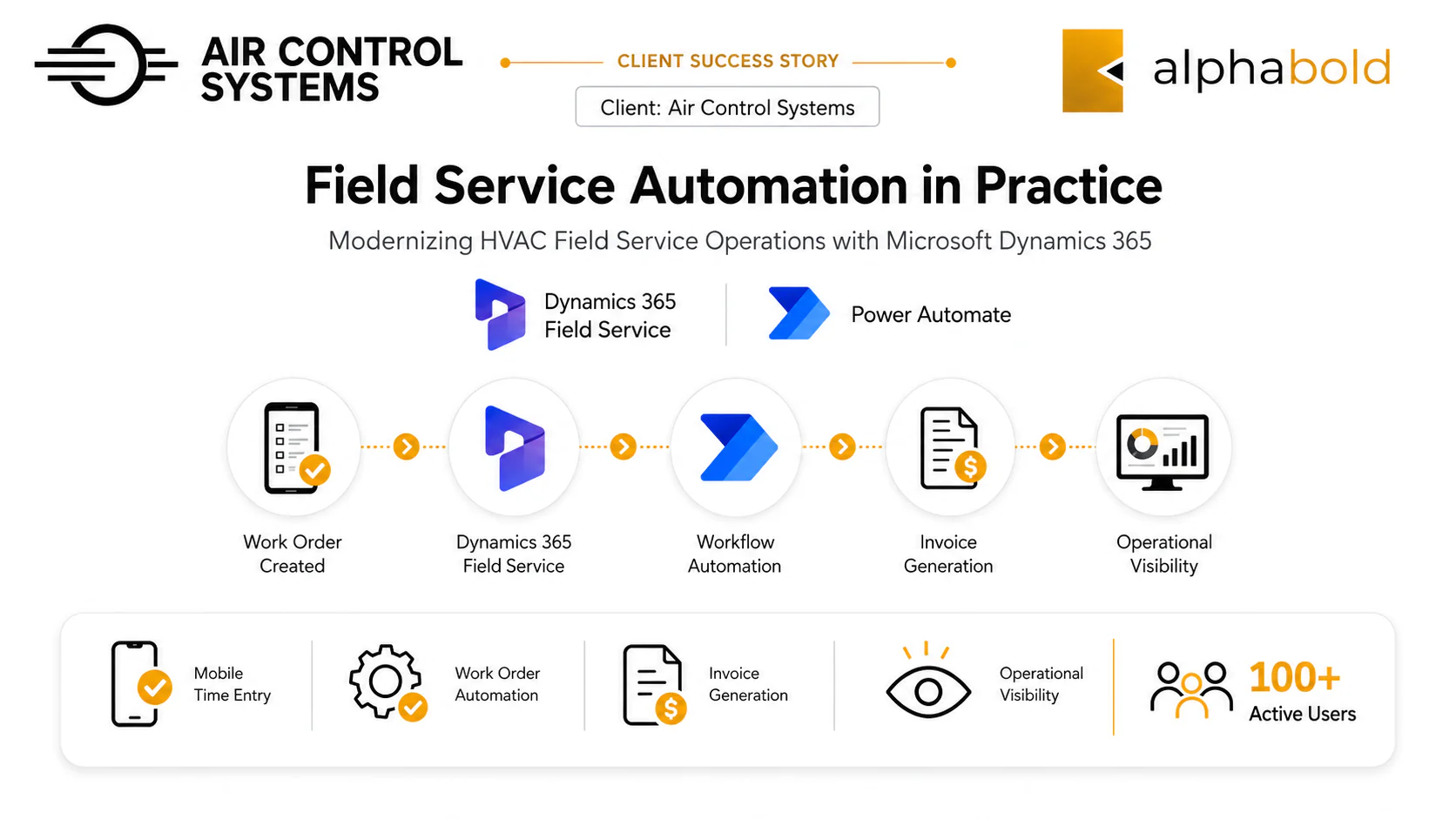
The complete ACS field service case study demonstrates an important principle: meaningful automation often comes from improving the connections between technicians, work orders, and back-office processes rather than introducing one headline feature.
What Should Executives Assess Before Moving Forward?
Before approving an automation roadmap, leaders should ask:
- Are service processes consistent across teams and locations?
- Is customer, asset, resource, and work order data reliable?
- Which decisions can follow rules, and which require human approval?
- Are technician skills, territories, and scheduling constraints documented?
- Which applications must exchange information for the workflow to be complete?
- Who owns failed flows, exceptions, and AI-generated recommendations?
- Which capabilities are generally available, and which remain in preview?
- How will adoption and business performance be measured?
The solution architecture should also avoid dependencies on retired dedicated Field Service integrations. Microsoft ended support for the Field Service Outlook add-in, Teams app, Viva Connections integration, and Planner integration after October 30, 2025.
Conclusion
Dynamics 365 Field Service automation delivers the greatest value when it connects service intake, work order management, scheduling, technician execution, customer communication, and downstream systems.
Executives should begin with repeatable workflows, establish reliable operational data, and introduce advanced scheduling or AI where it supports a defined business outcome.
The goal is a field service process that moves faster, produces better information, and remains controllable as the organization grows.
FAQs
Yes. Dynamics 365 Field Service can automate or coordinate work order creation, classification, scheduling, preventive maintenance, technician updates, notifications, approvals, follow-up work, and downstream system updates. The appropriate scope depends on process design, data readiness, licensing, and integration requirements.
Yes. Schedule Assistant can recommend suitable resources, while Resource Scheduling Optimization can optimize multiple requirements according to configured goals and constraints. Microsoft is also developing the preview Scheduling Operations Agent for agent-assisted optimization scenarios.
Start with frequent, repeatable workflows that have clear inputs and measurable outcomes. Work order creation, preventive maintenance, status notifications, approvals, customer confirmations, and completion follow-up are often stronger starting points than complex AI-led scheduling.
No. Organizations can automate substantial parts of field service through Dynamics 365 configuration and Power Automate without AI. Copilot and agent capabilities add summarization, natural-language interaction, and assisted optimization where they provide clear operational value.
Explore Recent Blog Posts