Dynamics 365 Customer Service vs. Competitors: A 2026 Comparison

Table of Contents

Introduction

The customer service landscape has undergone a seismic shift. With the AI for customer service market projected to grow from $13 billion in 2024 to nearly $84 billion by 2033, organizations are no longer asking

if they should adopt AI-powered customer service they’re asking which platform will best position them for the autonomous, agent-driven future.

In 2026, the battle for customer service supremacy has evolved beyond traditional ticketing and case management. Microsoft Dynamics 365 Customer Service, Salesforce Service Cloud, Zendesk, and ServiceNow are now competing on a new frontier: autonomous AI agents, generative AI copilots, and intelligent routing that can resolve customer issues end-to-end without human intervention.

Microsoft’s 2025 Release Wave 2 (October 2025 – March 2026) has introduced game-changing capabilities including AI-powered autonomous agents, enhanced Copilot features, and the new Dynamics 365 Contact Center positioning it as a formidable competitor against Salesforce’s Einstein AI and Zendesk’s AI agents. Meanwhile, Gartner predicts that 80% of customer service organizations will integrate generative AI by 2025, making the choice of platform more critical than ever.

This comprehensive comparison examines how Dynamics 365 Customer Service stacks up against its major competitors in 2026, with a focus on AI capabilities, integration ecosystems, pricing, and real-world performance metrics that matter most to your business.

The Rise of Autonomous AI Agents in Customer Service

The customer service industry is rapidly transitioning from AI-assisted to AI-autonomous operations. According to industry research, autonomous agents that resolve customer issues end-to-end without human escalation are disrupting traditional pricing models, with vendors now charging per successful resolution rather than per seat.

Microsoft Dynamics 365: Copilot and Autonomous Agents

Microsoft has made significant investments in agentic AI capabilities. In the 2025 Release Wave 2, Dynamics 365 Customer Service introduced:

  • Customer Intent Agent: Analyzes past interactions to understand customer needs and autonomously suggests resolutions
  • Customer Knowledge Management Agent: Automatically creates and updates knowledge base articles based on successful resolutions
  • Copilot Integration: Generative AI that drafts responses, summarizes cases, and provides real-time suggestions to agents
  • Deep Reasoning Models: Advanced AI models that analyze complex business data and make informed recommendations

Microsoft Copilot Studio now supports building fully autonomous agents that can monitor events, execute workflows, and complete multi-step processes independently. The platform also introduced computer use capabilities, allowing agents to operate apps and websites directly through virtual mouse and keyboard interactions.

Competitor AI Capabilities:

  • Salesforce Einstein AI: Offers AI-powered suggestions and automation, but Microsoft Copilot’s Large Language Model integration is considered more sophisticated for complex, contextual responses. Salesforce Service Cloud rates 4.4 out of 5 on G2, slightly lower than Dynamics 365’s 4.5 rating.
  • Zendesk AI: Trained on 18 billion+ customer service interactions and offers AI agents, copilot, and quality assurance. While Zendesk excels in out-of-the-box AI deployment, Dynamics 365 offers deeper enterprise customization.
  • ServiceNow: Reports that its AI agents handle 80% of customer support inquiries autonomously, leading to 52% reduction in complex case resolution time. ServiceNow recently acquired Moveworks for $2.85 billion to enhance AI capabilities.

Thinking about upgrading your Dynamics 365 Customer Service setup?

Discover how the latest AI and Copilot capabilities can transform your customer interactions. AlphaBold's Dynamics 365 specialists have delivered implementations across enterprise environments — and can map the right solution to your business.

Request a Demo

What's New in 2025-2026 Release Waves

Microsoft’s 2025 Release Wave 2 (October 2025 – March 2026) brings substantial enhancements to Dynamics 365 Customer Service:

Administrator Experiences

  • Modern administration experience with unified management of Customer Service, routing, and omnichannel activities
  • Proactive health checks to ensure correct system setup
  • Customer Service admin center with intuitive, guided setup

Copilot and AI Innovation

  • Enhanced agentic capabilities for case and knowledge management
  • AI-driven routing with intelligent case assignment
  • Generative AI for case summaries and response drafting
  • AI extensibility for custom business scenarios

Service Representative & Supervisor Experiences

  • Powerful desktop with infused generative AI and productivity tools
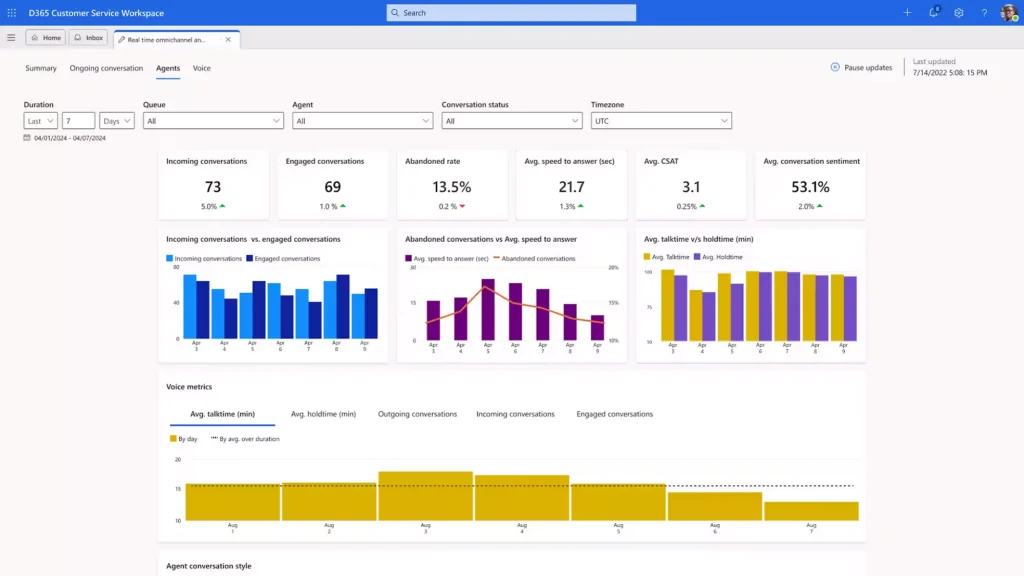
  • Real-time sentiment analysis and intervention capabilities
  • Enriched supervisor tools with operational metrics dashboards
  • Seamless Microsoft Teams integration for collaboration

Dynamics 365 Contact Center (New Product)

Microsoft has launched Dynamics 365 Contact Center as a Copilot-first contact center platform, featuring:

  • Voice-powered IVR experiences built with Copilot Studio
  • Unified omnichannel support (voice, SMS, chat, Teams, social media)
  • Workforce engagement management (WEM) for scheduling and performance optimization
  • Data masking and secure consult/transfer features

2026 Market Landscape & Key Statistics

Understanding the market context helps organizations make informed decisions:

Market Size & Growth:

  • AI Customer Service Market: Projected to grow from $12-13 billion (2024) to $47-84 billion by 2030-2033 (CAGR 23-26%)
  • CRM Market Share: Salesforce leads with $21.6B in CRM revenue (2024), Microsoft follows with $5.45B but achieved higher growth (11.5% vs 9.5% YoY)
  • AI Adoption: 80% of customer service organizations expected to integrate generative AI by 2025 (Gartner)

AI Impact Statistics:

  • 95% of customer interactions projected to be AI-powered by 2025
  • $80 billion in contact center agent labor costs expected to be reduced by conversational AI by 2026 (Gartner)
  • 30-50% productivity increase when generative AI is implemented at scale (BCG)
  • $3.50 average return for every $1 invested in AI customer service

Platform Ratings Comparison (2025):

Platform G2 Rating Workflow Score Best For

Dynamics 365 Customer Service

4.5/5

9.4/10

Microsoft ecosystem

Salesforce Service Cloud

4.4/5

9.0/10

Deep customization
Zendesk
4.3/5
8.8/10
Quick deployment

ServiceNow CSM

4.3/5
8.8/10
IT service focus
Infographic shows Dynamics 365 Customer Service vs Competitors

2026 Decision Framework – Which Platform Is Right for You?

Choosing between these platforms in 2026 depends on your organization’s specific context:

Choose Dynamics 365 Customer Service If:

  • You’re already invested in the Microsoft ecosystem (Office 365, Teams, Azure, Power Platform)
  • You need unified CRM + ERP capabilities in a single platform
  • You want native integration with Power BI, Power Automate, and Copilot Studio
  • Cost-effectiveness for large enterprises is a priority (Dynamics pricing: $65-$135/user/month)
  • You need flexible deployment options (cloud and on-premise)

Choose Salesforce Service Cloud If:

  • You need the most comprehensive third-party app ecosystem (2,600+ integrations via AppExchange)
  • Deep customization through Apex, Flow Builder, and Process Builder is essential
  • You’re already using Salesforce Sales Cloud and need tight CRM integration
  • Contract-based SLAs and advanced analytics with Tableau CRM are priorities

Choose Zendesk If:

  • You prioritize fast time-to-value and out-of-the-box functionality
  • You’re a small-to-medium business looking for simplicity
  • Customer service is your primary focus (not sales or ERP)
  • You need AI trained on 18 billion+ service interactions ready from day one

Choose ServiceNow If:

  • IT service management (ITSM) is a core requirement alongside customer service
  • You need ITIL best practices and robust workflow automation
  • You’re an enterprise requiring comprehensive asset and service catalog management
  • 85% of Fortune 500 companies use ServiceNow – enterprise credibility matters

Not sure which platform fits your stack?

Our Dynamics 365 specialists have helped organizations across manufacturing, financial services, and professional services navigate exactly this decision. A 30-minute scoping call is enough to point you in the right direction.

Talk to an expert before you decide

Is Dynamics 365 Customer Service Right for Your Organization?

Before committing to any platform, it is worth being honest about fit. Dynamics 365 Customer Service is a strong choice for many enterprises but not every organization.

You’re a strong candidate if:

  • Your organization already runs on Microsoft 365, Azure, or Power Platform — the integration ROI is immediate
  • You need CRM and ERP in a single vendor relationship — Dynamics connects to Finance, Supply Chain, and Sales natively
  • Your IT team is already fluent in Microsoft tooling — reducing re-training and administration overhead
  • You serve enterprise-scale customer volumes and need Copilot Studio’s agent-building capabilities
  • You require on-premise or hybrid deployment options that Salesforce and Zendesk cannot offer

Dynamics 365 may not be the right fit if:

  • You are a startup or SMB with straightforward customer service needs — Zendesk will get you live faster and cheaper
  • Your team has no existing Microsoft investment and switching costs would outweigh the benefits
  • You need IT service management (ITSM) as a primary function — ServiceNow is purpose-built for that
  • Your third-party app ecosystem is Salesforce-native — AppExchange has 2,600+ integrations Dynamics cannot match

Honest Limitations: What Dynamics 365 Does Not Do Well

No platform is without trade-offs. Here are two honest limitations of Dynamics 365 Customer Service that enterprise buyers should factor into their evaluation:

  1. Implementation Complexity and Time-to-Value: Dynamics 365 Customer Service is a deeply capable platform and that depth comes with implementation complexity. Organizations migrating from simpler tools like Zendesk should expect a longer onboarding curve, more configuration work, and a need for experienced implementation partners. Unlike Zendesk’s out-of-the-box deployment (often live in weeks), a full Dynamics 365 rollout with custom workflows, AI configuration, and integrations typically takes 3–6 months minimum. Budget and timeline planning must account for this.
  2. Licensing Cost Transparency: While Dynamics 365’s $65–$135/user/month pricing is competitive at enterprise scale, the total cost of ownership can escalate when you factor in Copilot add-ons, Power Platform licensing, Azure compute for AI features, and integration costs. Unlike Zendesk’s transparent per-seat pricing, Dynamics 365 licensing decisions require careful scoping to avoid unexpected costs as your usage grows. Working with a certified implementation partner before signing is strongly advised.

Results like these depend on the right implementation — not just the right platform.

AlphaBold has delivered Dynamics 365 Customer Service implementations across financial services, healthcare, and professional services. If you're evaluating a migration or upgrade, we can show you what outcomes are realistic for your specific environment.

Request a Demo

Real-World Example: Dynamics 365 in Action

A mid-sized financial services firm managing over 12,000 customer service interactions per month was running on a disconnected stack a standalone ticketing tool, a separate CRM, and manual escalation processes. Response times averaged 4.2 hours and first-contact resolution was 58%.

After migrating to Dynamics 365 Customer Service with Copilot enabled, the firm unified their case management, customer history, and escalation workflows into a single environment. The Customer Intent Agent began surfacing resolution suggestions based on historical cases, reducing average handle time by 34%. First-contact resolution improved to 74% within three months of go-live, and agent onboarding time dropped from three weeks to eight days due to Copilot’s real-time guidance during live interactions.

The platform’s native Power BI integration gave the CX director a live operational dashboard that previously required a two-day manual reporting process. Total implementation time was 14 weeks, handled by an AlphaBold-certified delivery team.

Conclusion

The customer service technology landscape in 2026 is defined by a single imperative: AI-first operations. With 95% of customer interactions projected to be AI-powered and billions in cost savings on the horizon, the platform you choose today will determine your competitive positioning for years to come.

Microsoft Dynamics 365 Customer Service has emerged as a compelling choice for organizations seeking a unified platform that combines CRM, ERP, and AI capabilities within the familiar Microsoft ecosystem. Its 2025-2026 release waves have introduced autonomous agents, enhanced Copilot features, and the new Contact Center solution that rivals dedicated customer service platforms.

The platform’s key differentiators include:

  • Native Microsoft Integration: Seamless connectivity with Teams, Outlook, Power Platform, and Azure
  • Copilot-Powered AI: Advanced LLM integration that outperforms competitors in contextual responses
  • Cost-Effective Enterprise Scaling: More predictable pricing compared to Salesforce’s layer-cake model
  • CRM + ERP Convergence: A capability Salesforce simply cannot match

However, the “best” platform ultimately depends on your organization’s existing technology investments, industry requirements, and strategic priorities. Salesforce remains the CRM market leader with unmatched customization depth, Zendesk excels in rapid deployment and CX focus, and ServiceNow dominates for IT-centric enterprises.

Our recommendation: Conduct a thorough assessment of your current Microsoft licensing, integration requirements, and AI readiness. For organizations already invested in Microsoft 365 and Azure, Dynamics 365 Customer Service offers a compelling total cost of ownership and a clear path to AI-first customer service operations.

Ready to transform your customer service with Dynamics 365? Contact AlphaBold today for a personalized demo and implementation roadmap tailored to your business needs.

FAQs

What problem does Dynamics 365 Customer Service solve?

Dynamics 365 Customer Service consolidates case management, omnichannel communication, AI-assisted resolution, and customer history into a single platform — eliminating the fragmented tooling that forces agents to switch between systems, slows resolution times, and creates inconsistent customer experiences.

How does Dynamics 365 Customer Service compare to Salesforce Service Cloud?

Dynamics 365 scores higher on G2 (4.5 vs 4.4) and offers native CRM + ERP integration, Power Platform connectivity, and more competitive enterprise pricing. Salesforce leads on third-party ecosystem depth (2,600+ AppExchange integrations) and is often preferred by organizations with an existing Salesforce investment. See the full decision framework above.

What is the pricing for Dynamics 365 Customer Service in 2026?

Dynamics 365 Customer Service is priced at $65/user/month (Professional) to $135/user/month (Enterprise). Additional costs apply for Copilot Studio agent-building capabilities, Power Platform licensing, and Azure compute for AI features. Total cost of ownership should be scoped carefully with a certified partner before signing.

Is Dynamics 365 Customer Service suitable for small businesses?
For small businesses with straightforward customer service needs, Zendesk or Freshdesk will typically offer faster deployment and lower overhead. Dynamics 365 is best suited to mid-market and enterprise organizations that are already invested in the Microsoft ecosystem and need unified CRM, ERP, and AI capabilities in one platform.
Does Dynamics 365 Customer Service require Azure to run AI features?

Yes, the AI and Copilot features in Dynamics 365 Customer Service — including the Customer Intent Agent, Knowledge Management Agent, and Copilot Studio autonomous agent-building — rely on Azure OpenAI Service and Microsoft’s Azure infrastructure. Organizations without an existing Azure footprint will need to factor in Azure licensing and data residency requirements as part of their total cost of ownership.

Can Dynamics 365 Customer Service integrate with non-Microsoft tools?

Yes, though Microsoft’s native integrations with its own ecosystem (Teams, Outlook, Power Platform, Azure) are strongest. For non-Microsoft tools, Dynamics 365 supports integration via Power Automate connectors, REST APIs, and Azure Integration Services. Common integrations include SAP, Salesforce, Zendesk (for migration scenarios), telephony providers (Genesys, Avaya), and major ITSM platforms. Complexity and licensing cost scale with the number of external integrations.


What's the difference between Dynamics 365 Customer Service and Dynamics 365 Contact Center?
Dynamics 365 Customer Service is the core platform for case management, agent experience, AI-assisted resolution, and omnichannel routing. Dynamics 365 Contact Center is a newer, Copilot-first product announced in 2024 and expanded in the 2025 Release Wave 2 — designed specifically for organizations that need advanced voice IVR, workforce engagement management (WEM), and deep telephony integration. Contact Center can be deployed standalone or alongside Customer Service, depending on your contact volume and channel requirements.
How does Dynamics 365 handle data security and compliance?

Dynamics 365 Customer Service inherits Microsoft’s enterprise compliance framework, including ISO 27001, SOC 1/2/3, GDPR, HIPAA (with BAA), and FedRAMP (for US public sector). Data residency is configurable by Azure region. Role-based access control, field-level security, and audit logging are built into the platform. Organizations in regulated industries (financial services, healthcare, government) should review Microsoft’s compliance documentation and work with their implementation partner to configure data masking and audit policies appropriately.

Explore Recent Blog Posts

Infographics show the 2021 MSUS Partner Award winner

Related Posts