Microsoft Purview to OneLake Migration: What Can You Keep, and What Must Change?

Table of Contents
What Does Microsoft Purview Data Governance Retirement Mean for Existing Customers?
Microsoft announced the retirement of Purview Data Governance on November 12, 2026, shifting its governance strategy toward Microsoft Fabric and the OneLake catalog. Existing customers must determine how to preserve their governance investments while maintaining data discovery, ownership, and operational continuity.
The retirement affects:
- Microsoft Purview Unified Catalog: Business-focused data discovery and governance capabilities.
- Microsoft Purview Data Map: Metadata scanning and technical asset discovery.
- Purview Workflows: Governance approvals and management processes.
- Classic Azure Purview governance solutions: Legacy catalog and governance functionality.
Existing services are in maintenance mode, with support ending November 12, 2027. New Purview Data Governance accounts can no longer be created.
Microsoft Purview security and compliance capabilities are not being retired. Supported information protection, data loss prevention, auditing, and compliance services remain available.
For existing customers, the priority is identifying which processes depend on retiring capabilities and what must change before the deadline.
What Happens to Your Existing Purview Catalog, Glossaries, and Workflows?
A Purview to OneLake migration should begin with an inventory of governance assets, not an assumption that every object can be transferred. Organizations may have spent years developing business definitions, metadata relationships, ownership structures, and approval processes. The objective should be preserving those governance outcomes rather than reproducing every configuration.
| Existing Purview asset | What businesses should evaluate |
|---|---|
|
Metadata catalog |
Which assets can be discovered in OneLake, and which require another approach? |
|
Business glossaries |
How will definitions, relationships, and ownership information be preserved? |
|
Data lineage |
Which source-to-report relationships remain traceable? |
|
Governance domains |
How will organizational structures and responsibilities map to Fabric? |
|
Data products |
How will ownership, certification, and lifecycle requirements be maintained? |
|
Governance workflows |
Which approval and stewardship processes require redesign? |
Governance migration does not necessarily require physically moving underlying business data into OneLake. Purview Data Map and Unified Catalog primarily manage metadata and governance information. Whether data movement is necessary depends on the target architecture, existing systems, and supported connectivity.
For example, an organization using Purview to document financial reporting definitions and approval workflows may need to redesign those processes even if its data remains in existing systems.
The distinction is between preserving metadata, maintaining governance processes, and moving actual data. Each requires separate assessment.
Can OneLake Catalog Replace Your Current Purview Governance Capabilities?
OneLake catalog supports governance within Microsoft Fabric, but it is not a one-to-one replacement for every Purview Data Governance capability. Its suitability depends on existing governance requirements, data architecture, external integrations, and operational responsibilities.
The following comparison reflects important considerations as of November 2026.
| Governance requirement | OneLake catalog considerations |
|---|---|
|
Unified Customer |
Supports Fabric asset discovery; external coverage depends on supported integration methods. |
|
Business glossaries |
Tags, descriptions, and endorsements provide context but do not reproduce full glossary functionality. |
|
Data lineage |
Supports lineage for compatible Fabric workloads; broader cross-platform lineage may require additional solutions. |
|
Governance domains |
Domains and subdomains support organizational grouping but do not reproduce every Purview governance-domain capability. |
|
Data quality |
Governance insights support oversight but are not a replacement for comprehensive rule-based data quality management. |
|
Access governance |
Fabric provides workspace, item, and OneLake security controls, while connected sources may retain their own permissions. Access must be validated across relevant workloads. |
|
External data governance |
Shortcuts, mirroring, and connectors support integration, but connectivity does not equal comprehensive metadata governance. |
Some Fabric governance capabilities, including Fabric Policies, remain in preview or have scope and regional limitations. Organizations should confirm current availability before incorporating them into production migration plans.
OneLake can support governance scenarios involving external data through supported integration methods. However, connecting an external source does not automatically reproduce the metadata scanning, lineage, business context, or workflows previously maintained in Purview.
Organizations should validate these differences against their most important governance scenarios, including access restrictions, approval requirements, and lineage coverage.
Unsure What Your Purview Environment Can Retain?
Identify which governance assets, integrations, and workflows can be preserved and where additional configuration or redesign may be required before selecting a replacement architecture.
Request a ConsultationShould You Move to OneLake or Consider Another Governance Platform?
OneLake may be suitable for organizations already using Microsoft Fabric extensively. However, businesses operating across multiple cloud platforms, data warehouses, and enterprise applications should evaluate whether Fabric-native governance meets their broader requirements.
The decision should reflect where critical data resides and which governance capabilities must remain available.
OneLake may be appropriate when:
- Microsoft Fabric is central to the analytics architecture.
- Governance requirements primarily involve supported Fabric assets.
- Existing teams can manage governance through Fabric administration and security controls.
An independent or complementary governance platform may be worth evaluating when:
- Critical data assets span multiple technology platforms.
- Extensive business glossaries or specialized stewardship workflows are necessary.
- Cross-platform lineage and metadata management are business-critical.
The retirement also raises a broader platform-selection question, explored in Gartner’s November 2026 analysis, Purview Data Governance Is Ending. Is It Time to Look Beyond Microsoft?.
Rather than automatically adopting another Microsoft solution, organizations should select an architecture that preserves required governance capabilities and supports long-term business needs.
You may also like: Microsoft Fabric for Data Analytics
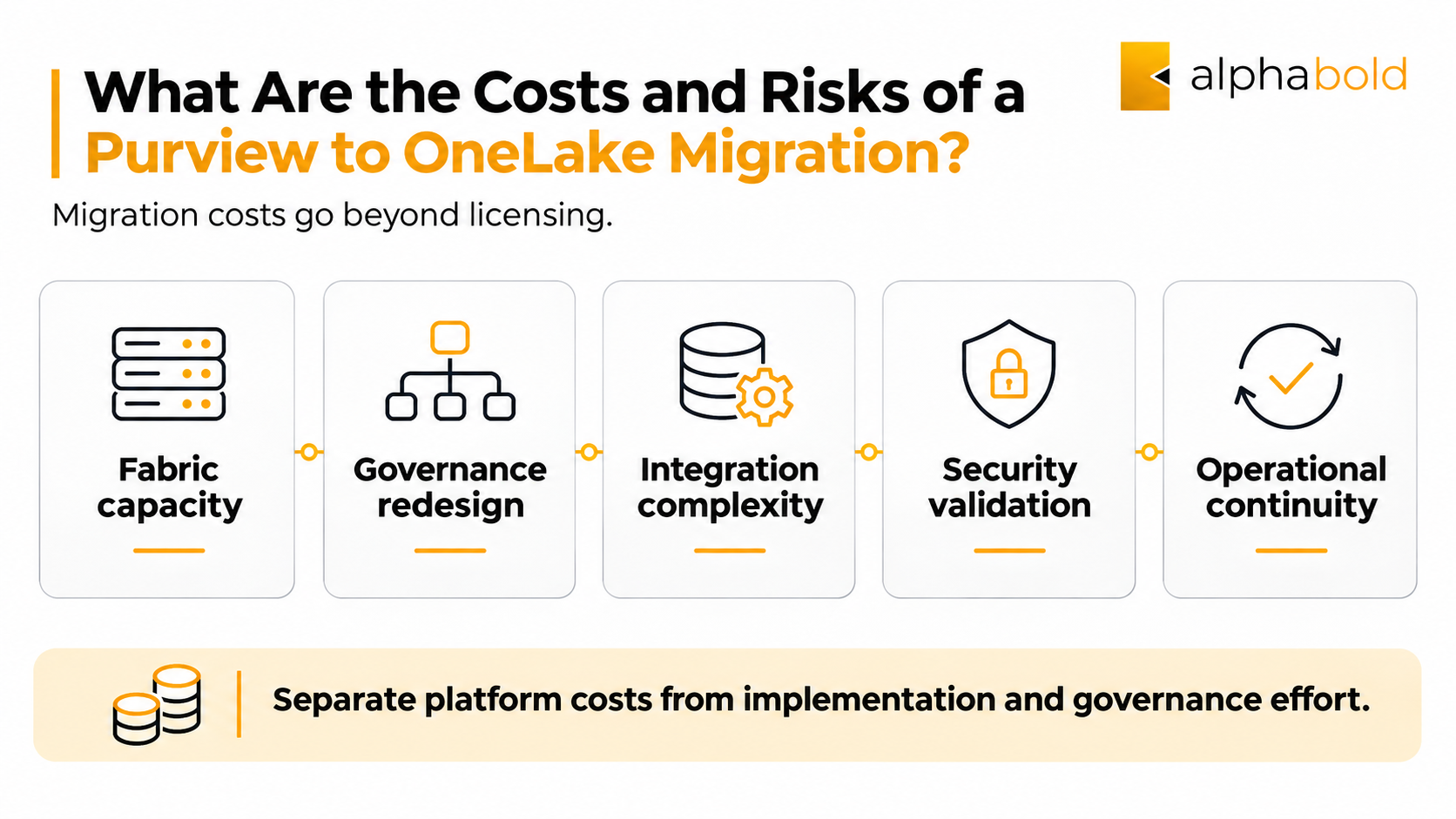
What Are the Costs and Risks of a Purview to OneLake Migration?
Purview to OneLake migration costs extend beyond platform licensing. Organizations must account for governance assessments, process redesign, integration validation, permissions, and operational readiness. The total investment depends on the complexity of the existing environment and the capabilities required in the target architecture.
Important cost considerations include:
- Fabric capacity: Evaluate capacity requirements, workloads, and related services.
- Governance redesign: Estimate the effort to preserve business definitions, ownership structures, and workflows.
- Integration complexity: Review external sources, existing scans, APIs, and metadata dependencies.
- Security validation: Test permissions, sensitivity labels, auditing, and applicable compliance controls.
- Operational continuity: Account for parallel operation, testing, training, and decommissioning.
Core OneLake catalog governance capabilities are included with Microsoft Fabric capacity. Additional licensing may apply to Microsoft Purview security and compliance features, other services, or third-party governance products.
A realistic budget should distinguish platform expenses from implementation effort, validation, and ongoing governance operations.
You may also like: Microsoft Fabric Pricing and Licensing: Complete Cost Guide 2027
How Should You Prepare for a Purview to OneLake Migration Before 2027?
Organizations should use the November 2027 deadline to initiate structured discovery rather than rush into a replacement. A phased assessment helps identify dependencies, validate target capabilities, and establish acceptance criteria before retiring existing governance processes.
A practical migration-readiness checklist includes:
- Inventory existing assets: Document registered sources, metadata, glossary terms, ownership assignments, workflows, integrations, and policies.
- Prioritize governance requirements: Identify capabilities essential for business continuity, regulatory obligations, and operational reporting.
- Assess feature gaps: Compare required outcomes with currently supported Fabric capabilities and identify unsupported dependencies.
- Design the target architecture: Determine where OneLake, Purview security and compliance, existing systems, or complementary tools will operate.
- Pilot a critical use case: Validate metadata discovery, lineage, permissions, governance responsibilities, and security controls.
- Plan a phased transition: Establish migration milestones, accountable owners, acceptance criteria, and decommissioning requirements.
Organizations operating in highly regulated environments or with contractual governance obligations should engage their Microsoft account teams early to assess additional transition considerations.
Businesses with complex data engineering and advanced analytics environments should also assess existing pipelines, external systems, and reporting dependencies.
The transition should only be considered complete when critical governance processes work reliably in the target environment, not simply when a new catalog becomes available.
You may also like: How Can Microsoft Fabric Simplify Your Data Integration with OneLake?
How Can AlphaBOLD Help Assess Your Microsoft Fabric Migration Readiness?
AlphaBOLD helps organizations evaluate and implement modern data architectures using Microsoft Fabric, data engineering, and enterprise integration technologies. As a Microsoft Fabric Featured Partner, AlphaBOLD brings relevant platform experience to organizations evaluating their existing environments and modernization requirements.
Through our Microsoft Fabric consulting services, we can support relevant aspects of transition planning, including:
- Current-state assessment: Review data architecture, integrations, and governance dependencies.
- Architecture evaluation: Assess Fabric readiness and target-platform requirements.
- Data integration planning: Evaluate connections between existing systems and Microsoft Fabric.
- Implementation and validation: Support platform configuration, technical testing, and migration planning.
- Operational readiness: Help establish scalable data architectures aligned with business requirements.

AlphaBOLD’s Microsoft Fabric experience includes enterprise data integration, scalable pipelines, and analytics modernization.
For example, AlphaBOLD helped a U.S.-based energy drink manufacturer build a Fabric-based data engineering solution capable of processing approximately 10 million records in under 20 minutes.
This demonstrates relevant data engineering experience. Specific Purview governance migration requirements, however, should be evaluated separately for each organization.
Plan Your Next Steps Before the 2027 Deadline
Understand your existing governance dependencies, assess Microsoft Fabric readiness, and identify potential transition risks before committing to another technology investment.
Request a ConsultationConclusion
Microsoft Purview Data Governance’s retirement makes transition planning necessary, but it does not mean every organization must rebuild its governance environment entirely within OneLake.
The right approach begins with understanding which metadata, business definitions, controls, and governance processes must survive. Organizations can then evaluate OneLake’s current capabilities, identify gaps, and select a transition strategy that protects existing investments.
Starting early provides time to validate options before support ends in November 2027.
FAQs
Decision-makers should request documented feature-gap assessments, metadata preservation results, validated lineage, tested access controls, and clearly defined acceptance criteria. Critical governance workflows should be demonstrated in the target environment before existing processes are retired. Documentation should also identify unresolved gaps, accountable owners, and contingency plans.