Microsoft Fabric for Supply Chain: Building the Data Foundation for Autonomous Operations

Table of Contents
Microsoft Fabric can help supply chain organizations move from fragmented data to decision-ready operations by connecting ERP, warehouse, supplier, logistics, and planning data within a governed architecture. This gives teams a more consistent view of operational data and helps them respond faster when conditions change. Fabric can support batch and real-time data patterns, add shared business context, detect important events, and trigger or recommend governed actions. Supply chain leaders should start with one measurable use case, define the required data, latency, ownership, and business rules, then expand once the approach proves value. Trusted data foundations are essential before agents or workflows are given greater responsibility for operational decisions.
How Can Microsoft Fabric Support Autonomous Supply Chain Operations?
Microsoft Fabric for supply chain operations can unify operational data, add real-time intelligence, and create a governed foundation for AI-assisted and autonomous decision-making. But autonomy does not start with an agent. It starts with data that is consistent, timely, understood, and tied to a specific business decision.
ERP, warehouse, supplier, logistics, and planning systems may already contain the signals a supply chain needs. The challenge is whether those signals can be connected quickly enough, interpreted consistently, and trusted enough to support action.
That is where Fabric becomes useful: not simply as another reporting layer, but as the architecture that can move supply chain data toward decision-ready operations.
Why Does Supply Chain Autonomy Start With Data Architecture?
Autonomous operations require a reliable relationship between a signal, its business meaning, the decision it informs, and the action that follows.
A shipment delay is a simple example. A carrier may report it first, but the business still needs to know which purchase orders, inventory positions, customer commitments, or production plans are affected. If those relationships are unclear, the organization may have real-time data without real-time decision capability.
The first architecture question should therefore be: Which decision are we trying to improve, and what data does that decision require?
A strong data engineering and analytics foundation can then connect the relevant sources without turning the first use case into an enterprise-wide consolidation project.
You may also like: How Microsoft Fabric Simplifies Data Integration With OneLake
Why Doesn't Unified Data Automatically Create a Single Source of Truth?
Integration solves access. It does not automatically solve meaning.
A supplier may have different identifiers across ERP and warehouse systems. Procurement and finance may define “on-time” against different dates. A product, shipment, purchase order, customer order, and inventory position may be related operationally but represented differently across systems.
Before analytics, workflows, or agents can use that information reliably, the organization needs to establish which definitions, relationships, and rules are authoritative.
Fabric IQ is relevant here because ontology is designed to represent business concepts, properties, and relationships across Fabric data. In a supply chain model, that could include Product, Supplier, Order, Shipment, Plant, Route, or Location. As of September 2026, Fabric IQ ontology remains in preview and should be evaluated accordingly.
The broader principle matters more than the feature itself: autonomous decisions require shared meaning, not merely shared storage.
You may also like: Microsoft Fabric IQ: Fix Data Meaning for Analytics & AI
What Makes Supply Chain Data Decision-Ready?
Decision-ready data has to do more than arrive in Fabric. It needs to support a defined operational decision.
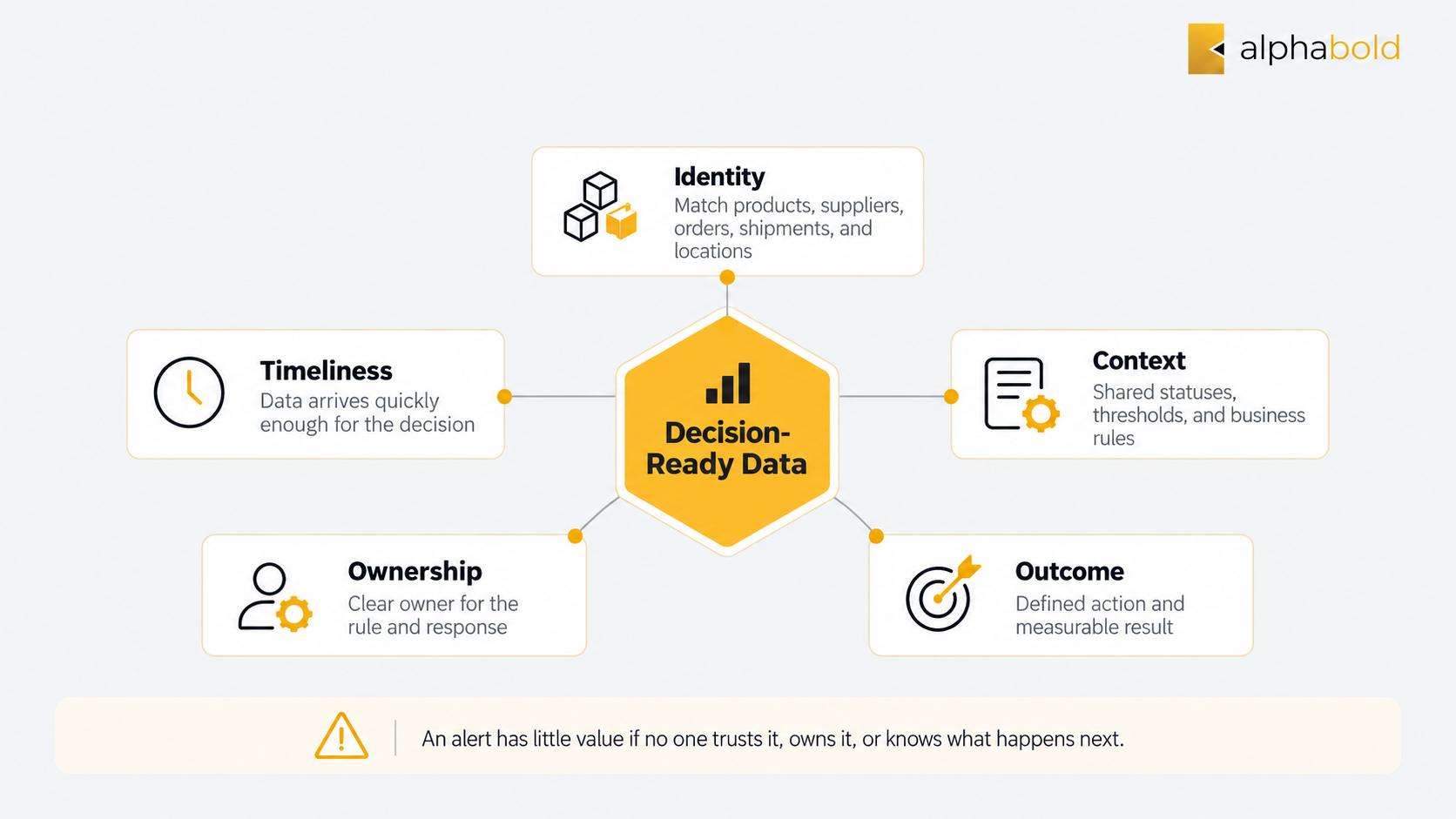
For each use case, validate five areas:
- Identity: Can the same product, supplier, order, shipment, or location be matched reliably across systems?
- Timeliness: Does the data arrive quickly enough for the decision being made?
- Context: Are statuses, relationships, thresholds, and business definitions understood consistently?
- Ownership: Who owns the data, business rule, and exception process?
- Outcome: What should happen when the condition occurs, and how will improvement be measured?
A technically accurate alert may still have little operational value if the threshold is disputed, nobody owns the response, or the system cannot determine what should happen next.
Map Your First Supply Chain Decision
Start with the operational decision creating the most measurable delay, cost, or risk. AlphaBOLD can help map the required data, business definitions, latency, governance, and Fabric architecture before you expand the scope.
Request a ConsultationDoes Every Supply Chain Dataset Need to Be Real-Time?
No. The right data latency depends on the decision latency.
Shipment telemetry, production events, or inventory changes may require low-latency processing when minutes matter for service or cost. Supplier scorecards, planning inputs, or some master-data updates may not. Designing every source for the fastest possible ingestion can increase capacity usage, engineering effort, and operating complexity without changing the business outcome.
Fabric can support different patterns within the same architecture. Historical and operational data can be brought into OneLake, while Real-Time Intelligence can handle streaming and time-sensitive events. The architecture should match the process’s latency requirements rather than force every source into the same pattern.
How Does Fabric Connect Data to an Operational Action?
A Fabric supply chain architecture can connect four distinct layers: data access, business context, event detection, and governed action.
At the data layer, OneLake, Data Factory, shortcuts, mirroring, and other supported integration patterns can bring relevant enterprise data into a common analytics foundation.
At the context layer, semantic models and, where appropriate, Fabric IQ can add business definitions and relationships.
At the event layer, Real-Time Intelligence can process time-sensitive signals, while Activator can monitor defined conditions and trigger downstream workflows.
At the action layer, Operations Agent can continuously monitor supported data, recommend actions, and, with approval, invoke configured Fabric or Power Automate actions. Operations Agent became generally available in June 2026.
The point is not the number of Fabric services involved. It is the decision flow they create:
Signal → Context → Decision Rule → Recommendation or Trigger → Governed Action
Agents can help determine or execute what happens next, but they depend on reliable data and business context underneath them. That is why this architecture should be established before an organization expands agent-led supply chain workflows.
You may also like: The Role of AI Agents in Optimizing Supply Chains and Operations
What Should Be Automated, and What Should Stay Human-Controlled?
Not every operational decision should become autonomous. Gartner’s August 2026 research on autonomous-ready supply chains argues that organizations need to move beyond applying AI to existing processes and prepare for operating models in which people and machines share decision-making responsibilities. For architecture planning, the practical question is whether an action is safe to delegate. Frequent, predictable, low-risk, and reversible actions are stronger candidates. Decisions with significant financial exposure, customer impact, safety implications, or strategic consequences may remain advisory or approval-based.
Permissions, approval thresholds, escalation paths, audit requirements, and the human owner should therefore be defined before the system is given authority to act.
How Should Supply Chain Leaders Measure the Value of Fabric Architecture?
Measure the operational decision, not the number of systems connected. Depending on the use case, relevant baselines may include stockout rate, fill rate, on-time-in-full performance, inventory turns, expedited freight spend, supplier performance, mean time to detect an exception, or mean time to respond. Establish the baseline before implementation. Then determine whether the new architecture helps identify issues earlier, make decisions faster, reduce manual effort, or lower the cost and risk associated with exceptions.
Build a Fabric Foundation That Can Scale
AlphaBOLD helps organizations connect fragmented operational data, establish trusted business context, and design Microsoft Fabric architectures around measurable decisions. Start with one focused use case, prove the data and decision model, and expand from a foundation that can support analytics, AI, and governed action.
Request a ConsultationWhat Should a First Fabric Supply Chain Use Case Include?
The strongest first use case is narrow enough to implement but important enough to measure.
Before building it, identify:
- The decision you want to improve
- The source systems and entities it depends on
- The business definitions that must be reconciled
- The required data latency
- The person or team responsible for the outcome
- The action that should follow the signal
- The metric that will demonstrate improvement
Once those pieces are clear, the technical architecture has a purpose.
That is the distinction between centralizing supply chain data and building a decision-ready foundation. Fabric provides platform components, but value comes from designing the relationships between data, meaning, decisions, and action correctly.
Conclusion
Microsoft Fabric can give supply chains the data, context, and real-time intelligence needed to support better decisions and governed automation. But autonomy only works when the underlying data, business definitions, and decision rules are trustworthy.
AlphaBOLD helps organizations design Fabric architectures around real operational decisions, not just technology deployment. Our focus is on building the data foundation, governance, and decision model needed to scale analytics, AI, and automation with confidence.
FAQs
There is no fixed accuracy rate. Response quality depends on the quality and structure of the selected data sources, the business context available to the agent, and how the agent is configured. Fabric Data Agents support multiple data-source types, including lakehouses, warehouses, Eventhouse KQL databases, Power BI semantic models, mirrored databases, and ontology. Test agents against representative questions and expected answers before relying on them for operational use.
Further Reading: Microsoft Fabric Data Agents: Features, Use Cases & How They Work
Yes, when the source can be connected through a supported Fabric or external integration pattern. Fabric is a data and analytics platform, not a replacement for the ERP, WMS, TMS, or operational application executing core transactions. Integration design should reflect the source system, available connectivity, latency requirements, and whether data should be copied, mirrored, streamed, or referenced.
Size capacity around actual workload behavior rather than the number of connected systems. Consider ingestion frequency, transformations, streaming volume, retention, Power BI concurrency, AI workloads, and peak processing periods. A representative pilot monitored with Fabric capacity metrics provides a stronger basis for sizing before the architecture is expanded.